

A hundred and fifty years ago, the forests that occupied the eastern United States looked very different from the way they do today. This difference can largely be attributed to the disappearance of a single tree species. From Maine, south to northern Florida, and west to Mississippi, the American chestnut tree (Castanea dentata) once numbered in the billions. Among the hills and uplands of the Appalachian Mountains and the piedmont and ridge and valley regions it was sometimes the single most common tree species. About one in four trees is believed to have been an American chestnut in some forests. Historical accounts from early botanists and naturalists describe how some mountain landscapes would turn creamy white each year during summer when this tree flowered. The American chestnut has been called the perfect tree. It was big; commonly reaching a diameter of ten feet across and growing to a hundred feet tall. It produced excellent strong, straight, and rot-resistant lumber and timbers, and was often used for log cabin construction, fence posts, cross ties, and framing timbers and lumber. American chestnut trees also produced tons of sweet nuts in the fall that were hugely important for a wide variety of wildlife species. Raccoons, squirrels, deer, turkeys, passenger pigeons, and many other wild animals enjoyed an abundant food source in the form of chestnuts on the forest floor. According to many historical accounts, the sight of “clouds” of hundreds of thousands passenger pigeons darkening the skies to feed on ripe chestnut mast was once commonplace. The abundant chestnut fruits were also highly sought after by humans and their livestock. Cattle and hogs were free ranged in the forests around the time of the chestnuts ripening, and wagons (and even railcars) were loaded with the sweet fruits to be sold in the cities as holiday treats.
And then around 1904 an organism appeared on the scene that would alter the ecology and culture of the eastern American forest. A bark fungus called Chryphonectria parasitica (also known as the Chinese chestnut blight) was accidentally brought into the country on imported Chinese chestnut trees in and around the area that is now the Bronx Zoo. This fungus grows and produces toxins in the tissues of the cambium layer under the bark of chestnut trees. This tissue damage essentially girdles the tree and kills it within a few months. The American chestnut did not have any natural resistance to the Asian pathogen, and so from New York the fungus spread like wildfire across the eastern half of the country via airborne spores. By 1945 the damage was done. Today only an isolated few American chestnut trees remain, most in the form of small stump sprouts that are periodically killed back before they can reach the age of flowering. Using the limited amount of genetic material that has been collected from the few blight-resistant trees that persisted, researchers and conservationists are building a seed source for restocking and restoration for this once dominant tree. Perhaps someday this species will return to some level of its former glory but the ecological and economic impacts of its absence for such a long time is difficult to quantify.
A very similar fate unfolded for the American elm. Another stately tree specimen, the American elm was prized for its aesthetic beauty and shade in both rural front yards and along the streets of towns across the country. But it was suddenly and drastically reduced across its range in an amazingly short window of time due to Dutch elm disease. A different species of non-native fungus (Ophiostoma ulmi) was responsible for this disease. The first cases of Dutch elm disease were observed in 1930 in Cleveland, Ohio and by the late 1980’s it had decimated the American elm population. The O. ulmi fungus produces microscopic spores which are transmitted from infected trees to healthy trees by two kinds of elm bark beetles; non-native European bark beetles (Scolytus spp.), and the native elm bark beetle, Hylurgopinus rufipes. The beetles do not kill the trees outright, but they inoculate them with the fungus. The American elm was hardest hit of the elm species. Other elms (including winged and slippery elms) were less susceptible to mortality from this disease. If you enjoyed the shade of a large American elm as a child, chances are it is gone today.
The two examples above clearly illustrate how diseases and insects can significantly affect forest ecosystems across large landscapes, especially when those pathogens are not native to the region. These however are extreme cases of wide-spread diseases in trees, and most native pests and fungi are less likely to cause range-wide mortality events. In this article we will provide an overview of the biology, damage, and potential control of some of the most common forest insects and diseases in the East. Since so much of our region’s timber and forestry industry involves pine forests, we will focus predominately on those insect and diseases that affect pines. However, we will also mention a few important hardwood pests to be watchful for as well.
Pine Forest Pests
One of the most important pine forest insects in the US is the Southern Pine Beetle (Dendroctonus frontalis), or SPB (Figure 1). This small black bark beetle measures about 2 or 3 millimeters long and ranges from the forests of New England down into and across the entire southeastern United States, westward into Texas, Arizona, and New Mexico, and southward down into Mexico and Central America. As its name implies it infects the cambium layer of various pine species (including but not limited to loblolly, Virginia, pitch and pond pines in North America) through its life cycle. The SPB will also infect longleaf and other pine types but epidemic outbreaks are not typical in the less-preferred pine species. During normal, non-epidemic years the SPB populations remain at relatively low levels and infestations (spots) are seen only sporadically across the local landscape, often following damage to individual pine stands caused from drought, fire, harvest operations, or other diseases. However, this beetle can cause major and-wide-sweeping damage when local conditions warrant and populations swell to outbreak levels. Some experts suggest a 6-10-year cycle for local population peaks for SPB, although they typically occur at high concentrations in one or more locations somewhere within the range each year. The USDA reports annual estimated timber losses from SPB to be in excess of “100 million board feet of sawtimber and 30 million cubic feet of pulpwood” (Clarke and Nowak, 2009). This same report indicated a timber loss of $1 Billion during the outbreaks of 1999-2002 in the eastern US.

Since the SPB is a native species, our native pines are in some ways adapted to dealing with them in low numbers. A healthy pine tree can sometimes produce enough resin to “pitch” out the beetle as it attacks the tree. Pine trees that are stressed however are more susceptible to a successful attack. These stressed host trees produce certain chemical indicators that the beetles can recognize and hone in on. Female adult beetles release pheromones themselves when a suitable host tree is found. This pheromone attracts males as well as more female beetles. As males arrive they too produce pheromones that attract even more beetles. What the SPB lacks in size it soon makes up for in numbers. The adult beetles bore into the bark and excavate winding S-shaped tunnels with galleries for their eggs and larval broods (Figure 2). The larvae feed on the cambial tissues and when sufficient numbers infect a pine tree, its natural defenses collapse and the tree begins to die as the cambium function deteriorates. The larvae pupate and the emerging beetles expand into adjacent trees and the “spot” grows.
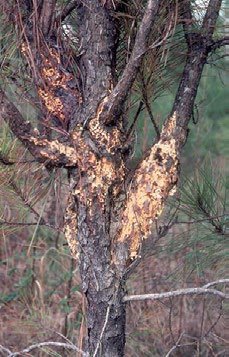
An SPB infestation can be identified by whitish or yellowish pitch tubes in the bark crevices that look like pieces of popcorn stuck to the pine tree (Figure 3). SPB pitch tubes will typically be concentrated on the upper half of the tree. The infected tree’s needles will remain green in the early stages of infestation and then fade into yellow and red as they die. The head of the spot typically moves in one direction or another, away from the dead and dying trees. Although there are native predators of SPB’s, including several woodpecker species and the clerid beetle (Thanasimus dubius), the most effective ways of dealing with them on a property is through vegetation management. Preventative thinning in a young or overstocked pine plantation is one of the most common ways of mitigating the threats and losses from SPB. Not only does thinning in dense pine stands open up the canopy for the release and expansion of herbaceous understory plant communities and wildlife habitats, but it also reduces the stress of the stand making it less likely to attract SPB in the first place. Infestations in thinned healthy loblollies for example have been shown to be less likely to develop into spots of more than a few trees, and are also slower to expand. Longleaf pines are typically more resistant to SPB infestation (due in part to the increased amount of resin production) and are less likely to become infected. Once a spot develops, the most common and effective method of control is to perform a “cut and leave” or a “cut and remove” treatment around the head of the spot, felling the yellow fading infected trees and a buffer (of about two tree lengths) of the green unaffected trees inward towards the spot head. The trees are either salvaged (removed) if they are commercially viable or left in place to decay. Early suppression treatment will generally result in fewer trees lost. Chemical treatment (lindane) of infested spots was sometimes used in the past but it is not common now.

In the South, other common pine bark beetles include the Black Turpentine Beetle and the Ips Engraver Beetle. While SPB’s typically attack the top half of the tree, Black turpentine beetles usually concentrate on the lower 8 feet of the trunk and Ips engravers may attack the entire tree. Therefore, the pitch tube concentration zone is one of the initial methods to help determine which species is affecting your pines. Sloughing pine bark can be also removed to examine the characteristics of the insects and their burrows. Ecology and life cycle of these beetles is similar to the SPB however damage and treatment implications can be different, depending on which species is present. At ¼” in length, the black turpentine beetle is a bit larger than the SPB. It has a rounded abdomen like the SPB and can be similar in color, but it creates significantly larger pitch tubes near the base of the trunk. This species burrows within the pine cambium in a downward direction, parallel to the wood grain. Eggs are laid along the tunnels and larvae follow the adult tunnels, feeding on the soft inner bark. Black turpentine beetle infestations are typically much less of a concern than those caused by SPB and damage is generally at a much smaller scale. Chemical treatment (including insecticides such as permethrin and bifenthrin products) is still sometimes used as an effective method for turpentine beetle suppression. Ips engravers are smaller than turpentine beetles (usually less than 3 mm) and have a spiked, or “chewed off” abdomen. They create small pitch tubes that resemble those made by the SPB. Ips burrows are straighter than SPB and typically run parallel to the wood grain. Eggs are laid in these burrows and upon hatching larvae typically feed out from them at 90-degree angles, creating the characteristic “engraved” patterns under the bark. Engravers also serve as vectors for and carry the spores of Ophiostoma and Ceratocystis fungi, which cause “blue stain”. As more and more engravers inoculate the tree with fungal spores, these fungi grow and infect the tree with threadlike mycelia, eventually degrading the phloem and penetrating into the sapwood killing the tree. Therefore, an Ips-infested tree usually cannot be saved and would not generally be treated with an herbicide.

A few species of weevils are also pests of yellow pines. Weevils are similar to the beetles described earlier but are generally larger (about ¼ inch long) and have stouter legs and elongated “snouts”. The Pales Weevil (Hylobius pales) is one of the more common species and its preferred host species are loblolly, longleaf, shortleaf, slash, pond, and sand pines. Sometimes referred to as “reproduction weevils”, Pales weevil adults feed on pine seedlings while the larvae feed on the roots of cut or damaged pines. Adults are attracted to the odors from fresh flow resin and use these damaged trees as hosts for their young. For Pales control, pesticides such as Sevin or Malathion are often used in some areas. However, the most economical strategy for control is to postpone planting of a recently harvested pine stand for a period of a year. This window of time will reduce or eliminate the risk of emerging adults affecting the newly planted seedlings. A similar species, Deodar weevil (Pissodes nemorensis) larvae feed on the inner bark tissues much like bark beetles, however they actively feed during the fall and winter instead of in warmer months. The larval chambers of the Deodar weevil appear under the bark as rounded chip cocoons and are easy to see in infested trees. Adults emerge in spring and remain inactive through the warmer months until fall when the cycle starts over again. The insecticides mentioned above can be used to treat infestations but the Deodar weevil is also a vector for pitch canker fungus, which can also affect and cause mortality in yellow pines itself.
Other pine pest insects include the Pine Sawfly (Neodiprion spp.), the Nantucket Pine Tip Moth (Rhyacionia frustrana), and the Pine Webworm (Tetralopha robustella). There are several species of pine sawfly and they can affect virtually all the southern pine species. The flying adult looks somewhat like a wasp and females deposit their eggs along the grooves of pine needles. Upon hatching, larvae begin to feed on the outer parts of the needles, defoliating branches, seedlings, or even the majority of the crown in extreme cases. Pine sawfly infestations do not usually kill or significantly harm the host tree and therefore are seldom cause for concern. Although there are several effective insecticides (like Sevin or Malthion) that can be used to protect individual ornamental or otherwise important trees, native predators typically reduce infestations before they can become a concern. The Nantucket pine tip moth also affects most southern pines but does not typically infest longleaf pines or white pines. The elusive adult moth is only about ¼ inch long and is brownish gray with reddish patches on the wings. More commonly seen is the brown foliage, dying tips, and other damage caused to the meristem shoots of the pine branches. The larvae of the moths hollow out the shoot tips as they feed and then pupate there before emerging. Like pine sawfly, the tip moth does not usually kill the tree but can cause stunted or deformed growth in some cases. In most cases no forestry control measures are ever recommended. The pine webworm is a type of moth which is similar in its ecology and life cycle to the tip moth. Instead of infesting the inside of the pine shoot however the larvae build a silken web (typically filled with brownish frass pellets) near the ends of the pine seedling shoots where they live and feed on the needles. Several larvae typically occupy each web nest. Like the tip moth, the pine web worm seldom kills the seedling and control management is not generally needed.

A variety of fungi are also known to affect live pine forests across the US. While each species has its own niche and attack strategy, all are similar in that they grow in or on the tree tissues and cause harm by one of a few ways; stealing nutrients, producing toxins, or blocking the physiological functions of the tree. We will mention a few of the most important to the timber and forestry industry. Brown Spot Needle Blight is a fungal disease caused by Scirrhia acicola that primarily affects longleaf pine in the South. Seedlings in the grass stage are most susceptible. This fungus is identified by yellowish spots that develop on the seedling needles, which eventually turn to a brown color. As the fungus persists, the seedling will defoliate in the affected areas. This disease doesn’t typically kill the seedling but it does generally cause significant reduction in growth rates and vigor. For a recently planted longleaf stand, the most common and effective control measure is to prescribe burn the longleaf plantation to kill the fungus and spores and to encourage the longleaf regeneration to bolt out of the grass stage. Certain fungicides (such as Chlorothalonil) can also be used where burning is not an option.
Heterobasidion annosum is the name of the fungus responsible for Annosus Root Rot. This is an important disease with regards to commercial production of pine pulp and timber. Like other fungi it often enters the host tree (mostly loblolly or slash pine) via a break in the bark or other wound. Once inside the tree it migrates to the heartwood and down into the roots where it causes decay. This rotting of the root tissues will cause sparse crowns in an infected stand and has a high mortality rate over time. The easiest way to identify the Annosus rot fungus is by the whitish tan conk, or mushroom body, that often appears at the base of infected trees, although not all infected trees will express conks. Annosus root rot is often associated with well-drained sandy soils and local county foresters can often provide soil maps with high risk soil areas. Thinned or select cut tree stumps in an infected stand should be covered with borax. However, once the fungus infects a stand it is often necessary to clear-cut the stand and start over.
Fusiform Rust (Cronartium quercum) is another serious pest that typically infects loblolly and slash pines. This fungus uses oaks as its alternate host and it produces orange spores on the underside of the oak leaves. On pines it forms distinctive orangish-yellow blisters that form on stems or trunks in the springtime. The blisters can develop into swelled canker-like masses. Seedlings may die within a few years of infection while older pine trees may be weakened or eventually break at the infection site. Control measures for fusiform rust may include using a genetically resistant seedling source, or specific systemic fungicides (like Triadimefon) for protection of individual ornamental pines. Sanitation thinning to remove heavily infected trees in a stand is also a common practice. Little Leaf Disease, caused by the fungus Phytopthora cinnamomi, predominately affects shortleaf pines as they mature (after 20-25 years old). This disease usually affects shortleaf stands on poor, highly eroded or clay soils. The fungus is spread by spores in the soil that infect the root hairs of the tree. As the disease progresses the tree become chlorotic and yellow, and often produces smaller needles and abundant “stress cone” crops before it dies. Reducing prescribed fire in shortleaf stands on sites that have high risk for little leaf disease has been recommended as a possible preventative measure. A similar fungal agent, Leptographium spp., can cause Loblolly Decline in loblolly pine stands on contaminated soils. As in little leaf disease, loblolly decline is typically expressed in older trees (over 30 years) on poor, highly disturbed sites. This disease is often spread by a number of bark beetle and root weevil species (Eckhardt et al., 2007). For prevention of this disease land managers should consider planting loblolly on higher index sites where they are more naturally occurring. Longleaf pine may be a better choice when replanting stands on dry, poor soils and ridges where stress is likely.
Hardwood Forest Insects and Disease
Hardwoods (which are flowering plants) are very different, both physiologically and ecologically, from conifers. Therefore, it stands to reason that the pests that affect them are usually quite different as well. But just as in pines, hardwoods are plagued by insect and fungal pests that sometimes result in significant damage over time. The Gypsy Moth (Lymantria dispar) is one notorious insect pest of eastern hardwood forests. The gypsy moth is not native to the US. It was introduced from Europe by a French scientist in 1869. The first large outbreak was recorded in 1889 in Massachusetts and it has now spread across the Northeast and into parts of the West, although it has not yet become a serious pest in the Southeast. The adult female moth is white (males have more dark brown lines) with fine gray or black markings on the wing. Gypsy moth larvae (caterpillars) have a distinctive pattern of 5 pairs of blue spots and 6 pairs of red spots along the back. This species can be extremely prolific during outbreak years and larvae can defoliate entire hardwood forests. While there are some semi-preventative tactics (fertilizing, covering trunks with burlap, etc.) that homeowners might employ, monitoring is about the only measure that typically occurs in forestry applications for this species (McManus, et al, 1989). A similar species, the Forest Tent Caterpillar (Malacosoma disstria) is widespread and infests a wide variety of hardwood species. This plain looking moth is native to the US and its larval form defoliates leaves and branches much like the gypsy moth, however outbreaks are not usually as severe. According to the USDA, outbreaks occur at 6 to 16-year cycles in northern regions but southern forests see annual infestations in many areas. (Batzer and Morris, 1978). Larvae grow to about 2 inches long and are black and slightly hairy with beige footprint shaped spots down the back. Another very similar species is the Eastern Tent Caterpillar (M. americanum) whose larvae are also black but have a white stripe down the back with pale blue spots on either side. Eastern tent caterpillars typically choose cherries, apples, crabapples, or pecans as their hosts. Both tent caterpillar species’ larvae spin web tents where they can take refuge from avian predators. Control of these two native species is not usually needed due to the many native predators (including birds, wasps, flies, and fungi) that keep populations in check. Agrilus planipennis, aka the Emerald ash borer is an invasive jewel beetle from Asia that feeds on ash tree species. It arrived in Michigan near Detroit sometime around 2002. Like so many other invasives it likely hitched a ride in plane or ship cargo. In its native Asia it typically occurs at low population levels and does little harm, but here in the US it has been very destructive. The larvae feeds on the inner tissues of ash trees and according to the Arbor Day Foundation it has killed around 40 million ashes in the state of Michigan alone. The emerald green adult is fairly easy to identify, as well as the D-shaped exit holes it leaves as it emerges from the tree trunk bark. This species has been mainly affecting forests in the midwestern and northeastern states but it is now spreading into other areas as well, including many southern states. Movement of firewood is believed to be one of the chief ways it’s spreading so quickly, and as a result quarantine zones in infested areas (including some counties in Texas, Louisiana, Arkansas, Alabama, Tennessee, Georgia, and the Carolinas, to name a few) are now in place. It is illegal to transport firewood from these areas. A hotline has also been set up for sightings of this beetle.

In hardwoods, there are several fungal agents that can cause diseases. Anthracnose for example is a fairly common group of diseases caused by Gloeosporium spp., Gnomonia spp., and Apiognomonia spp. that affects sycamore, maple, oak, ash, and other hardwoods. Symptoms typically include lesions on the leaves (often with colorful margins at the edges of the damaged tissues beginning near the leaf veins) although the effects vary depending on the hardwood host species. In sycamores, it often also affects the twigs and shoots. Control management is generally not needed and Anthracnose is generally considered to be of little importance to forest health as it seldom kills trees, except in the case of Dogwood Anthracnose. Dogwood anthracnose is caused by the fungus Discula sp., and in the past couple decades this disease has become a serious pest of flowering dogwoods in the East. It is unclear whether this fungus was recently introduced or mutated into a more destructive pathogen, but it has affected dogwood populations across their range. Symptoms include tan spots on the leaves (with purple spot margins), twig die-back and epicormic sprouting on limbs and eventually the trunk, and brown cankers at the base of dead limbs. If detected early, pruning of affected limbs and a spring application of a balanced (not high nitrogen) fertilizer may curb this disease on ornamental or high value dogwoods, but once significant die-back occurs the tree will typically not be able to be saved. Along coastal plain areas of the southeast, Laurel Wilt is a relatively new disease that kills young and mature redbay trees, as well as others in the laurel family (including sassafras and avocados). The causal fungus (Raffaelea sp.) is transmitted by the tiny (2 mm) non-native Redbay Ambrosia Beetle, which is believed to have been introduced from southeast Asia. Laurel wilt has already affected entire stands of redbay in Florida and adjacent gulf coast states. The main recommendation for control is to avoid transport and movement of contaminated wood or debris. Research is ongoing in an attempt to find out more about this disease, determine its potential extent, and the indirect effects from its impacts.

References
Batzer, H.O., and Morris, R. C. 1978. Forest Tent Caterpillar. Forest Insect and Disease Leaflet 9. USDA. Retrieved online September 2017.
Clarke, S. R., and Nowak, J. T. 2009. Southern Pine Beetle. Forest Insect and Disease Leaflet 49. USDA. 8 p.
Belanger, R.P., R.L. Hedden, and P.L. Lorio, Jr. 1993. Management strategies to reduce losses from the southern pine beetle. South. J. Appl. For. 17:150-154.
Eckhardt, L.G., Weber, A.M., Menard, R.D., Jones, J.P., and Hess, N.J. 2007. Insect-fungal complex associated with loblolly pine decline in central Alabama. For. Sci. 53: 84-92.
McManus, M., Schneeberger, N., Reardon, R., and Mason, G. 1989. Gypsy Moth. Forest Insect and Disease Leaflet 162. USDA. Retrieved online September 2017.