

Have you ever heard “Take Cover”? Or “Run for Cover”? How about “Keep Undercover”? These are song titles, which isn’t surprising, since the concept of cover is one we can all relate to in life. Cover represents safety, immediate and reliable safety. Ideally, within the safety of cover there are also things needed for sustained safety. Habitat work is just that and cover means plants. I can remember when you heard older land managers refer to different types of “cover” (pronounced: ‘cuh-va’) rather than using the word “habitat”. The way I see it, cover is not only one component of habitat, but rather, it is the umbrella under which all other components work. Managing habitat or cover is a constant process and I believe our God-given responsibility. As practitioners, we’ve seen effects of habitat fragmentation and how it directly impacts diversity in wildlife and plants. Therefore, we’ve become better sophisticated in our effort to restore and improve our techniques of managing wildlife habitat. These efforts result in measurable progress in species diversity and pay nice dividends to boot, not the least of which is better hunting. Hunters and hunting organizations have long been the champions of the outdoors and today they are leading the field in biology as it relates to natural systems. For the primary game species in the Southeast (deer, quail and turkey) to thrive, a healthy ecosystem is required so there is a big incentive for hunters to be involved. In all terrestrial systems of the southeastern US, regardless of elevation or soil type, cover is the key. A large focus today lies on plants of the understory and how they are used by animals.
Managing ground cover in “quail woods” has been a part of my life from a young age but it took on an entirely new meaning fifteen years ago when I began working with native seeds and began formal training in native plant identification and propagation. I left a lifetime of row crop farming and decided to pursue this dream of starting a full-service native seed and plant business. I wanted to focus exclusively on the native plants of the southeastern US. As an avid hunter, I wanted to find ways to enhance habitat for game species, so I began focusing on methods to propagate and produce herbaceous plants that these animals need. Most of my earlier projects (the ones that were keeping the lights on) were focused on things like threatened and endangered species, pollinators and erosion control, rather than game species. But each of these had an important role in my continuing education. These projects helped me better understand the interdependency that exists between various animals, leading to a very fulfilling career in this business.
In 2013 I received a call from a large landowner in LA (Lower Alabama) who had read a recent magazine article I’d written titled “Plotting with Natives” and he wanted to know if I could ride out to take a look at his place. I had a site visit near Macon, so I decided to make the drive out to Alabama from there. My dad rode along with me and we met with the landowner the following morning on a gorgeous, several thousand-acre tract of loblolly timber with a basal area of ~40 and rolling hills covered with native grasses. It looked like a post card picture.
I immediately recognized this landowner as an authentic Southern gentleman. He was from the old school but was keenly interested in cutting edge habitat management and I was impressed with the knowledge he had accumulated through his studying. He had a saw mill on the place where they brought “lightning trees” to make rough cut lumber. His manager is a highly skilled carpenter who uses the lumber to build amazing structures around the property, everything from shooting houses to barns. After we became acquainted, the landowner drove us around to some of his favorite hunting spots. I always try to listen closely when riding and looking at the property with a landowner or manager. I’ve found that in conversation they often reveal ideas and thoughts that they may not have thought all the way through, but these ideas act as a piece of a puzzle. After all, my first priority is always to address the objectives of the landowner. Our conversation was relatively general at first. We discussed aesthetic treatments along several roadsides on the property. He wanted his place to have solid overall habitat value and quail were at the top of the list.
As mentioned earlier, this property already had the look of a classic plantation, but he said he was having no success in establishing new coveys of quail. The open native grass understory was burned regularly and had a very good population of native legumes like Lespedeza and Desmodium. It wasn’t immediately apparent what the issue was, so I began to ask about his predator control program. I always encourage landowners to stay after the predators continuously and if they don’t have the time for it themselves, to develop relationships with someone in the area who can do it for them. Most of the really skilled trappers seem to be about all gone now but you may be surprised to know there are still quite a few around. I believe it is worth the effort to trap and kill every coyote you possibly can and keep the other varmints thinned out, feral housecats included. This is an important part of any successful quail management program. This landowner was certain he didn’t have a predator problem.
The more we rode the property and looked around, the more I noticed that there was very little in the way of escape or brood cover for quail. Nesting cover was abundant. When I asked the landowner where he usually found quail, he pointed and replied, “Over that rise there’s a creek with some thick bushes and we seem to always find birds in there.” It reminded me of a statistic I heard at a habitat workshop many years ago. The average distance a bobwhite quail is found from dense mid-story cover is 70 feet. It was clear that there was a need for frequent patches of escape cover and rank, weedy, bug-attracting brood cover. I returned home to North Florida and wrote a report with a proposed plan of action to address both of these issues as well as some ideas for enhancing cover and aesthetics along the roadways and around the orchard pond. Our proposal was accepted and we set a date to return in early spring.
In the lower Southeast, I think it’s safe to say almost all of the undeveloped land that is not designated wetlands is either farmed, has been farmed, or is in pine production. Most of the high-quality soil in pine production was farmed at some point in the past. This means there is likely a seed bank that is full of annual weed seed (i.e. sickle pod, hairy indigo, nutsedge, crabgrass and others). Places like these often have abundant hardwoods in adjacent areas, along with a history of agriculture on the site. Land planted in pine rotation or left fallow, over time, will inevitably end up with acorns and other tree seeds in the seed bank having been dispersed by animals, in addition to the weed seed. In order to create quail escape cover in these cases we simply make what we call “ring arounds” wherein we disk circular fire lines every few acres throughout the open pine woods to exclude fire and allow woody brush and saplings to fill in. The fire lines double as brood cover areas since there is already a seed bank full of weed seed from the years of farming.
What I found interesting about this particular tract of land is that although it was good ground that looked like it would easily grow 120-bushel corn, to the landowner’s knowledge it had never been farmed. He thought because it was so perfect for growing loblolly pines nobody ever saw a reason to change. He had tried releasing weedy cover by disking and reported he rarely had anything come up. Hardwood competition within the pines was virtually non-existent due to the years of regular burning. We had no seed bank working for us so we had to build our cover from scratch.
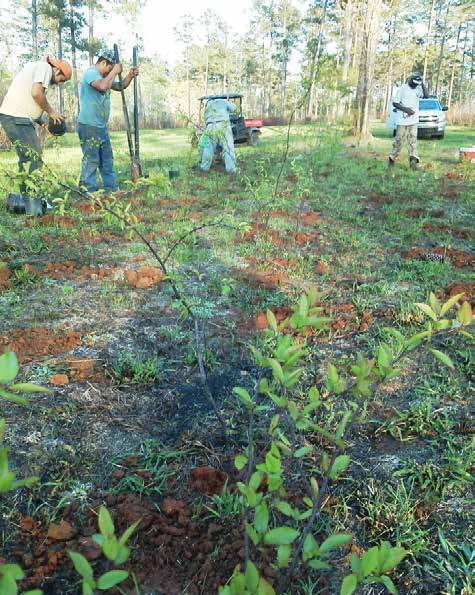
To provide escape cover, we planted thickets of plum, blueberry, persimmon and viburnum on three-foot centers, averaging one thicket to every five to ten acres, and ranging in size from 2,000 to 5,000 square feet each. To protect these thickets from fire we plowed a fire line around each one and planted it with partridge pea and ragweed seed. These annuals provided the weed cover needed to attract insects for chicks in the closest proximity to escape cover. Fall/Winter disking releases the annuals each spring.
Background is helpful in understanding why fire is essential to this system. As most readers here know, before the land was settled in the southeastern coastal plain there were ancient long leaf pine forests that covered millions of acres. Underneath was a ground cover composed of native grasses and herbaceous broadleaf plants. In summer when thunderstorms erupted, an old longleaf pine, full of sap, would catch fire and burn for days, even weeks. When the wind blew and caused the fire to spot out into the grass it would burn freely across the landscape. Some areas would burn hot while others may not due to running into water or into a shady hardwood swamp, which didn’t contain fine fuels sufficient to carry the fire. Eons of this continuous process resulted in the plants that occupied these open pine forest areas which were frequently burned in summer to be highly adapted to fire and even reliant on it. Shallow, open ephemeral wetlands also burned often, therefore supporting a wide array of fire adapted grasses and plants. Fire exclusion has been detrimental to this original southern groundcover.
As it turns out, fire is the most important tool in managing quail woods. I encourage managers to break up the property as much as possible into burn units that are burned on different rotations and different times of year. This increases the diversity of plant species, sizes and growth stages. The burns that benefit native grasses, perennial legumes and other forbs are late Spring and Summer burns. These burns can conflict with quail nesting times, which is another reason for breaking the area up into burn units and pushing fire later into the growing season.
I encourage managers to try to start fires around the rim of escape cover thickets when they burn if conditions permit and let the fire burn away from them. This will help prevent a head fire from running up into the thicket and killing the shrubs. It’s very common to lose thickets while burning, especially if the fire breaks are allowed to become covered with pine straw or grass. Several of the thickets planted on this Alabama project were lost to fire. It’s a good idea to send someone to scout before starting the fire. It may mean harrowing around the outside edge of the fire line (which should have weeds growing in it) to protect the woody shrubs within.
It takes time to acclimate pines to growing season burns to prevent stressing them too much. Since I am not a forester, I always recommend managers consult with someone who is when considering growing season burns. In my experience, when fuels are reduced adequately through winter burns, and pines have been burned for a few years, then the burns can be pushed further into the spring and eventually summer. This will control hardwood and brush infestations and will favor the development of native grasses and many important fire-adapted forbs. Longleaf pines are much more tolerant of growing season fire than slash or loblolly, but can still be injured or killed if burned too hot in summer. Always consider fuel loads, as well as other stressors, such as thinning, high temperatures and low moisture before conducting a summer burn. It’s always a good idea to save at least some areas to burn late in the growing season, even small areas (typically where hardwoods or other woody brush need to be reduced) to increase diversity. Increasing the diversity of the groundcover plants by mixing up burn times in turn increases animal species diversity, leading to a healthy forest system.
The last couple of days on this project we planted live native grasses along several roadsides. We brought a load of bare root yellow Indian grass and a few other species with us. The switchgrass growing wild on the place was so nice we decided to harvest some of it as well, to transplant along with the Indian grass. We dibbled these bare root plugs on three-foot centers along both sides of three stretches of road that needed cover. Live plant material is more expensive than seed but obviously matures and fills in twice as fast. Using live material allows us to achieve a consistent coverage with proper plant spacing allowing plants to fill out and reach their potential without being crowded and having to self-thin. Some species develop faster from seeds than others, so some species end up not being well represented in mixes while “weed windows” present their own set of challenges. Often times we use a two-prong approach by directly seeding some and going over top with live plugs of certain grass and/or wildflower species.

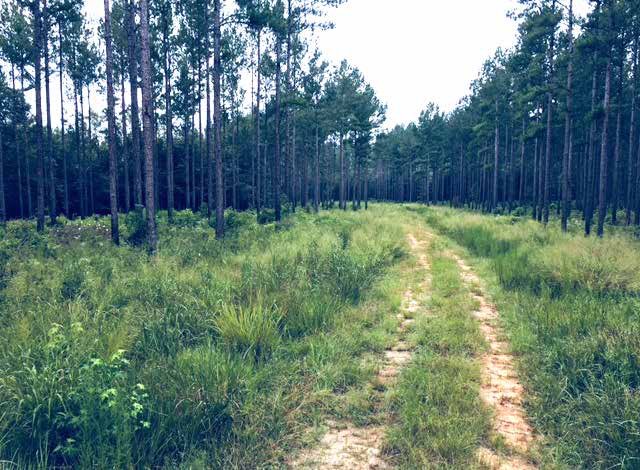

Afterwards, we moved to the beautiful orchard pond. There was a big dock with a two-story gazebo, a wooden bridge and a windmill that pumped water into the 12-acre pond. The pond was in a bottom surrounded by a pecan orchard. The perimeter of the pond was Bahia grass that was kept mowed down to the water. When we first saw the pond, I knew it needed some vegetation so we brought along some Virginia iris, Duck potato, Swamp Sunflower and Sugarcane plume grass to plant in groups around the edge of the pond.


We plan to visit the site in October to take pictures and evaluate the different species we planted. The landowner shared a few pictures which are shown here. While several of the thickets we planted were lost to fire, he reported that the escape cover thickets that remain are being used regularly by quail and the other plantings had filled in nicely.


This is one of many similar projects we’ve conducted in the lower Southeast and each one is special to me. Selecting native plants that match the target site and will most likely thrive in the long-term is key. It ends up being a futile effort to try to force something to grow in an area that it doesn’t prefer. Often, plantings like these will linger along for years, never really reaching their potential. Improving wildlife habitat is a very rewarding experience for me. Learning to grow these plants in the nursery and field is challenging but reassembling them into plant communities and watching a project mature makes it all worth it.
