

Many lake owners ask about improving their crappie fishery or creating one in a lake they are not currently in. In my opinion, nothing is finer than eating fried crappie. Minnows or small jigs with ultralight tackle make for some exciting fishing for both experienced and novice anglers. Sometimes a crappie population is easily created and/or maintained, but in other situations it’s a disaster or not recommended in the first place. Crappie require a larger waterbody and, in some situations, (small waterbodies) different forage than other predator species, such as the largemouth bass. A few small pond owners questioned me for my caution regarding crappie in small ponds and said their small crappie pond has been quite successful and my response is to enjoy it, because once they are there, it takes drastic measures to get them out.
Description, History and Habits
There are two species of crappie, the black (Pomoxis nigromaculatus) and white (Pomoxis annularis). I have also heard them called White Perch, Calico Bass, Papermouth, Speckled-Perch, Speck and Sac-a-lait. They are members of the sunfish family and the largest of the species lumped together and known as the panfish.
The black crappie is native to most of the eastern half of the U.S. but has been stocked throughout and extensively transplanted that today it almost entirely blankets the U.S. and reaches up into southern Manitoba, Ontario and Quebec, Canada. It is only noticeably scarce in an area of the Midwest stretching from western Texas up through Nevada, Colorado, Utah, Wyoming, Idaho and western Montana, and even these states have black crappie either along their borders or in limited internal areas. The black crappie is deep bodied, silvery-green in color with possibly some yellow, with black blotches randomly throughout the body. The dorsal fin has 7 – 8 spines. They will commonly reach lengths of 9 – 14 inches, with the world record set in 2006, from a private lake in Missouri, weighing 5.0 lbs. Depending on where you are located, they live between 4 – 6 years, but have been documented up to 9 years old. During the spawning season males and females look similar. Like other sunfish, they are nest builders and usually spawn in water temperatures between 55-68º F depending on where in the country you are located. This can happen between February and April based on how far North you are located. In the Southeast, crappie are usually the first nest spawning fish you will see along the shoreline. Although most of the year this species lives and feeds in open water in schools, during spawning season they move near shore in water 3 – 8 feet deep, near vegetation and fan a nest 8 – 15 inches in diameter. Females will lay between 10,000 and 180,000 eggs. This is why this species is hard to manage in small waterbodies. Eggs hatch in 3 – 5 days, guarded by the male and continues to stay with the newly hatched fry 2 – 3 more days until they leave the nest. Newly hatched black crappie feed on the egg yolk sack, then zooplankton (microscopic animals), insects and small fish. After about age two, they feed almost exclusively on small fish and occasionally large insects.

The white crappie is native to the eastern half of the U.S. and southern Ontario west of the Appalachians. This species has also been introduced throughout the continental United States. It is missing from most of peninsular Florida and from some north, central and Midwestern states. The white crappie is more silver with green vertical bars and a greenish back. The dorsal fin has 5 – 6 dorsal fin rays. Their size is slightly longer, but not as heavy as black crappie. The white crappie world record was caught in 1957 from a public lake in Mississippi, weighing 5.3 lbs. White crappie spawn when water temperatures are between 57 – 70º F depending on location. Females produce 2,900 to 91,700 eggs when they nest. Both species will only nest once per year. Both species have a prolific reproduction rate and in small waterbodies usually become stunted with lack of proper forage for adult fish. They reach about four inches total length after the first 12 months. Both species sexually mature at age 2 – 3.
Management
If you have crappie in your lake, whether it is small or large, you have to deal with them. If you do not yet have them, do not make an uneducated decision regarding introducing them into your waterbody. The old rule was if your lake is under 25 acres do not stock crappie, but that has changed over the years as more and more people have successfully stocked in smaller lakes, but for every success story there are several stories of failure in small lakes. We assess the lake size, physical traits, habitat, water chemistry and forage available or that can be introduced (stocked) before any decisions are made. I have never seen a quality crappie population in a waterbody less than five acres. I have successfully managed both public and private five-acre lakes with quality black crappie populations. But again, that is not the norm.
Crappie spend most of their adult life in open, deeper water, in schools, feeding on small schooling fish such as juvenile gizzard shad, threadfin shad and silversides (glass minnows). We have seen them thrive in a small waterbody on juvenile (small) golden shiners and fathead minnows, which does not fit the typical forage base criteria. A mixture of two or three of the above-mentioned forage species seems to work best in any size waterbody in keeping a sustainable crappie population. I believe as one forage base dwindles, they switch food sources, allowing the depleted one to rebound while the crappie target another. Without an abundant food source, they will not survive and will not reach their growth potential.


In small ponds, crappie will compete with largemouth bass for food. Removing all small bass and crappie when caught to allow more forage to be available for the bass and crappie that remain is required, if quality bass and crappie is the goal. This also promotes numbers of quality bass in the future and helps both species. Small bass and large crappie have the same size mouths; hence they look for the same size forage whether near shore or out in open water. Once largemouth bass reach 18 inches, they will be targeting larger forage too big for big crappie and possibly different species like bream, which crappie do not target as much.

Another fact regarding crappie is that they are cyclic. One or two years you may have a great crappie fishery, then a few years later it is considered average or poor, but rebounds again in a three-to-four years to quality status. This holds true in both large open systems and small closed ponds. This fluctuation goes up and down as the forage base improves and declines but usually takes longer in larger waterbodies than smaller ones. For example, a 2,500-acre lake may take 5 – 7 years from good year to good year, while we have seen in 5 – 25 acre lakes maybe 3 – 4 years from good year to good year.
Preferred habitat for adult crappie is a shoreline with vegetation close to spawning with a sandy or gravel substrate, although they will also nest on mud or clay, but not as successful. Deeper open water with woody snag, either standing timber or underwater brush piles (or artificial fish attractors) are desired for hiding and feeding around where they spend most of their adult life. It has been my experience where both crappie species are present when not the spawning season, the white prefer brushy areas and black more open water. Brush and vegetation both provide surfaces for invertebrates and zooplankton to live, which feeds and grows small crappie. Adding offshore natural brush or artificial materials creating “brush piles” to harbor some and to fish around is advised.
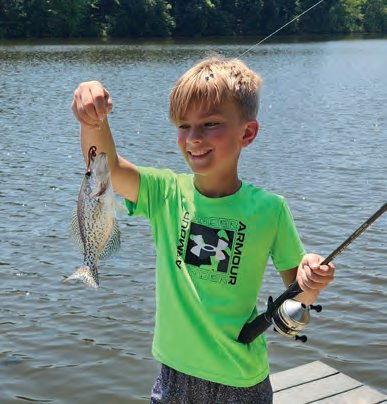

In the Southeast, most stock black crappie and as you move north, landowners have the luxury of either species. Now you can obtain a white/black cross (some refer to as a black nose crappie), which does not spawn as prolific and helps with overpopulation, and a few other crossing combinations with various claims on why they are better. I recommend starting in the middle or lower end of the recommended stocking rate that range from 50-100 per acre. If the forage is there, numbers will quickly come up and growth rates will be better if lower stocking rates are used. As opposed to stocking more, and growth rates being slower and depleting the forage base too quickly before quality size is reached. If creating a crappie only pond, stocking rates have been recommended as high as 200 per acre where sufficient forage is available, but again I recommend lowering that number and maximizing the growth rates from the first-year class. Do not think bass will keep the crappie numbers down, especially if there is other, easier to catch forage is available. Crappie are faster swimmers than other bass forage present. Angler removal will still be required.
Fishing and Preparing for Table Fare
Crappie fishing is vastly different all over the country. Some successful anglers use cane poles with minnows over brush piles in frigid fall and winter temperatures, while others drift across open water in spring, summer and fall with small jigs or minnows and load the cooler. Each waterbody and region has its own successful crappie fishing techniques. You will figure out your most successful technique as you fish more and more. Different techniques will be better than others depending on the time of year. A small (1/32 to 1/16 ounce) jig with colored rubber tail or minnow attached through the lip works well. A #4 hook, with a minnow hooked through the back, split shot and bobber also works well in certain lakes. With a slight breeze or use of trolling motor, I like to drift across a lake with a few minnows or jigs out at various depths to locate the depth they are at and see their bait preference, then concentrate on what works and where. Just before dark, crappie can be spotted feeding at the surface either on shad or silversides. Casting into the school with a small jig and rubber tail and reeling back in at moderate speed will fill a cooler in minutes when conditions are right. During the spring spawn, dropping minnows along the vegetative edge will catch some of the largest crappie in the lake.
Everyone has their own idea of what a harvestable size crappie is. Since they are highly successful at reproducing, overharvest in smaller waterbodies should not be a concern. Some like anything over 8 or 10 inches, and some want the “slabs” of 14-16 inches. You will learn about the crappie size structure in your pond as time goes on and be able to figure out at what size they will max out. If this is your situation, do not wait for 14-inches when 8, 10 or 12 inches may be as big as they will get in your area or waterbody. As you harvest, the average size should go up if you’re harvesting enough.
I am a traditionalist, nothing beats a scaled, gutted and headed crappie, dipped in egg and cornmeal, then fried in a cast iron skillet or deep fried until the fins are crispy served with hush puppies, baked beans and coleslaw. The larger crappie “The Slab” can be filleted and fried, baked or broiled. Many also enjoy a whole large crappie scaled and baked in foil with butter, lemon and seasoning.
The lesson is just because you want them, does not mean you should get them. Do your homework, be honest with yourself. Your pond may be able to grow nice crappie, but many small ponds cannot. Consult a trusted professional pond manager that does not tell you what you want to hear but gathers facts and makes an educated recommendation from the data available. It is better to evaluate and know your limitations than make a costly mistake and have to get the rotenone (fish poison) out and start your pond over.