

In the July/August 2025 edition of Wildlife Trends Journal, you may recall the article, “A Passion for Quail.” In that article, I hoped to arouse interest in those with a passion like I have for quail and to let them know that there was hope. More than a year later and I’m glad to report that our program continues to be successful! So in this article, I plan to provide more of the specifics on the steps and the costs that we have found to lead to success.
The heritage of quail hunting and the passion that it arouses may be difficult for some to understand. However, for some of us, and particularly those of us who are now familiar with the term “octogenarian”, we remember the good old days of having free access to most of the local farms around us. The local farmer was often a neighbor or friend who welcomed us to hunt their land. While those days are mostly gone, there’s still some pretty good quail hunting to be had for those who are willing to work hard at it.
This past fall and winter did not exactly offer favorable weather conditions for hunting on the Eastern Shore of Maryland. However, we were still able to get in about forty hunts and find more than two coveys per hour, which is far better than we did in what we thought were the “good old days”.
While each of us must adopt a program that suits their particular area, we have found that with approximately 300 acres, either owned or leased, it is quite possible to get fifty quality hunts per year. Now when I say “hunts”, I am referring to a two-to-three-hour hunt on a quail course that has been designed and managed specifically for quail. As an aside, remember that if you manage these areas for quail, the deer and turkey hunting will thrive as well. I mention this because we often have to share the property with others who have a similar passion for deer or turkey. While at first they might object, they almost always come back to thank us.
While getting these many successful hunting opportunities is significant, even more significant is the quality time that we get to spend with friends and family in the field and with the dogs. This past year in our forty hunts, we were able to take forty-five different people, and all of us had a great time. Many of these individuals had not hunted quail in years and were fascinated with the fact that a quality hunt was still possible.
Before we get into the specific steps to have a successful hunt, we must explain why it is necessary to stock quail even though you may have quail naturally regenerating on the property. If you do the math, the answer will be evident. As you may recall, for many years the standard for success was one bird per acre. Accordingly, if you had 100 acres you would be satisfied knowing that there were 100 birds on your property. However, today it is generally accepted that good game management practice is to limit harvests to no more than 10% of your population. That math suggests you could expect to harvest only ten birds from your 100 acres. That hardly seems like enough reward for putting in all the effort necessary for that result. However, if you have established high-quality quail habitat, we believe that you may stock to a level that will bring the total bird count on your property to an average of fifteen birds per acre. This would mean a total of 1,500 birds on our theoretical 100-acre parcel. Applying the 10% harvest standard, this would now allow you to harvest 150 birds. This scales up, so if you had 300 acres to work with, that would result in a 450-bird harvest, and so on. If your goal is to have forty-five hunts each year, that would result in a ten-bird harvest per hunt. That is exactly what we have been able to accomplish on our land, and I believe that you can do the same.
In my previous article, I mentioned that historically we were only finding about one new brood of quail hatching in the wild each year. In recent years that has been increasing, and in the past three years we have been experiencing a significant increase in brood sightings. We are now seeing an average of about twelve new broods each year. There are many who do not believe that our stocked birds are reproducing in the wild, but our experience tells us otherwise. Maybe it’s part wishful thinking, but the facts of what we see in the field are hard to deny. We have been convinced that the stocked bird carryover will reproduce and significantly increase the number of birds on a well-managed property.
When we ask ourselves or try to explain to others what makes our program work and these successful hunts possible, we have come up with the following twelve steps that we feel are essential:
- Habitat. By far the most important consideration is high-quality habitat. However, you must keep in mind that your goal is not just good quail habitat, but good, huntable quail habitat. Therefore, when you lay out your habitat plan keep in mind where your supplemental feeding lanes and your hunting lanes will be. You should make sure that your escape cover is not in a place that will significantly inhibit your shooting. There are many excellent articles on what makes up good quail habitat, including many that have appeared in the pages of Wildlife Trends Journal. But if you have been hunting for a long time, you already instinctively know which areas look “birdie” and which areas do not. If you don’t have good cover that keeps quail safe (and makes them feel safe), they will migrate off your property or get eaten by predators.
- Stocking. If you are planning a dove field, the number one element to ensure success is to put the dove field in an area that generally “has birds”. Sounds simple, and it is. The same idea applies to quail. But in our area, it is often very difficult to find a place that has even a marginal number of native wild birds. So, what do you do? You may try a translocation which definitely works, but if you are as old as I am, you probably don’t have enough remaining hunting seasons to get you to the result that you want. Therefore, stocking becomes an absolute necessity if you want to have a huntable population of quail. A good early release program where you stock into excellent habitat at a ratio of approximately fifteen birds per acre will assure you that your newly enhanced hunting habitat will be an area that “has birds”. A good early release program involves stocking the birds at least two months prior to the start of hunting season. The stocked birds plus your naturally regenerated birds will give you a more than sufficient number of quail to be hunted. Keep in mind, our goal is not a “quail shoot” like a “dove shoot,” but rather a “quail hunt.”

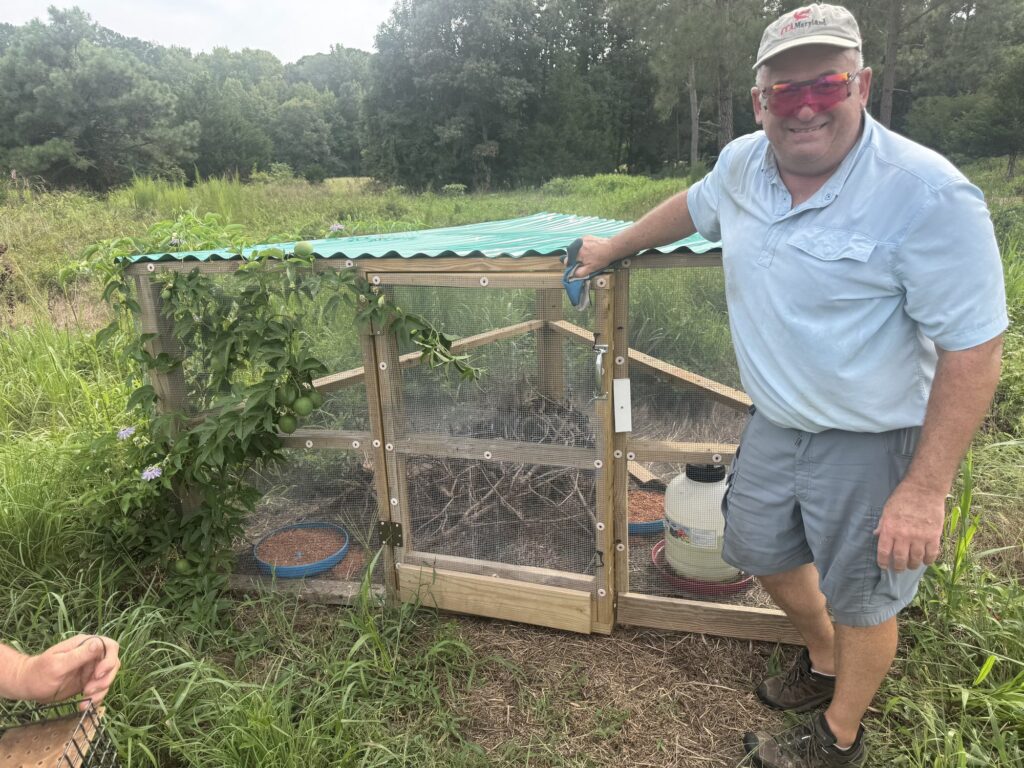
- Halfway Houses. We use what we call halfway houses, which are very similar to a “johnny house” when initially stocking birds. Our halfway houses are generally of a triangular shape with eight-foot sides and a height of four feet. This provides temporary shelter for the newly released bird for approximately ten days. After being housed in this fashion for roughly ten days, a small door is opened, allowing birds to come and go so as to avoid predators at night. In some instances, we will run several cycles of newly released birds in this manner. This not only helps with survival, but it also tends to allow the newly released bird to imprint on this location and stay close by throughout the season. A slight variation of this program calls for leaving three to five birds in the halfway house throughout the season without the ability to come and go. The remaining birds tend to call and may keep the other birds close by.
- Supplemental Feeding. Supplemental feeding is very important. Our procedures are modeled after the recommendations made by Tall Timbers. We generally spread or broadcast 300 pounds of milo per mile, every two weeks, over our predefined feeding lanes. We have found that predefined feeding lanes are far more beneficial than feeding specific spots where we have released birds. If you use the feeding spots method, you will find out in a hurry that your dogs will know exactly where these spots are and will merely run from one food spot to the next and not hunt the general area as you would like for them to do. Using the prescribed feeding lanes, you will find that your dogs will hunt the whole course and not just specific spots. Furthermore, predators will not be able to target a specific spot either.

- Where to Release. Determining exactly where to release your birds is also very important. However, it is one of the easier steps for those who have a quail hunting background and have a specific recollection of what looks like a “good spot” for birds. We generally try to separate these locations by approximately 100 yards, but there is no magic distance between locations. One of my favorite types of habitat to release in is blackberry patches surrounded by broomsedge.
- Predator Management. Predator management is always a problem when it comes to quail. However, we have determined that good habitat will generally trump predation. I’m sure this is an oversimplification, but it generally holds up. Predators will always be a problem, but in some ways, they can be an asset, as they are ultimately what makes quail fly. As one of my friends told me, if you got rid of all the predators you may as well stock chickens and hunt them, because your quail would not fly. It’s easy to get lax with your predator management, because it is extremely time-consuming. But the payoff is substantial. Predators come in all different forms, too. We have found black snakes to be the single worst predator on the land we manage.
Predators will always be a problem, but in some ways, they can be an asset, as they are ultimately what makes quail fly.

- The 14-Day Interval. Hunting a course, field, or specific area on a two week interval may be very beneficial. We have found that a covey that is disturbed more often than this is likely to migrate out of the area. Keep in mind the goal is to keep as many of your birds on your property as possible so that you can increase the odds of a successful hunt.
- Bag Limits. Limiting the number of birds that you kill on each hunt is very critical. One of our key principles is that we are always trying to have quality hunts and not quantity hunts. With this in mind, we have found that shooting one bird per hunter per covey found and pointed will result in a covey staying pretty well intact throughout a season. This may be hard in the early part of the season when you often find the coveys to be very large and the temptation is to take more. However, it is still the best practice.
Shooting one bird per hunter per covey found and pointed will result in a covey staying pretty well intact throughout a season
- Use a Flushing Dog. Having quality, well-trained, pointing dogs is always a must. But we find that the use of a well-trained flushing dog is also highly desirable. While we all enjoy watching our pointers retrieve, the fact is, they really don’t like to. They want to get on with finding the next covey. There are additional benefits to using a flushing dog as well, such as making the covey rise a stronger burst of birds that generally fly better. You may also discover that the flushing dog is more efficient at finding the downed bird. That quickness can increase the likelihood that there will be at least one bird left in the vicinity of the flush that may call back the other birds to that spot. Once again, we are trying to keep that same covey in or near the same location for our next hunt.

- Shooting in Pairs. While we strongly advocate only having two hunters shoot at a time on each covey rise, we often hunt in groups of four. This works well for us because we hunt from a quail buggy that holds four hunters. One hunter drives the buggy and marks dead birds and the other non-shooting hunter handles the dogs. In this manner each hunter gets to be involved in the action on each covey rise.
- Enjoying the Gift. A non-hunting but important part of our program is the real pleasure we get throughout the non-hunting portion of the year, hearing the iconic call of the male bird all summer long. We also have the pleasure of seeing birds pair up and run all over the farm all summer long, which is a real treat.
- Pray. The last step in ensuring a successful hunt, and possibly the most important step, is generally our first step. We start each hunt with a quick prayer, thanking our Lord for safety and success.
There is no finer upland game bird hunt than hunting the northern bobwhite quail. And if you are willing to put in a lot of enjoyable hard work, those hunts can be right in your own backyard. But no doubt you are asking yourself, “what would it cost to implement a program like we are describing?”
If, for example, you have found a theoretical 100 acres of cut over woodland and you have decided to implement a program just as we have described, the cost of implementation may look as follows:
- Land Cost. – Assuming that you are renting or leasing, in our area the rate is approximately $15 per acre per year. Rates near you may vary, but we’ll use a hypothetical land cost of $1,500 annually.
- Bird Cost. – As mentioned, I recommend stocking fifteen birds per acre, so our hypothetical 100-acre tract requires 1,500 birds. Assuming that birds are stocked between the age of 6 to 8 weeks, prices are approximately $2.25 per bird if you raise them yourself, for a total of $3,375. Alternatively, if you decided to purchase your birds, they would cost approximately $4.00 each for a total of $6,000.
- Halfway House Cost. – On a 100-acre tract, we would recommend eight halfway houses. We purchase a triangular version of these, with eight-foot sides and a height of four feet, locally for $375 each, for a total of $3,000. Assuming that they will last for 10 years each, we consider this a $300 per year annual cost. If, however, you preferred to build it yourself, the materials for one of these houses runs about $285.
- Supplemental Feeding Cost. – The supplemental feeding costs are about $1,080 annually. This is calculated on the basis of spreading 300 pounds of milo per mile every two weeks at a cost of $.15 per pound and assuming that we have two miles of feed trails per hundred acres. This would be a total cost of $90 every two weeks over the course of six months. Some individuals may wish to feed year-round if one of their objectives is to enhance reproduction in the wild. If you go this route, double your costs to $2,160 annually. We have found that in the areas that we supplemental feed year-round the wild reproduction is greatly enhanced.
- Predator Management Cost. – Our predator management costs are based upon using one box trap per twenty acres. We find the cost of these traps to be around $75 each which implies a total initial cost of $375. However, these traps will usually last for at least five years, so we estimate the annual cost to be $75.
- Dog Cost. – Quality bird dogs and retrievers are a necessity but a difficult cost to estimate. Most individuals who would be inclined to initiate a program as we have outlined will most likely have one or two dogs already. Many people find in today’s world that household pets turn out to be very good hunting dogs. With this in mind, we do not add an incremental cost for dogs, but depending on the breeding stock, training, etc., costs could be significant.
The total cost of the above items is $6,330 a year. While this may seem like a lot, don’t forget that the cost of a wild bird hunt may be upwards of $1000 per gun per day. A three-day hunting trip for two could easily top $6,000 with travel and lodging. Thus, what a bargain!
In summary, you too can have good quail hunting if you have good habitat, a good feeding program, and good stocking practices. All the above help make sure that the birds want to stay on your property throughout the year. And hopefully at the end of the season, you will still have a few birds, a few friends, and a few dollars left over to start the game all over again next year. But even if you don’t, I can assure you that you and your dogs will have had a great year to remember!
