
This is the first in a series of articles documenting the invasion of feral hogs on our small east-central Alabama farm and surrounding areas. What began as a novelty sighting of pigs has now turned into a full-blown assault on our QDM practices!
It is my goal to inform readers of a situation that changes wildlife and habitat management as we know it. It has for us.
The first indication of wild hogs occurred in the summer of 2004. One sow with piglets was spotted in a chufa field. The sow was killed and the pigs disappeared. There had been a rumor several feral pigs had been released on a hunt club three miles south of our farm in 2002.
That same year a neighbor to our south discovered hogs were raiding supplemental deer feeders filled with soybeans. A corral trap was built and over 20 hogs were caught and destroyed.
In the summer of 2005 another large hog began hitting our cornfields. We consulted the Alabama Department of Conservation and were issued a depredation permit. This allowed us to hunt hogs at night. All efforts were unsuccessful and that hog destroyed a lot of corn before abandoning the property in September.
It began with a trickle of rumors, sign and sightings. At first it was a novelty. Hogs on the farm meant a new opportunity to hunt when traditional seasons were closed. It also meant meat for the freezer. Little did we know the magnitude of the problems we would face in the very near future.
Feral Hog Facts
I could devote this entire article on our efforts to manage our farm and compete with feral hogs. Like most landowners, we keep a finger on the pulse of what is happening on our land. We do everything possible to make it a better place for the native wildlife that call it home.
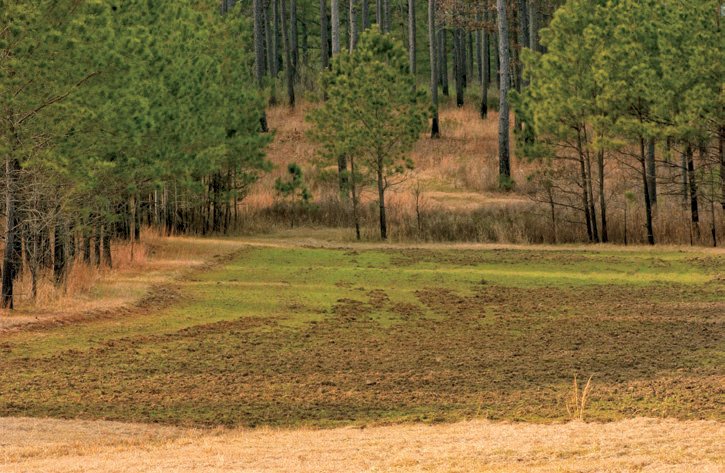
Feral hogs are not like the native wildlife we all cherish. They are relentless in their pursuit of food and destructive to the land. They will eat almost anything and out-compete native wildlife for food and space, damaging native plant ecosystems.
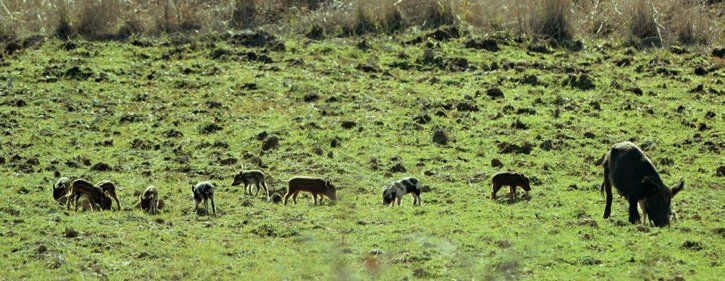
Feral hogs are prolific breeders and sexually mature at six months. They can produce two litters of pigs per year and three in 14 months. Litters can have 2 to 14 pigs, but average 6 to 8. If you start with two boars and two sows the numbers are staggering! Assuming a 50/50 sex ratio and six pigs per litter you will average three sows per litter. If left unchecked and there is no natural mortality, the original four hogs can be responsible for thousands more in just three years!
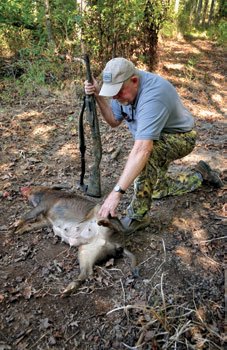
There are an estimated 5 million feral hogs in the United States and their damage to crops and property is estimated at nearly $2 billion annually. Populations of feral hogs can now be found in 39 states with Texas being the state with the highest population.
If you do not have hogs on your land now, odds are you know someone who does. And if you enhance your land by managing for native wildlife, you are a prime target for hogs as they expand their range.
Every year there were more and more hogs and we lost more corn crop to the endless pressure. Dr. Frazier Jones, our neighbor to the west, was also in the fight. Hogs were destroying his efforts to grow crops for native wildlife. The swamp shared by our farms seemed to be where most of the hogs spent the majority of their time.
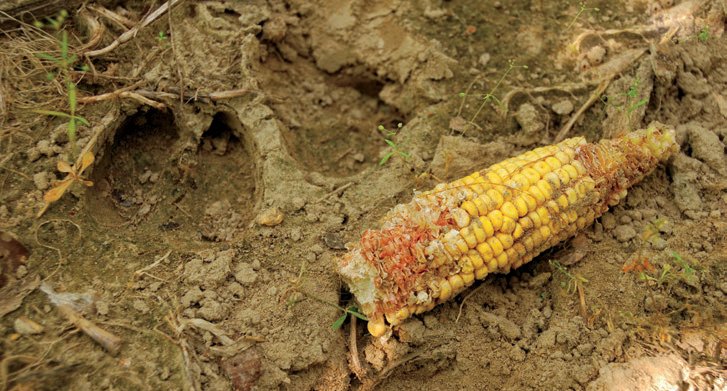
The decision to build traps was a natural progression. Three corral traps were constructed on Dr. Jones’ and one on our farm. Two traps were fitted with guillotine gates and two with rooter gates. Corn was used as bait and we began catching hogs almost immediately.
Shotguns loaded with buckshot and fitted with red “kill lights” were adopted as the weapon of choice in the cornfields. With the new lights in hand we adjusted our strategy. We began approaching fields from downwind on a HuntVe electric cart. As we moved from one field to another we used a spotlight fitted with a red lens cap to light the way and scan the fields. Once we arrived at a field we sat in the dark and listened for the sound of hogs trashing corn.
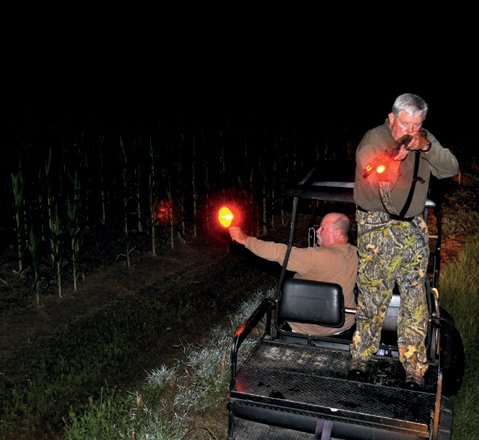
When we heard hogs we dismounted the cart and approached on foot. Many times we found ourselves within 20 yards of hogs that we could not see in the corn. To eliminate that problem I mowed lanes across the fields at 75-yard intervals. These lanes became killing lanes.
In 2011 we trapped and killed over 60 hogs on Dr. Jones’ farm. My wife, Tes, and I shot 32 hogs in our cornfields. We discovered the neighbor to our south was using dogs to fight the invaders. His dogs caught over 100 hogs that year. All hogs were dispatched where they were caught. He shot over 50 more hogs along the way. That meant almost 250 hogs were killed in an area totaling less than 4000 acres! We thought we had finally turned the tide in our favor. WRONG!
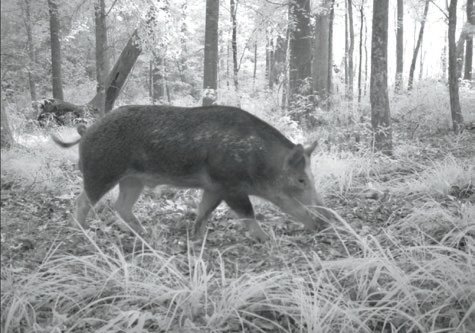
Lessons Learned
When hogs first appeared on our farm in 2004 we made the decision to fight them with all we had. At that time we thought we could control them by shooting them on sight. We deployed trail cameras around the farm to monitor hog movement and learn the best times to hunt an area. This put more hogs in our sights and we learned not only the best times to be in an area but where the hogs were coming and going.
We used water laced with yeast to sour corn for bait. The aroma seemed to attract hogs. We dug holes for soured corn to make the bait last longer. In time we learned hogs do not see red light very well. We bought lights designed specifically for this purpose and our success rates went up. During summer months when our cornfields were maturing we killed hogs on a nightly basis. This gave us a false sense of success because in the end we lost a lot of corn and pressured deer and turkeys off our land.
Feral Hog Realities
Dr. Frazier Jones is everything you could ask a neighbor to be. His QDM approach dovetails perfectly with ours. When Frazier called on Thanksgiving morning, 2011, Tes and I were not hunting. Frazier reported hearing hogs near the southwest corner of our farm. We scrambled, gathered our gear and headed that way. We dropped into the swamp with the wind in our face.
Immediately the wetland was filled with noise reminiscent of sounds from the movie Jurassic Park. A big sounder of hogs was squealing, snorting and grunting not far away. As we reached the southwest corner of our farm, we spotted a group of ten mature hogs in a field on the neighbor to the south. We heard another group in the timber behind the field. The hogs in view consisted of nine boars and one sow. It was obvious she was in season and the boars were competing for the lone sow’s attention. When the group crossed onto our property Tes killed one large boar. The rest scattered and Frazier killed another boar on his property. It was the last hog encounter of 2011.
In 2012 Tes and I had serious reservations about planting corn. After much consideration we decided to try one more time. I planted half the acreage in May and the rest in June. By the end of September both plantings were a complete loss in spite of our trapping and shooting efforts. Ditto for Dr. Jones.
That was our last attempt at growing corn for wildlife. Since then we have planted grain sorghum, soybeans and iron clay peas and none have made it to maturity. In fact, many times hogs destroy and eat the seed before they have time to emerge.
The effects on native wildlife have been noticeable. We began seeing fewer turkeys on the farm and have not seen a hen turkey with poults on our farm in two years. Body weights of deer are noticeably down and four-year-old bucks that once averaged 200 pounds now average 180 pounds.
Food plots that once provided corn, clover and summer forage lay fallow in spring and summer. Hogs rooted and wallowed edges of water holes. Established mineral sites were fouled and abandoned by deer. We were losing the war and it was time to change tactics!
A New Direction
The first step toward real change is realizing what you are doing is not working. Tes and I came to that conclusion after a decade of trying to control feral hogs on our land. The next question was, where do we go from here?
In the summer of 2012 Tes and I attended seminars on feral swine control at the Quality Deer Management Association’s national conference. The expert hosting the first seminar we attended left us thinking we were on track with our efforts to control hogs. In fact, we were probably ahead of the curve. We were already doing almost everything that expert recommended.
Rod Pinkston, owner of JAGER PRO (https://jagerpro.com), a private company specialized in feral swine control and eradication hosted the next seminar. That presentation was where we first heard the term “total sounder removal.”
By the end of the day Tes and I were confused. One expert said we were on the right track, the other said we were doing it all wrong. Five years later I can positively tell you the man who told us we were doing it wrong was absolutely RIGHT!
The JAGER PRO Way
“My military training taught me to make the most of any and all advantages when dealing with an enemy,” said Pinkston. “I was raised on a commercial hog farm so I understood how prolific hogs are. The methods we have developed to eliminate feral hogs from an area are effective but harsh to some people. If you hire a company to eliminate termites from your most valuable possession, your home, you want that company to eliminate all termites—adults, juveniles and even the eggs. The same applies to roaches, ants, rats and feral hogs.”
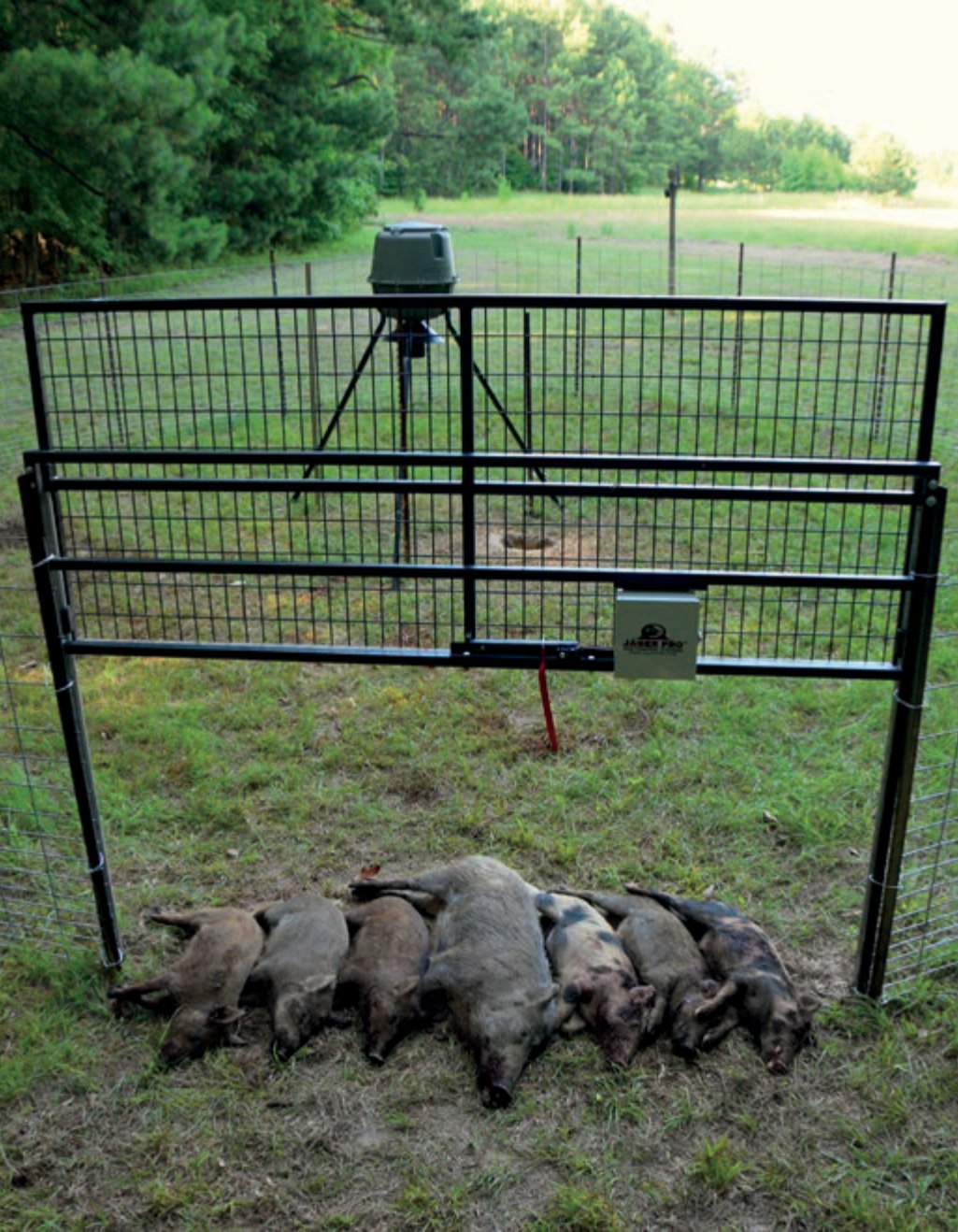
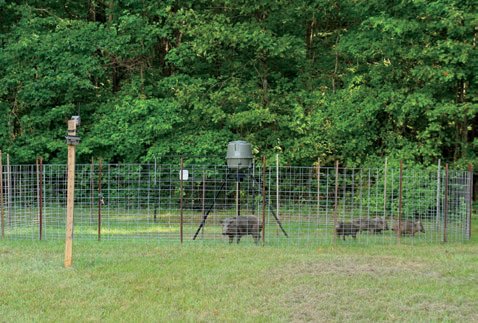
“We have spent years learning behaviors and natural tendencies of wild hogs. We have shot hundreds of hours of video footage documenting hogs in and around traps. We have tried all types of gates, panels, baits and trigger mechanisms. From all this research we have developed what we call the M.I.N.E. (manually initiated nuisance elimination) trapping system. The trap is 35 feet in diameter and consists of six of our specially designed panels that prevent even the smallest pig from escaping, twenty-six seven foot T-posts, an automatic feeder and the M.I.N.E. gate. The gate is eight feet wide and six feet high. It is designed to drop straight down and the bottom of the frame is buried so hogs do not step on a metal threshold to enter the trap.”
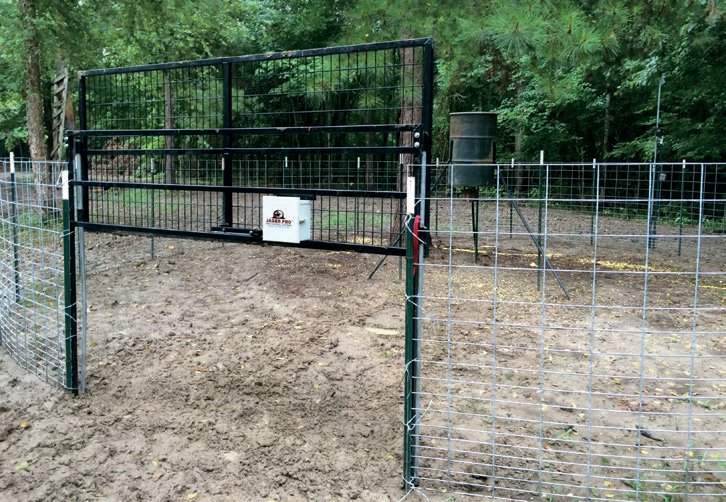
The gate can be dropped with the push of a button while on site or while viewing cellular pictures or live video from another location. JAGER PRO considers this the most efficient system because you know how many hogs are using the feeder and a human being makes the decision to drop the door on the trap.
“To fully utilize this system you first need to understand a few basics of wild hog behavior,” said Pinkston. “Female hogs or sows, along with their offspring form groups called sounders. Pre-breeding age boars form small bachelor groups of two to four and older breeding age boars are usually loners. Our strategy is to remove the entire sounder at each bait site so there are no sows left to reproduce or become educated. This disciplined approach will reduce the total farm population by 70-80%.
When we identify an area where hogs naturally feed and travel we put a feeder with a digital timer in that area. We set it to spin at the exact same time once a day. In winter we set the timer for dusk because the hogs are usually pressured by hunters and lay up during the day. We set the feeder to spin in the morning during summer. Winter and early spring are the best time to trap hogs. Natural food sources are depleted and it is easier to get the hogs on the feeder. We place one of our cameras to monitor the bait site. We offer cameras that stream live video or text still photos to your smart phone. You can also check the SD card manually. We are trying to determine how many hogs are using the bait and when they are using it.”
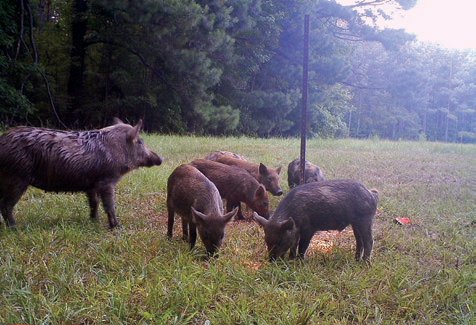
“Once we have intelligence on the number of hogs and when they are using the feeder, we go onsite and build the trap with the door facing the direction the hogs are coming. When the camera tells us the entire sounder is in the trap we can drop the gate by texting a code protected number or through a prompt on our JAGER PRO App. Since the hogs are conditioned to using the feeder as a daily source of food it normally takes less than five days to trap the entire sounder,” said Pinkston.

Feral Hog Control Mistakes
The expansion of feral hogs across the United States is a huge problem. It is a problem with no small solution and one that will not go away on its own. It is a problem easy to ignore, until it is your land that is invaded by these destructive animals.
Rod Pinkston—”We know how to control and eliminate feral swine. That is what we do. That is all we do. Our biggest problem is not the hogs; it’s getting landowners and agencies to buy into our system of total sounder elimination.”
These are the common mistakes landowners make when dealing with feral hogs:
- Wrong Definition of Success—anything less than removing the entire sounder is a mistake. Hogs that are exposed to insufficient traps or hogs that witness other hogs caught in traps quickly become educated and trap shy. These hogs become almost impossible to trap.
- No Measure of Success—you cannot manage what you do not measure. Not using a game camera to document exact populations, travel patterns and behavior before, during and after control measures. To JAGER PRO, trapping anything less than 100% of a sounder is a failure.
- Inefficient Method Timing—trapping year-round vs. focused efforts during the most effective winter months. Trapping is more efficient in winter through early spring when food sources are depleted and hogs are seeking food sources.
- Inefficient Bait Site Selection—choosing an ineffective location to establish a bait/trap site. Bait sites should be established on a proven travel corridor or in an area frequented by hogs. Traps are more efficient in areas where hogs want to be.
- Improper Sequence Selection—erecting a random sized trap prior to gathering intel and pre-baiting.
Even properly built corral traps are inefficient if they are not pre-baited and all hogs in a sounder using them are in the trap when the gate closes.
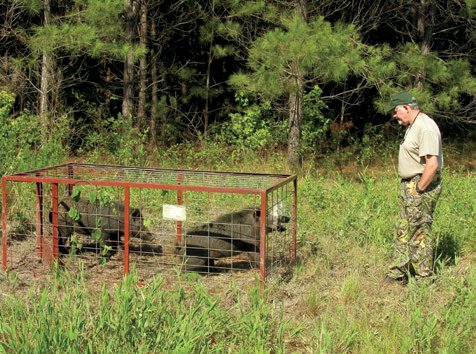
- Inefficient Trap Selection—choosing portable box traps vs. six panel coral traps. Box traps and small corral traps catch some hogs but educate many more. Hogs feel more comfortable entering a large trap. Six-panel corral traps allow more hogs into the trap.
- Inefficient Gate Selection—choosing narrow 36″ continuous catch gates vs. wide 96″ drop gates. Hogs are more likely to enter a trap through a wide opening as opposed to a narrow one and a manually dropped gate keeps the gate open until the entire sounder is inside the trap.
- Inefficient Panel Selection—choosing 48-52″ tall livestock panels vs. 60″ tall specialty trap panels. Our specially designed panels are 60″ tall and the space between the openings is smaller at the bottom. This prevents small pigs from escaping through the panel and prevents large hogs from climbing over the top.
- Inefficient Trigger Selection—choosing pig activated trip wires or rooter sticks vs. human activated remote control devices. A human activated trigger device eliminates the trap door dropping before the entire sounder is inside the trap.
- Bait Outside Trap—providing random bait outside the trap vs. only rewarding pigs with food inside the trap enclosure. Bait outside the trap rewards hogs on the outside of the trap. Your goal is to only reward them inside the trap.
- Shooting and Dogging Hogs—scattering hogs and ruining intel by shooting and dogging hogs. There is a time and place for shooting hogs, but not hogs you hope to trap. Shooting hogs and running them with dogs scatters them and blows the intel you have gathered. It is better to allow them to remain in a pattern that will eventually put the entire sounder inside a trap where the entire sounder can be caught.
The Way Forward
If your land has been invaded by feral hogs, odds are you have made many of the mistakes listed above. Lord knows we have. Now after a decade later we are paying the price and our only option is to begin winning the war.
Call it pride or call it ignorance. Either way we left the door open for the expansion of the hog population in our area. In the end we realized what we were doing was not working.
Thankfully there are companies like JAGER RPO who have spent years learning the do’s and don’ts of feral hog control. Pride and/or ignorance have taken a back seat to a new direction.
In the next article I will share the story of Steve and Andy Guy and their struggles to take their land back from feral hogs. I will also introduce Barry Estes, owner of Alabama Hog Control (http://alabamahogcontrol.com), an authorized JAGER PRO dealer, and his work to educate and assist landowners under siege by hogs.
The spread of feral hogs across the United States did not occur overnight. It has been a steady progression that continues today. There are many reasons these destructive animals have had the success they have. Stemming the tide of their expansion requires knowledge of the enemy we face and a plan that works. That plan requires persistence and dedication to the end goal of total population elimination. It requires specialized equipment capable of doing the job.
The goal of this series and Wildlife Trends Journal is to help you, the landowner, understand the problems feral hogs bring and formulate a plan that will allow you to “Take Back Your Land.”
In late May of this year we began baiting two sites on our farm and two sites on our neighbor Dr. Jones with soured corn. Trail cameras were set up to monitor each site for hog activity. This was the first step in the implementation of a plan to reduce and eventually eliminate feral hogs on our land.
Within a week all sites were being frequented by hogs. On June 4 Rod Pinkston delivered our purchase of materials to build three traps along with one M.I.N.E and two I.C.E cameras to monitor the sites.
The next two weeks were dedicated to gathering intelligence and identifying the hogs using each site. On June 18 two traps were constructed on Dr. Jones and one on our farm. The trap gate was installed on one of the sites on Dr. Jones’ farm. We were finally ready to trap hogs.
As predicted by Pinkston, the hogs were wary of the traps at first. One sow with six pigs on our farm became the first group comfortable inside the trap. On July 1 we moved the trap gate from the Jones farm to the trap on our farm. Again the hogs became wary of the change at first but on July 3 video revealed the sow and pigs had all entered the trap.
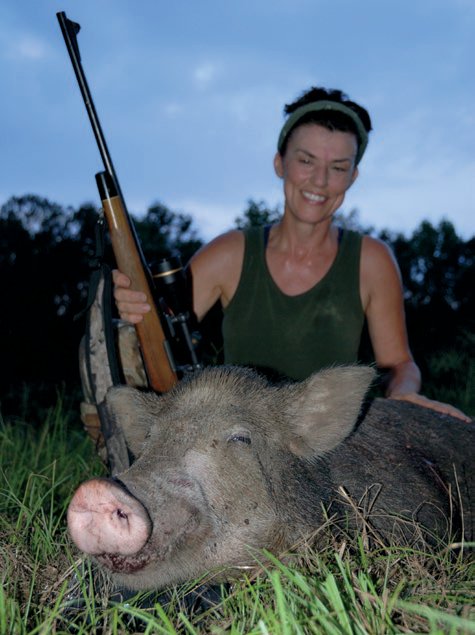
On the afternoon of July 4 Tes climbed into a ladder stand and confirmed with binoculars what the I.C.E. camera told us with a text message. I dropped the gate with the hand-held remote and the sow and six pigs were captured.
The gate has been moved and is in position to trap a sounder using a site on Dr. Jones’ property. This is how it begins. Hopefully, this is how we win.