
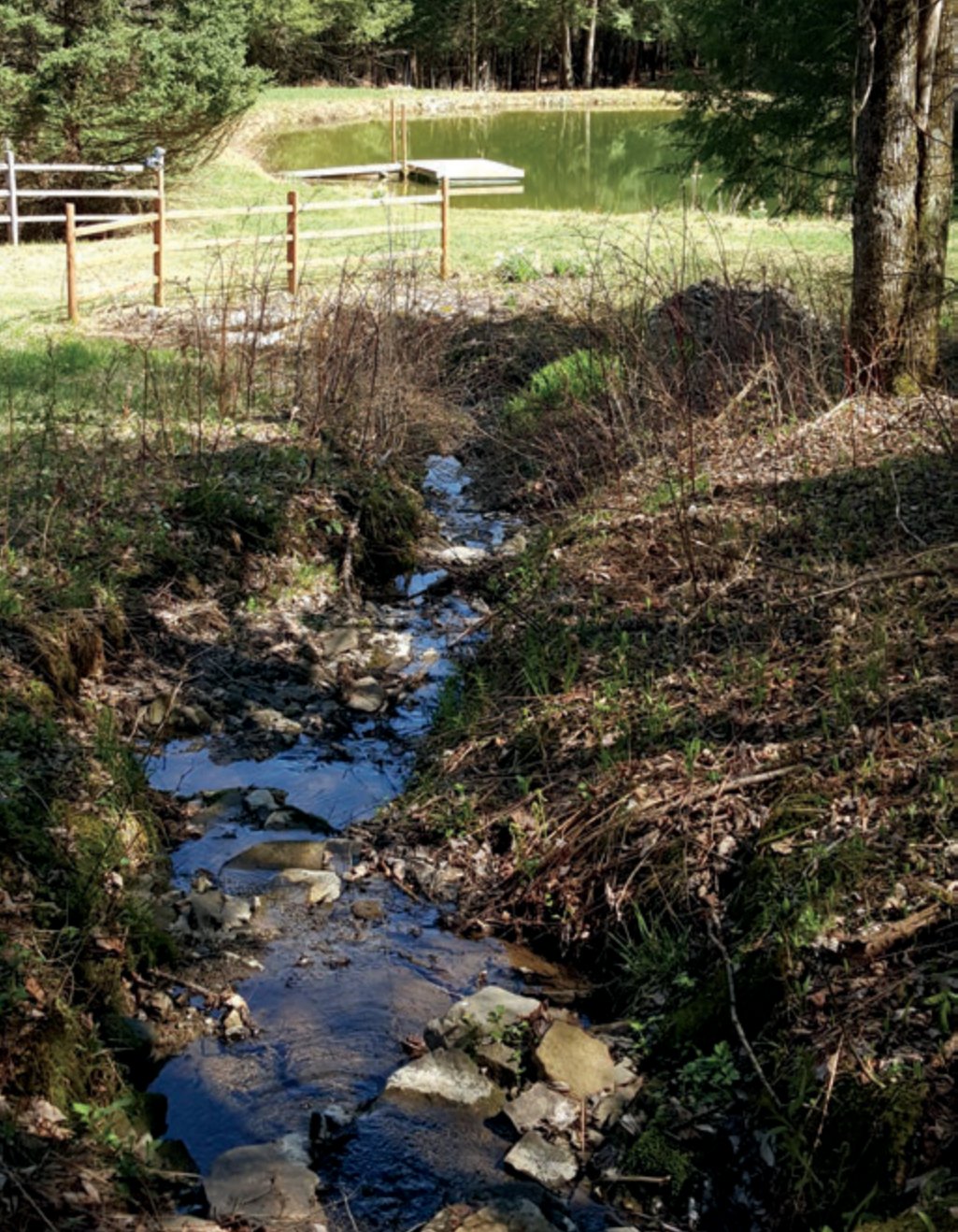
Anyone who performs lake management professionally or as a hobby knows the importance of good water quality. Water quality is the foundation of a pond or lake. There is almost no naturally occurring water chemistry make-up that will not support some fish, but there are definitely some that are better than others. Some of these can be manipulated, and some are too large or receive too much undesirable runoff and cannot practically be improved. Many things influence water chemistry in a waterbody such as where in the country the waterbody is located, nearby and upstream runoff, soil makeup, age of waterbody, depth, aquatic vegetation (shoreline, emergent and submergent) and historical vegetation present and historical run-off. Some of these are human influenced and some are naturally occurring. Over time a waterbody changes physically and chemically.
Basic water chemistry analysis consists of looking at water temperature top and bottom, Dissolved Oxygen (DO) top and bottom, ammonia, total alkalinity, conductivity, pH, carbon dioxide, total hardness, salinity (typically present along coastal areas) and visibility. There are other parameters that can be looked at depending on your location such as the source of the water or if you are managing a hatchery pond or fishing pond. Sometimes issues can be explained, the cause identified and corrected, while occasionally they cannot be depending on various factors.
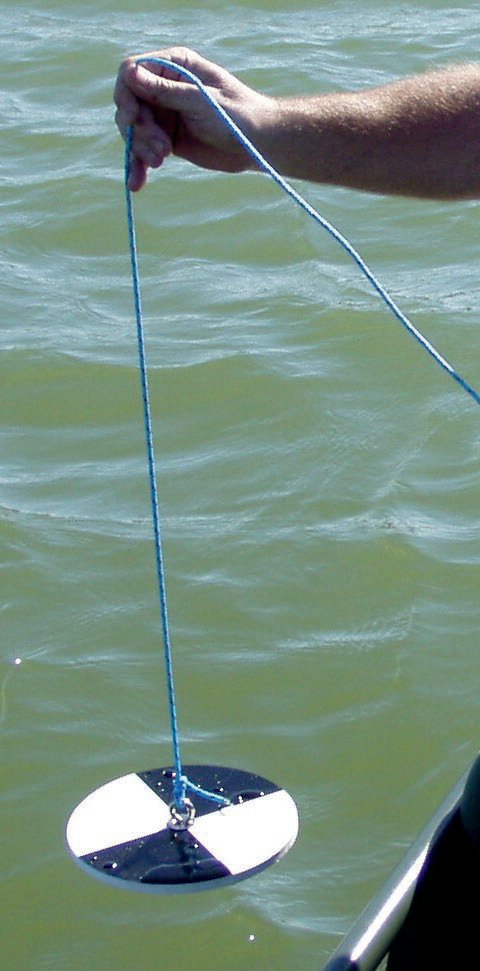
Common tools for testing water chemistry are a standard Secchi disk, freshwater aquaculture testing kit, and possibly some electronic meters for testing various parameters. The Secchi disk is an eight inch circle attached to a string or stick. The top surface has alternating quarter black and white sections. These can be homemade or purchased. Aquaculture testing kits look similar to a common pool testing kit, but designed for testing lake or river water. Samples of water are tested on-site to render results. These kits cost between $200 and $300. Various testing meters range from $100 for testing a single parameter to over $5,000 for testing multiple parameters down to 30 feet deep and deeper.
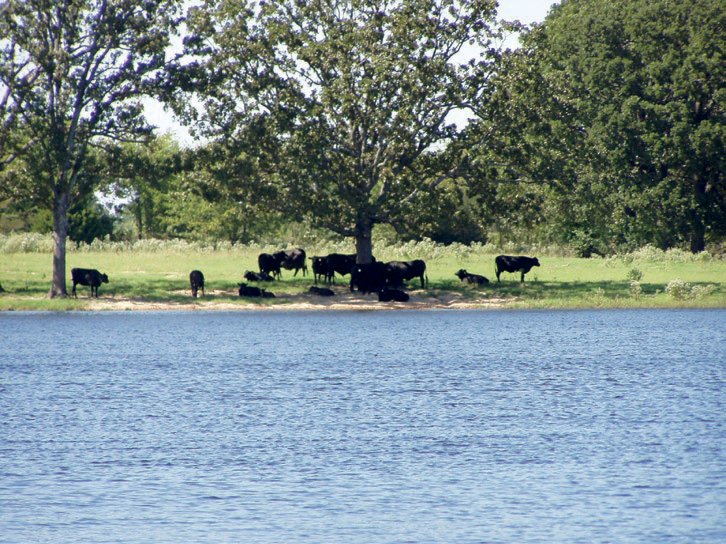
Before we make a site visit, we can tell some things about a waterbody and its water quality from aerial and soil maps. But, each waterbody is unique and has its own water chemistry make up, which is why water chemistry data should be collected every quarter at some point to know what is occurring during summer, fall, winter and spring. Each season will render different results from water chemistry data and a limiting factor slowing production and/or growth may only occur certain times of the year. It is not uncommon for water quality in warmer climates to look good in fall, winter and spring, while during the longest part of the growing season (summer) it may be poor or possess a limiting factor only detected by gathering water chemistry data. Knowing how a waterbody functions chemically all year long helps identify possible problem areas in a specific species, or in a certain stage of life for a particular species. Parameters such as pH, alkalinity, hardness and conductivity are different in different parts of the country. Water in the Southeast, away from the coast, usually has low conductivity, alkalinity and hardness. Salinity levels go up the closer to sea level the waterbody is located. If the waterbody is located down stream from a swamp/wetland with cypress and/or has a nearby pine plantation, the water may be tea colored, which is stained from tannin emitted from cypress, pine needles and a few other common plant species in that area, and will create a low pH due to tannic acid. Newer lakes tend to have better dissolved oxygen (DO) levels than older shallower lakes that have more organic material built up on bottom. Lakes with an algae bloom (green water) on sunny days have a high DO level, while overnight or on cloudy days DO is lower. At any given time, some parameters may be good for the fish population, but others may be bad at the same time, depending on the season, time of day and water quality makeup.
Water Temperatures
Water temperature on the surface and in the deepest holes tells us about mixing or lack of (stratification) and thermal refuges present, which change during each season. The depth at which the drastic temperature change occurs is known as the thermocline. Most waterbodies mix in spring and fall, where bottom temperatures may be similar to surface temps, depending on lake depth. Certain freshwater species cannot tolerate warm or cold water, so if considering stocking any of these species, knowing the water temperatures throughout the year and how they may affect your fish is important. A commonly stocked forage species is the threadfin shad. This species can become stressed and die if water temperatures get below 45º F. If a lake’s water temperatures frequently get below this threshold, from top to bottom, stocking this species may not be the best choice. Native warm water fish species all have their own optimal water temperature for growth between 55 – 85º F. The longer the water temperature is in this range, the more growth per year you will observe in all fish species present. This parameter fluctuates during the day, usually going up at daylight and down after dark.
Lake roll-over can occur when water temperatures on bottom warm above the surface temperature and surface water sinks and bottom water rises. If high organics and extreme low dissolved oxygen are present, a fish kill can occur. There is no practical way to cool or heat up a waterbody, but a bottom aeration system will mix water and provide a stable water temperature top to bottom to help prevent lake roll-over due to temperature.
Dissolved Oxygen
One parameter always looked at is DO (dissolved oxygen). Dissolved oxygen helps with decomposition and is what fish take in through their gills to survive. When dissolved oxygen levels get low in deep water, fish will avoid these areas until it comes back up. If the entire waterbody experiences low DO fish may become stressed, not feed, not breed, eggs may not hatch, and newly hatched fry may perish. Some species of freshwater fish tolerate low DO better than others. Catfish, gar and bowfin are a few that can tolerate extended periods of low DO levels while shad, bass, bream and other species cannot. The DO also fluctuates over a 24 hour period where the highest level is just before sunset and the lowest just before sunrise. Plants (including algae) begin emitting dissolved oxygen when the sun hits them. Older lakes with a large buildup of organics or dead plants (decomposing) may experience low DO all day. Warmer water holds less oxygen molecules, which is why it is not uncommon for DO readings to be low in shallow lakes during the summer. Decomposition will slow down or stop without oxygen, but fish will die without adequate levels of DO. Most fish kills are the results of low DO. Why it occurred is always the mystery to be solved. This can occur from lake roll-over, heavy rains and runoff, natural or man-made (agricultural runoff, excessive aquatic weed treatment) nutrient overload, and a green lake (algae bloom) experiencing several days of overcast weather where planktonic algae dies, starts decomposing and the DO drops to near zero from top to bottom. A solution to chronic low dissolved oxygen or stratification is aeration. These come in two types, surface or bottom. Surface aerators add more oxygen, but do not mix top and bottom water, which allows fish to use the entire water column, as opposed to just the top few feet where the oxygen is located without aeration or with surface aeration. For additional aeration information, reference Wildlife Trends Journal, January/February 2013, Volume 13, Issue 1.
pH Levels
The pH represents the acidity of the water. pH is as important to producing fish as it is in crop production. On a scale of 0 – 14, below 7 is acidic, above 7 is basic and 7 is neutral. An ideal pH is 6.5 – 9.0 for fish production. A low pH below 5.5 slows some plant species production and negatively affects fish from adults down to eggs in most species. A good estimate of the pH in your lake is whatever it is in your uplands. If your food plots typically have a pH of 5.7 before liming, overall lake pH will usually be similar and close to 5.7. A drastic daily fluctuation in pH can occur and is detrimental to fish. This is usually associated with significant amounts of organics present and/or elevated carbon dioxide levels, which may also be associated with an alkalinity value below 20 mg/l (milligrams per liter). A pH of below 4 and above 11 will kill fish. It is customary to lime lakes if a higher pH is desired. Rising into the desirable range and/or a fertilization program is desired. Liming where extremely high pH exists is also performed in rare cases.
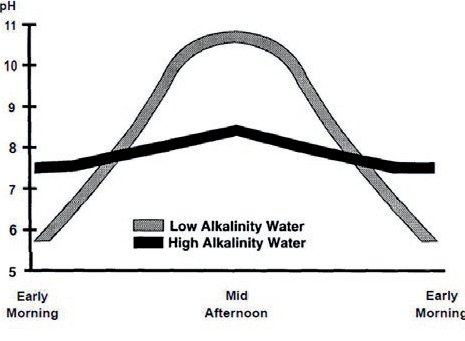
Conductivity is measured by how well the water will conduct electrical current. During calculation it is also correlated with salinity. A desirable range is 100-2000 uSiemens/cm (centimeter) and acceptable range is 30-5,000 uSiemens/cm. You always have high conductivity with high salinity. However, you can have high conductivity with low salinity in water that has other conducting particles present. Total alkalinity is the measure of water’s buffering capacity as carbonate and bicarbonate. A desirable reading is 50-150 mg/l and acceptable is >20 mg/l. Total hardness measures calcium and magnesium. A desirable reading is 50-150 mg/l and acceptable is >20 mg/l. Adding agricultural Lime at a rate of one to two tons per acre raises these if they are not acceptable for quality fish production.
Ammonia is naturally present, but can become elevated in waterbodies with large numbers of fish (from waste), heavy organics or high presence of well water (in some areas). Ammonia levels also fluctuate from season to season. It is rare to find ammonia levels detrimental to fish populations, but can be in a few rare instances. One lake we worked on in south Georgia had a fish die-off from elevated ammonia levels due to the addition of too much well water all at once. The levels were so high almost all of the first 13,000 bream stocked were no longer present a year later. This occurred in response to the landowner using center pivot irrigation from the lake during a six month long drought and simultaneously refilled with well water. Ammonia is absorbed by plants and bacteria. However, this particular lake did not have any aquatic vegetation to perform that process. Once the water withdrawal was moved to a different lake, the fish population has flourished ever since.
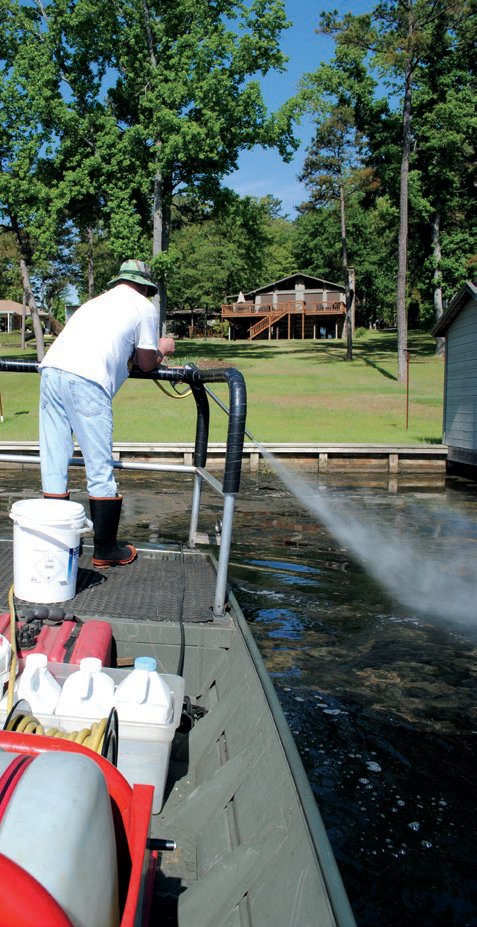
Salinity is generally related to the coastal areas, but not always. There are many waterbodies around the interior United States that have high salinity concentrations. Freshwater fish are common in brackish waters, and can do well. But if sudden salinity levels spike due to flooding from nearby saltwater areas or from underground seepage, freshwater fish will perish. A halocline is sometimes observed where saltwater is on bottom and freshwater on top in ponds as it is in natural open systems (saltwater wedge in coastal rivers). We recently discovered this in a small pond near a saltwater marsh where the salinity on the surface was low and appeared normal for a freshwater pond, but below seven feet deep brackish water characteristics existed. The freshwater fish at times would not utilize the fish feeder and multiple stockings of fish had rendered little improvements in forage or predator numbers. It was determined that at times, the lake would become mixed and salt levels would spike too high for some of the freshwater species and they became stressed or perished. Without testing water chemistry parameters we would have never discovered this anomaly.
Visibility is determined with a Secchi Disk. It is lowered into the water until the “X” becomes blurry, then slightly raised until the “X” becomes clear. That distance from the water surface to the disk is the visibility reading. This is very important if performing a fertilization program. Ideal conditions when checking for a fertilization program is a visibility of 18-36 inches. Fish can tolerate some turbidity, but if too little light penetrates into the water, fish become stressed, slowing down growth and reproduction. To clear muddy water gypsum, or alum is traditionally used. The shading of light, from whatever the source, helps reduce unwanted submerged aquatic plant growth.
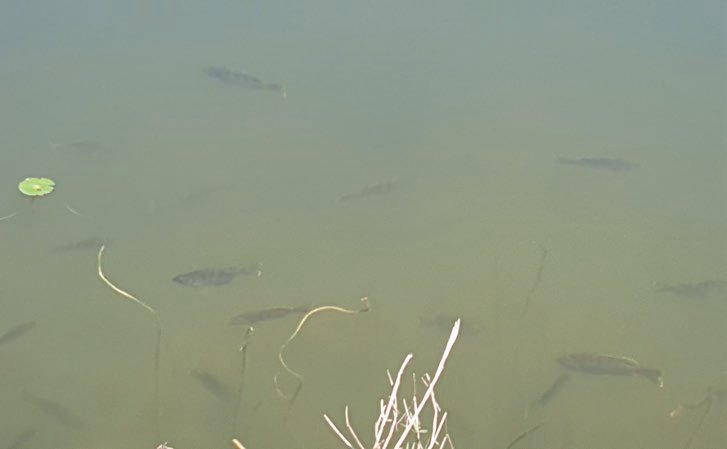
If you are trying to correct an unfavorable water chemistry issue, first identify what is causing the problem. Too often lake managers rush to correct something, only to have temporarily corrected it and shortly end up where they started, which leads to manager and Lake Owner frustration and costly mistakes. As we tell all our clients,”this is the boring stuff'”, when collecting water chemistry data prior to electrofishing. But it is as important as the electrofishing, just not nearly as fun to do or talk about.