
As land managers, we know that every creature is ecologically important. Most species are tolerated fine, but snakes in particular tend to get a bad reputation based on misinformation as well as a cultural bias. Sure, they serve a valuable niche in the environment…but let one crawl too close for comfort and all logic and sympathy for the lowly serpent disappears in the flash of an axe blade or shotgun blast.
The Southeast is home to an incredible diversity of over 50 snake species that range in length from 5 inches to about 8 feet. A snake’s skin is covered in scales made of keratin (like our fingernails) and is shed several times a year. There are a myriad of patterns and colors snakes can be, and variations can exist between juveniles and adults as well as within the same species. Most snakes lay eggs in late summer or fall, although pit vipers give birth to live young and stay with them to protect them for hours or even days. Most snakes are encountered in the spring when the animals are actively seeking mates and first meals after winter dormancy.
All snakes are ectotherms (“cold-blooded”) with an internal temperature typically around 86˚F. They can be nocturnal or diurnal, but their typical routine can change depending on the ambient temperature. Pine snakes and rat snakes are typically active during daylight hours whereas scarlet snakes are usually nocturnal. Corn snakes, copperheads, and watersnakes can be active at any time.
Feeding behavior varies from species to species. Some snakes such as the fast racer actively hunt for prey by sight, while pit vipers often wait in ambush (sometimes for days) for prey to pass within striking range. Watersnakes often hang over the water with their mouths open in the current, waiting until a fish touches it. Some snake species constrict their prey, some swallow it alive, and still others use venom or toxic saliva to subdue their prey. All prey is swallowed whole thanks to the ability of the snake to unhinge its lower jaw. Backward-facing teeth direct the prey toward the stomach.

All snakes have forked tongues which they use to “taste” the air for scent. The tongue is then inserted into the Jacobson’s organ in the roof of the mouth where the chemicals are analyzed. Snake diets often consist of a wide variety of prey items such as small mammals, insects, amphibians, other snakes, eggs, birds, fish, and carrion. However, some species have very specialized diets. The worm snake eats mainly earthworms while the scarlet snake is a reptile egg-eater (especially lizard eggs). Crown snakes specialize in eating poisonous centipedes while crayfish snakes eat…you guessed it…crayfish! There is even a salt marsh snake that can tolerate brackish water where it feeds on fish and fiddler crabs.
On the opposite end of the spectrum, the black racer holds the distinction as North America’s snake with the most diverse diet, eating everything from rodents to small turtles. Then there are a few species of note that go to extra lengths to supplement their diets. Canebrake rattlesnakes have a particular fondness for squirrels and will climb high into trees to get them.
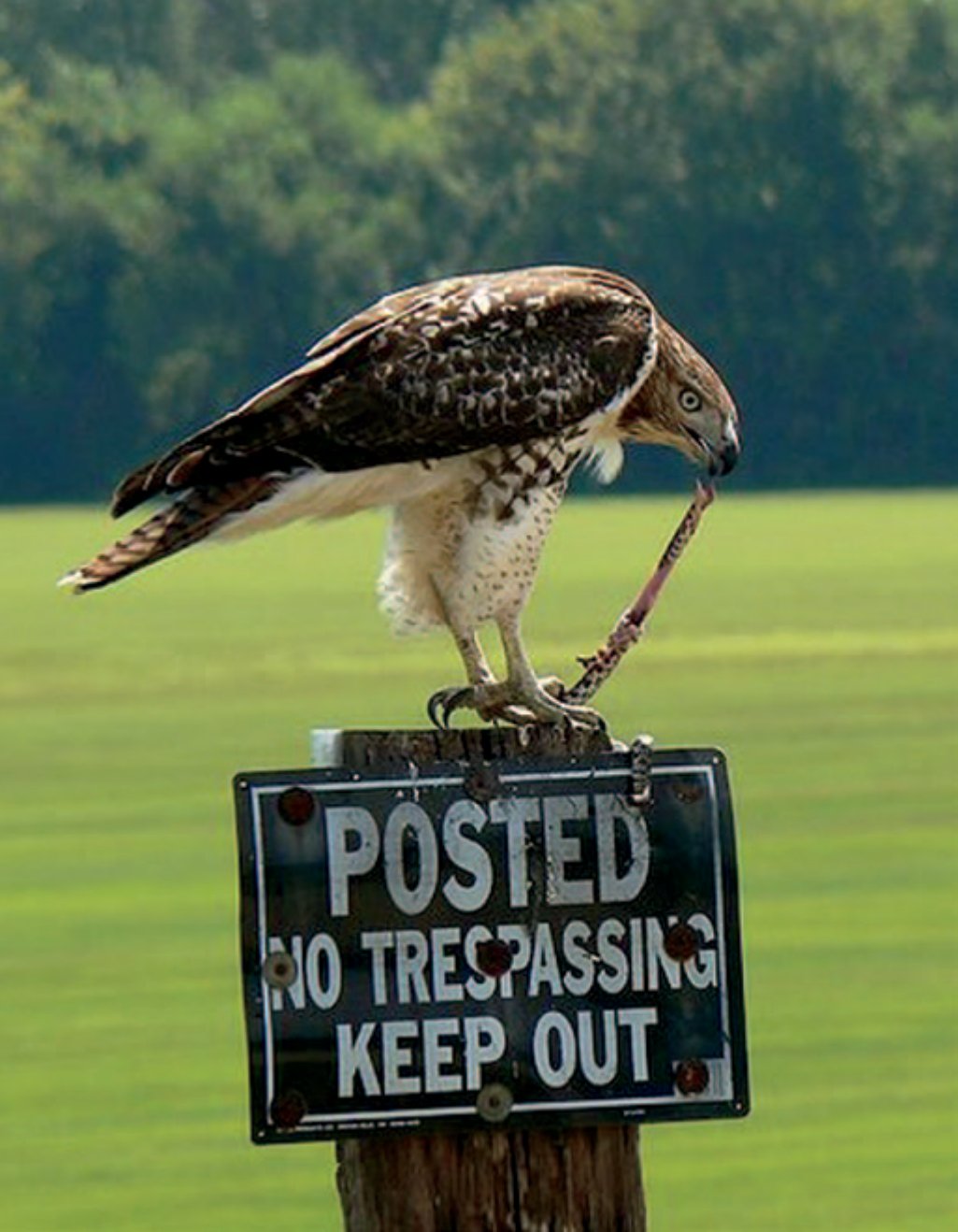
Cottonmouths will eat baby alligators while copperheads will climb trees to take out a noisy cicada or two. In turn, snakes are important food sources for raccoons, owls, hawks (especially red-tailed hawks), great blue herons, alligators, and large mammals. Even turkeys have been known to kill and eat such species as the pygmy rattlesnake.
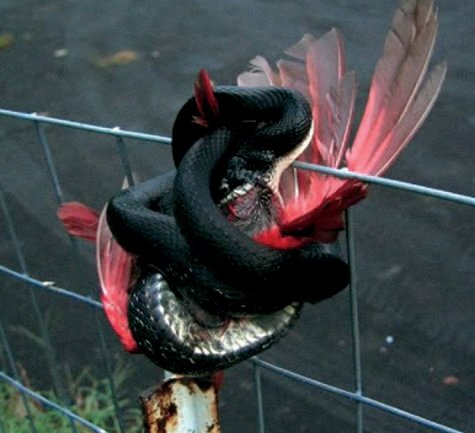
Often it is what a snake eats that either earns him the ire or respect of landowners and wildlife enthusiasts. Anyone who has opened a bluebird box to find a rat snake instead of baby birds has probably not reacted positively to that snake’s presence, to put it mildly! Then there are the quail managers who disapprove of those species that eat quail eggs, young, or adults (if they are lucky enough to catch them).
Sometimes, though, the presence of one predator can help offset the damage caused by another more effective predator. For example, rat snakes do eat bird eggs and nestlings. However, they also prey heavily on rats which are significant predators of quail nests and compete with the birds for food. Based on captive snake feeding habits, one adult rat snake can eat approximately 78 rats per year. Corn snakes, kingsnakes, rattlesnakes, copperheads, and many more species also prey on rodents, helping to keep their populations under control. This not only regulates rodent predation on other species but also reduces the potential for the spread of diseases such as hanta virus and Lyme disease.
Some of the species with highly specialized diets also have a positive impact on humans. The rainbow snake, a species of watersnake, primarily eats American eels and even has a tail spine to help anchor it as it feeds on slippery eels and salamanders. Fishermen don’t mind having this colorful snake around because otherwise eels would become a nuisance, stealing bait and eating more fish than even the snakes could catch. Watersnakes in general serve an important environmental purpose. As they eat dead and dying fish, they not only clean up the aquatic environment but also keep fish populations in check. As watersnakes eat, they ingest Mercury from their food making them great indicators of water quality.
For those people with a particular fear of venomous snakes, it may be comfort them to know that kingsnakes are the champions at eating pit vipers and coral snakes as they are immune to the venom. Other species that eat venomous snakes include the indigo snake and the coral snake (it being venomous itself). Of course, sometimes the tables are turned and the would-be hunter gets swallowed by the prey!
For the land manager who is concerned that the diamondback rattlesnake, who feeds heavily on rabbits, as well as the squirrel-eating canebrake rattlesnake will have an impact on these important game species, fear not. The larger the prey item taken, the fewer times the snake must feed. It takes a while to digest such a meal, especially with the metabolism of a snake. Diamondbacks have been known to live off of only four or five large meals per year!
Perhaps it would surprise you to know that the venom of many snakes is currently being tested or already in use in the medical field to help save human lives. Site-specific proteins found in the various venoms have been used in blood pressure medicines, as clot busters, cancer treatments, and analgesics (pain relievers).
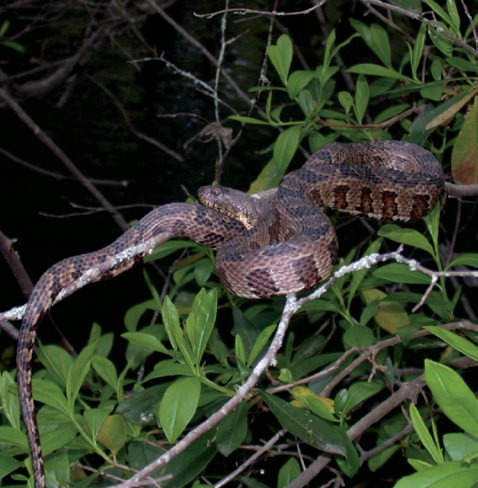
Of course, it is these venomous snakes most people fear. When going into a particularly good snake habitat or cleaning your property, arm yourself with these two things: knowledge and common sense. Invest in a good field guide and familiarize yourself with the Southeast’s 6 potentially dangerous snake species. Wear leather boots for protection and don’t put your hands into brush where a snake may be hiding. Common venomous snakes include the copperhead, cottonmouth, timber/canebrake rattlesnake, diamondback rattlesnake, pigmy rattlesnake, and the coral snake. All but the coral snake are pit vipers. This means they have a heat-sensing pit between the eye and nostril. Their pupils are elliptical in shape (whereas nonvenomous snake pupils are round) and their heads are often triangular shaped. However, nonvenomous watersnakes also have large heads for catching fish. Pit vipers usually have fangs that flex forward and inject a mostly hemotoxic protein venom into their prey which destroys blood and tissue. There is also a single row of scales beneath the anal vent on the tail of vipers. Nonvenomous snakes have a double row.
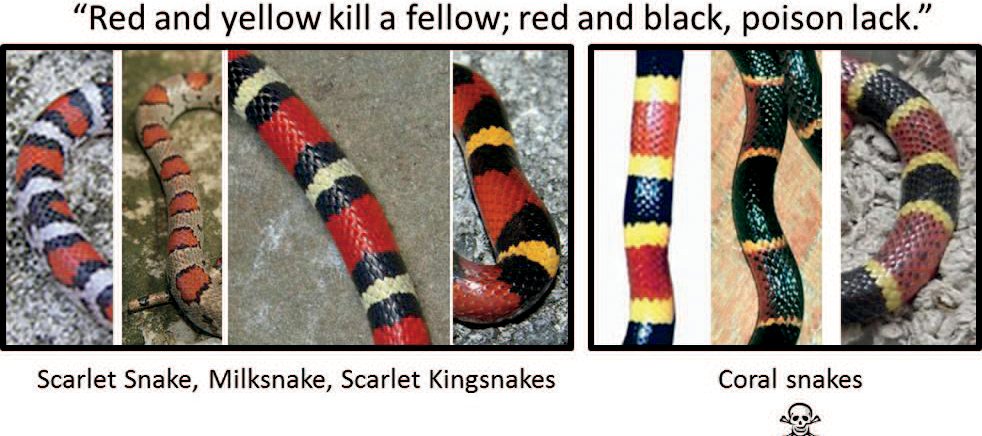
The coral snake is a member of the cobra family and has no pits and round pupils which can mislead people into thinking it is nonvenomous. Because its coloration resembles that of the harmless scarlet kingsnake and other similar species, knowing a helpful rhyme can keep identification simple: “If red touches black, poison lack; if red touches yellow, it will kill a fellow.” The coral snake has small, fixed fangs and chews on its prey to deliver its neurotoxin which inhibits breathing and other neurological functions. The tail scales of coral snakes are single like those of a nonvenomous snake.
Surprisingly, there are very few species of snakes that don’t have some form of toxin in their saliva. This is because most snakes (except for the rat snake, kingsnake, and corn snake) have a modified salivary gland called Duvernoy’s gland which is an evolutionary step towards a true venom gland. Some species like the crowned snake, flat-headed snake, pine woods snake, ringneck snake, and garter snake often chew on their prey in order to allow the toxins to subdue the prey. Hognose snakes are rear-fanged, although they don’t inject toxins; the saliva runs down a groove in the teeth into their prey. They specialize in eating toads which they often have to puncture to deflate before swallowing. These and other species of snakes are generally harmless to people unless someone has tendencies toward allergic reactions. Clean all snake bites well and apply an antiseptic.
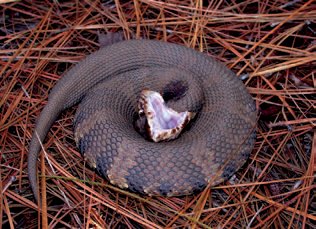
Snakes have a variety of ways to avoid a confrontation with humans or potential predators. They can lie still and rely on camouflage to keep them hidden, make bluff strikes, release musk from the cloaca, feign death (hognose), puff themselves up to look larger, hiss, gape (cottonmouth), vibrate their tails (rattlers) or rub their scales to make rattling sounds (rat snakes), or flee to water or a hole. Snakes do not chase people. Venom conservation is crucial to many snakes and they don’t want to waste it on a human. Most people get bitten when they unknowingly step on a snake or try to handle or harass one. Biting is a last defense and half of all bites are “dry bites.” Warning signs given by a snake should not be mistaken for aggression. However, there are certain instances when a snake can be more aggressive than usual. During shedding, the vision is obscured making the snake feel more vulnerable. Juveniles are also more likely to strike out of fear. Female rattlesnakes found at their den site or with young can become defensive. Having a healthy respect for all snakes and keeping a safe distance (4 to 6 feet to stay out of striking range) is advisable.
Understandably, snakes are under many threats. Highways, pets, habitat fragmentation, predation (even from fire ants attacking their eggs), and persecution all take their toll. Some snakes are targeted simply for their similarity in appearance to venomous species. Watersnakes are susceptible to siltation and stream pollution which directly impacts their food source. Agricultural tillage inadvertently kills fossorial (ground-dwelling) snakes. Already, the indigo snake is federally and state (GA) listed as endangered while the diamondback rattlesnake’s status is currently under review by the USFWS. Due to the loss of its primary habitat, longleaf pine savannahs, it may be headed for listing under the Endangered Species Act. Land managers can help maintain healthy snake populations by creating natural field borders, preserving a variety of habitats across the landscape, protecting winter den sites (rock piles, crevices, stumps, root holes), basking sites, and maintaining wetlands. Allowing vegetation to overhang water sources in some places will especially help improve watersnake habitat.
Resources Consulted
Bennett, S. 2012. Personal communication with SCDNR Herpetologist via email.
Bennett, S. 2012. Tracking the Eastern Diamondback Rattlesnake. South Carolina Wildlife September-October issue.
Daily, T. and T. Hutton. 2003. On the Edge: A Guide to Managing Land for Bobwhite Quail. Conservation Commission of the State of Missouri.
Gibbons, W. and M. Dorcas. 2005. Snakes of the Southeast. University of Georgia Press. Athens, GA. 253 pp.
National Institutes of Health, Office of Science Education. 2012. Making Medicines from Poisonous Snakes. http://science.education.nih.gov/animalresearch/nsf/Story1/Making+Medicines+from+Poisonous+Snakes.
North Carolina State University and A&T State University Cooperative Extension. Top Ten Snake Questions. http://www.ces.ncsu.edu/gaston/Pests/reptiles/snakefaq.htm
Nutra Pharma Corporation. The therapeutic uses of cobra venom neurotoxins. An interview with Paul F. Reid, PhD. www.nutrapharma.com/presskit/paulreidinterview.pdf.
Orr, Z. 2012. Personal communication with owner of Randolph Rattlesnake Refuge and Research Center via email.
Poole, J. R. 2010. Snakes Alive! South Carolina Wildlife, Sept.-Oct. 2010 issue.
University of Georgia Savannah River Ecology Lab (Janecek and Scott). 2002. Snakes of Georgia and South Carolina.
US Fish and Wildlife Service. 2012. USFWS Initiates Status Review of the Eastern Diamondback Rattlesnake. http://www.fws.gov/southeast/news/2012/024.html.
Wilson, L. A. and The Nature Conservancy. 1995. The Land Manager’s Guide to the Amphibians and Reptiles of the South. TNC Southeastern Region and the USFWS Southern Region.