
Over the years, working in both state government and in the private sector, I have been asked many questions regarding lake management. There are a core number of questions that lake owners ask most often. Some are related to the early phases of lake development such as how deep or how large does a pond need to be to grow quality fish. Should I lime and fertilize? Why can’t I treat large areas of aquatic vegetation with herbicide in the summer? Should I stock shad? And probably the most common question asked – Should I and why do I have to remove largemouth bass? Not all the answers are cut and dried, and every lake is unique and has to be looked at individually. For example, just because one of your waterbodies is benefitting from a fertilization program doesn’t mean all lakes on your property should be fertilized.
How big should my pond be to grow nice bass?
After lake construction is complete, this question is irrelevant. Generally, the heart of this question is – how small of a pond can I build and still have a chance to grow some big bass? Bream require at least a one acre pond to grow large individuals with a well maintained supplemental feeding program. For largemouth bass, we like to see three acres or larger. For black crappie, 15 acres or larger, while 25 acres or larger is preferred. However, we have seen a few smaller waterbodies offer great crappie fishing, but more often not they are not a good fishery. How many fish a waterbody can support is not based on the number of fish but the total weight (biomass) of that particular species. For example, a largemouth bass carrying capacity of 100 pounds can be 100, one pound individuals, 10, ten pound individuals, or a combination of weights and sizes totaling 100 pounds . Most desirable fish species are edge species, so shape can make up for size. A three acre pond with an irregular shoreline and islands can have more quality habitat than a square or round five acre pond.
How deep should my pond be?
This is another question that needs to be answered before the pond is built. In the North, shallow ponds get too cold, dissolved oxygen levels go down and ponds can freeze solid if not deep enough. In the South, water temperatures become elevated in the summer, pushing Dissolved Oxygen (DO) levels down. Both instances can stress or kill fish. A good rule of thumb is to have the pond at least eight feet deep during drought conditions and no more than 12 feet deep, unless you install aeration. Without aeration anything deeper than 15 feet will experience low DO in the deeper holes and fish do not go down there certain times of the year when DO is below acceptable levels (3 parts per million [ppm]). If you install an aeration system, going deeper is acceptable and will ensure fish will use the entire water column. Many landowners dig to eight feet and stop to let it refill, only to find out after refilling that the final product is only seven or six feet deep. Once you stop digging the lake starts filling in with sediment immediately as the water comes in, so dig a little deeper than desired to compensate for silting in during the filling process and to allow for adequate depths during drought.
Should I lime and fertilize?
Liming and fertilizing are great tools to increase fish production. Several things need to be looked at while considering this option and before implementing. Lake size is the first consideration. Lime is approximately $25/ton delivered, and extra for spreading (unless from shore or in lake bottom with delivery trucks in a new lake not yet filled). Two tons per acre in a 30 acre lake is $1,500 and you spread yourself. This usually needs to be performed every three-to-six years depending on natural pH and the rate of inflow/outflow of water. To some, this is not a financial issue; to others it may be a reason not to perform the task. Obviously the less adjusting of the pH required and the size of the waterbody can greatly influence costs. The price of fertilizer has gone up drastically over the years, so again the size of the waterbody, pH levels along with hardness and alkalinity need to be considered before you incorporate this management tool. To raise those parameters, liming may be required in your area. To fertilize, a pH above 6, and hardness and alkalinity above 20 milligrams per liter is desired. With so many variables, the answer to our question is to first look at some of the things previously mentioned. Be aware that fertilizing is something that requires constant monitoring to assure the desired effects occur and undesirable effects are non-existent or kept to a minimum.
Why can’t I treat large areas of vegetation in the summer?
Many do-it-yourself lake owners get behind in the spring trying to tend to the uplands and ponds simultaneously. They see a little vegetation growing in the lake and know that we always preach about leaving some habitat. Then by early to mid-summer the once “looking good” weeds are now out of control, affecting a large part of the lake and need to be treated with herbicide. The majority of herbicides prescribed for aquatic vegetation are not toxic to fish (a couple are toxic in extreme application rates). Most (99.9%) of fish kills that occur from herbicide use is from a drop in DO caused by dead plants. Living plants put oxygen into the atmosphere and water. But dead and decomposing plants in water are removing oxygen. The act of decomposing requires oxygen. If too much aquatic vegetation is treated with herbicides at once, a drop in DO can cause stress or kill fish. To help avoid this, treating partial areas over several weeks needs to be performed when water temperatures are elevated. Warmer water holds less dissolved oxygen than cooler water. Warmer water, decomposing plants, more fish present post spawn and less oxygen available means fish will become stressed or perish. Aquatic herbicide labels instruct you on how far apart treatments need to be in summer to defend against a fish kill. Usually it is 7-14 days between treatments and ¼-1/3 of the area gets treated at one time. For an entire waterbody treatment of contact herbicide, striping the area is better than doing a partial treatment all at one end. Stripe waterbody into six or eight sections, treat an area, then skip two or three sections and treat. Return after label recommended days and treat another untreated area and skip two or three sections, same way as the first treatment. After three or four visits, the entire area has been treated. When dealing with a severe infestation, it may be better to spot treat access points such as boat ramps, docks, feeders, etc. and then return in early fall and treat remaining nuisance vegetation.

Should I stock shad?
Shad have always been associated with a quality bass fishery. Several research papers and articles have been written documenting the benefits from threadfin shad, and some managers feel gizzard shad also benefit big bass. The first question we ask is, do you get a natural or man-made algae bloom (green water) every growing season? If not, these fish have nothing to eat, as they live off the planktonic algae and zooplankton in green water. Stocking them in clear water will result in them dying, not reproducing, and only being beneficial to bass for a short period of time. Another note is they are expensive, so stocking them without doing your homework is unadvisable. In the deep-South it is unadvisable to stock gizzard shad because they grow too fast, and many will get larger than the big bass can consume, eventually overpopulating and causing problems. Where winters are longer, gizzard shad growth is slower and more beneficial to big bass for more years. Threadfins can become stressed and die if water temperatures get below 44° F.
I have lots of minnows, why do I not have big bass?
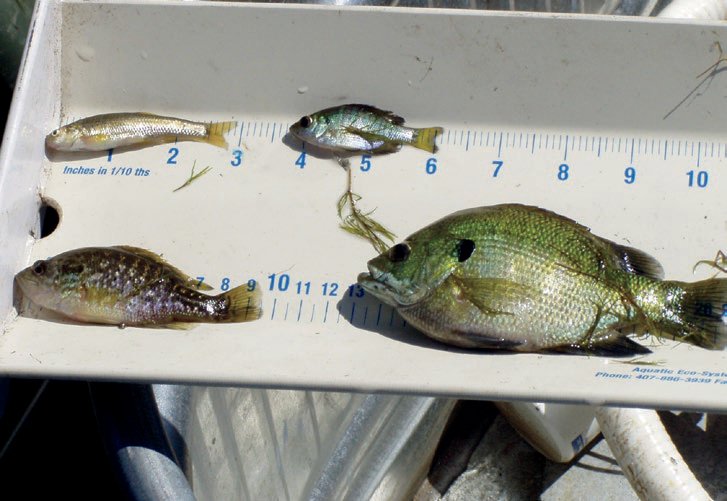
An abundance of forage a certain size does not make for a perfect forage base. One-to-two inch minnows or bream will not feed bass over a couple pounds. As mentioned earlier with the lake that had a bottle neck at the three-to-four pound range, the pond had plenty of threadfin shad up to 4 inches and plenty of bream over 7 inches. The largest bass had forage but the mid-size fish three-to-six pounds were struggling because there were so many mouths to feed, but not enough forage for bass that size. You must look at forage make-up. If 1,000 pounds of forage is present, all in the form of one inch minnows, it will not support bigger bass. Lots of food for small bass, but once they become larger, food becomes less plentiful and growth slows or stops. Various forage sizes are required to grow bass from juveniles to quality or trophy fish.
What is the one single thing that will improve my fish population the most?
After we develop a management strategy some lake owners want the “silver bullet” to improve their fish population. Some may decide their water chemistry is poor and their lake is too large (costly) to lime. So the question arises “of which recommendations will singly most improve things?” This is very difficult to answer but over the years we have seen starting and upkeeping a supplemental feeding program is more times than not the answer. Keeping feeders full, fully operational and using a quality fish feed are all necessary to get the biggest benefit. All fish benefit from a feeding program, including top predators that feed on that eat the feed.
Why do I have to take out bass?
This is the most asked question and most neglected task in bass management in small waterbodies. The more food present, and fewer individuals feeding, the faster and larger the predators (largemouth bass) remaining grow. A desired combination of increased forage and reduced number of predators creates favorable conditions for bass to reach their full growth potential. The number prescribed to be removed may be from 10 – 30 per acre, depending on how productive your lake is. Generally in plankton rich (green water) lakes, 20-30 bass per acre are prescribed to be removed ANNUALLY. In Clearwater lakes, possibly 10-15 per acre ANNUALLY may be prescribed. This is not a once in awhile task, it needs to be performed every year and every two-to-three years an evaluation (electrofishing) should be conducted to adjust the slot to accommodate the needs of the bass population. The more bass present, the more that needs to be removed. This “bottle neck” usually occurs from 12-16 inches, but it can occur throughout the size range. Fish become stunted when there is not enough appropriate size forage for a particular size predator to keep growing at their full potential. We have seen this around three-to-four pounds, in which case fewer individuals are removed, but they are each larger than the typical one pound fish. Instead of 30 one pound fish per acre to be removed, 10 three pound fish per acre may need to be removed. Additionally, forage for bass in this size group is lacking and it needs to be addressed to provide food for those individuals.

These are a few of the common questions lake owners have for professional lake managers, but there are a wide range of answers to each one. When I get asked one of these questions, I usually ask a lot of questions back before I can give the best answer for their particular situation.