

Wildlife populations can obviously be affected by a variety of influences. Most often as managers, we deal with population manipulation directly via harvest management, or indirectly through vegetative habitat improvements. It is easy for us to conceive how chronic overharvesting of a species in a concentrated area could bring numbers down significantly. Indirect management activities like prescribed burning or timber thinning, on the other hand, can also obviously have drastic influences on local wildlife populations. In fact, for most wildlife species, habitat condition can be the difference between abundance and complete absence on a particular area of land. These are all concepts that most of us are familiar with. However there is another significant factor that can bring sweeping changes to native wildlife populations; sometimes regardless of the local management we provide. That factor is disease.
Just as in humans, disease in wild animals can be induced by several categories of causative agents. These categories include bacterial, viral, fungal, and parasitic agents, but also can include certain chemical toxins. (There are also a few protozoan-caused diseases that are associates with some species but we will not address those here.) Just as in humans, some of these diseases have predictable symptoms, cycles, and remedies. Yet with others, there is little we as managers can do but let natural illness run its course. Another thing to consider is that pathogens, and in turn diseases, are always evolving. In this article we will provide an overview of some of the common and not-so-common modern diseases in major game and select non-game wildlife species. We will especially highlight certain zoonotic diseases (those that can be shared by humans and animals) so that precautions can be taken when dealing with wildlife.
Bacterial Diseases
Bacterial diseases are the most likely of the aforementioned categories to be zoonotic. That is because many bacteria are generalists and can infect a multitude of species. One of the most common examples is probably Salmonellosis, caused by one of several species of Salmonella bacteria. It is most often found in birds and reptiles but these bacteria can also infect a host of mammal species, including humans. In wild animals, this disease (as is the case with most bacterial diseases) does not generally pose a major threat to population levels. In fact symptoms (often including diarrhea and fever) are not even typically noticeable. In humans however it can be associated with severe gastrointestinal distress and dehydration.
A somewhat more serious (in regards to human risk) bacterial disease is Tularemia, or rabbit fever, cause by the Francisella tularensis organism. Just as its name implies, this disease is commonly found in rabbits as well as rodents and other mammals. Beavers, flying squirrels, and muskrats are all known carriers, as well as a few species of birds. In the aforementioned mammals, it generally causes fever, loss of appetite, sepsis, and even death in some cases. Vectors in nature are typically deer flies and ticks but humans can also become infected from handling infected animals (through cuts or skin abrasions). It can even be contracted by inhaling the bacteria during the skinning process. Skin lesions are a common symptom in human infections. The F. tularensis bacterium also attacks white blood cells in humans and can evade the immune system for some time, leading to high fever and the infection of several organs. Untreated, the disease has a 7% average mortality rate in humans (CIDRAP, 2013) but with antibiotic treatment the fatality rate is well under 1%. Wild rabbits that appear “lazy” or exhibiting no fear of hunters or other odd behavior would be suspect this disease.
Leptospirosis is another bacterial disease and has recently been a topic of discussion. With the expansion of feral pigs and the public health threats associated with them, this disease is worthy of some concern. Preliminary results from studies by LSU, APHIS Wildlife Services, and other researchers have shown alarmingly high rates of leptospirosis in feral swine in recent years. For the pigs (and the many other mammal carriers such as rats, skunks, raccoons, and opossums) the disease is not typically fatal, however experimental infections in white-tailed deer did induce fever, fetal abortion, and death in some cases. Generally wild animals will build immunity and recover from the disease but will remain carriers of the bacteria. That means they can infect domestic livestock and people where they frequently cross paths. The disease is most often spread to other animals through contaminated drinking water, and to humans by them either swimming in urine-contaminated waters or via direct contact with an infected animal’s urine. Either way, the corkscrew shaped spirochete bacteria can be bad news for humans, as it can cause severe headaches, fever, vomiting, meningitis, and even kidney failure.
Leptospirosis
Preliminary results from studies by LSU, APHIS Wildlife Services, and other researchers have shown alarmingly high rates of leptospirosis in feral swine in recent years. Figure provided by USDA APHIS Wildlife Services, 2012.

Leptospirosis is not the only bacterial threat that feral pigs present. In fact, they are carriers of over 40 different diseases that pose a threat to domestic animals, wildlife, and/or humans. Brucellosis and Escherichia coli are just two of the other notable infections that are commonly seen in wild pig populations across the country. Both are gram-negative rod-shaped bacteria. Most folks are already aware of the unpleasant consequences of E. coli, so we will briefly discuss Brucellosis. This disease is caused by the Brucella spp. bacterium and it can infect many other wildlife species including elk, bison, foxes, and raccoons, as well as domestic livestock. Deer can also be infected; however they seem to be much less susceptible than elk and other species. In a national study (including white-tailed and mule deer) with a sample of over 17,000 individuals, only 20 (all were white-tails) tested positive for the bacteria. In cattle and other ruminants, abortion is a common result of infection, along with chronic infections in bones and joints. There have been successful vaccination programs in the domestic livestock industry; however vaccination of wild animals is very challenging. In the West elk are the most prevalent carriers, while in the Southeast feral pigs are probably the most common host. Prior to pasteurization, human infection most commonly occurred through consumption of infected milk. In modern times, human risk is greatest from direct exposure from butchering infected animals or from other occupational exposure. Consumption of infected meat can also infect humans as well as predators. In humans, Brucellosis is characterized in the initial phase by undulant fever, profuse sweating, and joint and muscle pain. A long-term, multiple antibiotic regime is usually needed. If untreated, it can cause chronic bone and joint problems. Preventative precautions include using protective gear, especially nitrile gloves while handling potentially infected animals.

The final zoonotic bacterial disease we will briefly mention here is bubonic plague, caused by the Yersinia pestis bacterium. In the western US, this disease is transmitted by fleas and cycles naturally through wild rodents like ground squirrels, prairie dogs, chipmunks, wood rats, and mice. Typically low levels of plague exist in wild rodents from year to year with no drastic population effects. Rabbits are also sometimes susceptible. Humans and pets (especially house cats) can be infected by the bacteria-contaminated fleas or through direct contact with infected rodents. In humans bubonic plague symptoms include rapidly swelling lymph glands. If infection of the lungs develops, that infected person can then be contagious (by coughing infectious droplets) to other humans. This version of the disease is referred to as pneumonic plague, and has a higher fatality rate.
Viral Infections in Wildlife
A wide variety of viruses are known to cause disease in wild animals, and some have the potential to cause major population-level declines. However, only a few viral diseases in wildlife are zoonotic. An example of one zoonotic viral threat is rabies, caused by Lyssavirus (Rhabdovirus family). Rabies is a mammalian disease, most commonly seen throughout recent decades in wild skunks, foxes, raccoons, and bats. In fact, these animals make up over 95% of all recent reported cases in the US, although the host importance varies by location. The raccoon rabies virus for example is most prevalent along the East Coast and adjacent regions, while rabid bats consistently show up all across the country. Prior to the mid-1900’s and consistent vaccination programs, domestic dogs served as the country’s main reservoir for the disease for a period of several decades. Rabies causes acute swelling of the brain, and in non-human animals, it is characterized by three different stages. During the first stage (1-3 days) of the disease (the prodromal phase) some basic behavioral changes are noticeable. Animals may begin to lose their fear of humans and may be seen out during unusual hours. The second stage (with a duration of 3-4 days) is the excitable phase (also called the furious stage) in which the infected subject becomes hyper-reactive with a tendency to bite anything in sight. Finally, the affected mammal experiences a paralytic stage, where motor neurons of the nervous system are severely damaged. Loss of limb function and drooling (due to facial and throat muscle paralysis) is characteristic of this third and final phase of rabies. Death soon follows, often as a result of suffocation. Without treatment, human infection is also fatal. Precautions include occupational vaccination (for those who handle bats or other potentially infected wildlife) and avoidance of suspicious bats or other animals. To combat the spread of rabies in wild raccoons, the Animal and Plant Health Inspection Service aerially deploys baits embedded with an oral vaccine packet seasonally in strategic locations across the East. These baits and vaccines are safe for pets and if you find one of them in the woods, the best thing to do is simply leave it where it is.
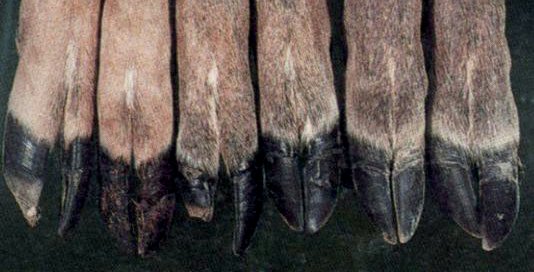
Another very important viral disease with regards to American ungulates is Epizootic Hemorrhagic Disease (EHD). Although it can affect pronghorn, elk, big-horn sheep, and mule deer, it is most commonly seen in white-tailed deer. In fact it is the most important viral disease of white-tails across the country. The disease is caused by an orbivirus in the Reoviridae family. It is transmitted by small biting flies called midges which are in the Culicoides genus, especially C. variipennis. The seasonality of EHD outbreaks (typically late summer into fall) coincides with the abundance of this insect vector. In the West and Midwest, occurrences of EHD are intermittent while in the Southeast, outbreaks occur annually. Some animals carry only mild infections with no symptoms while others experience a variety of clinical symptoms. Deer with EHD will often lose their fear of humans and may seek out water sources like creeks and ponds (to reduce fever). Some infected animals may experience a swollen neck, tongue, or throat and have breathing issues. Some deer die quickly (within 3 or 4 days) while others usually live longer with other complications, including lameness. Lesions are common in EHD-infected deer, as well as hemorrhages of the heart, pulmonary artery, rumen, or intestines. Individuals that survive the disease often have cracking or sloughing hooves. The severity of past outbreaks have typically involved mortality rates lower than 20% of the population, however local die-offs of more than 50% have occurred. Because of the high mortality rate this disease can have drastic effects on local deer populations. There is no current treatment for the disease in wild animals, since widespread vaccination is not an option. There is no evidence that suggests EHD poses a threat to humans and venison from infected animals has been declared safe. However use discretion in the consumption of animals with ulcers, abscesses, or other abnormalities. Hunters who observe deer with symptoms of EHD are encouraged to report to their local state conservation agency.

In wild birds, a myriad of viral diseases are known. We covered several of these important avian viral illnesses in detail in a previous Wildlife Trends article (including avian influenza, lymphoproliferative disease, avian pox, and Newcastle Disease). However, here we will highlight a couple of the lesser known viral diseases in wild birds. The first is a relatively recently discovered disease that affects American woodcocks. In the winter of 1989-90, approximately 1000 dead woodcocks were found in the coastal regions of New Jersey and Virginia (Docherty et al., 1994). Another die-off occurred in the winter of 1993-94. From these birds a type of virus (called a reovirus) was isolated. Reoviruses are fairly well known from poultry industry and in domestic chickens they can cause inflammation of the pericardium, enteritis, hepatitis, bone degeneration, and other symptoms. Little is known however about the woodcock reovirus. There were no visible lesions on the dead birds although most were thin and emaciated. Following the outbreaks, samples were collected from across the range of the species, from hunter-harvested and live-trapped birds. No positive results were found from any of those tissue samples (N=481) or cloacal swabs (N=305) (Docherty et al., 1994) in the Southeastern and Midwestern populations. The implications of woodcock reovirus in regards to population declines are still not well understood. No human threats from this disease are known.
Another viral disease that affects ducks, geese, and swans (Order Anseriformes) is duck plague, also called duck virus enteritis. This disease is caused by a herpes virus and only waterfowl are known to be susceptible. Therefore, when several ducks or geese are found dead and there is no observed mortality in local shorebirds or other species, duck plague is likely responsible. Although duck plague is not zoonotic and poses no direct risk to humans, this disease is important to migratory waterfowl as they can carry the virus long distances during the incubation period. Mortality during outbreaks can reach as high as 90% (Carter, et. al., 2006). The only known control is depopulation and decontamination of affected carcasses and sites.
Chemical Toxins and Wildlife
Chemical toxins associated with the transportation, manufacturing, and agricultural industries have been an important topic regarding wildlife conservation for the past several decades. The following chemicals have been known to cause problems in wildlife, especially in birds: pesticides, polychlorinated biphenyls, oil, lead, selenium, and mercury. Chlorinated hydrocarbon insecticides like DDT (also called organochlorines) were largely banned in the United States in the 1970’s because of their persistence in the environment and ecological effects. Since then, organophosphate (OP) and carabamate insecticides have become more common. These pesticides typically last only days or weeks in the environment instead of months, but they can still accumulate and cause die-offs in wild free-ranging birds. While many species can be affected by OP insecticides, passerines, raptors, and waterfowl are among the most commonly reported mortalities. Birds are usually exposed to OP and carabamate insecticides via consumption of seeds or vegetation with residues, eating treated insects, drinking contaminated water (runoff), or through direct contact (inhalation or absorption) in treated areas. OP and carabamates are toxic because they disrupt enzymes in the nervous system, and in wild birds this can cause symptoms including convulsions, drooping wings, respiratory distress, and paralysis.
Polychlorinated biphenyls (PCB’s) are used in multiple industrial applications (including the plastic, insulation, printing, asphalt, and paint industries) and are very long-lived in the environment. This has made them one of the most common worldwide contaminants, especially in rivers and industrial-associated water bodies. They are similar in their molecular structure to DDT and can bio-accumulate in the tissues of wildlife as they move up through the food chain. Large long-lived predatory fish are more likely to build high concentrations of PCB’s. Mammals, especially mink, are also very susceptible to these compounds. Other affected wildlife species include fish-eating birds like cormorants and pelicans. The Hudson River in New York is one of the best-known case studies for PCB contamination in wildlife.
Oil is obviously another chemical toxin that can affect birds and marine wildlife. Accidental petroleum releases are actually more common than most people realize and on average over 10 million gallons are spilled directly into fresh and saltwater environments in the US. Even more comes from intentional wastewater release and from urban run-off. Oil contamination is probably most well known in birds. In addition to the obvious issues associated with oiled feathers and the resulting hypothermia that usually ensues (due to the inhibition of the waterproofing and insulating properties of the plumage), there are a variety of toxicological problems that are associated from exposure to petroleum products. Chronic exposure to oil can cause reproductive system failure, malformation of embryos, impaired immunity, and a host of other symptoms in many types of birds. Shorebirds, waterfowl, and wading birds like herons and egrets are typically the most affected species. Another contaminant that commonly affects waterfowl is lead. Almost all species of ducks and geese are affected to some extent by lead poisoning in the US. Field symptoms in waterfowl include a crooked, slouching neck and emaciation. Canada geese, mallards, pintails, and scaup are usually the most commonly seen species with symptoms. These ducks are dabblers and are generally exposed by picking up and ingesting lead shot (from shotgun hunting) in shallow waters and marshes. Although waterfowl hunting regulations (using only non-lead shot) were imposed nationally around 1991, a significant level of lead poisoning in ducks can still be seen in many locations mainly due to residual shot from years of hunting, and the occasional ingestion of lead fishing sinkers or mine wastes. In addition to waterfowl, raptors (especially eagles) have also recently been found to carry elevated concentrations of lead in a surprisingly high percentage of the population. Eagles and other birds of prey ingest lead bullet fragments from hunter killed carcasses and carrion. In 2011 for example, of the 120 bald and golden eagles taken into the Minnesota Raptor Center, 85% of those tested positive for elevated blood lead levels. Similar findings have been occurring in recent years across many other states. Considering these statistics, there is a movement currently to introduce legislation that would prohibit the use of lead bullets used in rifle hunting. This would undoubtedly lead to increased costs in ammunition and so it will continue to be a topic of debate for some time to come.

Other elements like selenium and mercury are also naturally occurring in the environment but can be hazardous to wildlife in certain situations. Selenium for example is actually an essential nutrient but at some point-source locations (such as smelter sites or sewage treatment areas) it can accumulate in plant tissues and then be passed through the food chain and concentrate in birds and mammals at toxic levels. It often causes embryonic abnormalities and missing limbs in wild birds. Humans can also be poisoned by high selenium levels. Mercury is a heavy, non-essential metal that can be introduced into the environment at higher than natural levels. It’s presence in fish and shellfish in many locations (and potential risk to humans who eat them), is well documented. Like selenium, mercury is transferred up through the food chain and causes emaciation in birds and a variety of other symptoms in mammals. Mitigation for chemical intoxication among wildlife involves careful disposal of wastes, responsible industrial management, and clean-up of contaminated sites. The latter can be very difficult and virtually impossible in aquatic environments.
In this article, we have discussed a variety of wildlife diseases caused by bacterial, viral, and chemical agents. Some of these typically persist in game and non-game populations without causing too much of a problem. Others, as we indicated, have the ability to cause major die-offs and can significantly affect local population levels. In Part 2, we will continue this discussion by taking a detailed look at some very different diseases caused by fungal and parasitic agents.
References
Carter, G. R., Flores, E. F., and Wise, D. J. 2006. Herpesviridae. A Concise Review of Veterinary Virology. Retrieved 3-10-2015.
Center for Infectious Disease Research and Policy (CIDRAP). 2013. Tularemia: Current, comprehensive information on pathogenesis, microbiology, epidemiology, diagnosis, treatment, and prophylaxis. University of Minnesota.
USDA APHIS Wildlife Services. 2012. Update on leptospirosis testing in feral swine. National Wildlife Disease Program, Program Activity report.
Docherty, D. E., Converse, K. A., Hansen, W. R., and Norman, G. W. 1994. American woodcock (Scolopax minor) mortality associated with a reovirus. Avian Diseases 38:4, pp. 899-904.