

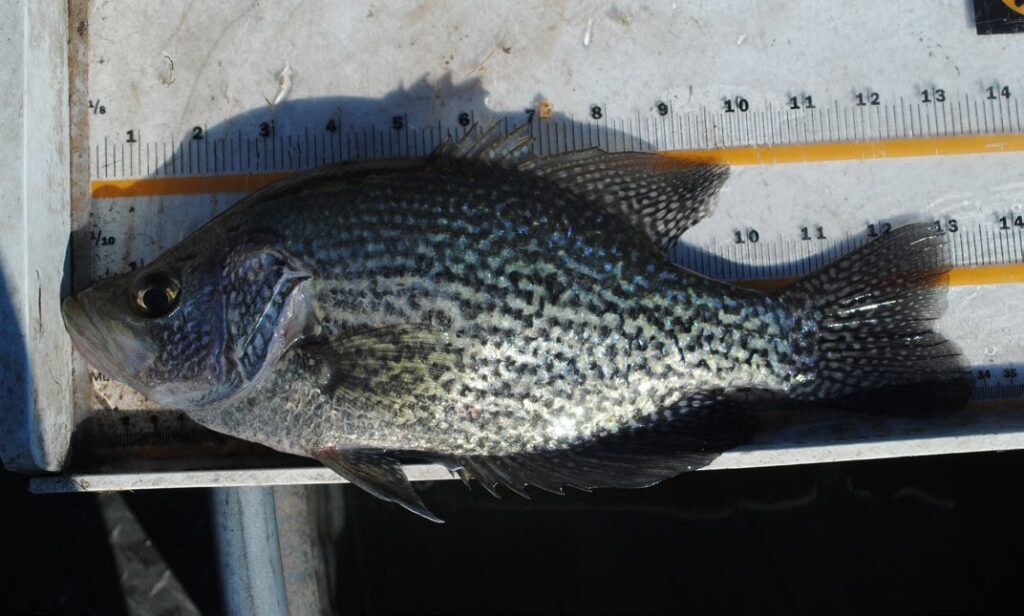
Last edition I discussed a lake’s shoreline (literal zone) and now we will cover what is going on offshore in open (usually deeper) water. Offshore and in water with depth, some water chemistry parameters can vary from top to bottom depending on how deep your waterbody. The habitat usually does not consist of vegetation, but in some instances it may, depending on water clarity. Away from shore there are probably fewer fish species that spend most or all their life there, and those species may consist of both top-level predators like the crappie and forage such as the threadfin shad. In some deep lakes, quality largemouth bass may prefer the open water than the shoreline for various reasons. Each waterbody is different how much the offshore and deeper water is used by various species. If there is a reason for fish to be out there – food, habitat or good water quality, shoreline species and open water species will both benefit.
Offshore and deeper water will become stratified (layered like a cake) various times of the year. Usually in spring and fall, stratification is less noticeable or nonexistent compared to summer and winter. The most common changes as you go deeper into the water column are temperature, dissolved oxygen and pH. The pH reading generally tends to decrease with depth, but usually not enough to affect fish, but daily swings in pH can stress fish, but this occurs lake-wide, and not just offshore. In spring, as the water gradually heats up and breezes help mix, the warmer water below rises to the top and cooler water sinks and by summer there may be a few degrees difference or 10-20 degrees temperature difference depending on the depth, clarity and if there is any groundwater (spring) influence from top to bottom. In summer, the bottom water is usually cooler than the top. In the fall, as water cools at surface it begins to sink and now warmer water near bottom rises and again another natural mixing process occurs. In winter the deeper water may be warmer than the cooler surface water. Knowing if this thermocline exists and at what depth in colder climates is important, when wanting to stock threadfin shad or golden shiners. Both threadfin shad and golden shiners can die off during a cold winter if water temperatures get below 45 degrees F and 34 degrees F, respectively. In the summer, bigger bass and other species may seek cooler water offshore to avoid hotter water temperatures near the surface, and moving into the shallows and feeding after dark to return offshore after daylight. We have seen some largemouth bass living most of their adult life offshore in open water if there is adequate dissolved oxygen and forage.
Besides a temperature difference in the water column, certain times of the year may have a Dissolved Oxygen (DO) difference. Again, this depends on depth and water clarity. This stratification in DO may or may not occur along with the temperature. In spring and fall DO’s are usually good and uniformed throughout the water column. In summer and winter the DO at the surface is good, but may be zero at the bottom, which means no fish are utilizing those areas where there is little or no DO. Sometimes you may catch a lot of bream and/or catfish off the bottom, and other times you may catch none, because they are not there due to lack of oxygen. This is why we direct clients to not place fish attractors in the deepest holes in the waterbody without aeration. Placing fish attractors in 15 feet deep water when there is no DO there six months of the year is wasting your efforts, place them above the line where DO plummets so they are used 12 months a year.
Obtaining a yearly water chemistry profile on your waterbody helps you understand what is happening throughout the year (four seasons) and identifies areas of your water column fish may not utilize.
Depending on the algae bloom, the DO may only be good 7-9 feet below the surface. If your lake is 15 feet deep, that is a lot of area not being used by fish. A bottom aeration system would help. A bottom aeration system not only adds dissolved oxygen to the water, but it also de-stratifies the water column, mixing low DO water off the bottom with the oxygen rich surface water creating a water column fish can utilize from top to bottom. If you have a nutrient rich supersaturated waterbody where algae is an issue, the movement of water will also reduce some of the algae growth and possibly make it a desirable level instead of a nuisance.
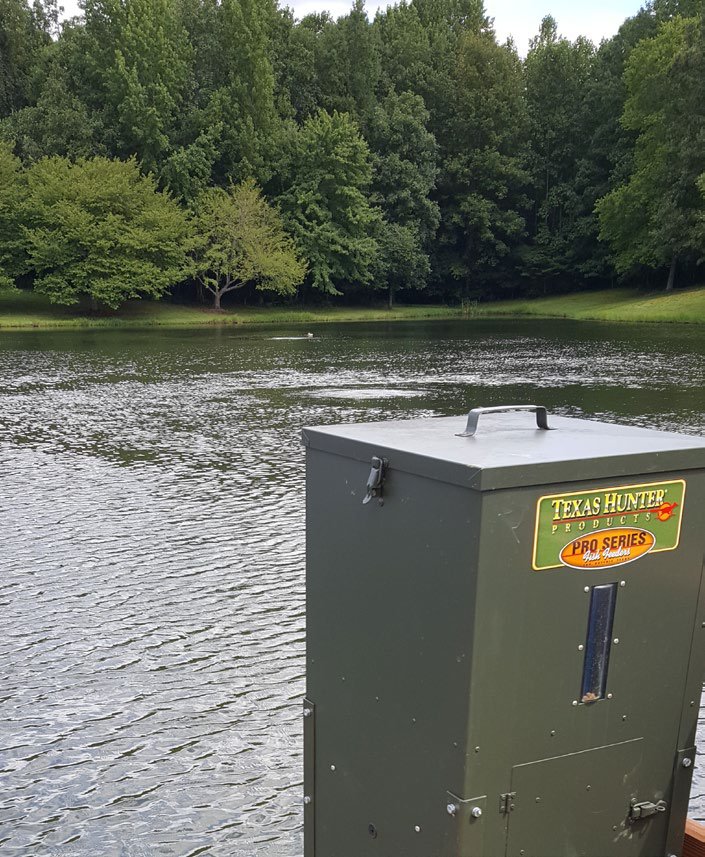
Habitat offshore is usually limited to bottom contour/design, structure and in a few instances’ vegetation. Not having a bathtub-like lake bottom is a big improvement to offshore habitat. If feasible, having trenches, deep holes and rises, and shallow areas in the middle of lakes are all beneficial to sportfish and their food. When designing a lake bottom make sure all the deep holes and trenches are connected. This will help with mixing and reduce poor water quality areas. If aeration is installed, make sure some bubblers are in these areas to mix this water with the more DO rich, so fish can use these areas all year long. These special contoured areas can be marked with a GPS or fish finder to locate quickly and start fishing. This mixing can also help lower water temperatures throughout the water column in the summer and raise temperatures during the winter encouraging fish (including largemouth bass) to feed more often as opposed to slowing from heat or cold stress.
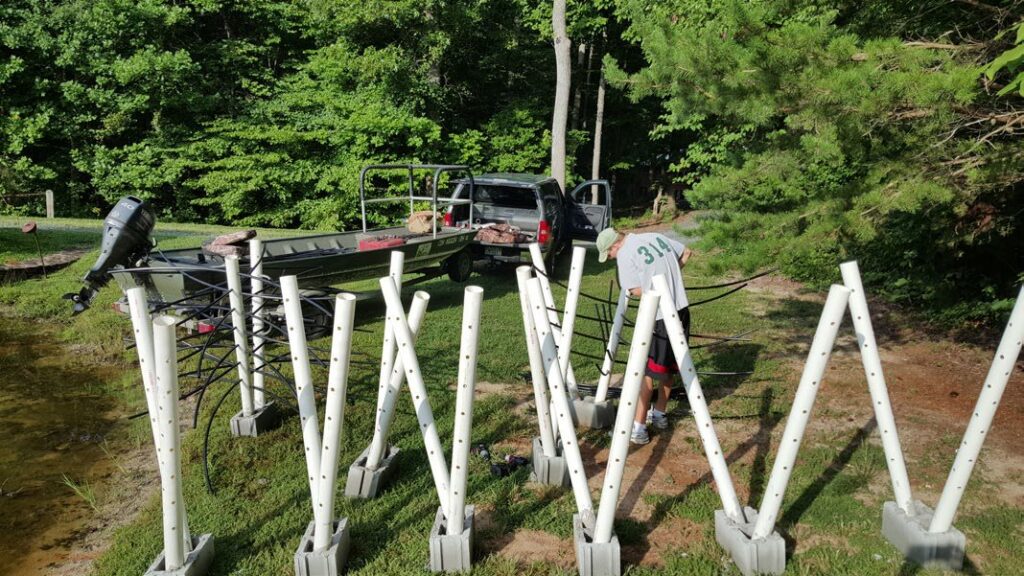
Open water structure can be in the form of boulders, natural trees, root balls and artificial fish attractors. Without aeration, they need to be placed in water 6-9 feet deep. Placed in deeper water, they may not get utilized all year. If bottom aeration is present or scheduled to be installed, placing fish attractors in all various depths is recommended. These will harbor catfish, bream, crappie and largemouth bass. It will provide additional habitat for traditional shoreline species offshore, increasing your waterbody’s carrying capacity if enough is in place. These areas become places to concentrate fish for anglers. They can be marked with a duck decoy or with a GPS to find quickly.
On occasions various species of vegetation will grow in deep water offshore. Identifying the plant species and determining if it is desirable or not is required. Some species may grow on bottom in 10 feet or more deep water and may grow all the way to the surface or remain just a few feet off the bottom. Properly identifying the plant species to determine if it is a nuisance or desirable is a must. It may remain well below the surface, never become an issue and be great habitat for shoreline fish that otherwise would not be out there. If it is determined it is an undesirable plant species, mechanical removal, treatment with herbicide and/or grass carp stocking is needed to keep it under control. Herbicide applications offshore often are more expensive because you have to treat the entire water column (some instances the entire lake) and/or apply herbicides subsurface.
It also may contribute to lowering the dissolved oxygen during the decomposing process or silting in offshore (creating muck, (organics), over time).
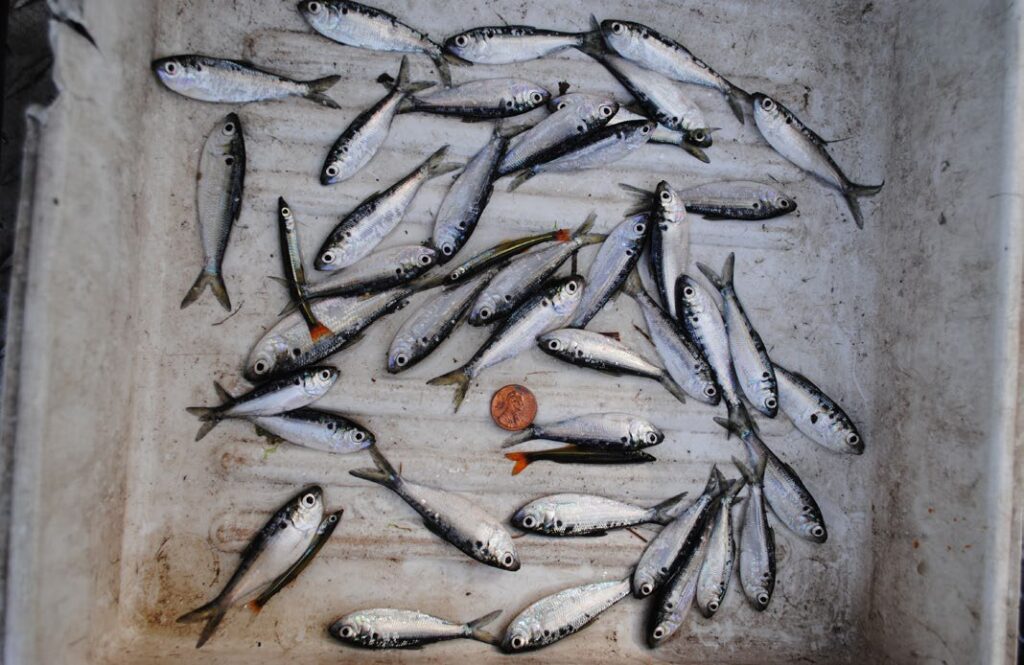
If you have an algae bloom, it will occupy the top 3-7 feet of the water column. Within the algae layer will be Phytoplankton (microscopic plants) and zooplankton (microscopic animals), which can also feed various fish species including threadfin shad, brook silversides (glass minnows) that spend their entire lives offshore in open water feeding, and most newly hatched fish including bream and largemouth bass also feed on algae and zooplankton the first week of life. Brook silversides and threadfin shad are favorite foods of crappie and largemouth bass. Brook silversides have to naturally occur, as they are not available from hatcheries, but threadfin shad can be purchased and stocked from hatcheries.
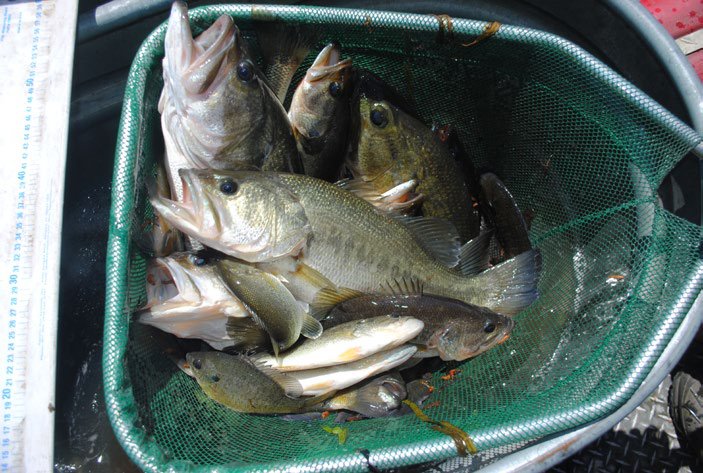
Besides crappie, striped bass hybrids and channel catfish are offshore in open water. All may venture to the shore to feed or spawn, but for most of their lives they are offshore in open water, catfish near bottom. Depending on water-color, temperature and lack of shoreline habitat, all fish at some point in the year may migrate from offshore at dusk to feed along shore and then back to offshore, deeper water during the day to hide from predators. These situations usually are associated with no shoreline habitat, tannin stained (tea colored) water and are generally unproductive (have a poor fishery). The darker deeper water provides better concealment than a bare shoreline with light penetrating it, allowing predators to see better.
This is an area more difficult for biologists to sample the fish population than the shoreline. Electrofishing does work offshore, depending how deep the area is and how conductive the water. We have successfully sampled fish attractors in 8-10 feet deep water, but the fish were probably only 4-6 feet deep. The water had good conductivity and we “hover” over the attractors until fish came to the surface. Other sampling devices such as gill nets, hoop nets and trotlines are also effective for certain species in deeper open water. In certain situations, larger largemouth bass may live in the deeper open water and angling deep with shiners is the only method to document they are present. Clients will say they have poured forage for years into their lake and rarely see quality largemouth bass, so we ask them to fish the next growing season in deep water with shiners and circle hooks, and more times than not, they discover an entire high quality fishery living offshore in deeper water they did not know even existed. We have seen this several times in waterbodies over 20 feet deep. These lakes also generally have some type of quality bass forage offshore, such as shad, that they can sustain a life out there, grow at an accelerated rate, and rarely come to the shoreline to feed and spawn
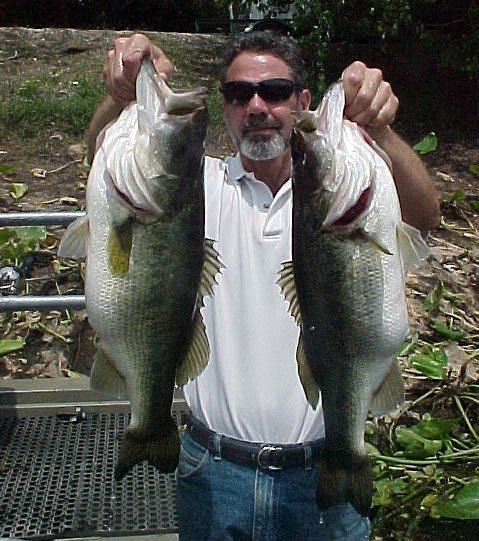
Open, deeper water does not have to be a void in your waterbody. Naturally or through management, things can occur to encourage more fish to use the area and increase your waterbody’s carrying capacity. A lot of attention is provided to the literal zone, and it should be, but open offshore areas need not be neglected and with help will improve your overall fishery and aquatic ecosystem.