
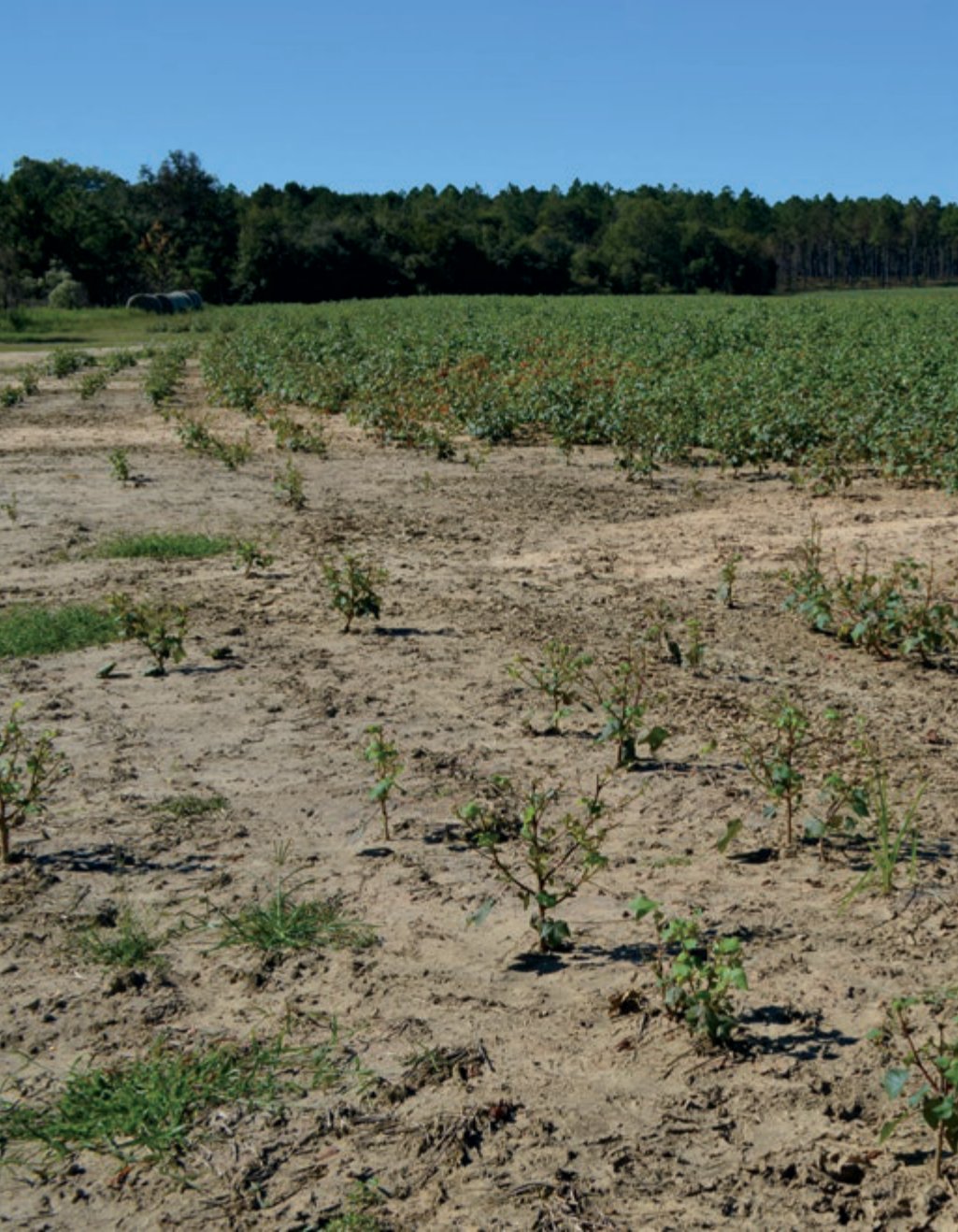
Recently I was asked to evaluate a property in the Southeast to evaluate crop consumption by white-tailed deer and their economic impact on the property. The following results of my report may help many landowners because we often see the same problems in many parts of the country. The farm was placed in Trust with Regions Natural Resource Department as part of estate planning over 20 years ago. This was done in order to hand the property down to the heir, insure sound financial management well into the future and reduce tax liabilities. Two Regions employees handle the farm; a Trust Administrator and a Property Manager. There is also a Farm Manager, Crop Advisor and a Crop Duster. My initial evaluation was conducted in October 2013. Hunting whitetail deer had never been allowed on the property and the Property Manager felt that the deer population was too high, reducing the cash flow potential of the property. I usually take a holistic approach to a task like this and evaluate the entire property, making recommendations as appropriate. The following subjects, therefore, were addressed:
Whitetail Deer Density/Economic Impact, Poaching Loss, Deer-Vehicle Accidents, Fire lane Screening, RIFA (Red Imported Fire Ant) Control, Non-Native Invasive Plant Eradication, Longleaf Pine Prescribed Burning Regime, Sawtimber Stands, Late-Rotational Sawtimber Stands Low-Quality Hardwood Brush Control.
Whitetail Deer Density/Economic Impact
According to the Quality Deer Management Association’s White-tailed Deer Density Map, this geographical area contains approximately 30 to 45 deer per square mile (640 acres). So, at an average of around 38 deer/square mile in the subject county, there should be approximately 300 deer on the property. In a normal population, a well-managed free-range condition would equate to around 100 bucks and 200 does/fawns, with a 1:2 buck to doe ratio. These 300 deer would consume approximately 2,550 pounds (green weight) of vegetation/crops per day, or around 930,750 pounds vegetation/crops per year, most of it native browse.
Actual deer density at the subject property appears to be significantly higher than the state average. During my first tour on the afternoon of October 22 with the Regions Trust Administrator, Regions Property Manager and the Farm Manager, we saw a total of 48 deer (5 bucks & 43 does/fawns) for a buck/doe ratio of 1:9. Later that evening, we returned to place 13 cameras at 10 locations and saw another 82 deer (all doe/fawns). We returned the next morning to take up the cameras and saw another 39 deer (3 bucks and 36 doe/fawns) for a buck/doe ratio of 1:12. That was a grand total of 169 deer and we only visited a relatively small percentage of the total acreage, and only for a few hours over two days.
The Farm Manager has witnessed single whitetail deer herds of over 100 individual animals on numerous occasions, all feeding on crops, as had the Crop Duster on two occasions in the same day. He witnessed a herd of over 100 deer from the air and questioned the need for a fungicide treatment in that field as he thought that the deer would just eat all the leaves. Herds of over 40 deer have also been observed on numerous occasions. On one 400-acre parcel, herds of 40-50 deer and 30-40 deer have been seen. And on two occasions, herds of between 60 and 70 deer have been observed at one time. In one 38-acre pecan orchard over 70 deer were observed in a single herd, and 30-40 were witnessed several additional times, all feeding on pecans.

It is extremely difficult to accurately ascertain the exact population on the farm without conducting a full 10-day camera census, but it is apparent that the deer density is substantially higher than the state average, perhaps by a two to three-fold factor. This would equate to a deer density of perhaps 100 deer/square mile, or approximately 800 whitetail deer on the farm at any given time. This would also equate to around 6,800 pounds of vegetation/crops (green weight) consumed daily, or around 2.5 million pounds per year, every year. It is impossible, however, to know how much of each crop (corn, cotton, pecans, soybeans, and peanuts) they consume, and how much natural vegetation they eat. Over a 10-year period, assuming the whitetail deer population remained fairly constant (and likely would in the complete absence of hunting) they would eat over 26 million pounds green weight of vegetation and crops.
The deer seem to be consuming vast amounts of the crops and are quite mobile, constantly moving around the property as each crop becomes available. They rely mainly on crop residue and native vegetation during the winter. The camera sites resulted in many photographs of deer, and in only one occasion was a deer in poor physical condition, probably due to EHD (epizootic hemorrhagic disease). One can look at the QDMA Forum and search for “Deer eat Pecans” or “Deer eat Cotton” and read the posts from around the country that discuss how much farmers are losing annually.
Perhaps a more accurate way to estimate deer utilization of crops would be to look at the estimated percent crop loss per commodity/year and subtract the amount that we believe that the deer eat of each. The Regions Trust Administrator provided me with the income figures for the five primary commodities for a three-year period (2010, 2011, and 2012).
The five commodities were corn, cotton, peanuts, pecans, and soybeans. The total cash flow was $4,595,888 for the three year period, ($1,531,963/yr) or $919,178 per crop. There was only one negative cash flow for one crop over the three year period, so there were 14 positive cash flows with a profitability ratio of 93% which was outstanding!
Now, that is the total for three farms that are held within the Trust. I have ascertained that, based on the number of irrigated and dry crop acres of each farm, the subject farm accounts for 55% of the total income. All the pecans are located at the subject farm.
Next, let’s look at crop loss due to consumption by whitetail deer on the farm. I questioned the Farm Manager as to his estimation of each commodity’s consumption as a percent and asked the same question of the Crop Advisor, as well as the Crop Duster. The Regions Property Manager and I also looked at the whitetail deer consumption of cotton and pecans and measured the losses in each field. There was some variation in the estimated percentage crop loss from each person, so I took the average percent crop loss.
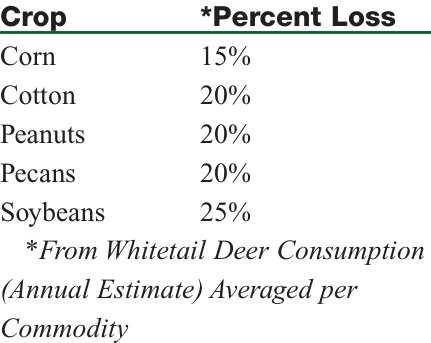
*From Whitetail Deer Consumption (Annual Estimate) Averaged per Commodity
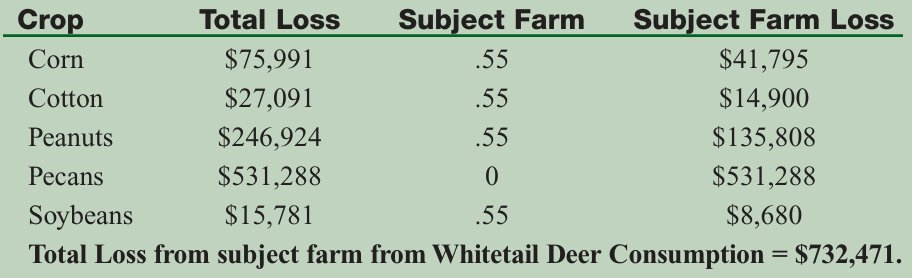
Total Loss from subject farm from Whitetail Deer Consumption = $732,471.
Applying these percentage crop losses to each crop (total revenue from all three farms) realizes -$75,991 (corn), -$27,019 (cotton), -$246,924 (peanuts), -$531,288 (pecans), and -$15,781 (soybeans), for a total loss for the three-year period of -$1,531,963. We now must take 55% of each of those numbers in order to isolate the loss only from the subject farm.
Now remember that this is over the three-year period of 2010, 2011, and 2012. The annualized loss is approximately $244,157 per year, or approximately a quarter of a million dollars per year. That equates to a loss of around $2.5 million over a 10-year period, to look at a longer term view. I suspect that is an accurate figure, and one can say with some confidence that the whitetail deer herd at the subject farm have consumed around $2.5 million worth of crops from 2003 – 2012. Without some adjustment this property will likely realize another $2.5 million loss over the next decade.
There are several ways to minimize the economic loss from whitetail deer predation on cropland. The most common method is the use of regulated hunting to reduce the whitetail deer density. High-fencing is also utilized, but is quite expensive at around $25,000/linear mile. Another negative is the constant opening/closing of gates when moving equipment and harvesting crops as well as continual fence maintenance. Planting food plots can also be done, but in this case the deer would not be able to distinguish between food plots and agricultural crops.
I would recommend leasing the deer/turkey/small game rights at the farm to a local hunting club which utilizes modern archery methods (compound bow/crossbow) only (no firearms). The farm can be certified as a QDMA-managed property with the Quality Deer Management Association (QDMA) and also a Wild Turkey Woodland through the National Wild Turkey Federation. You can stipulate terms in the contract with respect to parking (designated areas only along the periphery), doe harvest, ATV use (for deer retrieval only), sanctuaries, buck harvest criteria, etc. Leasing 5,000 acres would generate revenue of approximately $125,000/year @ $25/acre. It would reduce crop predation by deer, increase crop revenue at the farm and potentially reduce deer-vehicle accidents. It would also substantially reduce poaching. The deer harvested would not be wasted, as is currently happening. You may also be able to realize an additional savings by not utilizing the property security firm for the full year. There would be no impact on the existing farming operation.
Poaching Loss
Poaching of whitetail bucks is an ongoing problem at the farm, as the estimated buck/doe ratio of 1:9 to 1:12 indicates. Two older bucks were poached in 2012, there were four arrests in 2011 involving shooting from the paved road, and four dead (shot) bucks were killed in 2010 and found on the property. The Farm Manager believes that these poachers are using night-vision (FLIR – Forward Looking Infra Red) technology. Since the locals know that there is no hunting at the farm, it has become a magnet for poaching, and the lack of hunting is actually promoting this behavior. So, the buck population is not growing and being retained at the farm, but is being poached by night road hunters. EHD (epizootic hemorrhagic disease) is also taking some of the older bucks each year. There is a dead 10-point in the creek right now, likely killed by EHD.
Deer-Vehicle Accidents
The Regions Property Manager and I noticed during our brief tour that there had been two recent deer-vehicle accidents on the paved roads that dissect the farm in the last several weeks.
From July 01, 2011 to June 30, 2012, there were 1,142,910 claims filed (State Farm Insurance) in the United States. This was 13% higher than five years ago, and 22% higher than nine years ago. Much of this increase was in the Southeast. In the Southeast, the number of deer killed by vehicles during 2011-12 was 19% of the 2011 total deer harvest in this region. Thus, approximately one deer was hit on the road for every five taken by hunters. From 2002-03 to 2011-12, the Southeast saw a more than 35% increase in deer-vehicle accidents. The best techniques for reducing deer-vehicle collisions are to balance the deer herd with the habitat and make motorists aware of high-risk time periods (spring-fawning and fall-breeding) and areas. QDMA recommends the use of regulated hunting to manage deer herds at levels that are in balance with the habitat which reduces the number of animals that are available for accidents.
This may reduce the liability of litigation in the future and dramatically reduce deer-vehicle accidents along the frontage roads that dissect the farm. My recommendation is to implement managed hunting within the farm coupled with signage at known deer crossings.
Fire lane Screening
Many of the fire lanes intersect the road systems at a 90 degree angle, allowing poachers to shine down the lanes and shoot deer. I would recommend planting a screen of loblolly pine, arborvitae, eastern red cedar, etc. in order to screen these fire lanes from the adjacent roads.
RIFA (Red Imported Fire Ant) Control
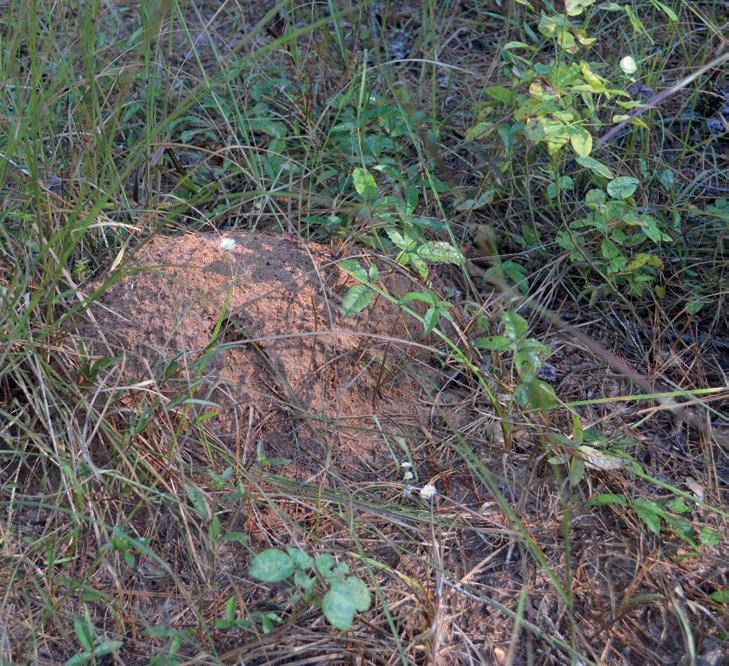
I noticed a moderate infestation of red imported fire ants mainly confined to the pecan plantations, field borders and fire lanes. For every visible above-ground mound, there are approximately 20 more subterranean colonies, and a broadcast treatment is the only feasible control method.
I recommend an Amdro® application to the pecan orchards and fire lanes of one pound/acre broadcast. Apply in the mornings when the dew has completely dried and the temperature is over 84 degrees for optimum results. Do not disturb mounds during the application.
Non-Native Invasive Plant Eradication
The Regions Property Manager and I noticed that there is a significant problem with non-native, invasive plants at the farm, mainly Chinese parasoltree, Chinaberry, and Chinese privet. The Chinaberry and Chinese privet are mainly along the interior road edges and field borders. The Chinese parasoltree is mainly confined to an interior compartment near an old cemetery, and currently has spread to take over approximately 8 acres. I communicated with the Farm Manager concerning the prescribed treatment which includes imazapyr @ a 50:50 dilution with water and applying 1 ml. per injection site with one injection site per 4″ DbH. Glyphosate @ 3% by volume with a surfactant can be applied to the leaves to wet the smaller stems. The Chinaberry can also be injected, and the Chinese privet can be sprayed with 3% glyphosate during the dormant season, prior to March/April. All of this work can be done this fall/winter.
Longleaf Pine Prescribed Burning Regime
The longleaf pine stands from 10-12 years of age are in need of a prescribed burn. I would recommend that these be burned within the next year or two along with a regular prescribed burning regime. Currently around 1,000 acres/year ((917 acres in ’09, and 920 in ’10) are being burned. This prescribed burning regime is providing excellent habitat for whitetail deer fawning/bedding cover, and for quail habitat. The RIFA is probably keeping the quail population down. One of the indicator species for habitat quality is the desmodium population (beggar’s ticks), and there is a very high concentration of this plant in the burn compartments.

Sawtimber Stands
The sawtimber stands that have been thinned at least twice are in need of the final harvest, as economic maturity has passed and many of the stands are either stagnant or barely growing. There is significant mortality in many stands, and growth right now is not sufficient to counter mortality. I recommend setting these stands up for harvest within the next 2 to 3 years, timing with the increasing sawtimber market.
The southern pine sawtimber market is poised for a major boom, as the Canadian sawtimber supply is shrinking due to two primary factors. The British Columbia pine beetle epidemic has destroyed over 43 million acres of Crown timber, and they are at the end of their salvage operation. The supply from British Columbia will be reduced dramatically over the next two to three years. Secondarily, Eastern Canada has been grossly over-harvesting for a decade now, and it is predicted that their output will drop dramatically over the next several years. There is also a growing demand from China, and this should coincide with the housing market expansion in the United States. Approximately 64 billion board feet will be needed in the United States for the estimated 1.4 million new housing starts. The traditional Canadian market share in the southern United States averaged around 33% but will be reduced to around 20% within a few years.
In summary, the South will have to fill this void, and sawtimber will increase in stumpage value as a result. Further testament to this is the fact that Canada is presently buying high production southern pine mills at an accelerated rate.
Late-Rotation Sawtimber Stand Low-Quality Hardwood Brush Control
Several stands that have been recently thinned are in need of an understory low quality brush control herbicide treatment. The Regions Property Manager and I pointed out these stands to the Farm Manager during our tour. Prescribed burning alone will not sufficiently control the hardwood brush in these areas. Apply 0.5% imazapyr by volume with 0.25% surfactant to the leaves during the late fall for complete control.

Conclusion and Update
I am pleased to report that immediately after reading my report, the Property Owner and the advisors started implementing many of the recommendations that I made. Over 120 white-tail deer were harvested before the end of the season last year and an aggressive program to eradicate non-native vegetation was initiated over the dormant season. This year, plans are to conduct several timber sales, and fire lanes are being prepared for prescribed burning. Red imported fire ants are being eradicated in the pecan plantations, signs are being put up at deer crossings, and understory herbicide treatments to control low-quality hardwoods are being conducted. Lastly, if you are thinking about estate planning, I would recommend placing your land in Trust managed by professionals. And if you suspect your property is not producing the maximum cash flow possible, engage a consultant to provide an objective analysis.
Whitetail Deer Plant Consumption
Whitetail deer rely primarily on native plants and agricultural crops for food. These plants can be divided into three main groups depending on the natural preference in which deer consume them. First choice foods consist of succulent herbaceous plants like Alabama supplejack, greenbrier, blackberry, lespedeza, and strawberry bush. Second choice foods will start to be consumed when most of the preferred foods are depleted. They include species like American beautyberry and sumac and some of the more woody browse-like red maple, red mulberry and flowering dogwood. Third choice foods are sometimes called emergency foods or stuffers and include sweetgum, blackjack oak, hickory, redbud and cedar. Agricultural crops preferred include soybeans, alfalfa, corn, clover, peanuts, cotton, and pecans. Whitetail deer preferentially browse the most preferred plants first, utilizing less desirable browse later until they are finally forced to browse on emergency/stuffer foods. If you lack herbaceous plants on your property and there is a browse line on your hardwoods and your cedars look like bonsai trees, you have a serious whitetail deer over-population problem. This, sadly, occurs on many properties, especially in our State Parks and other areas where hunting is not allowed.
Think for a moment about the incredible amount of plant materials that are consumed annually by whitetail deer. A single whitetail deer consumes between 8.25 and 12 pounds of plant material daily (green weight) or over 3,000 pounds a year. That does not sound like all that much does it? But let’s look at the annual consumption in a single state and then look at the entire whitetail deer range. Let’s say that the state of Alabama, for example, has approximately 2.8 million whitetail deer which each consume an average of 8.25 pounds of plant material daily, or 3,011 pounds annually. This equates to over 4.2 MILLION TONS of plant material required ANNUALLY! That’s over 8 BILLION pounds consumed per year by deer in Alabama. This would equate to over 80 BILLION pounds required in a decade if the deer population remained stable in Alabama. There are approximately 32 million whitetail deer in the United States today. This population is considered super over-abundant and is substantially higher than at any time since pre-recorded history. This is a testament to the hard work done by our State and Federal wildlife departments, hunters/sportsmen, private landowners, and wildlife conservation organizations like the Quality Deer Management Association. The whitetail deer population in the United States consumes approximately 132,000 TONS of plant material daily or almost 50 MILLION TONS annually! This equates to almost 100 BILLION POUNDS of plant foods consumed per year in the range of the whitetail deer in the United States. In areas where deer are over populated, a significant reduction in overall plant biodiversity has occurred with some preferred plant species having been all but wiped out.
What further complicates this is the fact that exotic, non-native and invasive plants are displacing our native plant communities at an alarming rate. We are currently losing over 4,500 acres per day of native plants in the United States due to the encroachment of exotic, invasive, non-native plants. This equates to over 1 and ½ MILLION acres of native plants permanently lost per year. Over 7 million acres of native plant communities have already been displaced. Other wildlife species also consume native plants. Elk, mule deer, antelope and moose populations are all over 1 million animals each in North America. Moose, for example, consume an average of between 40 and 60 pounds of plants per day. In Maine, for example, a population of around 70,000 moose consume around 4 million pounds of plants (including broccoli and potato) per day. This equates to almost 2,000 tons per day, or over 650,000 tons of browse consumed each year by moose in Maine.
Whitetail deer are selective feeders. They choose native plants with considerable discrimination and, in actuality, consume a variety of different foods including acorns, vines, mushrooms, nuts, fruits, grasses, sedges, rushes, forbs, shrubs and twigs from trees. They tend to select succulent herbaceous plants first and turn to woody plant materials later. Food plots utilizing agricultural plants can be a source of highly nutritional food, as can agricultural fields (primarily soybeans, corn, peanuts, cotton, pecans, etc.). But, primarily, whitetail deer rely on agricultural crops when available, as the protein content of these plants is often over 25%, compared to only 10% in native plants. There is, however, little emphasis placed on enhancing native plant communities and little information available that explains exactly how to do it. Yet, it is relatively easy with long-lasting positive impacts usually at a fraction of the cost of establishing and maintaining agricultural food plots. Research has shown up to 40-fold increases in highly preferred native plants with protein contents of 26 to 32%, much higher than the 12-18% minimum required by whitetail deer. And, native plant communities are seldom impacted by drought. Selective herbicides like imazapyr actually release many native plants preferred by whitetail deer, wild turkey, and bobwhite quail. Other desirable native plants are promoted during forest management activities, especially clearcutting. It’s amazing how many hunters still do not understand how forest management activities improve whitetail deer food availability. Undoubtedly, the most food available on any hunting club is right in the middle of the most recent clearcut. Mid-rotation pine forests released with imazapyr also have an abundance of native plants preferred by whitetail deer, especially after thinning.
The next time you observe a whitetail deer browsing, remember that 100 billion pounds of plant materials are consumed each year by whitetail deer in the United States. This is why so many of our State Parks that are overpopulated with deer and that do not allow hunting are essentially biological deserts with many deer starving to death each year or fanning out to consume landscape plants in adjoining neighborhoods at night. Follow the advice of your deer biologists when they suggest harvest strategies that reduce deer density by removing does. This will ensure that your deer population stays within the limits or carrying capacity of your habitat. This not only promotes healthier deer but also enhances the buck/doe ratio. Seek advice pertaining to native plant enhancement and learn how to identify preferred native plants utilized by whitetail deer in your area. Follow the Quality Deer Management Association (QDMA) guidelines on protecting yearling bucks from harvesting, thus shifting your population to older age class bucks.