
As the long, hot summer days gradually begin to cool, virtually every deer hunter across the country begins anticipating the approaching hunting season. Each work day is continually interrupted by thoughts of upcoming days spent in the woods or constant emails from hunting companions containing the most recent trail camera photos. Many are counting the days until the first weekend spent on their property or hunting lease to kick off the season by preparing food plots, cleaning up hunting stands, trimming roads and stand entrance trails, etc. One of the most popular pre-season activities is planting fall food plots. Supplemental food plots have become a major component in nearly every quality deer management program. Hunters spend thousands of dollars every year planting food plots on their property and/or hunting club. However, as the housing market and economy continue to struggle and prices at the pump continue to increase, the average hunter finds their budget becoming tighter and tighter. As seed, fertilizer, and fuel costs continue to rise, many deer managers find themselves taking shortcuts with their food plot management strategies, which unfortunately results in low quality food plots with regard to forage production, attraction, and nutritional quality. To avoid compromising the quality and quantity of food plots planted, hunters must be smarter and more resourceful than ever. Below are a few tips to make sure you and your deer herd are getting the most out of your food plot dollar.
Collect Soil Samples
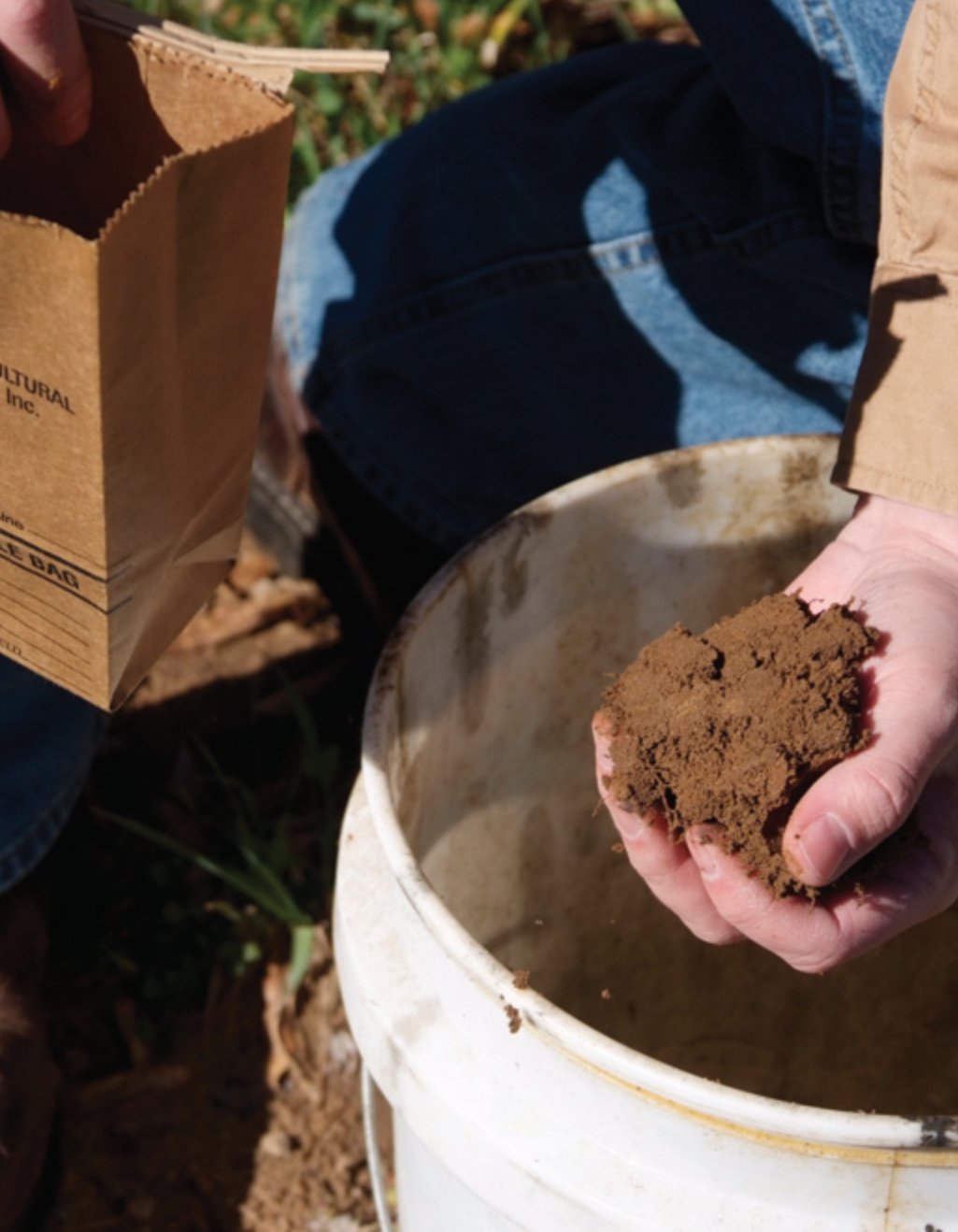
Each food plot job should begin with collecting soil samples. Collecting soil samples on an annual basis is a quick and inexpensive way to assess soil quality and calculate lime and fertilizer requirements for the forages you are planting. The best way to collect samples is to gather “sub-samples” from multiple locations across each field. A good rule of thumb is to collect 5-10 sub-samples per 1 acre of food plot. Samples should be collected 4-5 inches deep from the “root zone”. Use a small bucket to mix all of the sub-samples from the field and fill the sample bag to the recommended level. Multiple samples ensure an accurate representation of soil quality for each field. Make sure to label each bag with the property and field name. It is also important to include the forages you plan to plant (i.e., cereal grains and clovers, corn, cowpeas, etc.). Samples should be returned to your local co-op or sent directly to a soil testing lab for analysis. If you need assistance interpreting results, your local farmer’s co-op, county agent, NRCS agent, state biologist, or wildlife consultant can help.
Calculate Acreage
For whatever reason, most hunters have a hard time judging acreage. Like most fishing and hunting stories, the size of a food plot is always overestimated!! I have seen countless “one acre fields” that turned out to be ½ acre or less. The situation generally gets worse as the field gets bigger! Hunters waste a lot of money each year on seed and fertilizer they don’t need. When planting food plots, more is not better. Take the time to use a GPS, rangefinder, or simply pace your fields to calculate the acreage…it will cut down on unnecessary seed, fertilizer, and lime costs in the long run. If you simply must estimate, try thinking of a football field to help come up with an educated guess. A football field is 100 yards long (end zone to end zone), 53 yards wide, and comprises a little over 1 acre. Additionally, one acre is equivalent to approximately 70 yards by 70 yards and two acres is equivalent to approximately 100 yards by 100 yards. In summary, know how many acres you are planting to avoid applying more than the necessary amounts of seed, fertilizer, and lime.
Maintain a Neutral Soil pH
Unless your property is located in the Black Belt Region of Alabama/Mississippi or you have been liming your fields regularly, your soil pH will likely be low and require lime for optimum forage production, nutrition, and attraction. A low pH results in valuable nutrients being “tied up” in the soil. If nutrients are tied up, they are not available to plants. If nutrients are not available to plants, they are not available to deer. If nutrients are not available to deer, you are missing out on a great opportunity to improve the nutritional plane of your property and enhance the quality of the deer herd. If you have not been to the feed store lately to purchase fertilizer, you might want to brace yourself. Current fertilizer prices have increased 2-3 times since last fall ranging from $500-$1,200/ton. Conversely, the current price to have bulk lime delivered and spread by a local co-op is generally $40-$60/ton. At most, you would spend ~$100/acre to apply lime (2 tons/acre). Not only is lime considerably cheaper, but raising the soil pH will allow the nutrients already present within the soil to be utilized by plants and therefore, less fertilizer will be needed to obtain healthy plots. Properly amending the soil with lime is the most productive step to ensure quality forage production.
Plant/Inoculate Legumes
Another cost-saving tip is to plant legumes. Legumes are plants that produce seed in a pod and most have a symbiotic relationship with certain bacteria. These bacteria have the ability to “fix” nitrogen in the soil in nodules on the root systems of legumes. Examples of legumes include clovers, peas, beans, etc. Some fields containing legumes are able to produce up to 200 lbs/acre of nitrogen per year. As a “thrifty” deer manager this is important because it means less nitrogen fertilizer is needed. However, it is very important to make sure legumes are properly inoculated. The inoculant contains the bacteria needed to form nodules on the root systems of legumes to produce nitrogen. Some commercial seed blends include pre-inoculated legumes but be sure to read the label. If you purchase seed individually, make sure you purchase the correct inoculant for the seed you are planting.
The first step to properly inoculating legumes is to pour the inoculant on the seed (it is best to use a bucket or some other large container). Next use a sticking agent to moisten the seed and inoculant. While there are commercial stickers available, a squirt bottle containing a mixture of water and sugar (4:1 ratio) works well. We do not recommend using “cola” as a sticking agent, as it is highly acidic and can kill the bacteria. Depending on the amount of seed being inoculated, it may be necessary to split applications to allow for adequate stirring and ensure coverage (be careful not to add too much water though…the goal is to create a “slurry”). Finally, the seed should be spread out on newspaper/plywood in a covered or shady area to dry. Allowing the seed to dry will prevent it from sticking and possibly clogging the spreader. The seed is ready to plant once it is dry but should be kept in the shade until it is planted.
Purchase Bulk Fertilizer
As previously mentioned, fertilizer prices have increased dramatically over the last couple years. I fear this is the area where most food plot managers’ budgets will be hit the hardest and attempts will be made to cut costs. After collecting soil samples, nutrient levels (nitrogen-N, phosphorous-P, and potassium-K) should be calculated to ensure optimum production and nutrition. Let’s pretend your soil samples indicate you need 150 lbs. of N, 85 lbs. of P and 100 lbs. of K per acre. The average food plot manager will go to the co-op or feed store and purchase 300 lbs. of bagged 13-13-13, regardless of what their soil samples say. 300 lbs. of 13-13-13 would be the equivalent to 39 lbs each of N, P, and K. As you can see, this is well short of the recommendations obtained from soil samples. If you were to use 13-13-13 to reach the recommended 85 lbs of phosphorous, you would need 650 lbs./acre! Conversely, if you purchased bulk fertilizer, such as DAP (18-46-0) and potash (0-0-60), you would only need 325 lbs./acre to achieve the recommended levels. If you desired more nitrogen, you could add ammonium nitrate (34-0-0). However, if you are planting legumes (as previously discussed) additional nitrogen is not necessary. Another benefit of using bulk fertilizer is the reduced effort needed for application. Bulk fertilizer is mixed in large spreader buggies that hold up to four tons. This means no more pouring 50 lb. bags into a spreader! These buggies can easily be adjusted to apply the proper amount of fertilizer per acre at a much wider spreading width than conventional cyclone spreaders. The reduced amount of fertilizer needed to achieve the recommended levels and decreased effort, certainly make purchasing bulk fertilizer a more economical and practical option.
Plant with a Seed Drill
Seeding rates for food plot forages are generally given as broadcast or drilled. Broadcast applications are the most common among food plot managers. These include large spreader buggies, tractor mounted and pull-behind cyclone spreaders, ATV mounted spreaders, and hand spreaders. However, rates for broadcasting are higher because seed placement is less precise. Drilled applications (row planters, grain drills, and no-till drills) have lower seeding rates because they are generally more precise, ensure correct planting depth, and generally result in higher germination rates. Drilled applications require about 50% less seed than broadcast applications, thus seed costs can be cut in half. In addition to requiring less seed, drilling also can reduce the number of passes on each field. For example, many drills have separate seed boxes for large and small seed and allow you to plant them simultaneously. This means less work and lower fuel costs for equipment. While the average deer manager may not be able to afford a seed drill, many tractor and equipment dealers, NRCS offices, as well as feed stores and co-ops will rent them on a daily basis.
Manage Weed Competition
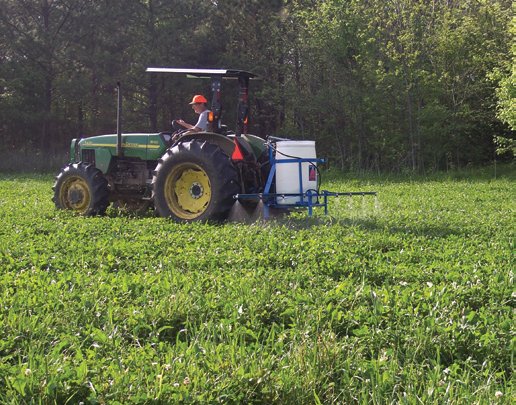
There is nothing more frustrating than spending time and money to produce quality food plots only to see them taken over by annual ryegrass, johnsongrass, Bermudagrass, pigweed, or other weeds commonly found in food plots. After all the time, money, and effort spent planting food plots, these weeds will rob planted forages of nutrients (fertilizer). The most effective and economical method for controlling weed competition is with herbicides. Herbicides are typically applied as pre- or post-emergent and should be used according to their label. It is critical to match the specific herbicide with not only the planted crop, but also the weeds that need to be controlled. For example, if you are fighting grass weeds in your perennial clover plots, you would use a grass-selective herbicide (Poast Plus, Select, Arrest) to kill grass weeds, but not harm the clover. Again, your local co-op, government agencies, or wildlife consultant can assist you with identifying weeds and selecting the appropriate herbicides. While some might consider herbicides an added cost, they are very cheap considering the benefits and cost per acre. Although you may have already invested a couple hundred dollars per acre to establish your plots, how much are they worth if they are full of undesirable weeds and not providing your deer herd with quality nutrition? While costs will vary, most herbicides used for managing food plots can be applied for ~$10-$20/acre. Eliminating weed competition is definitely another technique to maximize the money spent managing food plots.
Planting food plots is often one of the highlights of deer season for landowners and hunting club members. It is generally the “kick-off” to hunting season and the first opportunity to spend time on the property before the season begins. Don’t let rising costs dampen your food plot program this year. Try following these simple tips to maximize your dollar and ensure you are producing quality food plots to improve the condition of your deer herd and offer productive hunting opportunities.