

Burn, baby, burn…right?!! When the question is raised regarding how to manage and attract turkeys in southern pine forests, the overwhelmingly used answer is…you guessed it, PRESCRIBED BURNING. And yes, in my opinion, prescribed fire is the number one forest management tool to enhance turkey habitat. However, there are more ways to benefit your property concerning turkey management than what meets the eye when it comes to fire. Often questions are left unanswered regarding burning in relation to turkeys and woods management: When should I burn? Where should I burn? How big of an area should I burn? What should I do if I cannot burn? Hopefully this article will shed light on how to use different techniques with fire and herbicide, along with timber management strategies, on your property to grow, attract, and hold more turkeys than ever before.
Patch or “Checkerboard” Burn Regimes
“Juxtaposition” and “interspersion” are terms I learned in wildlife camp that I figured I would never use as a wildlife biologist…until I started managing for turkeys. Without getting too deep into wildlife terminology, juxtaposition is basically how vegetation types are arranged next to each other (small picture) and interspersion is how these are arranged across the landscape or your property (big picture). For example, regarding turkey management on your property, is there quality brooding cover adjacent (juxtaposed) to quality nesting cover? Is there connectivity between good roosting trees, food sources, and loafing areas? How are these components arranged (interspersed) on your property?
Let’s bring fire back into the picture. For those of you that do not know why burning is so critical for turkeys in pine forests, it does a tremendous job of setting back plant succession in the understory while exposing food sources like seeds and invertebrates. Pine trees are able to withstand fire at certain growth stages depending on the species, and they also shed needles that add valuable fuels for carrying fire. By setting back succession, burning provides a vegetative structure that is more favorable to turkey brood-rearing, nesting, and simply traversing through the woods. Given the fertile soil and yearly rainfall amounts on the property I manage in Alabama, if we do not burn on a rotation every 2-3 years, the understory structure of the stand will get to a point where it is not favorable for turkey use. On your property, you may can go 4-5 years on your burn rotation, but it is unlikely you will need to burn more frequently than 2 years.
Patch or “checkerboard” burning is a concept that can be very advantageous for wild turkeys. From a management standpoint, would it not make sense to strategically place quality brood-rearing next to quality nesting habitat so that once a clutch of poults hatches, the hen can lead them directly to the “promised land?” This minimizes exposure to avian predators and is a management practice we have implemented on our property.
From our observations, it appears that hens are selecting pine stands that have been burned 2-3 years prior for nesting. These stands consist of a scattered woody component that provides “clumps” of vertical structure that conceal hens and protect from predation while nesting. So by alternating burn years on adjacent stands, there is quality nesting cover with a nearby freshly burned area for excellent brood rearing after poults hatch out. In our location, by the time poults typically hatch, a recently burned stand will provide low “umbrella” cover. This vegetative structure generally is tall enough to conceal poults from avian and ground predators, but still allows the hen to see well. Mobility and feeding is also easier in these stands during an extremely physically demanding time for poults. In my opinion, patch burning is a valuable technique to diversify vegetation composition and structure from a turkey management perspective.
Patch size can vary according to property size, stand size, or other habitat features. We usually divide our pine stands into 50 – 75-acre management units for our patch burning regime. There is no magic number for this size. The main thing is getting a feel for your property and the time you have to devote to burning. In our case, we have a limited number of quality burn days with a vast amount of woods to burn. To make things more feasible for us, this is generally the size we break our burn units into. I don’t like patches over 100 acres because large areas have reduced habitat diversity. Patches less than 10 acres can promote increased diversity but are difficult to manage on this small of scale.
Another question managers often have is when or what time of year should burning be conducted? As I stated previously, you may only have a handful of good burn days or other time constraints that hinder you. We typically start in late November after a frost through the end of March before nesting initiation generally takes place (this is primarily dormant season fire in our neck of the woods). One concern is burning during deer season, but from my experience, prescribed burning has not negatively affected deer hunting to justify delaying burning until after deer season. When burning on a 2- or 3-year rotation in the Deep South, there will still likely be a vertical hardwood component left standing after a burn that would still provide enough cover to hold deer (unless a herbicide treatment has previously been applied, but more on that later!). Now, if you are interested in holding turkeys, start burning stands off through the winter and early spring. You may have the problem of “not knowing which bird to go to” come opening day! With that said, there is nothing wrong with waiting to burn a stand in March if that is what works best for your situation. Everybody has that stand or two down in the “honey hole” that there is always a bird hanging around that you may want to immediately attract with a clean burn just before turkey season. I know we do!
Alternatively, there is nothing wrong with burning late growing season (August – October) if you can get fire to carry then. In fact, I recommend this in stands dominated by a woody understory. Burns conducted during this time are more effective at controlling woody competition than dormant season fire, which promotes more desirable forbs and grasses for turkeys. On our property, we generally don’t have time to devote to burning during the fall or the ability to carry fire effectively due to fuel conditions. In West Alabama, we have to be careful burning too early in the fall because of fawning. Also, to avoid destroying turkey nests, we try to avoid burning in the early growing season (April-June in Alabama).
Also, please note that burning is not something learned on a YouTube video. This article is not intended to explain how to conduct prescribed burns; however, I will say that fire should always be taken seriously and used under the right burning conditions, along with the right personnel, equipment, and fire breaks. It is highly recommended that you contact your state forestry agency for any information or regulations on conducting prescribed burns, or if a burn certification program is required before lighting a match. Also, if you are unfamiliar with the species and growth stage of the pine on your property, it would be a good idea to contact a registered forester to determine whether or not it can tolerate fire. Some state agencies or private consultants can aide in conducting the burn when landowners either do not have the personnel or equipment, or do not feel comfortable doing it themselves. However, burning is like anything else in life you have never done before. After a little time and practice, you will be asking yourself “Why have I not been doing this all along?!!” There is definitely something innately primal about man and fire, you’ve just got to let your inner caveman out!
Thinned row Management
In some cases, landowners and managers may not be able to burn, or burning may not be the right tool for the job in certain situations. On our property in West Alabama, we have a problem with encroaching blackberry, sweetgum, beautyberry, yaupon, privet, devil’s walkingstick, and other woody species in some of our pine stands. Time spent in the fall planting food plots and conducting deer camera surveys, along with the inability to effectively carry fire, usually restricts us to burning only during the dormant season. Fire during the dormant season typically just “top-kills” the woody species until the following spring growing season, where it will resprout from the roots. Using dormant season fire every few years through the stand will keep the vegetation structure at acceptable levels for turkey use, but this can get tiresome and time-consuming on large tracts of land. This is precisely the situation in which we have incorporated thinned row spraying to diversify the vegetative composition to enhance turkey use, especially when fire intervals are lengthy. This is easily accomplished in pine stands that have been thinned in rows.

Before we put the cart before the horse, you need the right equipment to do this. There are wildlife and forestry consultant services that contract spraying with skidders, but this management practice is also achievable for the common landowner. However, it is ideal to have an enclosed or caged tractor to protect the driver from getting “limb-whipped”, in addition to a skid plate to protect the undercarriage from stumps, logging debris, etc. Regarding the sprayer rig, I would recommend a 3-pt style for maneuvering purposes, and at least a 100-gallon tank for efficiency (if you spray a minimum of 10 gallons per acre then this will result in 10 acres on a tank). We calibrate our sprayer at 30 psi at a speed of 3 mph, which is a comfortable speed in the woods. A simple internet search regarding sprayer calibration can help set up your sprayer.
When spraying thinned rows, the most important aspect other than which herbicide to use is the nozzle selection. Depending on your objectives and the thinned row widths, you may need a nozzle to spray a narrow or wide swath. In most situations, it’s not ideal to kill all of the woody component in the stand. It is smart to leave enough woody cover between the rows for turkeys to escape avian predators. By killing the hardwood component in the rows, this allows forbs and grasses (herbaceous plants) enough space and sunlight to grow. Herbaceous plants provide more food availability from seed and invertebrate production, along with providing easier turkey mobility. Essentially, we are making linear wildlife openings beneath the stand of timber. If you are able, spraying perpendicular to the rows as well can provide a clumpy woody cover instead of strips, which is ideal in my opinion. Lastly, burning as soon as the fuel load allows in a year or two following the herbicide application can really accelerate herbaceous response.
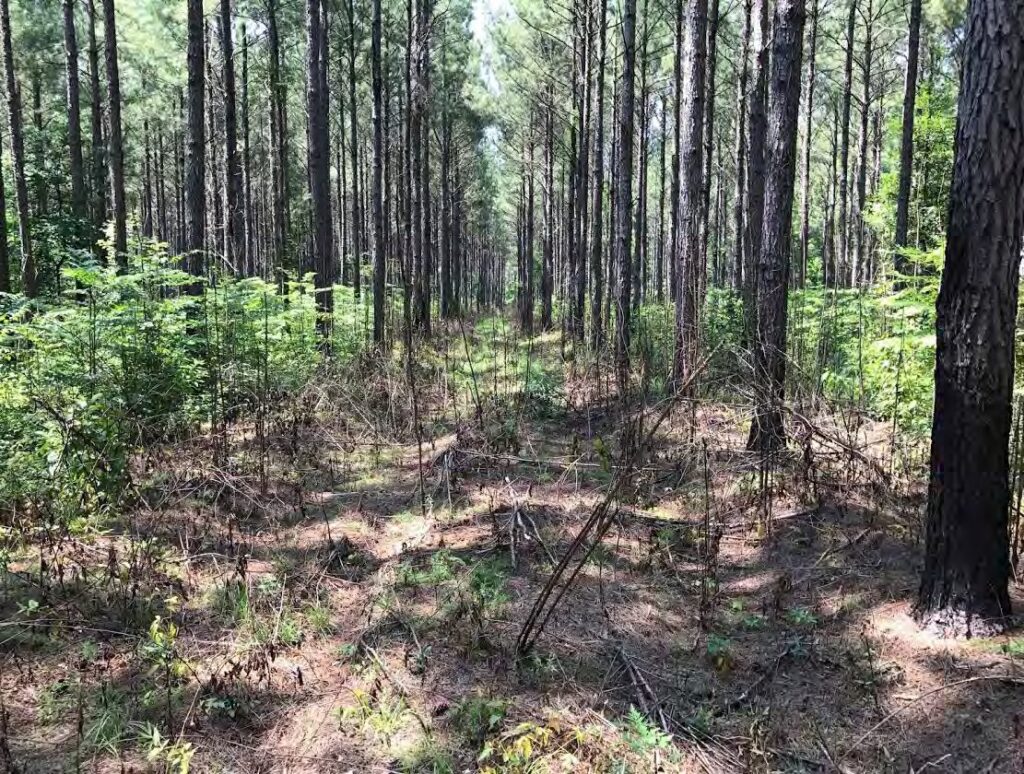
The second part of the equation is when to spray and which herbicide to use. We have learned it’s ideal, but not a necessity, to burn the stand the year prior to spraying. Not only does this make the vigorous woody regrowth more susceptible to the herbicide, but it also improves the visibility in the stand for the person doing the spraying. If you are new to spraying, there are numerous herbicides out there so I will not go into too much detail on brands and pricing. However, as turkey managers in most piney woods in the Southeast, our never ending battle is against hardwood competition in the understory. As opposed to mechanical control options such as mowing or roller chopping, we have found herbicide applications to be easier and more effective for us. Thus, I will touch on a few select herbicides that we commonly use that are safe to spray under your pines.

Sometimes, too much of a good thing can turn into a bad thing. For example, we had a pine stand on fertile ground that was so dominated by blackberry that it was impenetrable. Repeated burning only kept the blackberry from absolutely exploding, but after a couple of years it was reverting back to the “Amazon jungle” phase. Blackberry is not a bad species for turkeys (it provides fruit and escape cover), however a monoculture of it is not ideal. In this situation, we had success using metsulfuron methyl (Escort XP, MSM 60) for selective blackberry control in thinned rows. Metsulfuron methyl will also eliminate most brush and smaller woody trees, in addition to protecting most native warm-season grasses.
Herbicides containing the active ingredient triclopyr (Garlon, Element, Boulder) are also great options for controlling woody species, especially waxy-leaf species such as yaupon, gallberry, etc. without harming desirable grasses. Additionally, imazapyr (Arsenal, Chopper) herbicides have residual soil activity and can also be used in situations to eliminate woody competition and retain blackberry and forb coverage, but it could be more damaging to native grasses. However, you should avoid spraying imazapyr around any mature hardwoods that you want to retain. It is important you figure out your objectives and which understory species are present in your pine stands to select the proper herbicide. Always follow labels for application and safety instructions. Last but not least, remember not to eliminate all of the woody component in the stand. Leave some for escape cover!
Timber Management Strategies
Some other things to consider when managing for turkeys is when and how much to cut timber. Obviously, money is a driving factor behind this decision, as well as the value of your timber. Older, mature pine timber that can be managed with fire is highly valued to the eye of a turkey, but also to the eye of the logger. There’s nothing wrong in conducting timber harvest in pine plantations in regards to turkey management. It can actually be very beneficial! However, I urge you to manage stands on a longer rotation if possible (e.g. 35-40+ years) and conduct more subsequent thinnings within the stand.
Depending on the species, site, and planting density, a stand can usually provide at least 2-3 thinnings throughout the life cycle. Every time a stand is thinned, space and sunlight is now available to increase diversity in the understory. In addition, logging equipment does a good job trampling woody encroachment within the stand. Generally, we use basal area (a measure of the average amount of area occupied by tree stems) as a way to communicate with loggers how to thin to ideal stand densities. We typically shoot for a residual basal area (BA) of 60-75 on the first thin, 50-60 BA on the second thin, and 35-40 BA on the third thin. We have found these BAs to be a good balance between letting enough light penetrate the stand to promote herbaceous plants for turkeys while leaving enough merchantable, residual timber within the stand for the next thinning. If desired, the stand will then be clearcut following the third thinning.
I don’t have to do much preaching to drive home the value of a fresh clearcut for turkeys. Everyone who hunts turkeys regularly knows this. However, if you do decide to clearcut, keeping stand size relatively small is more beneficial than large clearcuts. You want the stand to be manageable from a timber aspect when you replant it, but not too large where it will impede turkey movement on a large scale when the pines enter what I call the “uglies” (typically a few years after planting until the stand is first thinned). For example, if you have a 150-acre pine stand, incrementally harvesting 50 acre blocks over 5-10 years would provide better diversity and connectivity over time than if you were to cut it all at once.
When replanting pine, we have used longleaf wherever the soil is conducive. Longleafs were once abundant across the Southeast, but have been logged and replanted with faster growing pine species since. In regards to turkey management, the ability of longleaf to tolerate fire puts it a step above other pine species. Longleaf can be burned extensively throughout most of its life cycle, however, precautions should be taken when burning seedlings (usually 2-5 ft). As a manager or landowner, soil and longleaf suitability information can be obtained from https://websoilsurvey.nrcs.usda.gov to see if replanting longleaf would be a viable option on your property. Remember, just because the soil is not ideal for growing longleaf does not mean that it will not grow there, it may just not grow as well as other pine species.
Additionally, keep in mind the importance of roosting habitat and streamside management zones (SMZs). If you have inherited any timber land, most plantation pines were planted as close to creeks as possible. It is also no secret that turkeys like to roost on creeks or near water sources. It is beneficial to stop timber harvest close to these areas and specifically leave mature roost trees. We have done this, especially in areas that have little or no hardwood buffer along creeks.
Lastly, roads and firebreaks are extensively used by turkeys for traveling. Proper edge management of these features are critical to maintain connectivity for turkeys. Harvesting timber to widen roads and firebreaks can add tremendous seed and invertebrate availability readily used by turkeys while traveling, but are also quick to “grow up” when sunlight is let in. Within only a few years, woody shrubs and saplings can create a “wall or curtain” effect which can hinder turkey movement. When walls appear, we generally turn on one side of our sprayer and spray Garlon XRT along the target area. The value of using Garlon XRT is that it will kill any part of the hardwood species where the spray touches the leaves, but is less volatile to surrounding non-target species. Therefore, you don’t have to worry when spraying under mature hardwood trees that you want to retain.

Final thoughts
Managing quality turkey habitat in the Deep South is no walk in the park! It takes a good deal of time, effort, and patience. However, it is extremely rewarding when it all starts to come together. From a habitat perspective, fire, herbicide, and proper timber management are three of the most valuable tools in managing quality vegetation diversity and structure for turkeys in southern piney woods. Quality turkey management is a continuous learning process and will never be completely figured out, but since we seriously started implementing patch burning, thinned row spraying, and strategic timber management, our turkey survey results have shown about a 30% increase over the past few years. Hopefully, by using or modifying these techniques to best fit your management scheme, it will help your turkey populations to grow as well!