
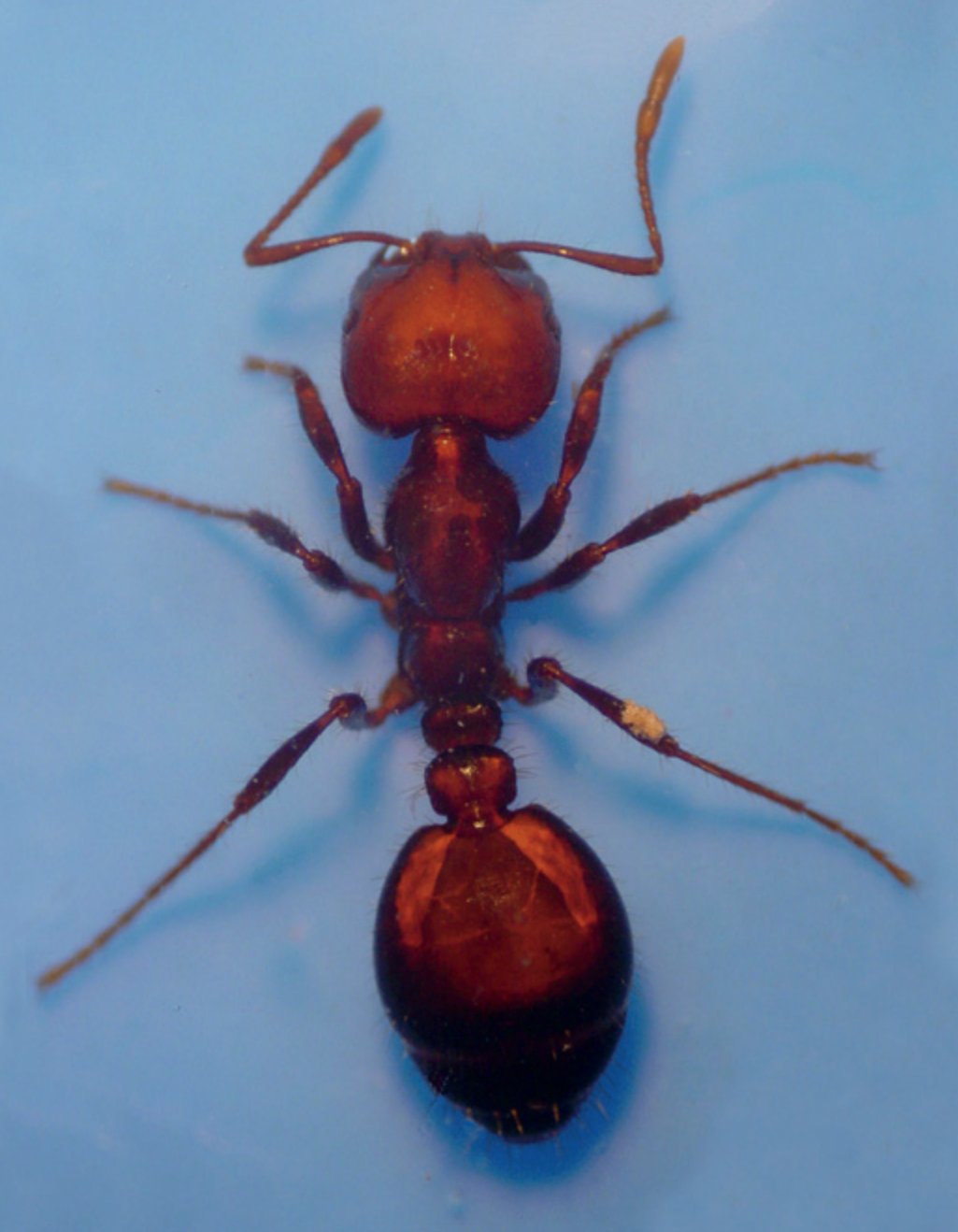
I grew up in Alabama and have always lived in the state. It is difficult to remember a time when fire ants were not a part of my life. When fire ants reached the area of West Alabama where I grew up, I was six years old. Probably the only people in Alabama that have not tangled with fire ants are visitors that go directly from their car to the hotel room and back. Most people who have strayed off concrete or asphalt have been attacked by imported fire ants, or will be. These creatures everyone loves to hate are very aggressive and cause painful stings to humans, pets, domestic animals and wildlife. Imported fire ants have been blamed for wildlife reduction, livestock deaths, crop damage, property damage (especially electrical equipment) and even human deaths. Economic costs across the Southeast are estimated to be in the billions. The effect that these ants have on wildlife, including insects and birds, is one area of research that needs more attention.
How did they get here?
When imported fire ants were accidentally introduced from South America during the early 1900’s, no natural enemies came with them. The natural aggressiveness of imported fire ants coupled with this lack of natural enemies allowed them to expand throughout the Southeast and, within the last ten years, to other parts of the United States and the world.
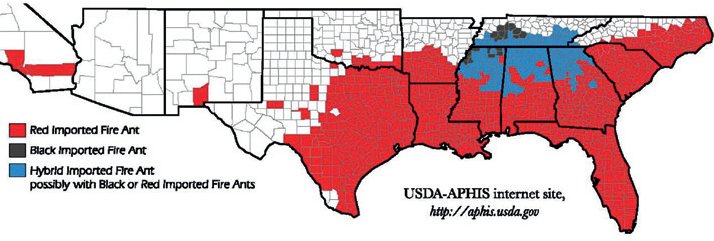
Not one, but two species of imported fire ant made the trip to Alabama. They were first discovered in Mobile, Ala. The black imported fire ant entered in 1918, and the red imported fire ant appeared between 1930 and 1940.

Currently, the red imported fire ant occupies most of the Southeast (see hybrid map). A hybrid between the two species was discovered in 1985 and occupies most of the northern half of Alabama, Georgia, Mississippi and the southern portion of Tennessee. The black imported fire ant can be found in a small area of northwest Alabama, northern Mississippi and central and western Tennessee.
Our native fire ants, the tropical fire ant and the southern fire ant, are rarely seen now. As imported fire ants have spread, these ants along with other native ants have been displaced. Yet, some ants, such as the little black ant, get along with these invaders quite well and have increased in numbers and distribution.
Most imported fire ant colonies in the Southeast are single queen colonies (monogyne), and the ants are territorial. In the early 1970’s, a multiple queen form was detected and has become increasingly more common. This form is found in isolated areas of Alabama, but is more commonly found in Texas and Florida than other areas of its introduced range. Populations of this form have two to three times more ants in an area than the single queen form. These ants are not territorial and visit from mound to mound. Normal mound densities in Alabama range from 40 to 80 mounds per acre. But in one area of Talladega County, AL we have counted 267 mounds per acre in one of these multi-queen sites.
What problems can they cause?
In the 1960’s, newspaper headlines such as “Dying Fish Populations Laid to Fire Ants” were seen. Fisheries experts still get two or three calls a year of fish killed by fire ants, but these are rare occurrences. Normally, bream that eat imported fire ants will spit them back out. But, if they eat enough, it is likely they will die.
During dry conditions, imported fire ants build their mounds on the sides of ponds. When heavy rains come, the ants may be washed into the pond. When in water, the ants will form a ball and float until they come to dry land. The conditions that cause bream to feed on fire ants are not known, but some bream may find this floating buffet too irresistible to pass up.
The multiple queen, high density form of the imported fire ant has increased the debate on fire ants and quail. Early work on fire ants and observational data in the early 1970’s convinced most that imported fire ants were not a threat to quail. Studies in Texas in the 90’s showed that quail populations were affected in areas with multiple queen forms.
Work in southwest Georgia, where the single queen form is dominant, has found that about 10 percent of quail nest failures were due to imported fire ants. But, these percentages are similar to a study done 70 years earlier when only our native species of fire ants were present. So, the debate about imported fire ants and quail continues. Imported fire ants are not solely responsible for the decline in quail numbers, but more work is needed to define their role in the Southeast.
Bob Mount, a former Auburn herpetologist, was first to notice effects of imported fire ants on reptiles and amphibians. He observed imported fire ants eating eggs of the six-lined race runner. They have been found attacking box turtles, toads, the nests of alligators, and can be found at the entrance to many gopher tortoise burrows.
Of course, imported fire ants have a direct impact on mammals, including humans. Newborn cottontail rabbits and white-tailed deer have been attacked. Two calves were killed in Chilton County, Ala. in 2002. The ants also have indirect effects on animals by reducing food availability which can change search patterns for food and increase the chance of predation. One friend here in Auburn swears that the fire ants in his field can find his downed doves before he is able to get to them.
However, fire ants can also be beneficial. Anecdotal evidence suggests that the tick population in the South was reduced as fire ants moved into an area. While serving as a major pest in hay fields, fire ants are more than welcome in cotton and sugar cane fields where they attack many of the insects that damage these two crops and can reduce the number of insecticide applications in the fields.
Current Research
Past research on quail in areas with single queen colonies has shown that fire ants were only a minor problem with piping nests, but studies in multiple queen areas have shown other effects on nests. A research study underway at the LSU AgCenter is looking at the effect of fire ants on quail nests. The researchers are studying egg predation by fire ants.
Fire ants are omnivorous and predatory. A portion of their diet consists of captured insects. Insects captured on the ground are also a major portion of the bluebird diet. Most studies of fire ant impacts look at the direct affect of fire ants on a population. Researchers at Auburn University are taking a novel approach to look at the interaction between fire ants and blue bird foraging. This study will attempt to determine if fire ants have an effect on bluebirds by reducing their insect food source and affecting their ability to forage.
A new approach is underway to level the playing field against imported fire ants and give our native ants an opportunity to compete with these aggressive invaders. Natural enemies of fire ants from South America have been imported and are being established in fire ant populations across the southeast. These natural enemies are called decapitating flies or phorid flies.

These amazing little creatures survive by eating fire ants. The adult female hovers over fire ant workers that are out of the mound foraging or repairing the mound. Once a worker of the correct size is located, the fly takes less than a tenth of a second to dive in and deposit her egg into the thorax of the fire ant. When the egg hatches, the maggot migrates into the head of the fire ant. Eventually, it eats the contents of the ant head, and the ant’s head falls off.
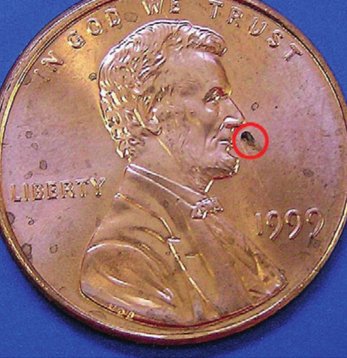
The maggot then uses the fire ant head as a pupal case. During the warm summer, a new fly emerges about five weeks after the egg was deposited. The newly emerged female fly mates and searches for worker ants. Male flies simply look for more female flies. The adults live only one to three days in the field, but females are capable of laying eggs in 2-300 worker fire ants.
An obvious advantage to these flies is that they are only attracted to imported fire ants and are not a threat to our native ants. The flies are actually so specific that they are only able to deposit their egg into fire ant workers of the correct size. There are around 20 species of phorid flies in South America that attack fire ants in their native habitat. The phorids select ant workers by attacking different size ants, attacking at different times of the day and attacking ants depending on the activity.
Phorids are currently reared at the USDA-Animal and Plant Health Inspection Service facility in Gainesville, Fla. They are the only source for the flies and only supply them to cooperating USDA or university personnel in 12 states. There are two species of fly in production at this facility. One species is in quarantine at the USDA-Center for Medical and Veterinary Entomology to ensure that it is safe for release. Releases are scheduled to spread the flies across the state and the Southeast, as flies are made available.
The first decapitating fly established in Alabama was Pseudacteon tricuspis. It was first successfully released in Alabama near Notasulga in Macon County in 1999. This fly is attracted to the red imported fire ant located in the southern portion of the state and prefers to deposit eggs in medium to large size workers. Other releases of this species were made in eight other counties across the state from 2000-2006.

In May of 2000, a second species of decapitating fly, Pseudacteon curvatus, was established in Talladega County and has spread over 12 miles from the release site. This was the first establishment of this species in the United States. This fly is attracted to the black imported fire ant and the hybrid found in northern Alabama. It prefers worker ants that are small to medium in size. Other releases of this species were made in Walker, Madison, Cullman and Lauderdale. There is a second biotype of this species that prefers the red imported fire ant. It was established in Mobile County in 2006.
These two species have been released in 12 Southeastern states from Texas and Oklahoma to North Carolina. They are spreading from the original release sites at a rate of 10 to 20 miles per year and have become well established in most Southeastern states and are spreading in the others. At least one of these two phorids has been found in every county in Alabama and approximately two-thirds of the counties in the state have both.
Alabama was the first state to have two species of phorid fly established and is the only state with the species Pseudacteon litoralis established This fly was released in three sites in Florida, one in Louisiana and one in Alabama, Alabama is the only site where P. litoralis has been recovered in the field. This fly prefers very large workers of the red imported fire ant. It is elusive, and few are found each year. But in the summer of 2008, flies were recovered 14 miles from the 2005 release site.
A fourth species of phorid, Pseudacteon obtusus, was released in Alabama in September 2008. It prefers large workers. Unlike the other species, it attacks ants along the foraging trail rather than at disturbances. It is established in Texas and Florida.

Is there anything I can do?
Current control measures for imported fire ants rely on chemicals. Chemical control options include baits, contact insecticides (sprays, drenches, dusts, granules, etc.) and a combination of these two. Eradication of the fire ant is not an option, but management of fire ant populations using sustainable technologies is possible, but can be costly.
Most of the calls I get for fire ant control want the problem gone yesterday. This is what I call the ‘reactive’ method of control. Fire ants are easier to manage if a proactive approach is taken. Fire ant baits are safe, effective and relatively inexpensive way to manage a population. But they do not fit the mold of the ‘I want them gone now’ approach. Depending on the product and the time of year applied, baits can take from 2 to 12 weeks to work.
Fire ant baits are taken to the mound by foragers like any other food particle and must be fed to other workers in the mound. A large mound may have over 200,000 workers. Baits that inhibit metabolism will work in 2 to 4 weeks by killing adult and immature ants. Baits that have an insect growth regulator as the active ingredient will take 4 to 12 weeks to work since they only prevent immature ants and eggs from developing. Adult workers in these colonies die of old age and are not replaced so the mound dies slowly.
Most baits are broadcast at a rate of 1.5 pounds per acre. If you have a large area, baits may be purchased in 25 pound bags. The cost per acre for most will range $12 to $15 per acre for an application.
Baits are difficult to apply broadcast at this rate. Most broadcast seeders will put out too much product. The only bait spreader available to apply baits at this rate that I am aware of is the fire ant model GT-77 made by the Herd Seeder Co. Here in Alabama, the Alabama Fire Ant Management program has a program to make applicators available to stakeholders. Over 40 of these spreaders are placed in Extension offices across the state. Anyone wanting to apply fire ant bait to their property can go to the county Extension office and borrow one of these spreaders at no cost.
I don’t have the space to go into different fire ant strategies in this article. I do think that bait applications, if done correctly, are an excellent management tool to maintain fire ant populations at a low level. If you want more information on how to manage your fire ants, there is now an excellent web site with information from all of the fire ant experts in the US. This site can be found at www.extension.org/fire+ants.