
It’s hard to believe another deer season has come and gone. It seems like only yesterday when I (along with fellow hunters) was sorting through our pre-season trail camera photographs developing our “hit list” of bucks to target during the season.
Outside of population management, I often refer to deer season as “down time.” For me, this is the time when my phone stops ringing and emails slow down to a manageable level because my clients (myself included) are in the woods enjoying the fruits of their labor…and doing a little “population management” in the process! However, once deer season ends, it’s time to begin preparing for the next season.
Today’s hunters apply year-round management strategies, understanding that it takes this type of approach to achieve certain goals, as well as satisfy our inherent urge to be involved with the land and wildlife until the next hunting season rolls around. Under this approach, there is always something to be done on the property, no matter the time of year.
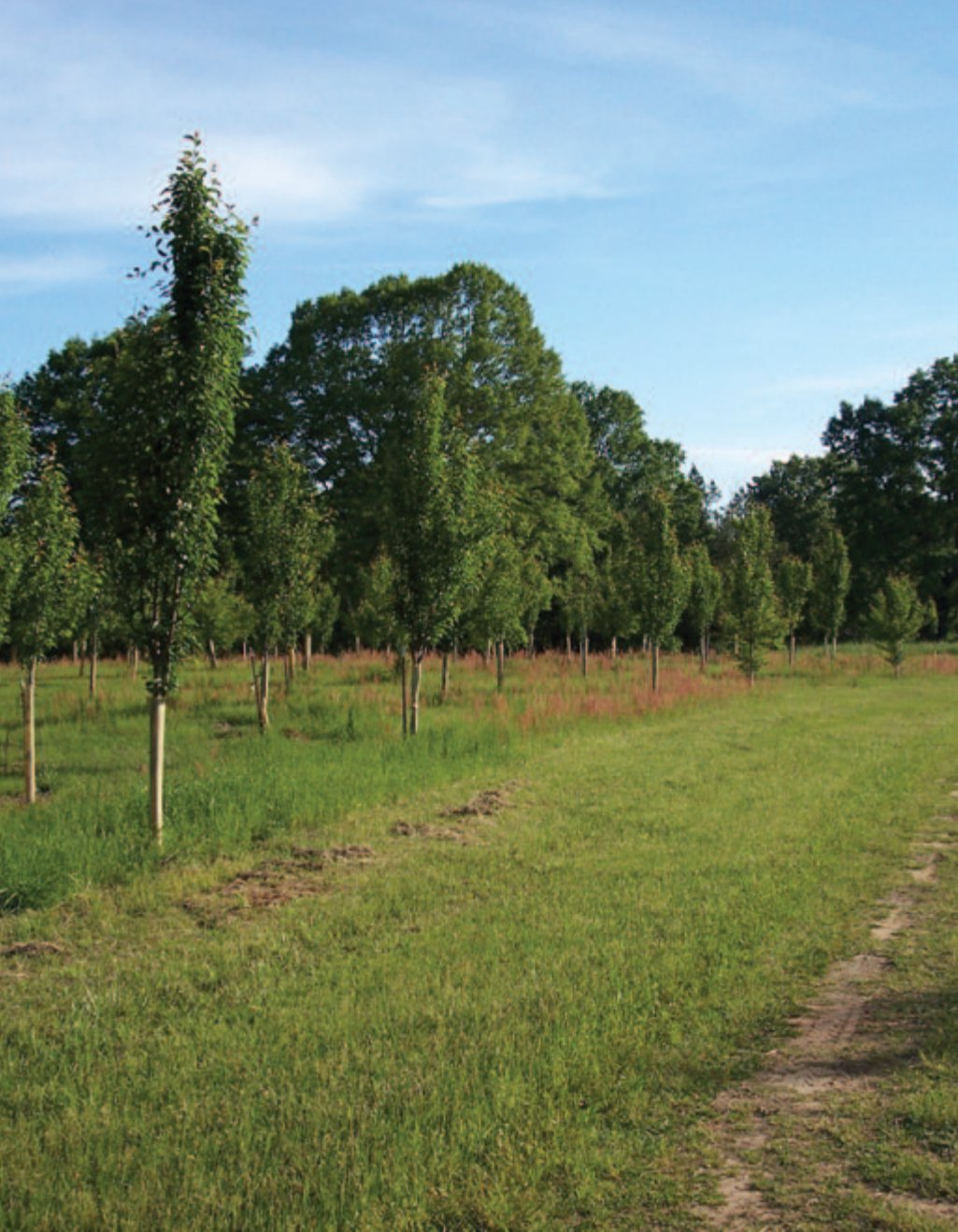
Indeed, late winter is generally a slow period from a habitat management standpoint relative to other months. With the exception of prescribed burning and other small-scale activities (e.g., strip disking, consolidating deer harvest and observation data, storing tree stands, shed hunting, etc.), there aren’t a lot of habitat management options available during the late winter months. One option that is often overlooked is planting and managing fruit trees (e.g., apples, pears, crabapples, persimmon, oaks, etc.). With modern advances in fruit tree varieties and commercial tree nurseries fully committed to wildlife plantings and staffed with experienced and dedicated growers, establishing fruit trees and orchards has never been easier. It’s a great way to increase the wildlife and aesthetic value of your property.
When to Plant
Because it is best to plant fruit trees during the dormant season (winter), this project can easily be worked into midday activities during a weekend of deer hunting or across several weekends after the season concludes, depending on how many trees you plant. I prefer to begin planting trees as soon as deer season ends so it doesn’t take away from critical time that could be spent in a tree stand. Trees can be planted earlier in the fall if desired. However, if your property has a tendency to get wet/soggy or flood during winter, planting in the fall when working conditions are typically drier is advised.
What to Plant
Johnny doesn’t need to plant apple seeds anymore! With new and improved varieties on the market, it doesn’t take long for trees to produce fruit and improve property aesthetics if properly managed. In fact, this past summer one of our biologists pulled 67 apples off a single 15-gallon apple tree we planted last February! The reason we pulled them off is because the apples were literally breaking the young branches. While all trees do not typically produce at this rate, the take home message is that the improved varieties of fruit trees available today can produce instant results.
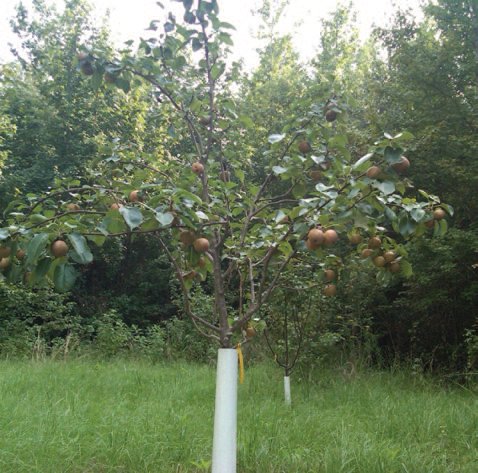
Some of my favorite trees to plant include varieties of pear, apple, crabapple, plum, persimmon, and various oaks. Some of these species require cross pollination (e.g., apple, persimmon) for fruit production. Thus, be sure to plant a minimum of 3-4 trees in close proximity to each other to ensure pollination. Fruit trees come in all different shapes and sizes (seedlings, 3-gal, 7-gal, 15-gal, etc.). In my experience, large trees (7+ gallon pots) tend to survive better and will produce fruit earlier.
Tree survival and performance depends on the site. That is, some fruit trees will perform better in certain geographic regions or soil types than others. Fortunately, many of the species and varieties have been developed to thrive in a wide range of climatic and soil conditions and are more disease resistant. Nonetheless, it is important to consult with your tree supplier to determine which species/varieties are best suited for your property.
Lastly, if you are concerned with only planting native species on your property, be sure to check with your tree supplier as some of the species they carry are not (e.g., sawtooth oak, Chinese chestnut, Japanese persimmon, etc.). It is also important to note that some of the commonly planted fruit trees and shrubs (e.g., autumn olive, bicolor lespedeza) can be invasive and spread aggressively in some cases, making them difficult and costly to control. Thus, if you wish to avoid this potential threat, be sure to consult with your tree supplier and other experts prior to purchasing and planting trees.
Mix it Up
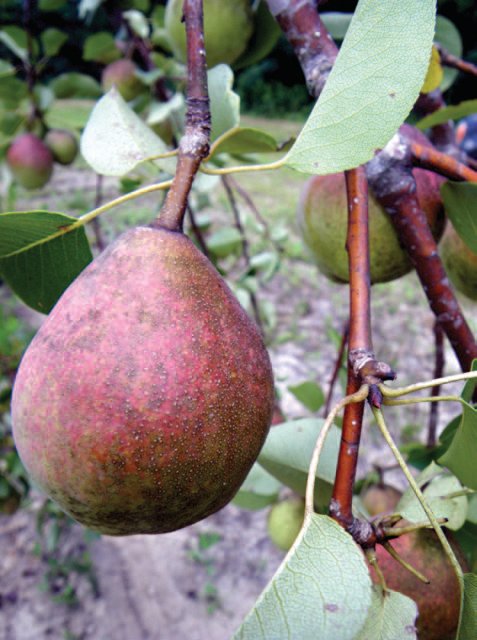
Planting a variety of species (and varieties of each species) is recommended because it staggers the availability of fruit from late summer through winter for increased attraction and nutrition. For example, one particular orchard we planted in Mississippi last year contained approximately 60 pear trees. Included within this orchard were six different varieties designed to stagger fruit maturation rates. With such a diversity of pear varieties, mature pears will be available from August through December, providing a consistent, attractive food source over a period of at least five months. This can be a great advantage from a hunting standpoint as you can attract and hold deer and other wildlife on your property for a longer period, which increases hunting opportunities. Fruit trees also provide an attractive food source that your neighbors may not have, which helps set your property apart from others.
How to Plant
Before I dive into techniques for planting and managing fruit tree orchards, it is important to note that the size of your fruit tree orchards is typically proportional to the benefit they will provide. That is, the more trees (and varieties of species) you plant, the more benefit they will provide. Similar to food plots, small plots will feed and attract a few deer while large plots have the ability to feed and attract lots of deer. I’m not suggesting you convert a 50-acre clearcut to a crabapple plantation, however, most properties I’ve assessed do not plant enough trees or orchards to provide a significant impact on deer and other wildlife on their property. That is, although most of these properties have established fruit trees and orchards, they typically consist of only a few trees “here and there” that are scattered along the edge of a couple of their larger food plots or align the property entrance road.
In most cases, the size of a particular opening dictates how many trees can be planted there, unless the opening is enlarged. Most properties have considerable acreage that isn’t being managed for something else (e.g., agriculture, timber, food plots, etc.) and could easily be converted to productive fruit tree orchards. For example, if your deer herd is in balance with the habitat, and you have several large food plots on your property (e.g., 3+ acres) that don’t receive excessive browsing pressure, consider devoting one acre of each plot to fruit trees to diversify food availability. Although orchards are planted in many shapes and sizes, I prefer planting orchards that contain at least 20-50 trees (different species and varieties), depending on available space and other property attributes. This ensures a respectable amount of food is available once trees mature and begin producing a large amount of fruit.
The first step in establishing fruit tree orchards on your property is to determine where to plant them. Good places to start include the corners/edges of large fields and food plots, along roadsides and intersections (primarily for aesthetics), and fallow openings. A current aerial photo of your property can be a very helpful tool during this stage. Once you’ve located areas to plant, lay out the orchard and determine tree spacing. A helpful tip is to use a long rope (100-200+ feet) marked with the desired tree spacing along the rope (e.g., every 25 feet) with a piece of duct tape, flagging, or some other type of marker. While the rope is stretched along the ground, use bright-colored spray paint to mark the tree locations on the ground. This ensures trees are spaced evenly along rows for a clean look. A common mistake is planting trees too close. Depending on your goals and tree species, most trees should be planted at least 25-45 feet apart to give them plenty of growing space for optimum crown development and fruit production (check with your supplier for specific recommendations).
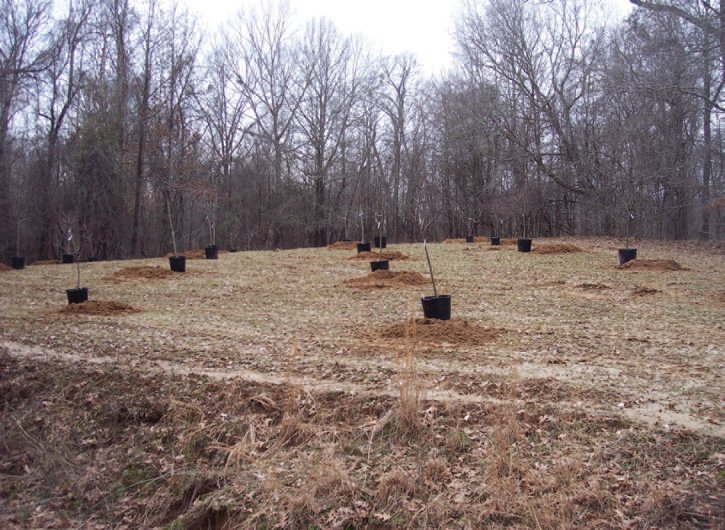
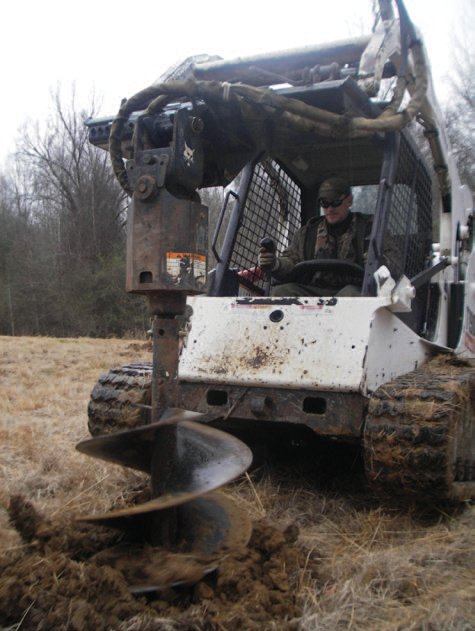
Once you’ve marked all of your tree locations, then comes the fun part – digging holes! If you’re not planting many trees, post-hole diggers and shovels work fine. However, if planting lots of trees (50+), consider borrowing or renting an auger. Hand-held augers work fine but I prefer tractor-mounted augers, or even better, a small skid-steer with an auger attachment. These machines are inexpensive to rent (~$200/day) and make digging holes a breeze, especially when all the tree locations are pre-marked with spray paint. Believe me, unless you plant hundreds of fruit trees, you’ll only need a day with one of these machines – your joints and back will thank you. Nonetheless, whatever method you chose, be sure to dig the holes a little deeper and wider than the root ball. This provides loose soil around the root mass for better growth.
Before placing trees into the holes, it’s a good idea to loosen/lightly break up the root mass to free feeder roots (i.e., fine roots that may be wrapped around the root ball as a result of growing in a pot). This will help them establish and grow better in their new environment. Next, apply a slow-release fertilizer into the hole (available from your supplier) and work it into the loose soil in the bottom of the hole, then drop the tree in.
Be sure not to plant trees too deep – flush with the top of the root mass is a good rule of thumb. Next, pack dirt firmly around the root mass to ensure a steady hold and good soil-to-root contact avoiding air pockets around the roots. Finally, it’s a good idea to install a tree protector if possible for added protection – especially if you have a lot of mature bucks on your property! Bucks have a knack for decorating fruit trees with a nice shiny rub.
Follow Up
During their first growing season, fruit trees will need a little TLC to ensure they get established well, or in some cases survive. If droughty conditions occur, young trees may need to be watered (if practical). Once fruit trees are established, there are a few minor maintenance activities that can keep them healthy and growing strong. During summer, be sure to keep competing weeds knocked back by spraying glyphosate (Roundup or other brands) around the base of the tree. However, be sure to keep the herbicide from contacting the tree. Having tree protectors in place makes this step much easier.
Some young trees tend to produce more fruit than they need to. Thus, if limbs are sagging and about to break, pick some of the fruit to relieve pressure. Although it might be hard for you to swallow, it is actually best to remove the fruit (or at least most of it) during the first couple years. This allows trees to devote energy toward growth, which will benefit long-term development and fruit production.
Lastly, be sure to prune the lower limbs during winter when the tree is dormant. This helps trees develop a nice, rounded crown and devote energy toward new growth for increased growth and fruit production the following year.
Invite the Family
In conclusion, whether your family is your spouse and kids or simply your circle of hunting companions, planting fruit trees is a great way to spend time outdoors improving your property for future rewards. In addition to benefiting wildlife, fruit trees will enhance the look of your property and provide recreational opportunities for generations to come.
Planting fruit trees alone will not produce that trophy buck we all dream about. It is simply a small part of a larger plan and should be used in conjunction with other habitat management practices (thinning, burning, food plots, etc.) to provide the most benefit to deer and other wildlife. Actively managing all aspects of your property (wildlife populations, habitat, and hunters) is the most effective strategy for reaching your long-term goals.