Unless you have had your head buried in the mud for the last decade you are aware of the feral hog invasion occurring across the United States. You have heard of the destruction caused by these invasive creatures and the diseases they carry. You have read and heard of the many theories and plans designed to control feral hogs. You have seen some of the innovative traps, futuristic night vision scopes and thermal optics, yet feral hog populations continue to explode and expand across the land.
As owners of a small farm in east-central Alabama, my wife Tes and I have experienced the invasion of feral hogs first-hand. We have witnessed the destruction of habitat and food sources. We have stressed our physical abilities and financial resources in an effort to protect our land from the feral hog invasion. We have learned valuable lessons along the way and made strides towards making our farm hog free, but after a decade we are still not there.
I know it is difficult for those who have not dealt with feral hogs to understand the depth and scope required to get a handle on the feral hog problem. Many think hogs are fun to hunt and do not understand what it takes to win this war, but have no doubt, it’s a war. When it’s your land being destroyed, your time consumed, your finances being wrecked, you will have a different perspective on feral hogs.
Feral Hog Facts
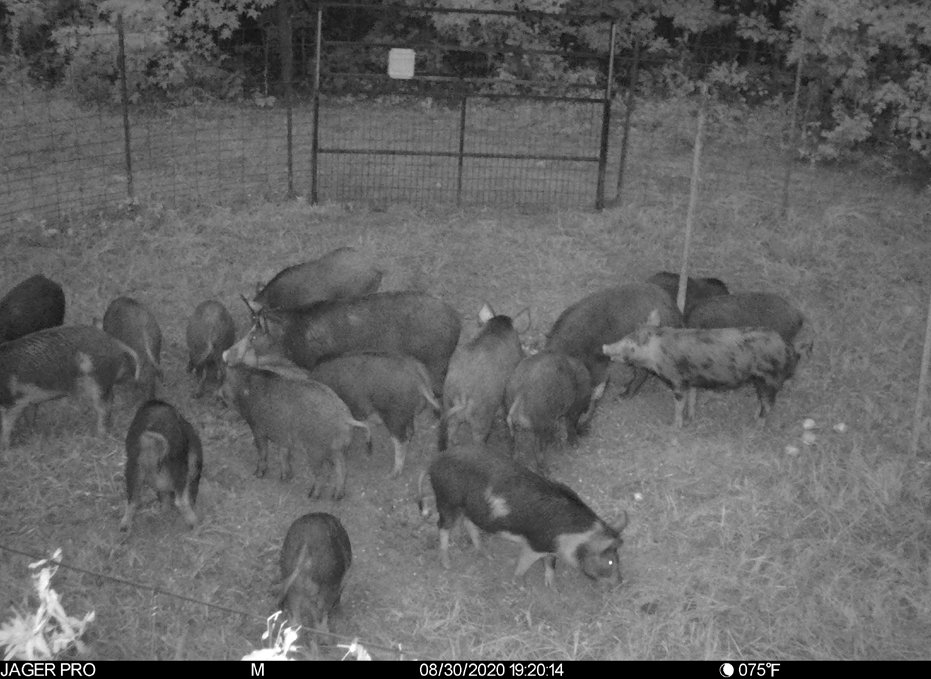
Feral hogs are prolific breeders. A female, or sow, can become sexually mature and have her first litter on average around one year of age. Litters average six pigs and the average sow has 1.5 litters per year or three litters in two years in average conditions. Her life span averages six years. Under better than average circumstances, such as abundant food sources, both litters per year and number of pigs per litter can be much higher. In good circumstances two litters per year are possi-ble, the first litter before the age of one year. More pigs per litter are common and average lifespan is longer.
Over the vast majority of their range, feral pigs face very light pressure from predators. This combined with the very prolific nature of hogs has created the perfect storm and the feral hog explosion we face today.
When hog numbers approach carrying capacity of their range they simply move to better conditions. This movement is part of the expansion problem but natural expansion is a slow process. Feral hog expansion has and continues to be greatly aided by humans transporting and releasing them in areas that are pig free.
Feral hogs are extremely intelligent creatures and once they are established in an area it is almost impossible to eradicate them. They associate humans with danger and learn to avoid them. Attempts to control them commonly educate them and make control even more difficult.
Our situation has drastically improved since the pinnacle of the invasion four years ago. It has been proven that smart traps designed and manufactured by companies such as Boar Buster™ and Jager Pro™ are the most efficient way to remove hogs from your property. Our experience is with Jager Pro™ and their Integrated Wild Pig Control®, (IWPC®) philosophy. They have proven that a trained Hog Control Operator™, using the right equipment, can eliminate hogs on 10,000 acres in 15-18 months. The amount of time that 10,000 acres remains pig free depends on the answer to six questions.
- Are neighboring landowners implementing a successful IWPC® program?
- Are there enough trained and certified Hog Control Operators™ in the county to effectively implement the IWPC® program?
- Has the state passed legislation to stop intrastate and inter-state transportation of feral pigs?
- How well are law enforcement personnel enforcing these rules in the state?
- Are judges and the court system prosecuting those breaking the rules with heavy fines?
- How many criminals are illegally transporting and releasing new feral hog populations in the county?
Success Creates New Problems
When we implemented our IWPC® program in 2016 we partnered with two neighbors and each bought a Jager Pro™ trap, camera and gate. We worked together with one goal in mind—rid our land of feral hogs.
We learned that randomly shooting hogs reduced our chance of trapping the entire sounder so we only shot single hogs and never a group.
We learned the value of conditioning hogs to trust a feeder as a reliable food source. We learned the value of information about the number of pigs in a sounder and to identify problem hogs that did not readily enter the trap. We learned patience paid big dividends and didn’t drop the gate until the entire sounder was inside the trap.
Once the traps were assembled and in place the gates began to fall within days. With each drop of the gate the numbers of pigs captured increased. At first, we butchered pigs for our own freezers. We gave pigs to friends and family. When a sounder became comfortable with the trap, we notified anyone and everyone interested in wild pig meat. Despite our best efforts there were more pigs trapped than we could utilize or give away. Since 2016 we have removed almost 600 hogs from three small farms that combined total less than 800 acres.
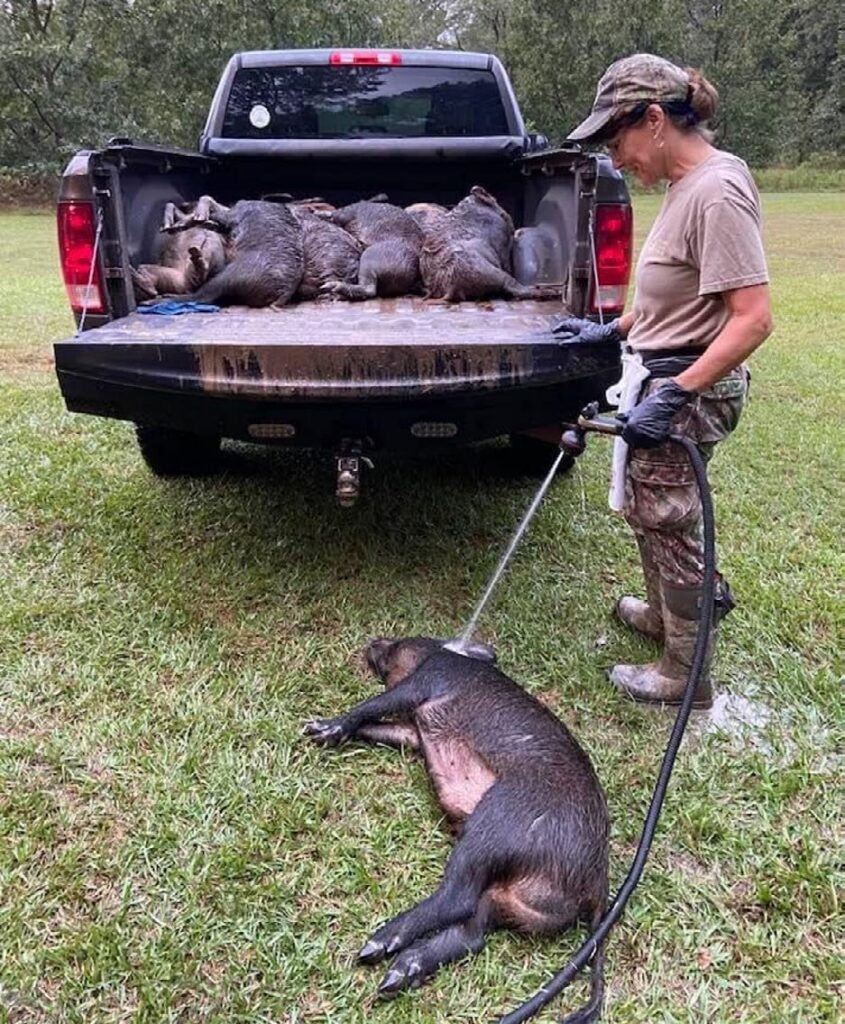
As managers, we are stewards of our land. We feel responsible for the welfare of the wildlife that call it home. The delicate balance between wise management, ethics and morals proved to be a huge challenge for each of us. Bluntly stated, our goal was to rid our land of non-native feral hogs and the only way to do that was to kill them. The fact that we could not utilize them all or find someone who could weighed heavily upon us.
Put yourself in our shoes. We are all committed to making our land the best it can be for wild-life. Suddenly we are invaded by a non-native species whose very nature is destructive to our land and the native wildlife. What would you do? You have two choices. You can kill pigs or watch your land and the wildlife suffer the consequences of feral hogs.
You would think as time passed the task would become easier, that your conscience would not ache with every drop of the gate. At this time that has not happened for Tes and me. We weigh the cause and justify the effect. We have to keep our eye on the goal of ridding our land of feral hogs.
Lessons Learned—Humane Euthanasia
As I write this story our farm is pig free. Last night we received a trail camera photo via text message of a large, solitary boar at a bait station set up just for him. Sour corn in a12 inch deep hole in the ground was more than he could resist. He was the only hog we had seen on the farm for over a month. We scrambled, grabbed our gear and headed to the site.
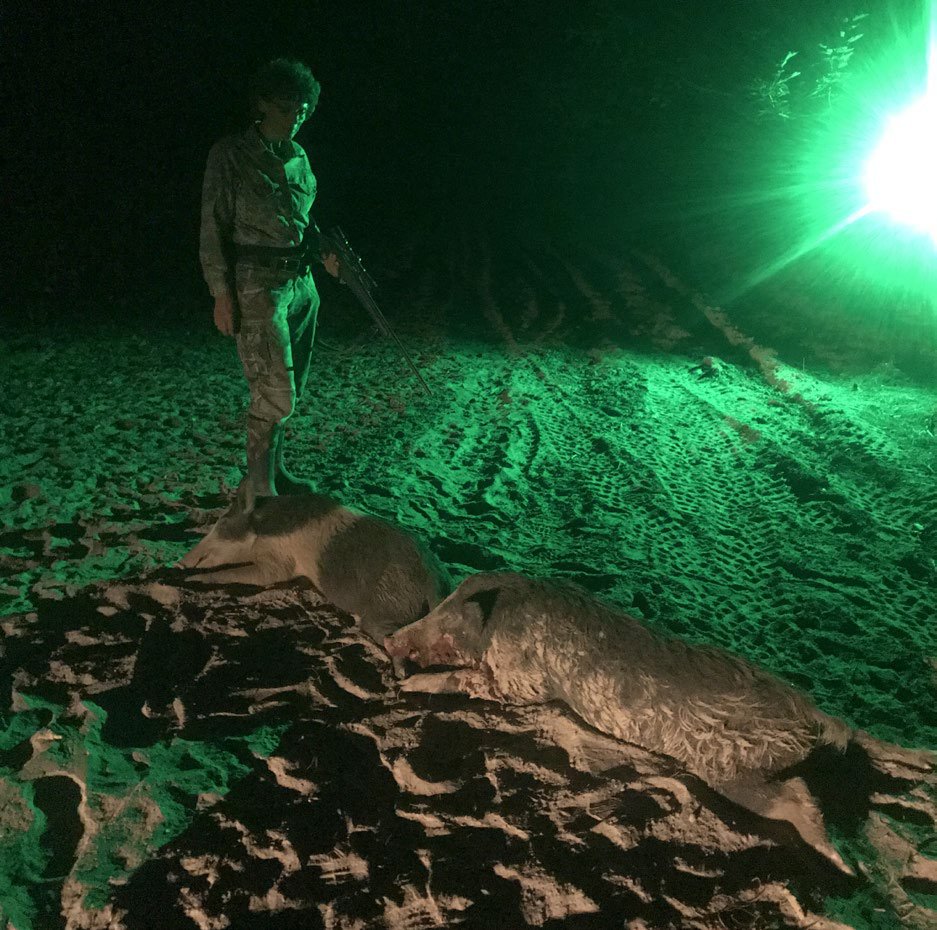
The Slow Glow Hog Light illuminated the big boar just enough for us to see him through con-ventional deer rifle scopes steadied by bipod shooting sticks. Countdown three, two, Ba Bang. The shots were almost simultaneous and he never knew what hit him. It was a clean, humane kill and the meat was appreciated by a friend who loves wild pork sausage, but it’s not always that way.
Note: Always check and comply with rules and regulations for baiting and shooting feral hogs at night in your state.
When we first started euthanizing hogs in the traps it was not pretty. Five, ten or as many as 30 hogs in a trap is pandemonium, especially in daylight and after the first shot is fired. Again, we found ourselves wrestling with the moral and emotional issue of killing hogs. For this reason, Ja-ger Pro developed a comprehensive set of protocols for humane euthanasia of feral hogs.
“The American Veterinary Medical Association, (AVMA), has deter-mined that a bullet to the brain is a humane way to euthanize feral swine,” says Rod Pinkston, founder of Jager Pro. “A properly placed gunshot causes immediate insensibility and a humane death. Under trapping conditions, a gunshot is the only practical way of euthanasia. Our capture protocol is all hogs must be euthanized in the trap no more than one hour after capture.
Most captures occur at night and a one-hour protocol reduces stress on animals by decreasing the amount of time they spend in the trap. A nocturnal routine reduces damage to animals and equipment because feral hogs tend to stand still when blinded by a 1200 lumen light. Feral hogs attempt much more violent escapes during daylight.”
“A properly placed 40 grain .22 caliber bullet is economical and entirely capable of euthanizing even the largest hog. It is important to recognize the exact location of a feral pig’s brain, especial-ly when using a small caliber bullet. Proper bullet placement is absolutely necessary to achieve a humane result,” said Pinkston. “Scientifically, a gun-shot destroys the brain which produces in-stant loss of consciousness and immediate animal collapse. However, brain electrical activity may continue for another 30 seconds producing exaggerated muscle activity and limb move-ment. It is important to recognize these involuntary movements are normal and not an indicator of distress, pain or suffering because death is almost instantaneous.”
The Reality of it All
Once we accepted there were no alternatives to killing feral pigs, whether the meat could be uti-lized or not, learned the most humane way kill them and saw the population begin to shrink, the task became somewhat less troubling. Still, it has never been fun.
Like many things in life it boils down to what is right, what is better for your land and the native wildlife that calls it home. Sadly, more and more managers are faced with these difficult decisions as the expansion of feral hogs continues across our country
We found peace and solace in the fact that we could make a differ-ence. We continue to search for ways to make it all easier but know-ing we were ridding our land of a disease carrying, habitat wrecking, non-native plague was the tipping point. Like many things in life and wildlife man-agement, the end jus-tifies the means.
Is our problem solved? No. We understand there will be more pigs on our farm but we also know they will not be here long and the destruction will not be as severe. Until we can expand our ef-forts to more farms in our area, we will always have pigs. They are oppor-tunistic and relentless in their pur-suit of food. Well managed land is a magnet for them and they always find it. All we can do is keep doing what we do and know it’s for the greater good. Sadly, for now, there is no other way.
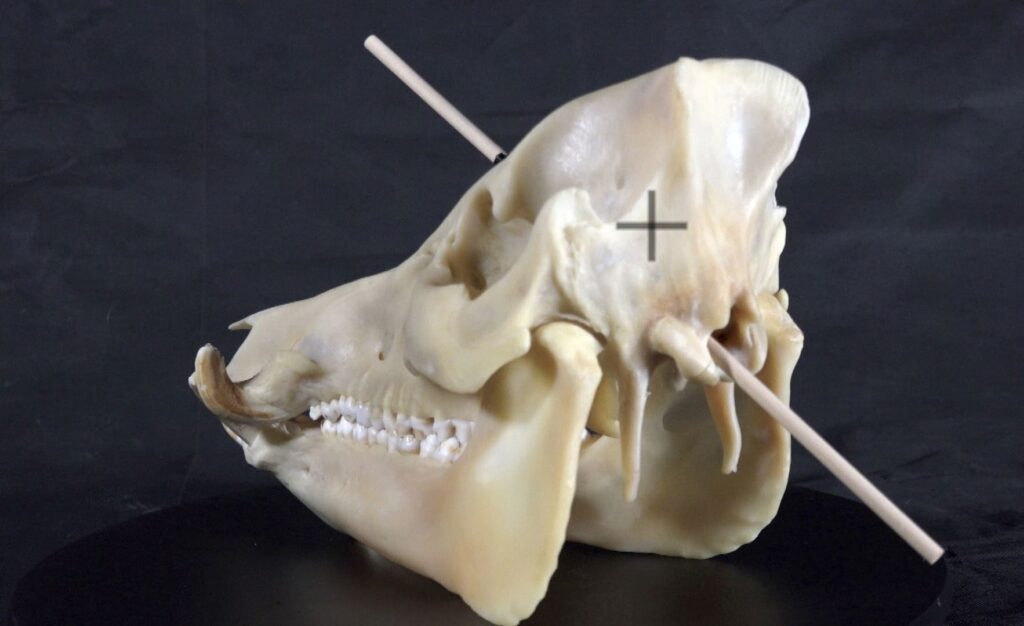
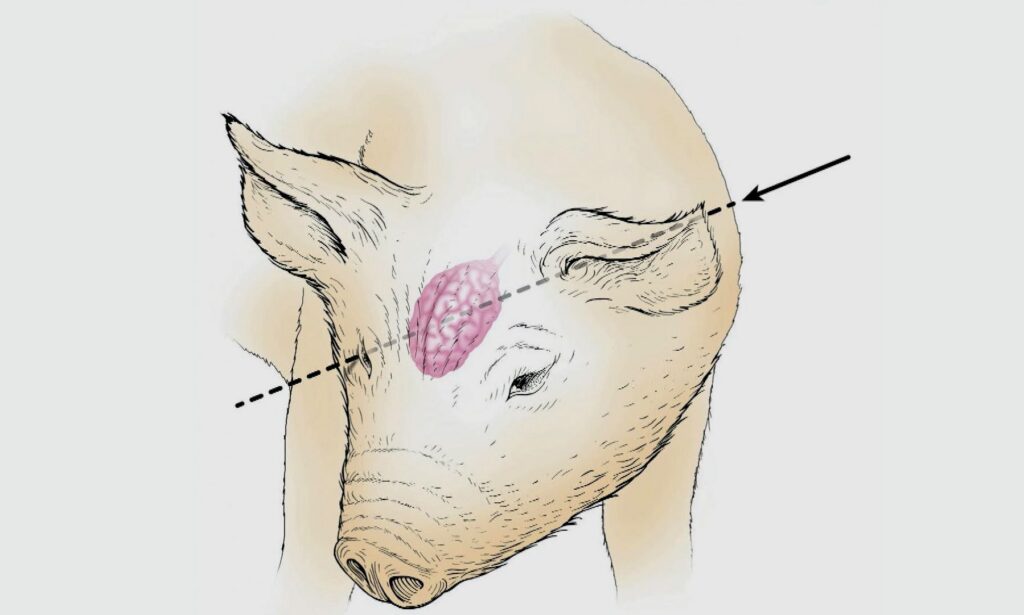
BULLET PLACEMENT FOR HUMANE KILLS
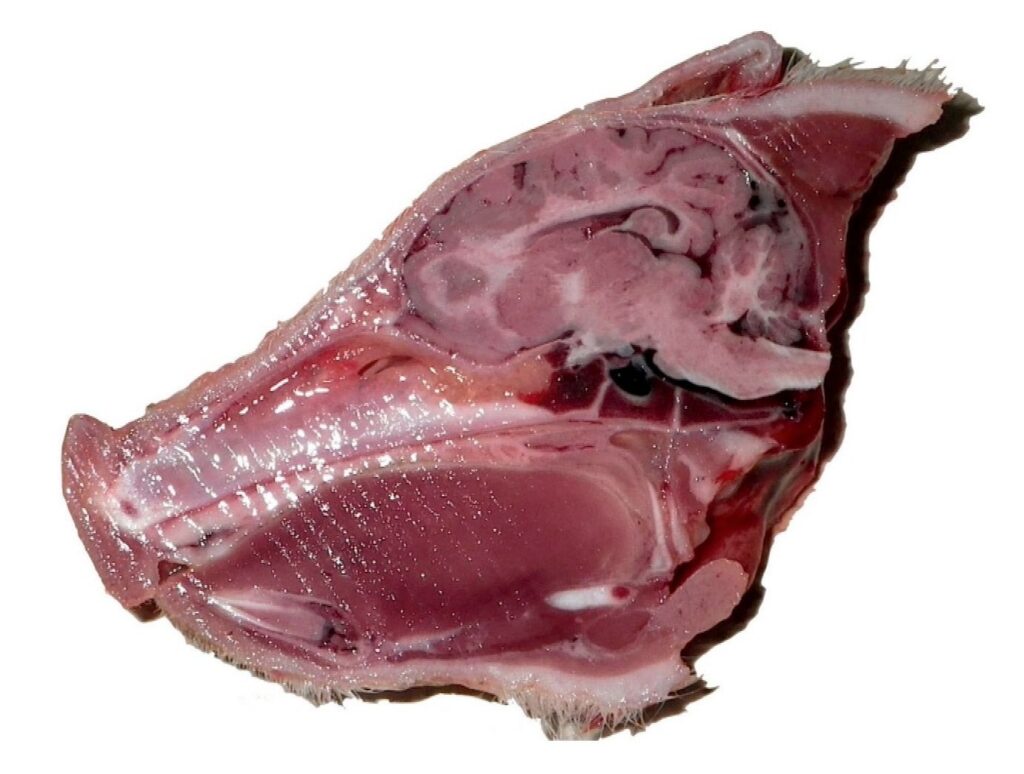
ANATOMY OF A PIG’S BRAIN
This photo is a cross section of a pig’s skull. Knowing the exact location of a pig’s brain is critical to making a clean, ethical, humane kill.
FRONTAL SHOT
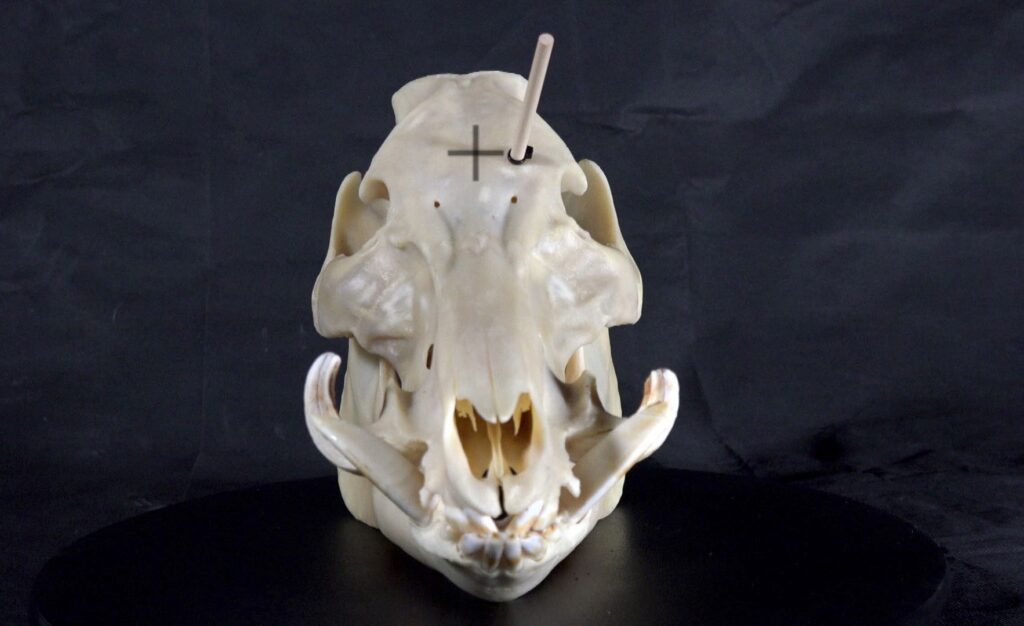
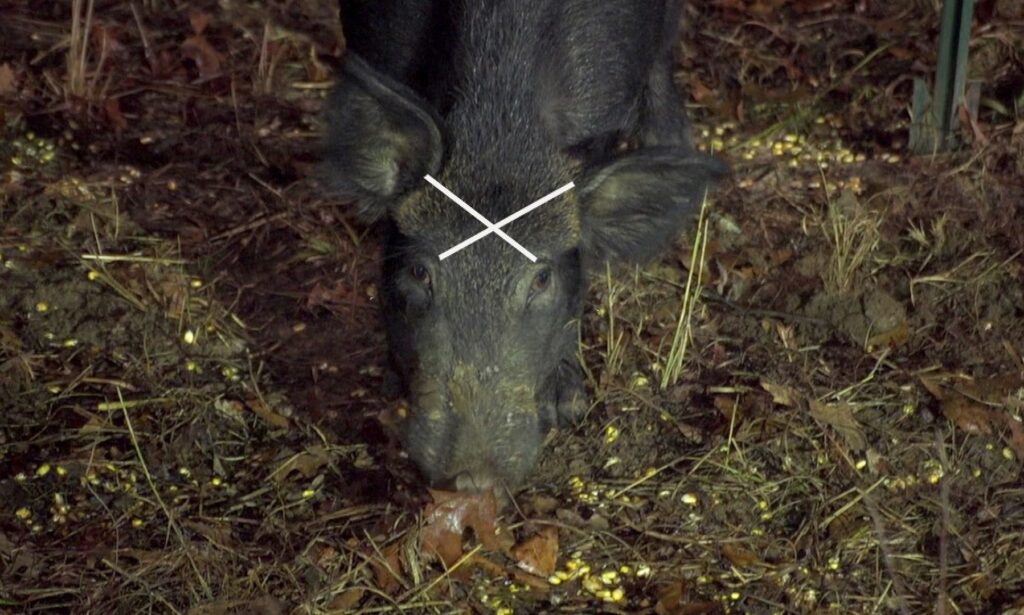
The mistake most often made during a frontal shot is aiming between the eyes, especially when the jaw or snout is angled down. The proper shot placement is two to three inches above the eye sockets in the center of the forehead. When the jaw is horizontal to the ground the perfect frontal impact site is the center of the forehead above the eye sockets. The bullet should always be directed toward the spinal column during a frontal shot.
QUARTERING-TO SHOT
The perfect quartering-to impact site is slightly above the eye socket to the center of the cranial cavity. The bullet should always be directed toward the brain’s center during a quartering to shot.
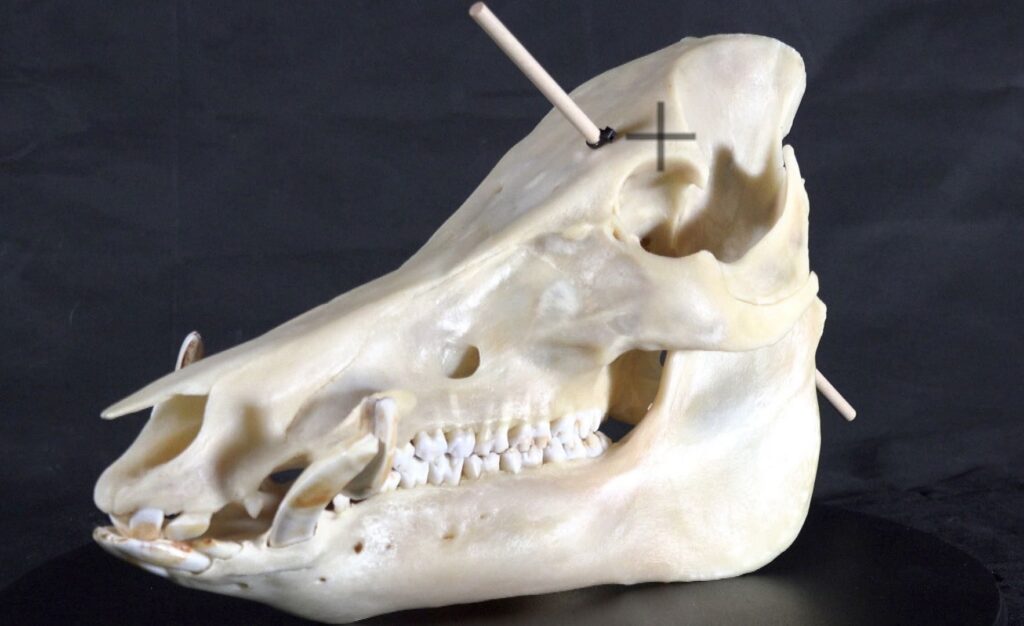
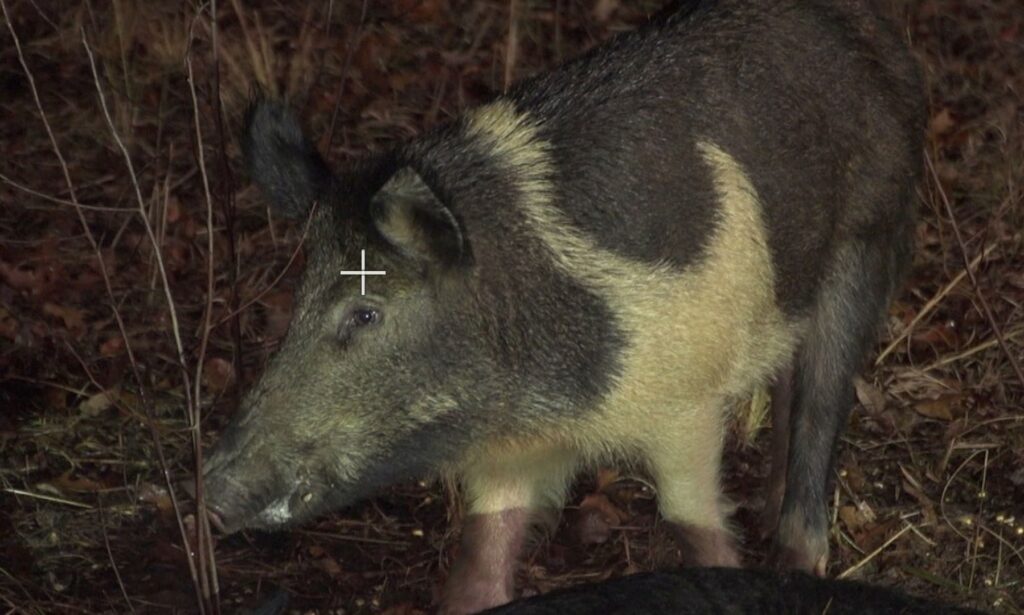
TEMPORAL SHOT
The perfect profile, or temporal impact site is slightly above the eye socket and below the ear to center the cranial cavity. The bullet should always be directed toward the brain’s center during a temporal shot.
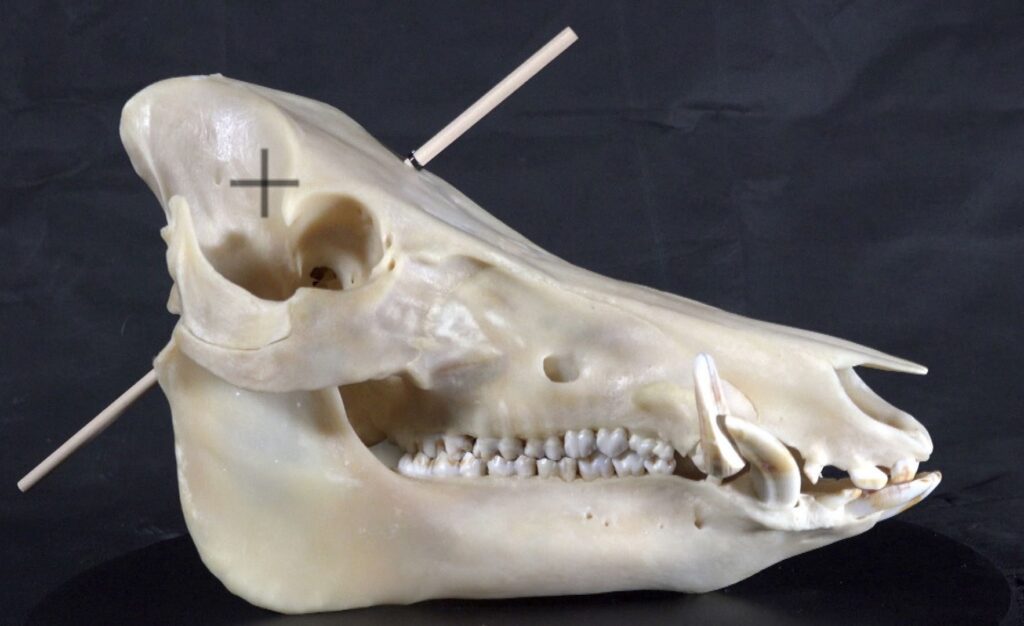
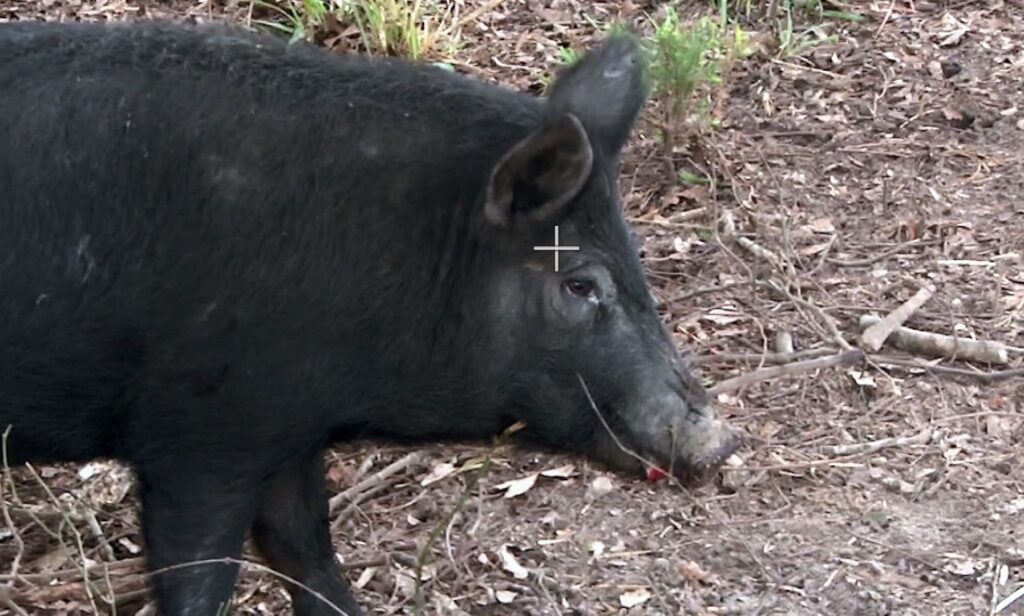
QUARTERING AWAY SHOT
The perfect quartering away impact site is behind the ear aiming towards the opposite eye to center the cranial cavity. The bullet should always be directed toward the brain’s center during a quartering away shot.