
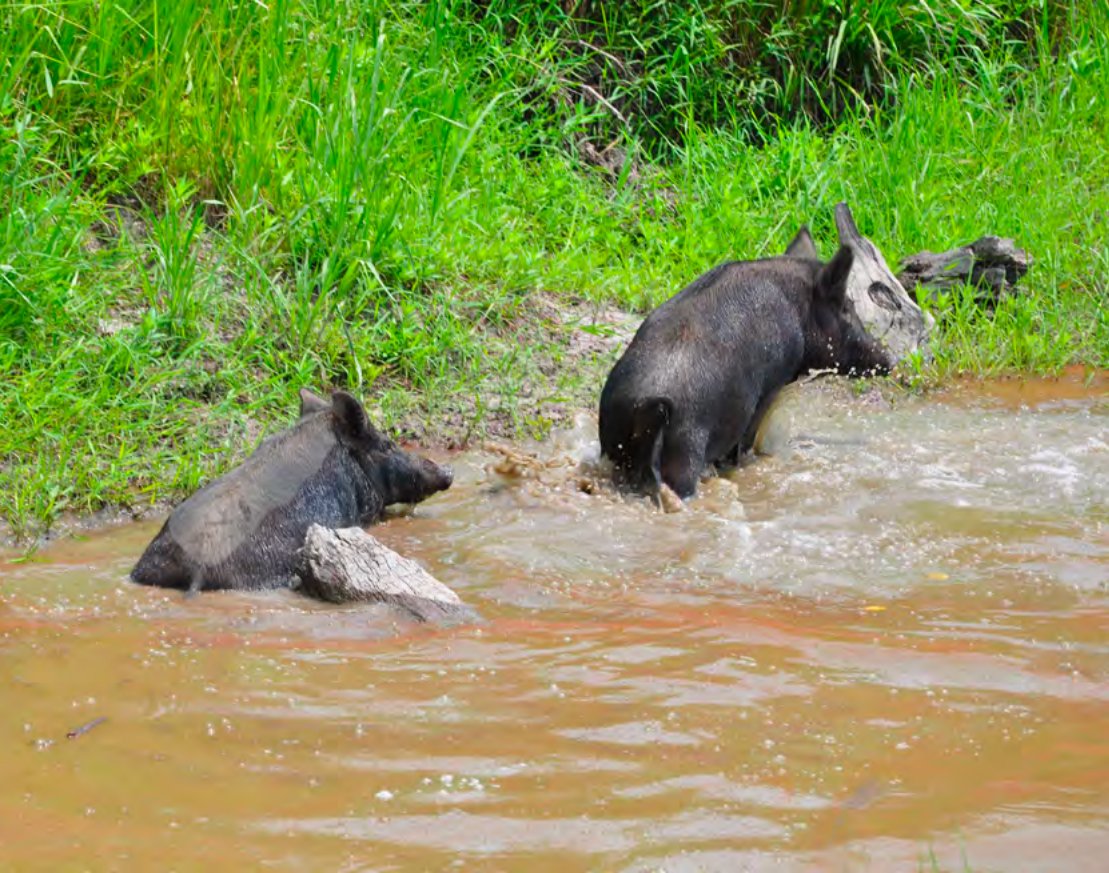
There are many factors that go into a successful year-round feral hog management program and knowing when to use a specific technique can be the difference between success and wasted time. Whether one is trapping, aerial gunning, or opportunistic shooting/hunting, the success can be impacted by many factors. Aerial gunning may be more productive in open habitats where pigs can be pushed into areas for easier shooting. While deciduous forests, young pine plantations and hilly areas can be very difficult to locate and remove hogs. Trapping with cellular equipment is very popular but may be difficult where signal is low. Hunting and opportunist shooting can be quite the challenge during the hot summer months when hogs aren’t moving during the day. Dog hunting may not be feasible on smaller acreages where crossing property lines is inevitable. Each method of feral hog removal is just another tool in the toolbox and a successful program may use all of them over the course of a year.
One of the most successful techniques that results in the removal of a large number of hogs in a short amount of time is known as corral trapping. The ability to catch 20 or more hogs at a time makes corral trapping very attractive to landowners with acreages of all sizes. A trap, with a simple wooden guillotine door, can cost less than $350 to build and be used for years. If a landowner has cellular service, then a more expensive trap that allows one to close the door at his convenience may be a better choice. Once the type of trap has been decided upon, another critical decision is where to locate it for maximum results. Whatever the setup, corral trapping is a method that has proven to be very productive (The Alabama Cooperative Extension Program has a YouTube page that provides detailed instructions on how to build a guillotine door and corral trap.).
Over the past 20-50 years, Macon County, Alabama has seen its feral hog population grow in uncontrollable numbers, doing damage to many acres of farm and hunting land. Dr. Mark Smith, a Professor at Auburn University, and I worked for several years conducting research on the effectiveness of corral trapping. We tested many factors including the location of each trap, how many pigs were caught, and time of year we were trapping. Even though the parameters changed based on what research was being done, we wanted to keep up with how many pigs were removed. All of the data from 2014 to 2016 was collected and filed. And after the numbers were compiled, the data showed an interesting trend in trap success.
Project Site
A 4500-acre site was agreed upon by a cooperative effort between several landowners. This acreage consisted of both agricultural and timber land. Agriculture included row crops, hay, and cattle. Soil type and topography varied throughout the property. Black belt soils with pH’s 7.5 and higher were scattered amongst the loam and sandy loams soils. The land was flat with little elevation change. Some of the fields were in the Conservation Resource Program and have been fallow for years with prescribed fire used as the only tool to keep succession down. A swamp with old growth hardwoods, clearcuts, and pine plantation were scattered throughout the properties. The pine plantations were being select cut for wildlife purposes and “quail woods” were being established throughout. Some clear cuts were left to natural regeneration while others were replanted in pine. Natural regeneration areas were kept to 15 acres or less to provide bedding and fawning areas for various wildlife.
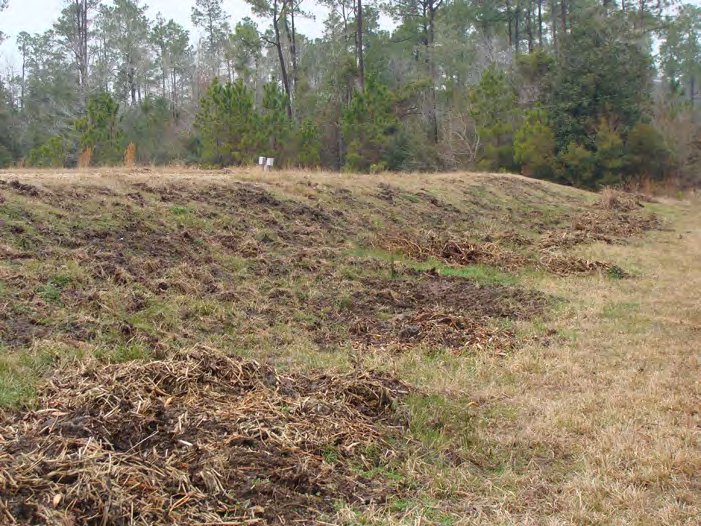
No hog hunting or opportunistic shooting was allowed during the deer or turkey seasons. Landowners, with the guidance of their biologists, strategically placed wildlife openings for winter and summer food plots. Prescribed fire, on a 3-year rotation in the pines, allowed for a wide variety of vegetative sites to aid in maximum habitat and hunting opportunities for the landowners. Any large field not used for food plots, were burned in late winter and early spring to provide bugging habitat for turkeys and to keep hardwoods from taking over. The natural plant growth provided an abundance of insects and by the time hens had poults, there was sufficient cover from avian predators. Landowners frequented their properties mainly during deer and turkey hunting seasons. During the spring and summer months, they would visit on occasion to work on their cabins, move hunting tree stands and to maintain road systems. In the fall, wildlife openings were planted and hunting stands were checked or moved.
Properties used in this research project already had a long history of feral hog management techniques applied, but the amount of trapping and techniques employed between landowners was not consistent. Some landowners used more active methods such as hunting and opportunistic shooting. Others allowed dog hunters access at any time. Others trapped but only on a small scale and only ran traps sparingly when time allowed. Some properties allowed day rides and night hunting at their discretion.
corral traps. Traps had an approximate 15-foot diameter and were equipped with a guillotine door. Triggers included a trip line with a snap shackle or root stick. A game camera was mounted to a tree near the trap to monitor pig activity before and after any capture. Trap monitors were used to determine if a trap was shut or not. These monitors did not give information on what, if anything, was caught, but rather emitted a beacon that could be heard with radio telemetry equipment to know if a door was shut. The 17-mile trip to visit all traps could take up to 4 hours. The telemetry equipment allowed all the traps to be checked in 4 minutes from a single location.
Traps were continuously set from May to October from 2014 to 2016. April trapping only resumed on properties if the landowner said all turkey hunting had ceased. All captured pigs were euthanized in the traps and the date, trap location, gender, and number of pigs were recorded. At no time were other scents put in the traps to mask the scent of any blood, feces, or urine.
Traps would only be moved to another location on the research site if the trap became too difficult to bait. This happened on occasion when the ground was wet and rooting behavior caused the inside of the trap to be too muddy to put the bait. If the trap was moved, it was moved a short distance, usually less than 20 yards. Many of the traps stayed at the same location for the duration of the project.
Bait type was not constant. Corn, soured corn, and sweet feed were the most common baits used. Molasses, fruit drinks, and other scents were used to add to the “attractiveness” of the bait. No research on the effectiveness of adding these scents had been done to this point so catch success cannot be attributed to the baits. Also, we did not maintain data on what types of bait were used in any trap.
Project Method and Data Collection
Dr. Mark Smith, lead project researcher, and I examined several different types of data. We compared the changes in the number and frequency of wild pig captures looking for how landscape, human movement, trap location, and duration of trapping had an impact. Thirteen locations were identified to place 3-inch panel corral traps. Traps had an approximate 15-foot diameter and were equipped with a guillotine door. Triggers included a trip line with a snap shackle or root stick. A game camera was mounted to a tree near the trap to monitor pig activity before and after any capture. Trap monitors were used to determine if a trap was shut or not. These monitors did not give information on what, if anything, was caught, but rather emitted a beacon that could be heard with radio telemetry equipment to know if a door was shut. The 17-mile trip to visit all traps could take up to 4 hours. The telemetry equipment allowed all the traps to be checked in 4 minutes from a single location.
When possible, a trap was put near a year-round water source as pigs use these areas heavy during the heat of the summer.

During the research project time period, 723 pigs were removed from the project site. In 2014 there were 359 hogs removed with 232 removed in 2015 and 132 removed in 2016. June turned out to be the best month for trap success with 158 pigs captured during the 3-year span. This was followed by August, September, November, July, and January. The least successful months were February followed by April, May, October, and December. No pigs were caught in March as no traps were set.
Discussion and Findings
As one might suspect, pig removal was highest during the summer months. Radio telemetry research conducted by Mr. Wes Gaston, graduate student at Auburn University, showed during months where temperatures are high, home ranges decrease significantly. During months where temperatures are colder, pigs roamed further distances to forage. Feral hogs also moved out of thickets and loafed and bedded down in open fields where sunshine could keep them warm. Winter soils are also usually softer making it easier to root for food.
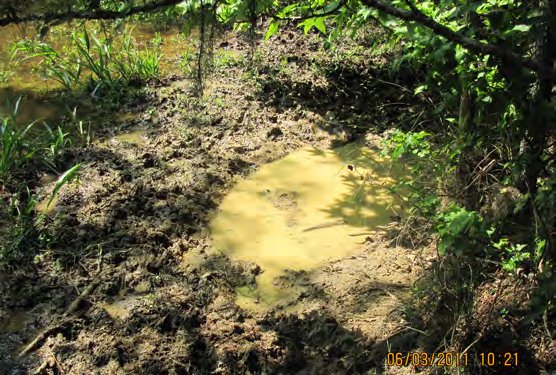
It’s hypothesized that trap success during the hot summer months was better because the population was forced to smaller areas. A year-round water source, soft ground, and shade during the day is essential. As temperatures warmed up, the home ranges decreased, making it easier to trap. The hotter temperatures forced hogs to hold near water sources so they could wallow to stay cool. Pigs do not sweat like other mammals and needed to stay near their wallows to help in thermoregulation. When pigs wallow in mud, the water evaporates from their skin, carrying away heat much in the same way sweat does in humans. The presence of wallow areas can be a sure indication of pig presence. Radio telemetry also showed that during summer month extended rain events, pigs moved further distances, temporarily, out of their normal summer areas.
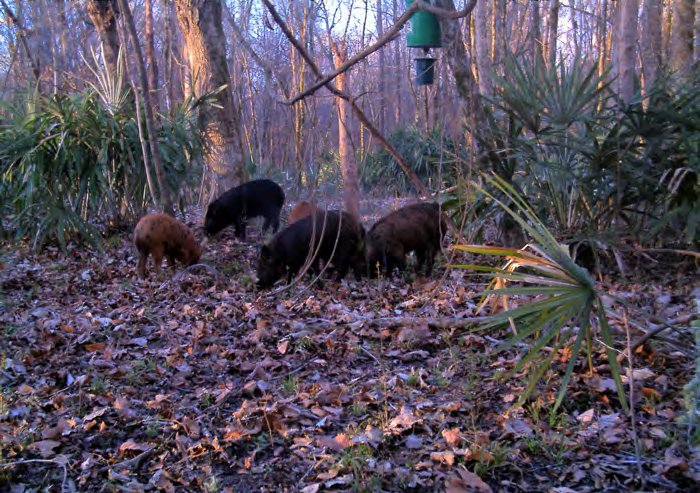
Trapping success in the fall and early winter decreased significantly. Project sites contained trees that produce bumper acorn crops and provided the hogs a preferred food source over corn. Photographs showed hogs feeding under acorn trees even around piles of corn. The fresh mast provided a much better nutritional value to the hogs. Therefore, baiting with corn to get them into traps was very difficult. November through January months were successful after most of the mast had been consumed or rotted. December was low in trap success but during this time many of the researchers were on winter vacation and the traps were not being run on a regular basis.
Late winter and early spring saw the lowest trapping success. One could reason that since the population had been decreased significantly during the summer months, there weren’t as many to trap. Another factor could have been the constant harassment by humans during hunting season pushing them from their home range to other areas. Finally, during the spring green up, an overabundance of food, low temperatures, and soft ground allowed the pigs to feed during the day and night and corn was not a primary food choice.
Trap location played a significant role in trap success. Traps located within 50 yards of a primary creek system or permanent water sources were more successful than those that were 200 or more yards away from water. Of the 723 pigs caught, 5 traps accounted for 521 of those. Three of those traps were within 50 yards of a year-round creek in swamp lowlands. While the other two were adjacent to a year-round water source, such as a pond.
Catch success in these traps reaffirms the previously discussed radio telemetry study showing that, during the summer months, pigs congregate near a year-round water source. They need these areas too so they can wallow and stay cool in the summer months. Without sweat glands, the pigs still need to stay near areas where they can wallow to cool down after feeding. The more preferred natural food sources may be too far to travel. Also, heavy clay soils are too hard to root. Even though traps located far away from water sources had a food source, the pigs weren’t traveling those distances for food.
Project Analysis
Pig trapping is a simple task if you know what to look for. Many individuals put traps in areas because they see fresh pig sign. They might see signs such as rooting, tracks or wallows, but that doesn’t mean it’s a good place to put a trap. Pigs travel more during winter months because the temperatures allow them to stay in the sun during the day. I am contacted frequently by landowners thinking they need a trap because they caught a picture of a lone boar on their game cameras. We discuss their habitat, and many times I advise them to wait and see. If their habitat is not conducive for a pig to survive during the hot summer months, I usually tell them to save their money and enjoy trying to remove it with opportunistic shooting or hunting.
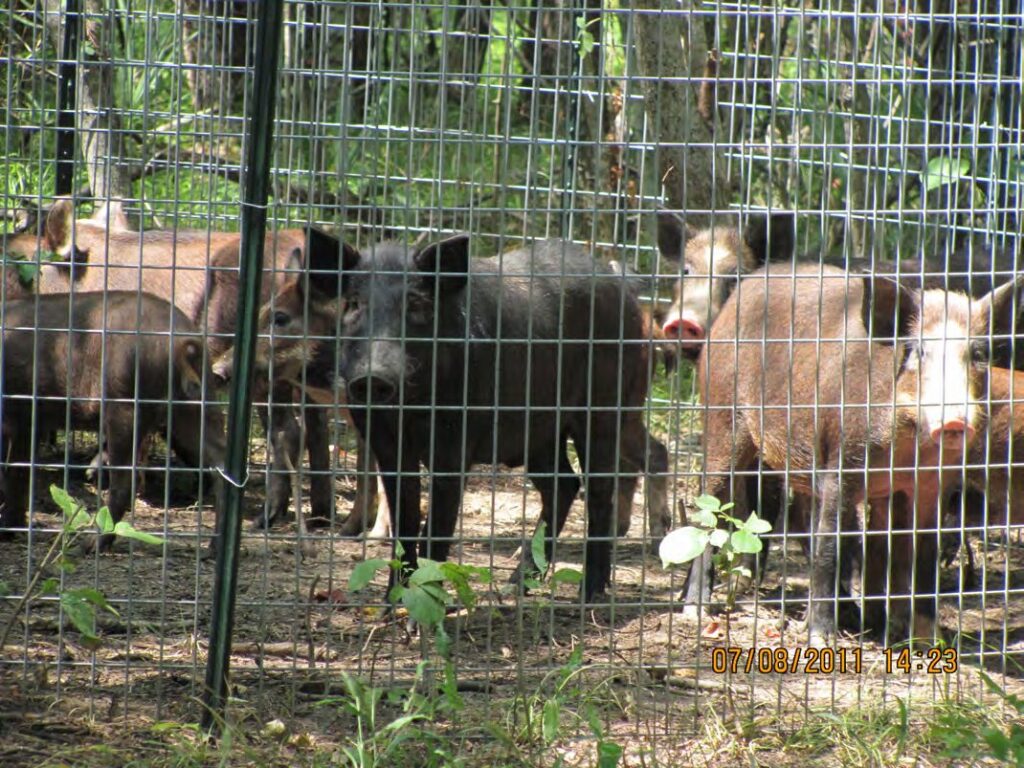
Those that have a history of feral hog presence and damage, I recommend putting traps near a summer water source. No matter what happens, pigs will migrate back to areas where they can wallow and stay out of the heat. Pigs, if left in a trap in the open, can die from heat exhaustion by 10 am in the summer. Even though removing pigs from properties is important, it’s more important to make sure they don’t suffer while in the trap.
As this project continues to be analyzed, I must mention a study that was conducted around the same time frame that examined whether or not feral swine had a “favorite” bait. As mentioned in the Project Method earlier, various types of baits and scents were used in the corral trapping study, which led researchers to ask the question, “Were pigs attracted to specific scents?” Every trapper has their favorite pig bait, right? Dry corn, soured corn, sweet feed, cattle pellets, powdered fruit drinks, molasses, soured fruit, old beer, and the list goes on. Many trappers even soak their corn in motor oil and mix it with dog food. The newest scent on the market is an attractant like deer scents that mimic a doe in estrous.
Dr. Mark Smith and Shannon M. Lambert decided to test some of these products to see if they had a significant impact on trap success. Some scents are expensive and take time to make. Were they worth it? They hypothesized certain scents decreased the amount of time it took for pigs to locate them. Their objective was to determine if detection time of wild pigs to a bait station differed by adding molasses or pig urine to corn piles verses having no scent at all.
Areas were chosen where there had never been a bait site. They set up 22 molasses, 23 pig urine, and 30 corn only sites. Researchers placed cameras on each site and monitored activity for two weeks. They documented the first time a pig was seen, frequency of visits, identifying characteristics and size of the sounder.
Pigs detected molasses on 10 of 21 sites or 48% of the time. Pigs visited 8 of the 23 urine sites and 5 of the 22 corn sites. Visitation time varied between each site. They stayed the longest at the urine site averaging 77.7 hours. Molasses and no scent were close at 51.4 hours and 49.4 respectively. The data suggests the molasses and pig urine scents do not significantly impact a pig’s bait station visiting times. This is important because pig trapping can be expensive, and every trapper has a budget.
There are still other questions that need to be answered regarding bait scents. Do pigs in other areas respond differently? If bait stations were placed differently would that have made a difference? Research on these and other feral swine behavior continues so that landowners and biologists will have the most effective tools in their toolbox to control this ever-growing nuisance.
Conclusion
Since this study was conducted over three years ago, the property site still experiences feral swine issues. Years of pig trapping has shown that if 150 to 200 hogs a year can be removed, there is far less damage to winter wildlife food plots and much better wildlife sightings of deer and turkeys. Combining rigorous trapping during the summer months with other methods in the winter or fall, the population can be controlled, but never eliminated.
Where are these pigs coming from? Areas where no pig management is taking place get crowded and the lack of food sources causes them to move and look for new areas. As a population increases, the young often roam until they find a good habitat. Often this happens along natural corridors following river and creek systems in lowland areas.
Unfortunately, there are those that move pigs to their hunting areas so they can make a profit off a weekend hog hunt. This is a bad idea, because a released hog, unfamiliar with the area, most likely will not remain in that spot. In most states it is illegal to relocate hogs, but it is still being done for recreation and money-making purposes. If the habitat is not conducive, the population may not reproduce well and be eliminated naturally over time. On the other hand, if they are moved into an area where the habitat can support a year-round population, they multiply radically, making it very difficult to eradicate them.
More research into population densities and movements in primary habitats could help develop strategies to slowly reduce pig damage by targeting habitat in prime trapping times. Feral hogs are not going to be eradicated anytime soon so using all the tools in the tool bag in a strategic way is the only option.
Trapping is the most effective method to remove large numbers of hogs with little effort in a short period of time. Time of year, trap location, and bait type all can influence pig trapping success. There are many factors that affect whether a pig is caught. Many times, that group of hogs you think got “smart” and are avoiding you got caught in the neighbor’s trap and they never told you. A sounder of pigs may show up one day on your camera and move on never to be seen again. The habitat type may be favorable for pigs in the winter and not summer. There are many questions when it comes to pig trapping and fewer answers. The only rule to pig trapping is if the trap’s not set, you can’t catch.