

For most of us avid turkey hunters, a crisp spring morning in April with multitudes of songbirds and frogs providing background noise and the woods ringing with mature gobblers is hard to beat and what drives us out of bed at ungodly early hours! The general consensus among both hunters and biologists is that the turkey population in the Southeast is trending down in the last few years, in some places for a decade or so. There are plenty of examples of well managed and well-placed properties that have as many turkeys as ever, but many places are suffering lower numbers. So, what is causing this decline and is it an issue that needs addressing?
It is well understood that turkey populations fluctuate due to various factors, mostly weather, predators and habitat quality. The simple equation is that we HAVE to recruit as many or more turkeys into the fall population than are lost to hunters, weather and predators. Most states collect reproductive data in the early summer in the form of poult counts and record the number of poults and hens to derive a “poult per hen” ratio that gives an estimate of reproduction. In the Southeast, this number has been going down for years and, in places that are declining, we are no longer replacing losses.
Bear in mind that gobblers are only a small part of the population, albeit, the most important to turkey hunters. When hens are declining, it is not because of hunting (at least in states that don’t allow hen harvest). So, something besides hunter harvest is going on where these declines are occurring. Although still to be proven, hunter harvest early in the spring before most hens are incubating may have an effect on reproduction and various research projects are studying this.
We can’t control the weather and have to live with what we get. Predation is a touchy subject that has been discussed in other issues of Wildlife Trends. Nests are lost to various critters from raccoons to crows, poults are lost to critters from foxes to Cooper’s hawks and hens are lost to critters from bobcats to owls. I will note that predator control can be effective at lessening nest and poult loss.
That leaves us with habitat management as our most effective tool to maintain or increase turkey populations. While most turkey hunters (and often managers) feel that the favorite habitat type of turkeys is hardwoods, woodland management is often much more complex. The most important concept for turkey management is that for abundant populations, a mix of three primary habitat types is necessary. While turkeys can exist in solid, young, pine plantations; expansive hardwood bottoms; large agricultural environments; and open, burned, quail plantation pineywoods, none of these habitat types generally yield optimum populations in and of themselves. An approximately even mix of open fields and pastures, pine stands, and hardwood bottomland is the best way to sustain quality turkey populations.
Turkeys will not only utilize, but thrive in many different habitat types (such as residential areas) that were previously thought uninhabitable. Take intensive pine plantations for instance. While not exactly what someone might recommend as a turkey management technique, some pine plantations are utilized quite extensively by turkeys and their broods. However, without hardwood bottoms for roosting and winter habitat, and available quality nesting habitat, extensive pine plantations are often void of turkeys. When the ground is bare after clearcutting, turkeys utilize the clearcut as they would any opening. From first growth after planting through the thick/brushy stage, hens use the area for nesting. Once the stand begins to shade out turkeys use it very little (very little food or cover is available in the shade) but will travel through it and use it for cover. Once a stand is thinned, and especially if it is burned, turkeys again use it for finding food, nesting and brood rearing. Where hardwoods are limited, as in the above scenario, they are extremely important to the turkey population and turkeys will travel long distances if necessary to find them during certain times of the year.
A brief life history is in order to illustrate how turkeys utilize these three habitats throughout the seasons. Usually the large winter flocks, often numbering from 15-50 or more, seek out large acreages of bottomland hardwoods interspersed with grassy openings. These open bottoms are often full of easy to access winter carbohydrate type foods – acorns. Turkeys can fatten up on acorns of various species and scratching the leaf litter in these open bottoms is easy. This is the time of year when these hardwood bottoms are at their most productive. The large winter flocks also like to roost in the bottomland hardwoods in large groups.
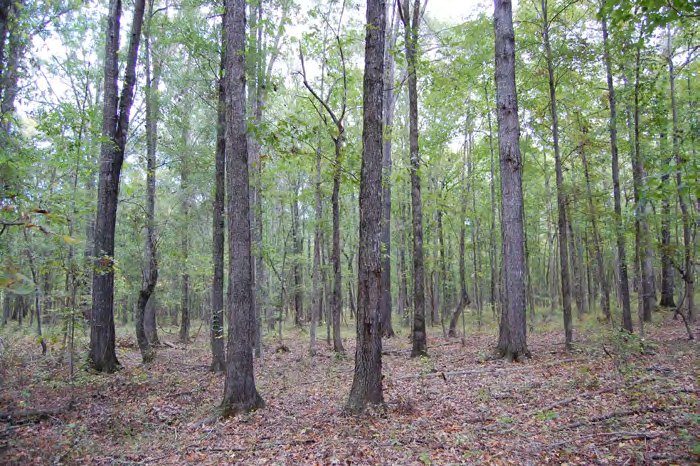
As the winter progresses into spring, several things begin to occur at once. Gobblers and hens begin to feel the seasonal changes and begin to prepare for breeding season. The large flocks begin to break up, acorns begin to become scarce, and the woods begin to green up. Hardwood bottoms, when they have their leaves on, are a low productivity habitat. With little sunlight available to grow plants on the ground, no food is available until fall when the oaks begin to drop acorns. As spring progresses, hens begin to feel the urge to search out nesting cover and begin to use upland habitats more (hence the common malady of lots of turkeys in the winter but can’t find any spring gobblers). Burned, grassy, open, upland pine stands are a choice habitat type at this time. The birds will roost in pine trees in both the uplands and bottoms and often feed all day in openings or pineywoods without being near large bottoms. Hens with poults in the summer use fields and open woods and by fall when regrouping begins to occur and the acorns start falling, they begin to prepare to winter in the nearest large hardwoods.
Generally, if a property is broken up with shady hardwoods in the creek bottoms, 10-30 % of the property in pastures and oldfields, and the uplands are well managed, turkeys do well with 30-60 % of the habitat in bottomland hardwoods. Much more hardwood and the property develops too little understory vegetation (nesting, brood rearing, and spring/summer feeding habitat) and cannot support a large turkey flock. Much less and there is too little winter habitat and spring roosting areas. If your property is composed of less than 20 % hardwood creekbottoms, turkeys may also leave in the winter for neighboring properties where the hardwoods compose more of the habitat or you may find yourself without turkeys at all.
Turkeys use pine stands throughout the year depending upon pine density, species, age, style of management, and season of the year. As noted before, low density, grassy, burned pine stands are highly important for turkey nesting. This type of “quail woods” pine management entails having a maximum of 100 trees per acre if the trees are 6-8″ in diameter and as low as 15-30 trees per acre in a mature sawtimber scenario. Burning every few years keeps the woodlands open and grassy while leaving scattered thicket cover. Turkeys actively seek out these “roughs” in grassy pineywoods to hide their nests. Newly sprouted grasses provide food, burning exposes seeds and nuts, and the clean nature of fresh burns allow turkeys to feed without worrying about being ambushed by predators. Turkeys will often fully move into these woodlands in the spring, roosting in pines and feeding in burned woods. Later in the early summer, low growing grasses provide abundant insects and excellent cover for hens raising broods. Longleaf pine is especially suited to this type of management, being tolerant of fire throughout their life cycle.
Not all pine stands on the property, however, need to be managed in an open nature. While grassy woodlands are imperative for good nesting habitat, turkeys also utilize more heavily stocked, shady pine or mixed pine/hardwood woodlands with a scattering of weeds and grasses. Transitioning pine stands from more heavily stocked along drain and hardwood edges to more open, and grassy on ridges is an excellent way to provide both stand types. This is especially productive when trying to maximize timber income by allowing these heavier stands to exist on the more productive soils of the mid and lower slopes of ridges and allowing the thinner stands to exist on the drier, less productive ridge tops.
As noted above, when the ground is freshly clearcut, turkeys utilize the area as a standard opening. Clean ground is easy to feed in and turkeys in the middle of large openings feel secure from ambush. While thick, young plantation pines are not a great turkey habitat type on a large scale, small clearcuts growing up with thick briars and brush as well as young pines provides security cover and limited nesting habitat. Unfortunately, most clearcuts become too thick for turkeys to enter beyond the immediate edges after a few years of growth and people often clearcut too large of a block.
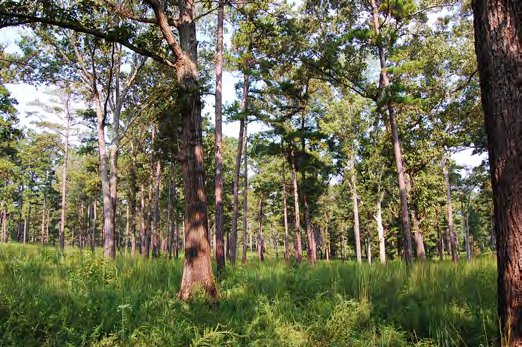
Turkeys typically do best when timber stand management units are kept to less than 100 acres and it is best in the 30–50-acre range. This allows better usage of the blocks throughout their life. Although turkeys have home ranges in the thousands of acres, smaller block size increases diversity of the property and keeps from having poor habitat (i.e., 5-year-old planted pine) composing large portions of their home range. This applies to burns as well. Although turkeys love a burn, large burns over hundreds of acres are poorly used by turkeys. Research has shown that turkeys only use the edges of large burns and often stay less than 200 yards from burn edges so the middle of large burn areas are not used much.
Natural mixed pine/hardwood is another type of timber stand that does not have much attention paid to it and its value. Most foresters don’t like mixed stands nor natural stands and they are, typically, the first stands on a property to be converted to planted pine. They are usually upland and these sites grow pine well. They don’t return much income and are hard to manage. A few decades ago, there was a lot of mixed stands that had been clearcut and simply allowed to regenerate in whatever came back. Stands cut in the early 1900’s and grown for 80 years or so were magnificent. This process takes decades and the timber is usually slow growing.
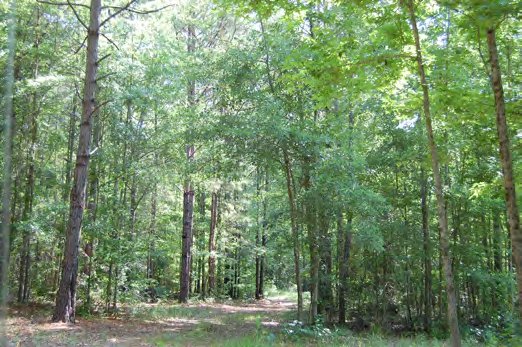
From a wildlife perspective, however, these stands have a lot of different species both in trees as well as mid-story saplings and shrubs. Pines are scattered among the hardwoods and often are composed of multiple species. Various types of oaks, hickory, black cherry, beech, elm, maple, poplar, pecan, gum, and persimmon are found. Mid story hardwoods are often hornbeam, chinkapin, dogwood, paw paw, mulberry, sassafras, red bud, locust, mayhaw, holly. Shrubs like blueberries, buckeye, beautyberry, chokecherry, wax myrtle, sumac and azaleas flourish in these woods. The beauty of these stands is in the species diversity and food being produced in multiple seasons. Make no mistake, turkeys LOVE these natural stands. Sadly, most all natural stands have been clearcut and converted and it is one of the types of timber that we seldom see anymore.
Hardwoods are another issue. While hardwood acres across the Southeast are reported to be stable, the size and quality is probably not. Large scale loss of mature hardwood areas are probably contributing to declines in turkeys in certain areas. Clearcut hardwood takes decades to become mast producing and roost trees and get back to being useful to turkeys. In the interim, they become great places for predators to live. If turkey management is part of a landowner’s objective, hardwood stands scattered throughout the property should be protected and any harvesting should be evaluated with a critical eye for its impact on turkeys. In mature hardwoods, the best way to regenerate oaks is to clearcut since oaks love sunlight and don’t regenerate well with any shade. If you have the need to regenerate a stand of hardwood, small clearcuts is the best way to go to provide quality habitat and reduce any negative impact on turkeys.
The bottom line here is that in the Southeast, turkeys are inextricably linked to hardwoods. Again, large blocks (hundreds of acres) of hardwood are not the best turkey habitat and tend to be devoid of turkeys in spring and summer. However, tracts without hardwood rarely have great turkey populations. The best way an avid turkey manager can maintain hardwoods correctly on their property is to retain the natural drainages and hardwood flats in predominantly hardwood stands and manage the uplands in pine. A few upland hardwood ridges allow a nice mixture of hardwoods species to retain a place within a property (some species of oaks are totally bottomland and some upland). In addition, retaining a scattering of upland, fire tolerant oaks and other hardwoods in a burned pine stand also add to the diversity of turkey woods.
Managing openings is the final “habitat” issue. Both plantings and “fallow” management is the optimum. Turkeys utilize openings in all seasons for a variety of reasons. Winter flocks will forage through harvested crop fields like corn, beans, etc. as well as greenfields planted to winter grains (wheat, oats, rye, etc.) and clovers. Turkeys tend to feel comfortable in low growth fields where they can get 100 yards or more from a woodline edge and avoid being ambushed by predators and hunters. Gobblers can readily be seen strutting and gobbles travel well in openings with low vegetation, both important characteristics for a gobbler who wants to advertise his presence to hens. Pastures with rolling terrain are especially well used (even better if the pasture has cows on it to keep it mowed and deposit patties which turkeys will “flip” looking for insects and undigested corn). This is an animal that relies heavily on their eyesight to prevent them from being eaten. Scattered pine and hardwoods (a couple per acre) throughout large pastures makes the field more attractive to turkey use. Hens with broods not only use pastures but also weedy fields where there is a low weed canopy that protects the chicks but the hen can still see over. Weedy fields and pastures usually have an abundance of insects that are necessary for growing chicks.
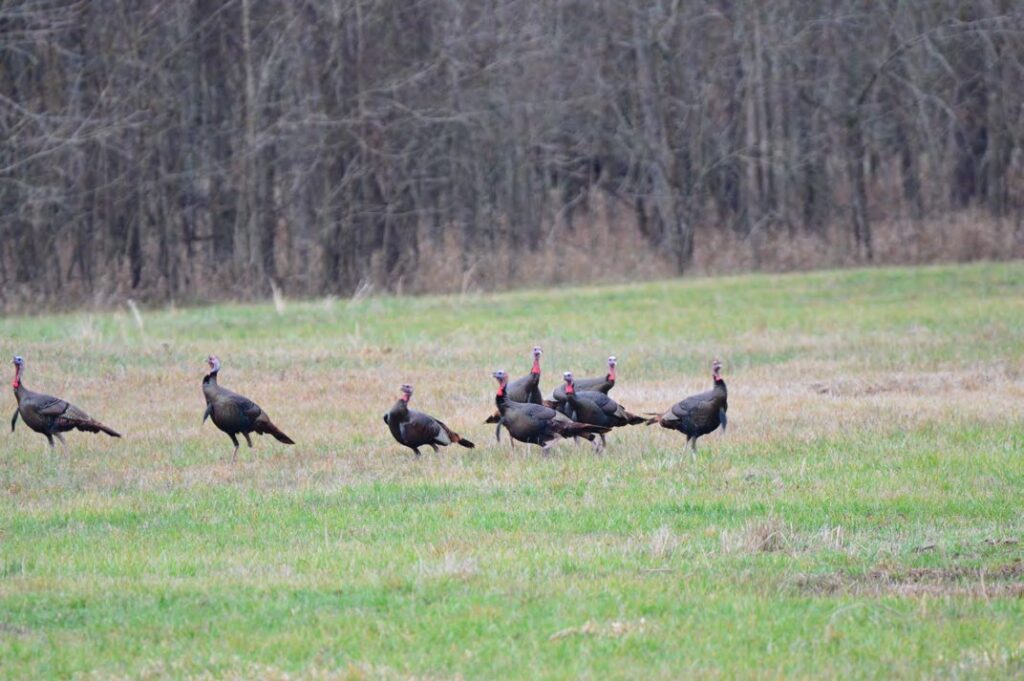
In general, turkey openings should be no less than an acre and 3-5 acres is a good average. Openings are important and should compose anywhere from 5-30% of a property and be well distributed throughout the property. Pastures and agricultural fields are well used in larger formats (up to 30 acres), again provided that they are narrow. Agricultural fields that are planted to a single, harvested crop can be significantly improved by allowing an unplanted 30-50-foot edge to exist along the perimeter of the field as well as leaving a few rows of standing crop unharvested along this border. Fields larger than 2-3 acres can be multiple cropped with two or more types of plantings existing in a single field. Fields smaller than this should have only one type of planting, provided that they can withstand existing deer browse pressure.
Fall disking a portion of your openings usually promotes an annual complex of ragweed, partridge pea, pussley and the like the following summer and is the primary way to manage “fallow” fields. This habitat type is highly insect productive and is good cover for chicks and hens. Portions of fields left fallow for a few years often result in broomstraw, Indian grass, blackberry, and other perennial natives and shrubs that provide good nesting habitat. One third to ½ of the openings scattered throughout the property left in this condition will provide for good reproductive habitat.
Annually planted fields in the remainder of the openings can be anything from winter greenfields to clovers or summer legumes if deer browse will allow them to be planted. Clovers are particularly well used by turkeys all spring and summer. They provide good green forage for turkeys as well as bugs for poults. Most plantings for wildlife have value for turkeys. Chufa, corn, beans, sorghum, millet, etc., all have value. What is planted in a field won’t necessarily make or break your turkey population. The fact that the fields are planted with something useful is the requirement.
Bottom line is that a top-notch turkey property all seem to have these components and a diverse structure. Hardwood drains and/or large bottoms, open and burned upland pine stands, Multiple aged and species pine stands from young longleaf to loblolly, scattered fallow openings, planted openings all in sized and spaced patches that allow turkeys to use all of the available habitat.
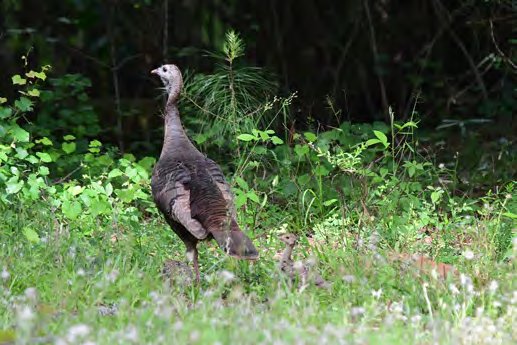
The property on this map is a good illustration.
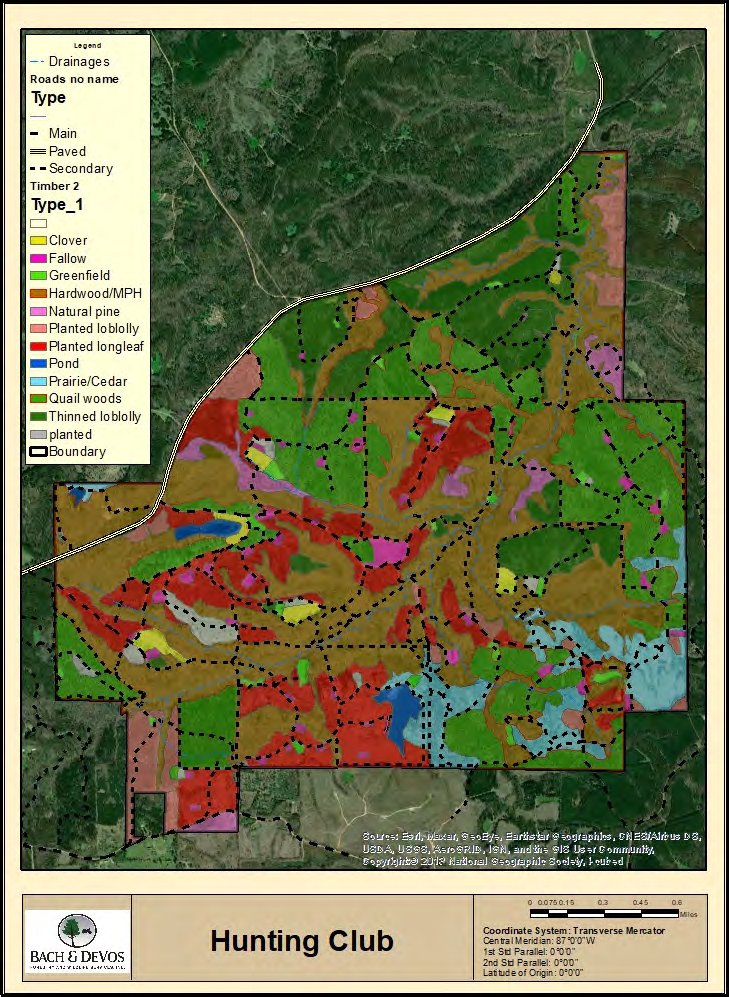
Understandably not everyone has the means to have a 3,000-acre tract with the habitat structure in place to create something like this. However, it is a good illustration of an incredibly diverse property with exceptional turkey numbers.
The bottom line is that habitat management, structure and diversity is the key to maintaining good turkey numbers. Like quail, turkeys may no longer be simply a byproduct of standard land management practices. While many are still blessed with good numbers without any concerted effort to maintain them, many are finding that to keep good turkey populations, they need to focus more on habitat management, burning and timber structure as well as things like predator control.