
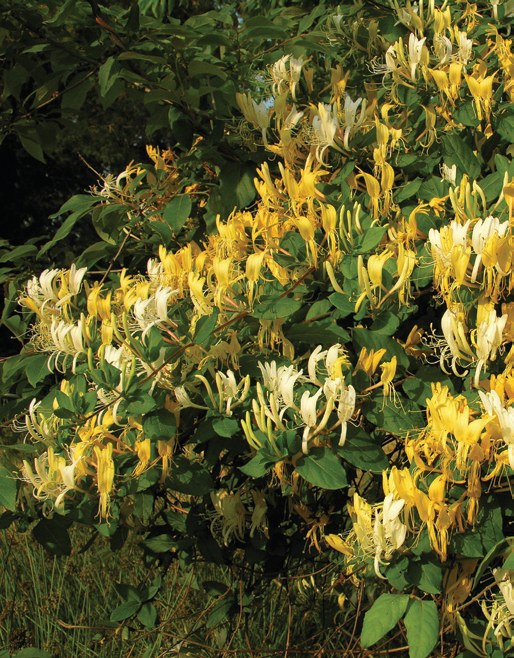
Research studies show that wildlife instinctively seek the most nutritious natural foods available. Does a single plant species exist that meets all of the nutritional needs of white-tailed deer? Probably not, however, one plant that comes close is Japanese honeysuckle (Lonicera japonica). A friend to wildlife managers and hunters, this naturalized invasive plant provides essential nutritional forage, and bedding and escape cover year round for deer, birds and small game.
Farmers and timber and natural area managers on the other hand, generally have a dim view of the choking vine and take steps to control or eradicate it in problem areas. Love it or hate it, experts say, Japanese honeysuckle is here to stay.
Honeysuckle exclosures and “fences” are effective tools as part of a quality deer and habitat management program. They’re easy to maintain, require relatively small investments in time and outlay and pay big dividends in improved nutrition, habitat and increased hunting and viewing opportunities. Design is only limited by your imagination. First, read on to learn more about Japanese honeysuckle. Then follow the general instructions below to construct “natural food bars” for the wildlife on your property.
Garden Escapee
Japanese honeysuckle is native to Japan, Korea, and eastern China. The vine was introduced as a cultivar from Asia to North America in the early 1800’s. The plants’ attractive and fragrant flowers destined it to be a valued garden ornamental. However, its hardy growth characteristics and a long-flowering period proved the forerunners of a garden runaway. It currently ranges from Texas to Florida, north to Massachusetts, and west to Iowa and Oklahoma as a result of seed dispersal by animals, use for road and railroad bank erosion control, and plantings for wildlife forage. Japanese honeysuckle is considered a naturalized invasive exotic in many areas, particularly in the southeastern US.
Honeysuckle is common in young pine and hardwood plantations, along forest margins, field edges, right of ways, and along streams. The semi-evergreen perennial vine quickly becomes tangled to form ground cover, densely tangled thickets, and arbors in woodland canopies. The root system may extend laterally for a distance of 7 to 10 feet, and attain depths of 3 to 4 feet. Leaves are broadly ovate to elliptic to oblong, grow opposite, and measure 1.5-2.5 inches long, by .8-1.5 inches wide. Leaf margins are often lobed in early spring.
Flowering occurs from April to August. Fragrant blossoms are white with a slight purple or pink tinge when young, changing to white or yellow with age. The flowers inspire a tradition southern children have enjoyed for generations of lazy summer days teaching younger ones the fine art of tasting “honey dew” by gently pinching off the base of a honeysuckle bloom then slowly pulling the flower’s pistil until a single drop of clear, sugary nectar appeared. The sweet prize was then quickly dabbed on the tongue.
Fruit and seeds mature from June to March. Round berries are green ripening to glossy black, measure 0.2 inch, and contain two to three seeds. Honeysuckle persists by rootstocks, rooting at nodes, and animal-distributed seeds.
A Deer Sanctuary
Often referred to as a “thicket”, a large honeysuckle thicket is an absolute deer sanctuary. In addition to a year-round food source, thickets provide thermal protection, and fawning, bedding and escape cover.
Wise hunters recognize Japanese honeysuckle as a significant browse species for white-tailed deer. Honeysuckle leaves supply a year-round, highly digestible, quality food for whitetail deer. Reported protein contents range from 9 to 20 percent. It can account for nearly half of the year-round diet of white-tailed deer in these areas and provides them with an important source of crude protein, calcium, phosphorous, and digestive bulk. Protein content is dependent upon the season and soil fertility with the highest levels reported during the cooler months of the year. Honeysuckle berries provide a food source for wild turkeys, bobwhites, songbirds and small mammals.

What’s not to like about Japanese honeysuckle? The plant’s positive attributes bear a caution. Typical of invasive species, Japanese honeysuckle’s growth hardiness, long flowering season, and seed dispersal allow it the capability to overtake and replace native flora on a wide range of site types. Consequently, its popularity may create some conflict between the goals (i.e., more habitat, forage, and deer) of hunters and wildlife managers, and invasive species control efforts to protect native plants.
Many hunting leases are under timber management or agricultural crops. Before planting or managing existing honeysuckle on any land except that which you own contact the landowner and/or lessor for approval.
Honeysuckle Exclosures, Build Them and the Deer Will Come
Honeysuckle is a robust plant but tough to establish in areas subjected to frequent burning or with high deer densities. Local honeysuckle is cost free and can be used to propagate. Cut sections of vine with nodes then root in pots or purchase seedlings from a nursery. Seedlings and rootstock planted in a wire exclosure are protected while allowing deer to browse on the succulent new growth.
Exclosures and fences can be constructed in a variety of styles and dimensions often with supplies already on hand.
Locate an area with limited shading and eliminate weeds and brush. Select locations that offer possible hunting and/or viewing opportunities. Pay attention to positioning in relation to nearby cover, prevailing winds, stand sites, and anticipated routes of approach by deer. Honeysuckle is not fire tolerant. If constructed in areas subject to controlled burns, establish fire lanes around the perimeter.

Honeysuckle seedlings, whether purchased or transplanted from the wild, should be planted during late winter or early spring to ensure sufficient rooting prior to the dry season. Fertilize once the seedlings have become established. Be careful not to over-fertilize.

Tent Style Exclosure
As shown in the photo, 2″x 4″ welded wire and posts can be used to form a tent style exclosure. These can be any length.
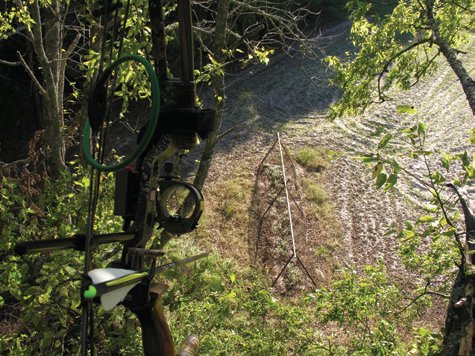
Supplies for a 15 ft. exclosure:
- 50ft. length of 2″x4″ welded wire 5 ft high
- Six 8ft. steel posts
- 1 roll of 4ft. wide ground mat. Lengths vary. One exclosure will use about 20 ft.
- Wire or plastic ties
- 15 honeysuckle plants
- Pine needle, bark or wheat straw mulch, (optional)
Measure and mark two 15 ft. lengths 3 ft. apart. Drive a post on an angle at each end and one midway on both sides crossing the post tops. Secure with wire.
To protect seedlings, dig a 6 inch trench for the wire between the posts and at ends. Install the ground sheeting. Cut two sections 25 ft. long of welded wire. Use wire or plastic ties to secure one length of wire to the posts leaving 5 ft. extending past the end posts.
Before installing the second wire section cut X’s in the sheeting about 1 ft. apart in an alternating pattern 1 ft. from a side. This will allow the plants to quickly attach to the wire. Plant the honeysuckle, water, and apply mulch if desired. To finish, install the second wire section. Close the ends with the overlapping wire to protect seedlings. Trim any excess wire at the ends. Fill in the trench with dirt.
When plants are established fertilize lightly with 13-13-13. Till or disk around the perimeter or apply an herbicide such as Roundup periodically as needed to control weeds.

Teepee Exclosure
A simple, economic design installs quickly and features a low teepee design. Select a location with limited shading. Till or disk to eliminate weeds and brush. These can be made small and positioned in groups.

Supplies:
- 5-10 ft. length of 5 or 6 ft. 2″x4″ wire
- honeysuckle seedlings for each foot of length
- T-stake posts to install every 2 ft of length
- 4 ft. ground matting cut to length
- Wheat straw, pine needle, or bark mulch (optional)
Measure and mark two sides to the desired length 3 ft. apart. Dig a 6 inch trench around the perimeter. Install ground matting. Cut X’s in the matting about 1 ft. apart in an alternating pattern 1 ft. from a side. Plant seedlings then water. Mulch if desired.
Bend the wire lengthwise to form a low teepee. Place wire over the seedlings in trench and anchor the exclosure using T-stake posts or tent stakes every 2 ft. Fill trench with dirt. Close the ends with leftover wire. Secure with plastic ties or wire. Honeysuckle is not fire tolerant. If constructed in areas subject to controlled burns shield by establishing fire lanes around the perimeter.
Honeysuckle Fence
The Mississippi Department of Wildlife, Fisheries and Parks constructed several “honeysuckle fences” on wildlife management areas. Two parallel fence lines were installed two feet apart using 2″x4″ welded wire. Each measures about 4.5 feet tall, 2.5 feet wide and 100 feet long. Fences can be any length that fits individual needs.
Cool or warm season food plots are ideal locations for large honeysuckle plantings. Honeysuckle fences install quickly and offer wildlife one stop dining for both cultivated and natural forage. Within cultivated food plots, management is convenient in terms of fertilization, weed control, and fire protection.

Supplies for a 45 ft. fence:
- 100 ft. length 2″x4″ welded wire
- 14 steel or wood posts
- wire fence ties or fence staples
- 50 ft. ground mat 4 ft. wide
- 45 honeysuckle plants
- bark, pine needle, or wheat straw mulch (optional)
Till or disk location. Measure and mark two 45 ft. sides about 2.5 ft. apart. Dig a trench 6 inches deep around perimeter. Install posts at about 7.5 ft. intervals along the long sides. Lay the ground mat. Cut Xs about 1 ft. apart alternating placement about 1 ft. from the sides.
Cut two 45 ft. lengths of wire. Place lower edge of wire in trench. Erect one fence using wire or fence staples to secure wire to posts. Plant the honeysuckle seedlings. Mulch if desired.
Erect second fence. Cut leftover wire to fit ends. Secure to posts closing the fence to protect young plants. Fertilize once plants are established. For an area of this size, only 0.35 pounds of ammonium nitrate and 0.6 pounds of 13-13-13 would be required.
Ring Exclosure
Ring exclosures are the same design as ones used to gauge browse pressure on cultivated food plots.
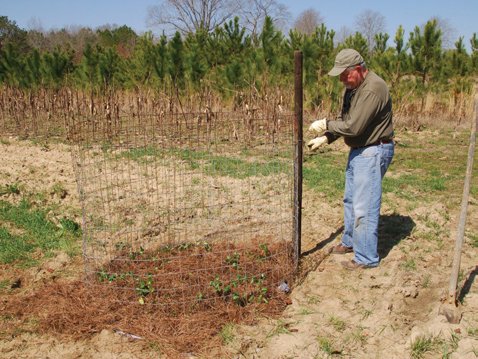
Supplies:
- 8 ft. length of 2″x4″ welded wire
- 1 6 ft. metal or wood post or Rebar
- wire or fence staples
- about 6 ft. of ground mat 4 ft. wide
- 4 honeysuckle seedlings
- bark, pine needle or wheat straw mulch (optional)
Till or disk area. Install post. Dig a 6″ trench the size of the wire circle. Lay ground mat. Cut Xs evenly spaced about 8 inches from inside edge of trench. Plant seedlings, then water. Apply mulch if desired.
Roll wire and secure ends together to form a circle. Set wire ring into trench over plants. Secure to post with wire or fence staples. Fill in trench. When plants are established fertilize lightly with 13-13-13. Periodically disk around the perimeter or apply an herbicide such as Roundup as needed to control weeds.
Tips To Manage Existing Japanese Honeysuckle
Winter is a good time to scout for potential areas to manage when green honeysuckle leaves highlight against a leafless landscape. Note areas that have grown out of reach for deer foraging. Mark those sites with flagging or go high tech with a GPS and store each site’s location for future reference.
Research studies report honeysuckle responds to browsing with vigorous growth. Following are steps to further increase production and forage volume of naturalized honeysuckle. Calculate the approximate area of each site. To do this use a rangefinder (remember to convert yards to feet), or a tape measure and boot leather to determine the thicket’s length and width. Do the math, (length x width in feet= Area in square feet). Convert to acreage. One acre = 43,560 square feet therefore 43,560÷area=acreage.
Collect soil samples for analysis. Apply lime according to test recommendations. Fertilize thickets in early spring and again in early fall with 300 pounds per acre 13-13-13. For the fall application 150 pounds per acre of ammonium nitrate may be substituted. Under ideal conditions managed honeysuckle patches have been reported to produce well over a ton of forage per acre. Due to honeysuckle’s trailing characteristic remove hardwood vegetation if possible to prevent excessive shading and ensure it remains within reach of browsing deer. Reserve brush tops to scatter on larger open sites for vines to climb.