

Seldom is there actually such a thing as single-species management. The closest examples I can think of occur in zoos. Yet, quite often we implement wildlife management practices on our properties with only one type of animal in mind. Other species will most likely be impacted by what we do as well. Even using a zoo example, there could be unanticipated indirect impacts. Let’s say a zookeeper installs soil and grass in a gorilla’s enclosure where there was once just bare concrete. It would be pretty safe to assume that the only one that would be affected by that change would be Mr. Kong, right? Actually there might have been English sparrows sneaking through the bars and picking up small crumbs of gorilla chow off the smooth concrete surface. The sparrows may not be as able to pick the crumbs out of the grass, and therefore may be negatively impacted, while the robins that hopped through and are pulling earthworms from the new sod are happy about the change.
This is a very artificial example of wildlife management, of course, but it illustrates how habitat management directed towards one species is bound to impact the other species in the area. Sometimes those impacts are significant, sometimes they are not. Sometimes the impacts are beneficial, sometimes they are not. It all depends on the species and what type of manipulation is taking place. In the case of bobwhite quail (a wild, free-ranging animal) management, typically a wide array of species will be affected (some positively and some negatively) by the required habitat treatments, depending on your location and current status of the property to be managed.
Natural Neighbors of the Bobwhite
To gauge the overall suitability of a property for bobwhites, managers often measure current habitats against historic conditions in the southeast. As we all know, way back before Europeans arrived, there was (in addition to scattered prairies and storm-blown openings) a vast amount of open longleaf and other upland pine or pine-oak forest that burned every few years. This open forest system allowed sunlight to reach the forest floor creating a patchwork of abundant grassy, herbaceous plant communities. These were the areas our native quail and many other critters scratched out a living, and in turn, is the kind of environment in which they are adapted to survive. Some species were tightly bound to this ecosystem and have been declining over the past few decades just like the bobwhite. It stands to reason species with the same basic needs as those of the bobwhite (grassy and shrubby cover, seeds, a warm-season arthropod prey base, and access to bare ground) would be affected by habitat manipulation in a similar manner as the bobwhite. This, as a general rule of thumb, is true. We will discuss the species that share these basic niches with the bobwhite later in this article. For those species, bobwhite habitat maintenance is almost always beneficial. There are, however, many species that share only certain aspects of the bobwhite’s habitat during one or more seasons of the year. Many species in this category are also favored by providing quality quail habitat, since it is generally limited on the landscape. On the completely opposite side of the coin however, if you are converting a piece of property that is currently not good for quail, to quail habitat, it is likely that some wildlife will be displaced or otherwise negatively affected. These impacts are generally quite predictable and knowing the wildlife population trends that are likely to occur as a result of your quail management is sometimes important.
Habitat Overlap and Species Effects
Three of the most common and most effective things we do as quail managers on the average tract of land is to thin timber stands, control hardwood midstory, and burn. Of course there is a lot more to quail management than just these three things, but they’re the main techniques that we will use in this discussion to illustrate potential impacts on different guilds of wildlife. When it comes to the various wildlife species that may be affected by thinning, midstory removal, and burning in the south, they will usually fit into one of the three general categories alluded to earlier; A) species that are completely benefited, B) species that will experience mixed impacts, and C) species that would be negatively impacted. Again, these impacts are typically related to the level of habitat overlap those species share with the bobwhite. As we work through this process you will be provided an overview of the general habitat requirements of some important southeastern wildlife species.


Some species in the “complete benefit” category may sound familiar to veteran quail managers. Species like Bachman’s and Henslow’s sparrows (Aimophila aestivalis and Ammodramus henslowii) are often mentioned in bobwhite quail (or longleaf ecosystem) management literature. These species are uncommon and declining throughout their range. Fortunately, aggressively managed quail habitat is ideal for these inconspicuous ground-dwelling birds. They rely directly on the early-seral bunchgrasses and other understory plants for cover and foraging. Bachman’s sparrow is a permanent resident of the southeast, while Henslow’s sparrow breeds in the northeast and midwest, and is typically found here only in winter. Both of these bird species have similar dietary requirements as quail, eating primarily annual plant seeds during the winter months. Bachman’s sparrow breeds in the southeast and like many other bird species, also utilizes the abundant herbaceous understory component of quail woods during summer, for seeds and insect production. Species like prairie warbler (Dendroica discolor), yellow-breasted chat (Icteria virens), and indigo bunting (Passerina cyanea) are migrants that winter primarily in the tropics of Central America, and then return to the open woodlands of the southeast each spring to breed and nest. But it is the scrubby, grassy understory they are drawn to, and not the overstory or midstory trees. It has been demonstrated that as midstory and canopy closure increase, this bird community decreases in abundance (Shurette et al., 2007). Some birds, including eastern wood-peewee (Contopus sordidulus), brown-headed nuthatch (Sitta pusilla), and yellow-throated warbler (Dendroica dominica) and the endangered red-cockaded woodpecker (Picoides borealis), do utilize overstory pine trees in this open woodland system for perching, foraging and/or nesting. However, the quality of their off-the-ground habitat is also influenced by the abundance and quality of the understory because of the associated insect and arthropod production of the ground cover (Hanula et. al., 1998). And unless pine basal area of a given stand becomes extremely low over a large area (less than about 20 ft2/acre) there would typically be enough large stems to support these species’ needs. Therefore all the bird species mentioned above would typically fall into Category A and would likely be fat and happy in good bobwhite piney woods. This is important to note because all of the bird species mentioned above are declining over much of their range.

Although they’re not as well-studied as birds, several small mammal species are known to inhabit the same early-seral habitat types as quail also. Boyer (1964) documented the capture (from longleaf pine stands in Alabama) of 25 oldfield mice (Peromyscus polionotus), 14 cotton mice (P. gossypinus), 4 least shrews (Cryptotis parva), 2 eastern harvest mice (Reithrodontomys humulis), and even 1 golden mouse (Ochrotomys nuttalli). However, is not well known how these species are affected by hardwood encroachment and fire suppression. Eastern cottontail rabbits, of course, are also considered early-successional species and are right at home in quail habitat all year long.
Other wildlife species, while they may use these early-successional habitats during some seasons or parts of their life cycle, do not rely on these systems throughout the year. Category B species (mixed impacts) are also more likely to be generalists. That is, they can more readily adapt to more than one specific habitat type or environment. They also tend to be more mobile and have larger home ranges than quail. White-tailed deer and wild turkey are two excellent examples. Whether the overall impact of bobwhite management is positive or negative for deer and turkeys depends on the current condition of your property and surrounding areas. For the vast majority of landowners, quail management will prove beneficial to both deer and turkey. Compared to a closed-canopy forest, an early-seral situation provides deer with increased browse opportunity, increased warm-season nutrition, and abundant cover. For turkeys, early succession is critical for brood-rearing (which is most often the limiting factor) and nesting. However, during winter these two species generally prefer hardwood mast and spend a lot of time in hardwood stands. For ideal deer and turkey habitat, it comes down to having a mix of these resources throughout the year. But again, unless you have a scarcity of mast-producing bottoms or hardwood areas, aggressive bobwhite habitat management (i.e. hardwood reduction) will almost always benefit deer and turkey.
Generalist songbird species, including northern cardinal (Cardinalis cardinalis) and Carolina wren (Thryothorus ludovicianus), also typically experience mixed impacts from thinning and burning. They usually remain abundant as a succession goes from an herbaceous understory, to scrub, to sapling, to a closed-canopy forest. In a field study I conducted (2001-2003) in central Alabama, these species were not significantly affected by the amount of midstory in upland longleaf stands. Similar trends were noted for white-breasted nuthatch (Sitta carolinensis), Downy Woodpecker (Picoides pubescens), and Blue-gray Gnatcatcher (Polioptila caerulea). Based on this study, it appears that the effects of thinning and burning is not as significant for these species as it is with bobwhites.
Reduction of hardwood encroachment and maintaining an abundant grassy understory has been shown to lead to increased species richness in amphibian species known to associated with open pine forest. However, a similar result for reptiles has yet to be shown (Steen et. al., 2010). Several bat species including the Seminole bat (Lasiurus seminolus), red bat (L. borealis), and evening bat (Nycticeius humeralis) have been documented to prefer open burned pine stands for foraging (Miles, 2005). It was also noted that evening bats preferred open mature longleaf pine stands over dense, managed loblolly stands in South Carolina. However, these bat species also use other habitat types and features that may be manipulated during quail management (including hardwood snags and cavities), and so these bat species would also fall into the mixed impacts category. The eastern spotted skunk (Spilogale putorius) is declining in many parts of its range. This species has been known to heavily use open, early-successional forests on the Savanah River Site in South Carolina (Butfiloski and Swaygnham, 2012). Dead and downed trees and abundant coarse woody debris and bottomland hardwoods are also used by spotted skunks however, and it is not well known how this species is affected by aggressive bobwhite management. Therefore, this species would likely fall into category B along with most other mesomammalian predators.

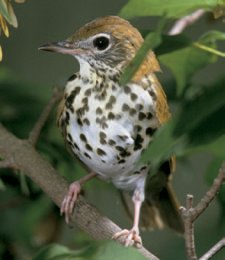
There is no doubt that a diverse, native herbaceous understory provides excellent habitat for a myriad of species during one or more stages of life. However, when we focus this energy and diversity at the ground level through some type of quail management (with hardwood removal or clear-cut for example) we should also be aware of what changes we are introducing at the canopy level. There has been a good deal of research looking at the correlation between wildlife species and forest canopy type. While dense-canopy loblolly forests (plantations) don’t appear to be important to very many species (Hill, 1998; Miles, 2005), closed canopy hardwood forests do provide important habitat for several types of wildlife. Based on the findings of my research and that of others, the following southeastern bird species would fall into category C (negative impacts from bobwhite management); yellow-billed cuckoo (Coccyzus americanus), scarlet tanager (Piranga olivacea), black-and-white warbler (Mniotilta varia), red-eyed vireo (Vireo olivaceus), yellow-throated vireo (Vireo flavifrons), ovenbird (Seiurus aurocapillus), cerulean warbler (Dendroica cerulea), and wood thrush (Hylocichla mustelina). All these species are summer residents, and all except ovenbird and wood thrush are canopy foragers. Yellow-billed cuckoo and vireos are primarily leaf-gleaners and feed almost exclusively on caterpillars. They might fly over quail habitat from time to time but you’ll probably never flush these species from the piney woods understory. Yellow-billed cuckoo is becoming quite rare in the west; however it is still fairly secure in the southeast. In fact the only species mentioned above in the “negative impacts” category that is listed on the USFWS “Species of Conservation Concern” list in the southeast are the cerulean warbler and wood thrush (USFWS, 2008), although neither is federally listed as threatened or endangered. Cerulean warbler inhabits the high canopy of some mature riparian hardwood forests. The wood thrush, like the ovenbird, forages on the ground in hardwood leaf litter. Since moist bottomland areas often do not carry fire anyway, due to high local humidity, prime examples of these mature hardwood habitats would probably be good choices for leaving as habitat for wood thrush and the other mature bottomland hardwood associates, depending on your objectives. Hardwoods in the dry uplands can also provide habitat for some migrant songbirds, however. Interestingly, I found black-throated green warbler (Dendroica virens), for example, to be much more common in fire-suppressed upland longleaf pine stands with dense hardwood midstories than in open longleaf stands in the Talladega Mountains. This species is still fairly secure across the majority of its range.
As far as mammals go, bobwhite management could arguably negatively affect mast-caching species like eastern chipmunks and gray squirrels, but again, these species are so common that there is little incentive to manage specifically for them. Southern fox squirrels are uncommon now in many parts of their range but they seem to be right at home in open quail woods, feeding on longleaf seeds. Golden mouse has been shown to be negatively impacted by fire (Sharp, 2005). This species along with most other non-longleaf associates are thought to retreat to the hardwood bottoms as open piney woods are being restored.
A Note on Lightning-Season Burning
Prescribed fire during the spring and summer is often a topic of some debate. This debate is typically due to the fact that there is an increased likelihood of nest mortality to wild turkey and quail (along with several other ground-nesting bird species) when we employ growing-season, or “lightning-season” fire (LSF). Depending on several factors (including current habitat conditions, current level of hardwood competition, size of burnable blocks, soil types, herbicide options, and how much money a landowner has) it is possible to successfully manage quail using only winter burning. However, during the restoration phase of highly-encroached habitats, LSF can be a powerful tool in reducing hardwood competition and saw palmetto, and building grassy cover and fine fuels (Glitzenstein et al. 1995). The effectiveness of later burning is largely due to the physiological properties of the target vegetation. As a hardwood sapling (or other fire-susceptible vegetation) moves carbohydrate-derived energy out of its rootstock and into developing buds and/or leaves, it is more vulnerable to being top-killed by fire than in its dormant state. As larger hardwood stems are top-killed, more sunlight is allowed to filter to the understory, releasing herbaceous species. Also, it has been shown that LSF has a positive influence on the flowering and fruiting of native grass species like wiregrass and bluestems (Brewer and Platt, 1994). Even on “maintenance phase” habitat, we have learned that occasional LSF is important in improving “seed catch” in longleaf pine, stimulating the germination of certain rare plant species, and other ecological processes. Insect production has also been found to significantly increase in the first year after lightning-season burning (Hardy 2003), contributing to brooding habitat quality for species like quail and turkey.
Lightning-caused fire (typically in spring and early summer) was a primary factor in shaping early-successional pineland ecosystems. Research looking at ancient pine stumps (Huffman, 2006) has suggested that, prior to extensive European settlement, fire typically occurred later in the year, even into summer. The plants and animals that are adapted to live in open pinelands have dealt with the phenomenon of LSF for eons through various means. The ability of turkey, quail, and other ground-nesting birds to successfully re-nest is often under-appreciated. Some studies at Tall Timbers in Florida have noted peak bobwhite nesting in June and suggest that a May burn on a 3-year rough for example would typically affect very few quail nests (Cox and Widener, 2012). Within a given burn block, it is likely (due to variances in individual nest times) that others of the same species will have already hatched chicks from that area, or will be able to successfully re-nest on adjacent lands following the burn. Jones (2001) suggested that LSF is often a benefit to wild turkey because of the associated increased insect availability and quality brooding habitat, which is often a limiting factor on large forest tracts. The benefit of the high-quality nesting and/or brooding cover and forage for these species produced by a growing-season burn can often outweigh the short-term losses (Cox and Widener, 2012). The willingness and ability to use LSF can also provide a larger window of time in which to conduct prescribed burning, facilitating early-successional management over more acreage. A manager must weigh all these factors when building good quail habitat, but in general, LSF is another valuable tool in southern bobwhite management.
Summary
Bobwhite management is seldom single-species management. As we have discussed, a wide array of wildlife species will be likely be affected by the thinning and burning required for quality bobwhite habitat. The species that use open, burned piney woods for one or more seasons of the year will generally benefit from these basic practices of quail management. The species that require closed-canopy hardwood forests or other ecosystems for all or a portion of their needs, may experience mixed or even negative effects. Many hardwood associates are generalists, however, and can adapt to dynamic forest structures and conditions. While there are a few species in the latter category (negative impacts from quail management) that are of conservation concern, there are also many rare plant and animal species that are tied to open, burned woodlands. By managing for this uncommon habitat type, early-successional species populations, including bobwhites, should respond positively over time. By strategically assessing the existing and potential habitat resources on your property, and by knowing which species you might affect during management, you can make informed decisions about building new, or maintaining existing, bobwhite quail habitat.
References
Boyer, W. D. 1964. Longleaf seed losses to animals on burned seedbeds. United States Department of Agriculture, Forest Service, Southern Forestry Experimental Station, Research Note SO-6:1-3.
Brewer, J.S. and W.J. Platt. 1994. Effects of fire season and herbivory on reproductive success in a clonal forb, Pityopsis graminifolia. Journal of Ecology. 82: 665-975
Butfiloski, J. and Swaygnham, T. 2012. Eastern Spotted Skunk, Spilogale putorius. http://www.dnr.sc.gov/cwcs/pdf/spotted-skunk.pdf
Cox, J. and B. Widener. 2012. Lightning-Season Burning: Friend or Foe of Breeding Birds? Tall Timbers Research Station & Land Conservancy. http://americaslongleaf.org/media/2401/Fire-Effects-on-Breeding-Birds-(NFWF).pdf
Glitzenstein, J.S., W.J. Platt, and D.R. Streng. 1995. Effects of fire regime and habitat on tree dynamics in north Florida longleaf pine savannas. Ecological Monographs 65:441-476.
Hanula, J. L. and K. E. Franzreb. 1998. Source, distribution and abundance of macroarthropods on the bark of longleaf pine: Potential prey for the red-cockaded woodpecker. J. of Forest Ecology and Management 102: 89-102.
Hardy, C. 2003. Flora and fauna community response to seasonal prescribed fire treatments in longleaf pine forests of the North Carolina sandhills. Ph. D. dissertation. Mississippi State University, Starkville, MS.
Hill, G. E. 1998. The importance of longleaf pine (Pinus palustris) for breeding birds in the Talladega Mountains, Alabama. J. of the Alabama Academy of Science 69:206-222.
Huffman, J. 2006. Historical fire regimes in southeastern pine savannas. Ph. D. Dissertation. Louisiana State University, Baton Rouge, LA.
Jones, D.D., L.M. Conner, T.H. Storey, and R.J. Warren. 2004. Prescribed fire and raccoon use of longleaf pine forests: implications for managing nest predation? Wildlife Society Bulletin. 32:1255-1259.
Miles, A. C. 2005. Bat Community Structure, Foraging Activity, and Evening Bat Roost Site Selection in Loblolly Pine and Longleaf Pine Forests of Georgia, Master’s Thesis, University of Georgia, Athens, Georgia.
Sharp, N. W. 2005. Demography of Small Mammal Populations in Longleaf Pine Undergoing Restoration. Master’s Thesis, Auburn University, Auburn, Alabama.
Shurette, G. R., R. E. Carter, and G. Cline. 2007. The effect of forest mid-story reduction on breeding bird populations in montane longleaf pine stands of the Talladega National Forest, Alabama. J. of the Alabama Academy of Science 78:221-230.
Steen, D. A., Rall McGee, A. E., Hermann, S. M., Stiles, J. A., Stiles, S. H., and C. Guyer. 2012. Effects of Forest Management on Amphibians and Reptiles: Generalist Species Obscure Trends Among Native Forest Associates. Open Environmental Sciences 4: 24-30
U.S. Fish and Wildlife Service. 2008. Birds of Conservation Concern 2008. United States Department of Interior, Fish and Wildlife Service, Division of Migratory Bird Management, Arlington, Virginia. 85 pp.