

Enjoy your Property
We see many landowners expending lots of time and money into their property, but never enjoying it. First thing in the morning or last hour of the day fish for bass, catfish or bream with light tackle. Arrange for kids, family, friends or neighbors to fish and remove some of the largemouth bass that are annually required in your lake management strategy. Organize a fish fry with local conservation organization chapters such as National Wild Turkey Federation, Quality Deer Management Association, Ducks Unlimited, etc. or invite local law enforcement to thank them for their hard work throughout the year in your county.
Herbicides Should Be Used Sparingly
Only spot treat extreme problem vegetation in and around your waterbody. During summer, if large areas of vegetation (emergent or submerging) are treated, decomposing plants can cause dissolved oxygen levels to drop that can stress fish or cause a fish kill. If a large area must be treated, treat approximately one third each time over a three week period. Do not do the third all at one end or in a cove. Spray, skip an area twice as large as you sprayed, then spray and skip another area twice as big as the area sprayed, and so on. This will spread out the dying and dead vegetation over the whole lake as opposed to it all being at one end. Never add dye the first time once an algae bloom is present or heavy submerged plant growth is established during the summer. This again will overload the system with nutrients and can cause fish stress or a kill. Knowing the reaction from your actions is absolutely necessary to prevent negative issues in your waterbody and possible effects downstream.

Continue Fertilization Program
Continue to check visibility and only fertilize if it is greater than 30 inches. Once you begin a fertilization program in the spring you must continue until the growing season ends. If stopped prematurely, submerged vegetation growth can be accelerated during a time when treating large amounts of submerged vegetation is not advised.
Continue Feeding, Adjust Accordingly
Continue feeding, but check water temperatures. If your water temperature is above 90° F a couple feet below the surface, reduce feeding to twice per day, once at dawn and at dusk when fish are most active. If water temperatures have remained below 90, continue feeding four times per day, twice in early morning and twice in late afternoon. Set feeding duration time so all feed is consumed in approximately 15 minutes to reduce waste and not create water quality issues by over-feeding.
Add Structure Offshore and Along Banks
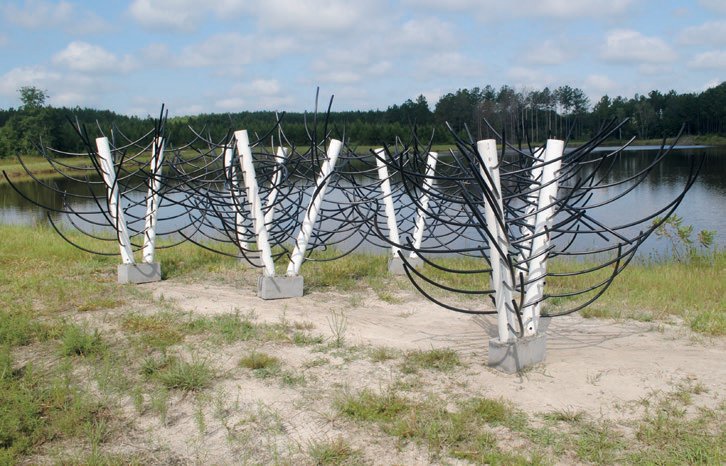
Installing fish attractors into an existing pond is best done in the summer when you can get wet and enjoy it, rather than in the winter when air and water temperatures are cold. Both natural and artificial materials can be used along shore and as offshore fish attractors. Artificial attractors can be built in front of fans where it’s cool, then hauled to the lake for dispersal. Natural materials can be gathered from upland wildlife management practices. If you already have attractors, maybe refurbishing natural ones or enlarging existing artificial ones will help. Do not place attractors where they will interfere with other activities such as swimming or boating. Keep away from docks that may be used as diving platforms, or make sure they are far enough underwater to not be hit by boats or jet skis.
Build a Dock
There’s no cooler place in summer than in the water. Place your dock in a location where a feeder can be placed on one corner in deep water fairly close to cover so fish can come out to eat and head back to their hiding areas. Docks do not have to be elaborate, but functional. Always use quality pressure treated lumber and galvanized hardware so it will last and require repairs later than sooner.

Organize Fall Lake Work
If any fish need to be stocked in the fall, make arrangements and reserve fish now so you do not miss out. No fish should be hauled any distance during summer months. Water temperatures can rise quickly in the hauling tank and the destination water can be as much as 20 degrees warmer than the hauling water, which can contribute to a low survival rate. Fall stocking of most species can be very successful, and some species are better stocked in the fall over spring, as their spawning time may be shortly after stocking and you receive even more fish than you paid for. Fall fish of some species are slightly larger, but do cost a little more.
Spring and fall are the best times to conduct electrofishing surveys, but some companies become booked as the season approaches. Organizing your fall sampling now alleviates being left out and having to wait six months to see how your fishery looks. Order any herbicides in advance of large fall aquatic vegetation treatments being conducted by you or a professional. Small amounts of unused herbicide can be stored without damage to active ingredients over the winter and used the following year.