
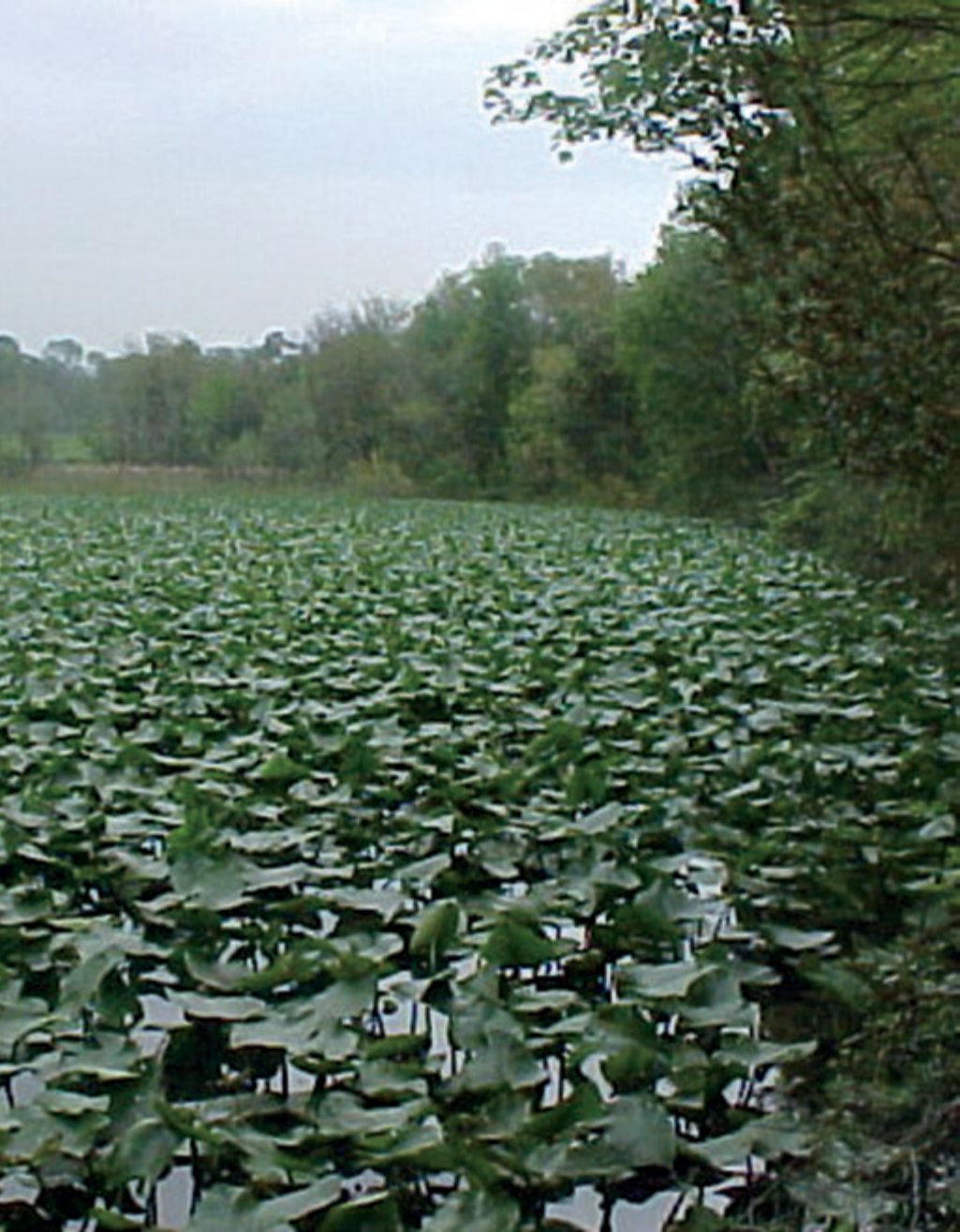
Ponds and lakes, over time, both man-made and natural, gradually fill in or “age”. This process is known as “Lake Succession”. Each lake has a life span and how it is managed or not, slows or expedites the aging process. This process can take thousands of years or only decades depending on the original waterbody’s size, depth, slopes and surrounding activity. The day a man-made lake is completed it begins aging due to erosion. Erosion, water loss and organic build up are the main contributors to lake succession. Lakes gradually fill in until they become a marsh, bog or wetland, and eventually woodlands. As a lake fills from erosion it gets shallower shores and less steep slopes, which give way to aquatic vegetation. Annual growing aquatic vegetation which dies and becomes organic bottom material expedites the aging process and can negatively affect the water chemistry.
Most private waterbodies are man-made either by damming a ditch or creek, known as an Embankment pond/lake, or by removing dirt from an area that water can sheet flow or be redirected, known as an excavated pond. Many times, both techniques are used on the same project where a ditch is dammed, but dug out so it is deeper or the slopes are greater than the natural lay of the land. Some of the aging process can be slowed by making sure lakes are deep enough to compensate for early erosion and the shoreline slopes steeply enough to discourage excess vegetation growth.
Besides construction, year to year management practices can be implemented to prolong the succession process which includes reducing erosion, limiting, but not eradicating emergent and submergent aquatic vegetation growth. And if large amounts of dead vegetation are known to occur, mechanically removing or biologically controlling with grass carp.
I have seen a seven acre man-made pond that was 12 feet deep with over 90 inches of organic material covering the bottom. This pond was only 65 years old but poor lake management by the surrounding 20 homeowners caused a huge mess. All aquatic vegetation (good or bad) was over-treated with herbicides, there was no buffer zone between lawns and water, and for many years people dumped their grass clippings into the lake along the shoreline. Decomposition in water only breaks down material so far, it doesn’t completely disappear. This is on a small scale, but the same process can happen due to careless development and timber or agricultural practices on a larger scale. I always stress that what you do around your lakes and upstream is as important as what you do in your lakes. Properly performed management in and around a waterbody can slow or quicken lake succession.

Preliminary Work
To identify whether your waterbody needs restoration and succession turned back, there are some things that help identify an aging lake and questions to ask to determine if it is time to act. Looking at water chemistry, vegetation and fish species present can all help determine if a restoration project should be conducted. We also want to look at how deep the waterbody is and how many inches of organic material (muck) is covering the bottom. We recently started work on some private lakes where the dominant plant species is Nuphar (lilies) and the fish species make-up is predominantly gar, bowfin, lake chubsucker and bullhead. Water chemistry data revealed poor water quality all year round on the bottom, despite the depth. Desirable species such as bream/panfish and largemouth bass have low spawning success. Their eggs do not hatch due to the lack of oxygen or if they do, young-of-the-year struggle to or do not survive. A spawn may not occur at all due to stress of the few adult fish of those desirable species present. Poor water quality conditions cause adult fish species stress which slows growth and diminishes reproduction.
Once it is decided to conduct a lake restoration project, which technique to use needs to be addressed. There are three ways to rejuvenate a waterbody and turn back lake succession. Some techniques are easier than others and some more expensive than others.
While determining which technique may be best for your particular situation, objectives, cost, equipment access, a disposal site if needed, and permitting requirements are all things to consider.
The cheapest technique to perform is a drawdown. This can also be used to reduce acreage and costs for a large herbicide treatment or to mechanically remove floating islands of vegetation (called tussocks). It can also expose vegetation during the winter causing a cold weather die-off. Finally, it can be performed to expose bottom sediments, allowing the drying of organic material and reducing the organics when it refills. This simulates an extreme drought and can be very beneficial to a fishery.
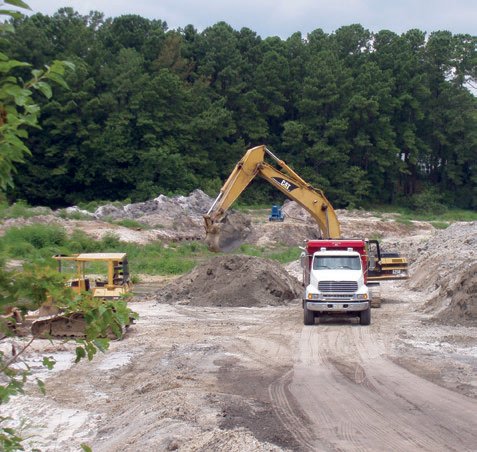
The next technique is dewatering and scraping. The water is drawn down to expose most or all of the bottom for access with heavy equipment to scrape and dig out material. If no deposit site can be found, the material can be used to create islands, if the waterbody is large enough, which creates more shoreline for desirable species such as bream/panfish and largemouth bass. Most private waterbodies are too small, however, and a material deposit site needs to be located nearby (reduces cost) to truck the material.
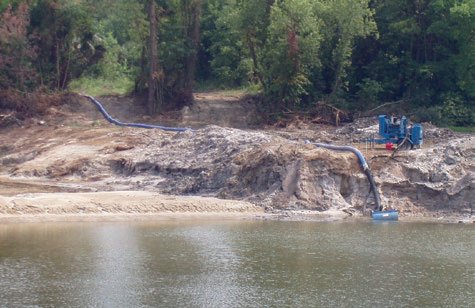
The third and most expensive technique is dredging. This does not require removing water, but does require a nearby site to temporarily store and dry material before trucking it to a deposit site or a nearby site where material and water can be pumped directly for its final destination as water drains off and leaves the material behind.
After you decide on a restoration technique, looking into permitting requirements is the next task. Each state and possibly county governments have different permitting requirements. Each state may also have multiple agencies which should be contacted to see what, if any permit is required from them. Removing water and pumping down stream may require a permit and each state and what agency is responsible for that differs around the country. Besides state and county governments, the US Fish and Wildlife Service may require a permit if the work affects threatened or endangered species at the project site or deposit location. The US Army Corp of Engineers may require a permit for larger projects and/or where the material will be deposited. Your project may be under all these agency’s minimum acreage or cubic yard deposit thresholds and no permits are required, but please check prior to pumping, digging or dumping as the fines are large.
Performing the work (if draining is required) during the dry season is mandatory. Checking average monthly rainfalls will tell you when to perform the work, other than dredging, which can be done any time.

If de-watering and removing organic bottom material, calculating the volume of water and cubic yards of material to be excavated is necessary to get a bid, if you are hiring someone to do the work, building on site spoil islands or to find a deposit site that can hold all the material removed. There are several on-line conversion and calculator web sites that can do it. Water volume is calculated by average depth (ft) times area (43,560 sq ft/ac), then multiplied by 7.48 to convert to gallons. When calculating, any spring influence must be taken into account. If this is a large amount, more water will need to be removed, and at a greater rate to keep it down during material removal. Material amount can be calculated by multiplying area times the average muck depth. Muck to be removed is calculated by area (4,840 sq yds/ac) times average muck depth (yds) to render cubic yards to be removed. Muck depths can be determined with a small diameter pvc pipe with half foot markings. Lower the pipe until you feel it come in contact with the top of the muck layer. Then gently push it through the muck until it reaches hard bottom. Once at hard bottom, forcefully raise and lower probe several times in the same spot to make sure it is not resting on a layer of hard crust with more muck below. The number of marks from first feeling it to hard bottom is times six for total inches of material at that spot. This needs to be done many times around the waterbody to determine an average muck depth. That average is multiplied times the surface acreage and converted into cubic yards of material needing removal. The original deeper spots of a waterbody will have more organic material because it sloughs off shelves and shallow areas into deeper holes by wind and wave action.

A survey downstream needs to be performed before any pump is turned on or gate opened, whether a permit is required or not, to guard against flooding another property or buildings which could result in disaster for your neighbors and leave you with fines, penalties and legal bills. Obviously the more water being drained or pumped the more important this becomes. Do not take this task lightly. Also create any silt barriers required and keep them maintained should they become full.
Performing Work
Once permits (if any required) are in hand and the time of year selected, de-watering can begin. Start slow and gradually increase the volume whether using a siphon, trash pump, tractor driven pump or gate valve. Depending on technique chosen and objectives, that will determine how far down the water level is lowered. If pumping down to scrape, place your pump in the deepest spot in the lake if feasible. If not, pump until a backhoe can get in and create ditches to channel water to the pump intake. As water drains and things dry you can move equipment into the lake bottom and start scraping, creating drying and loading areas to get material out of the lake bottom. The drier the material is, the easier it is to haul.
If lowering water to expose submerged vegetation to treat or freeze back, lower until most plants are exposed and treat immediately if warm enough. If mechanical removal of the vegetation is an option it is better to remove the rotting organic material before it sinks. Once the vegetation is in the state desired, dead or removed, it can be allowed to fill up naturally.
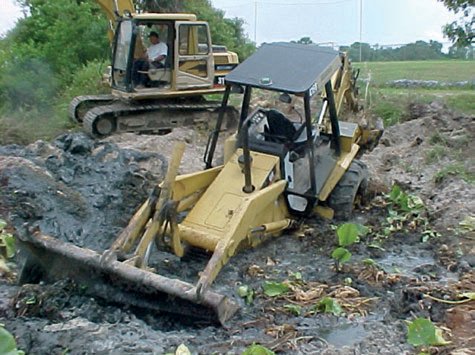
Once the desired bottom is exposed and dry enough for you to drive into the lake bottom, scraping can begin. If large pockets of organics are present, only experienced equipment operators need to be involved. A four foot deep hole of organic material will consume a dozer, backhoe or dump truck. When scraping, re-contouring the bottom can be done to benefit fish production and hinder unwanted vegetation growth. Also, if shoreline slope was too little, re-grade so it is steeper to deter excessive vegetation growth. Scraping the organics into rows to allow drainage before loading into trucks is advised. Scrape slightly below the organics removing a little of the hard bottom to mix with muck and ensure undesirable vegetation roots and tubers are removed. If an outflow pipe or gate valve looks questionable, go ahead and replace it since the water is down. Again, remember that slightly too deep is better than too shallow so this will not need to be done again in your lifetime.
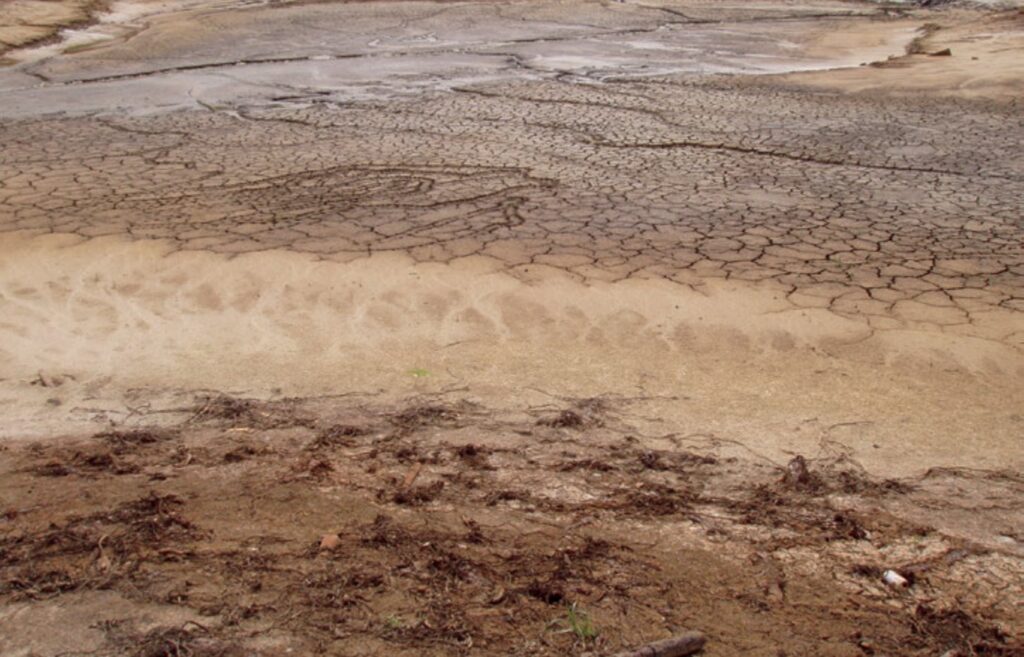
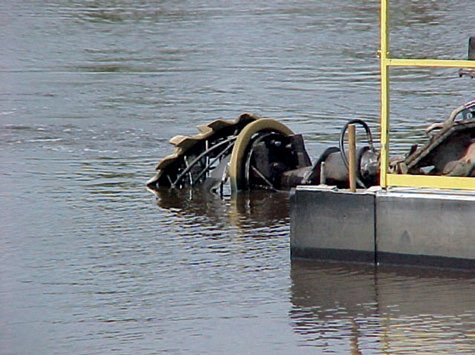
Dredging is done by disturbing the bottom with a dredge head, vacuuming material and water, and sending it to a deposit site or temporary drying area. Once the pumped material reaches its destination and settles, the water drains back off, usually into where it was taken. If using a temporary settling area, once it becomes filled with solids, it is dug out, loaded into trucks, hauled and spread onto its final resting site and dredging commences again. Creating celled drying areas so one can be pumped to while the other is receiving material is best and expedites the process. This technique does not work well if there are a lot of stumps, logs or large debris present, as it doesn’t allow the dredge head to work properly, causing delays and possible damage to the head.
Post-Project Work
Depending on the severity of the de-watering and the amount of scraping, things may need to be done post-project to get the fishery going. If scraping removed all vegetation along the shoreline, some revegetation with native, desirable, easy to control plant species is recommended. Planting a rye grass to prevent erosion until it refills can be done, along with other plants. See Wildlife Trends Journal Volume 12, Issue 3, May/June 2012, Aquascaping to Improve Your Pond.
If adding fish attractors or a dock is desired, adding while the water is down for these tasks is easier than after the lake fills. Natural brush materials can be drug and piled where desired with a tractor or heavy piece of equipment. Artificial material attractors can be set in place without a boat. A tractor with an auger can place dock poles exactly where desired, as opposed to jetting in poles after refill. Even if only the poles are set, the remainder of the dock can be built over water without much added work. See Wildlife Trends Journal Volume 12, Issue 4, July/August 2012, Structure for Your Pond
While the lake is down, if it’s not completely emptied and you have undesirable species present or severely stunted desired species, starting over is advised by applying Rotenone (fish toxicant). A lot less toxicant is required when all the fish are in a small area. Please check your state’s regulations and consult a professional for Rotenone applications. If a large area of the lake was not drained, I don’t recommend restocking largemouth bass if there are any still present. The top predators probably did better than prior to drainage because all the forage became concentrated and easy to catch since there was probably no vegetation for forage to hide. If the waterbody was down an excessive period of time and you had any problems such as water quality, fish kills or lack of forage, then a survey of what is present and an entire restocking strategy may need to be created. If the manager feels there are too many bass remaining, then creating a stocking strategy of bass forage is advised. In this situation, only stocking various sized forage may be necessary to kick start the bass population. In the beginning, it’s better to have too few bass, than too many. They will quickly catch up in numbers. See Wildlife Trends Journal Volume 12, Issue 5, September/October 2012, Forage for Largemouth Bass.