
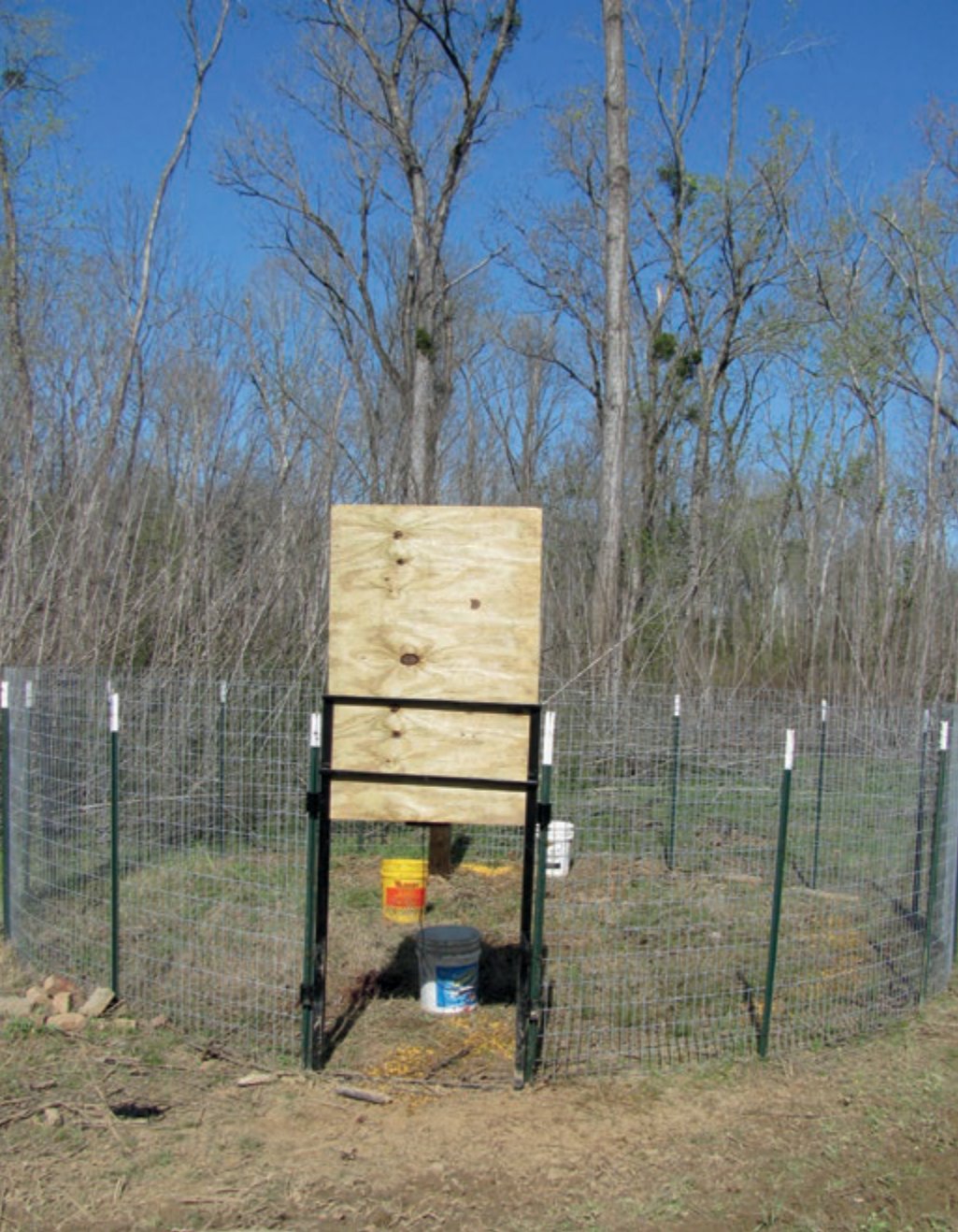
Feral pigs have become a major problem in the last decade. During that time pig trapping “myths” have dominated the “how to” in pig control. Such examples are: “You have to move a trap if there was pig blood in it.” “Pigs won’t go into a trap with a door less than four feet wide.” “If a pig ever got out of a trap they won’t go back in.” “Pigs are trap-shy.” “Utilize every legal method possible for successful pig control.” “Shoot at any pig if given the opportunity.” “If pigs see other pigs in a trap after the door shuts they won’t go in.” (So why would they push in a continuous catch door?) “Some pigs just won’t go in a trap.” “If you run pigs with dogs you can make them leave the property.” “If you are trapping use a saloon or root door because once the door closes more pigs will push in but they can’t get out.”
People accepted these statements as truth and, until now, there was no research that disputed them. As a wildlife biologist with many years of experience managing properties where pigs are a major problem, I can firmly say that there are many fallacies with the previous statements. The only problem is that these myths have been engrained in our heads by so many “professionals” for so long that people dare not question them or they will be ostracized from the pig catching community.
Much of pig trapping is based not on the majority, but the outliers of the bell shaped curve – that is, those individuals who do things that 90% don’t do. This trapping philosophy runs rampant through the continuous catch door trappers. There are numerous hog trap door designs with most being either “single” or “continuous” catch. On the single door design, no more hogs can enter the trap once the door closes. Examples of this type of design are guillotine or drop doors. On a continuous catch door design, more pigs can enter the trap once the door shuts. Two types of this design are “root” and “saloon”. It was believed that pigs could not get out of these doors, but photo evidence shows that they can. The continuous catch design is said to have an advantage over guillotine doors because more pigs can enter the trap after it has been tripped. For years “experts” have recommended these doors over the single catch types. They emphasize the theory that more pigs would push in after the trap shuts.
For years it was taken for granted that pigs pushed in these saloon and root doors but there had never been any research conducted to test the efficiency of these designs. I approached Dr. Mark Smith, associate professor at Auburn University, to help design a study to test how many pigs utilized the continuous catch abilities of the saloon and root doors after they closed. After a few months the project design was finalized and Auburn undergrad Mr. Trenton Smith was hired to assist with field needs and photo recognition. The results were eye-opening and we were amazed how many hogs pushed in a continuous catch door.
Study Design
The project was conducted in three counties with a total of seven landowners and 26 trap locations. There were four specific study locations with a minimum of 15 miles between them. This ensured that sounders from one area were not visiting traps in another location. It was important to find properties throughout the state that had been pressuring hogs in different ways. Of the four locations, one had very little pressure. Neither the use of dogs or traditional hunting methods was allowed. The other three locations had continuous year-round pressure. This included opportunistic shooting from vehicles, ATV’s, and UTV’s, stand and stalk hunting, baiting, dog hunting and shooting at pigs around traps. For years the landowners on these three locations practiced an “anything goes” control method.
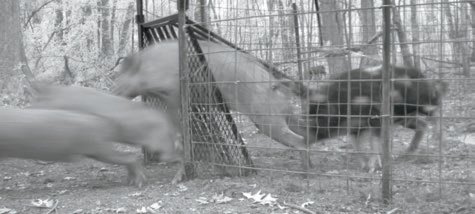
The three door types that were tested were root, saloon, and trainer. The trainer door was unique as it was designed to allow pigs to both enter and leave the trap during the pre-bait. One section of the door was left open with the other sections then close one section. That way there was still an opening, but the pig had to push the other side some. Over time it was thought that the pigs would get used to pushing on the door. At any time a bar could be put in place to keep the door from opening and allowing the pigs to get out.
An important decision for the project was to stop all pressure on pigs at all locations for one month. The first reason for this was to allow the pigs to not associate humans with danger. The second was to make sure no study subject was killed before the data was recorded. Everyone was instructed not to harass pigs if they were encountered. The goal was to have pigs comfortable around humans and see us as food providers. Over time the pigs that had been pressured became very comfortable around the researchers. After seeing how comfortable pigs were becoming to human presence in the lack of pressure, Dr. Smith and I immediately began forming the next study – Pressure Sensitivity and Pig Trapping. This project has been completed and the results will make everyone rethink their pig control program.

Each trap was pre-baited for up to three weeks or until all the pigs were going in the trap. It took less than a week for all the pigs in most sounders to enter the trap. Bait included soured and whole corn along with the use of feeders. The feeders were used to keep food in the trap at all times. Multiple cameras were used to provide irrefutable documentation that all the pigs were entering the traps. Of 239 pigs that had been identified, only two did not enter the trap. A boar was photographed one time and never seen again and a sow showed up on the final days of the project. This proves that the “trap shy pig” theory should be challenged. It is more likely that pigs are not trap shy but pressure sensitive. The more they are pressured by humans the less likely they are to consistently enter traps.
Traps were set after photos documented that all the pigs in each sounder were entering them. The goal was to catch a few pigs with those caught being random. This ensured that some pigs that had been documented entering and leaving the traps for at least a week were on the outside of the trap when it closed. These pigs now had the opportunity to push in. Traps were not checked for 16 hours from set time to allow plenty of time for pigs on the outside of the trap to push in the continuous catch doors. The age and sex of the captured pigs varied greatly. A few times the door was shut with only food in the trap. If the doors worked as advertised, pigs should attempt to enter the traps as many times as had been entering them, up to three times per day for the food.
A common myth is that if a pig is ever captured and released it will never enter a trap again. We tested that theory also. All captured pigs were released to see if they would re-enter the trap. The trap was reset to catch a few pigs again. It took on average 2.39 days for most pigs to re-enter the trap and by the 6th day 80% were back in the trap. Even after being released they would re-enter the trap but not push in the door. On one occasion we caught 16 out of 17 pigs, released them, and reset the trap the same day. The next day we caught 15 and the other two were on the outside of the trap. Pigs will go back in a trap if caught before. The reason most don’t is because they are having negative human reinforcement around the traps.
Results
This project proved that pigs conditioned to enter pre-baited traps will push in a continuous catch door; unfortunately the number that do is low. Of the 222 pigs that were documented on the outside of the trap when the door shut, only 11 pushed in. One was with a saloon, one a trainer, and nine with the root. Statistically that is only a 5% probability that a pig will figure out how to utilize the “continuous” catch design and push open the door to enter the trap. Less than 30% of the pigs touched the door with any part of their body, and less than 10% made any attempt to push the door with their head. Even if every pig that made the door move with their nose made it in, statistically this does not justify the cost as the rest will go within a week or two. The age and sex of the pigs that pushed in varied and no reasonable conclusion could be made why those animals entered. The stimulus inside the trap for the ones that did push in had varied greatly. There is an extremely low probability that any pigs will push in a continuous catch door. Those that do push in are completely random events.

Why don’t more pigs utilize this continual catch design? Simply speaking, pigs do not solve problems very well. Pigs respond well to positive and negative stimuli which make them easy to train. This may explain why they become comfortable around humans when fed and not harassed. This cannot be misconstrued as “smart” the way humans think of it. Biologically speaking, humans have a larger brain which gives us the ability to solve simple problems quickly. Someone told me that pigs have to be “intelligent” or “smart” because they searched for food when they were hungry. Flies also eat when hungry and they only have a central nervous system. During pre-bait there is no obstruction preventing hogs from entering the trap, but when the door shuts, there is now something blocking the opening. On average the sounders visited the trap 2.4 times per night and stayed around them 70 minutes. During this time 95% of the pigs will not figure out how to push in the trap, hence, they do not solve the problem.

I know many people are shaking their heads thinking that I must have fallen out of the tree-stand when I wrote that last paragraph. All we have ever been told is that pigs are smart. Here are some simple but contradicting statements made by a pig trapping “expert” in a recent conversation. “Pigs will push in a root door but they can’t push out.” This implies problem solving skills and learned behavior. In less than 70 minutes a pig will figure out why the opening in the fenced area now is obstructed and realize that to get in they must push on that spot even though they have not had to push on that spot during the entire pre-bait.
In the same conversation it was said that if you don’t catch the entire group the other pigs will figure out what is happening and become trap shy. OK, this implies that the pig has now figured out that it should not go in the trap because a bunch of his buddies are stuck in the trap and can’t get out. If a pig is smart enough to figure out that it shouldn’t go in the trap and from now on avoid traps because his buddies are caught in the trap, then he is probably “smart” (relative term) enough to figure out that he shouldn’t push in that continuous catch door because he won’t be able to get out.
My point is, don’t artificially raise the IQ of a pig to that of human status. They respond well to positive and negative stimuli quicker than other animals do and they are “feral”, which is defined as domesticated gone wild. Technically they should not have a fear of humans. That means that if given time and positive reinforcement, pigs will acclimate to humans if they don’t perceive of them as a threat. Before everyone runs to their computer to e-mail me that their pigs are smart, Pavlov did the same thing with a dog, bell and food. Learned behavior over continuous positive reinforcement is different than problem solving skills. When I say that smart is a relative term I am implying that you have to compare it to something of the same intelligence. A mouse is smart compared to a fly and a dog is smart compared to a mouse. Supposedly a pig is smart compared to a dog.
This study proved that occasionally a pig will push in a continuous door. Fiscally speaking, the low number and complete randomness illustrates that a much cheaper guillotine catch door may be a more financially viable option. That decision will be made by the person purchasing the trap. Don’t be fooled by fuzzy facts. If just one pig pushes in a continuous catch door does that justify the cost? This is a personal opinion, but in my experience just open the door and reset the trigger. Given time and no negative pressure the other pigs will come back to the trap.
A special thanks to the Alabama Farmers Federation for providing the funding for this project. Also to Dr. Mark Smith, associate professor at Auburn University. He and I worked side by side through the entire project and his knowledge and expertise in scientific design was imperative. Thanks to Auburn University Undergrad Trenton Smith for his long days and nights baiting traps and looking over photos. Finally, thanks to Dr. Steve Ditchkoff, Dr. Todd Steury, and the many fellow colleagues I called upon to help with the project. If you have any questions on feral hog trapping and control techniques please call USDA Wildlife Services at 334-844-5670 or Dr. Smith at 334-844-8099.