

In the last issue of Wildlife Trends Journal I described the failures of our approach to wild pig control in North America. We have been expending considerable effort into trapping and shooting wild pigs in an effort at reducing their numbers, but in most cases our efforts have had only marginal success. Truly successful pig control programs are rare. However, I suggested that it may be possible to reduce wild pig numbers with considerably less effort than traditional approaches, and that these efforts may be more long lasting. In this article, I will describe how to control wild pigs using a sounder-based removal strategy.
The Reproductive Unit
An important fundamental aspect of any control program is an understanding of the reproductive unit. If we have 100 pigs in an area, and they are found at a sex ratio of 1:1, then we have 50 females and 50 males. The only pigs we should be interested in are the females because they’re the ones that will produce more pigs. If we remove 49 males out of the 50 in an area, we will still have 50 females that are capable of producing young, and we will have reduced reproduction by 0%. But, if we remove 49 females out of the 50 in the area, we will have reduced reproduction by 98%. Another way to look at it is…by removing only one female (2% of the population), you will have more impact on the pig population than if you had removed 49 males (98% of the population). In short, males don’t matter. While males contribute to agricultural and habitat damage, possibly on a greater scale than females due to their greater size, they are irrelevant in any discussions about population control. And, because it requires such great effort to successfully reduce a pig population (and time is money), we cannot afford to expend effort at controlling males. By focusing our efforts on females, we will have a greater impact on pig damage in the long run.
Unfortunately, this concept is not well understood by most. Traditional pig control programs usually keep track of how many pigs they have removed. This body count is used to evaluate the success of the program. But, the inclusion of males in this body count is irrelevant and gives a false sense of success because they do not contribute to population growth. The female is the reproductive unit. Deer managers are one group that has a good grasp on this concept. They control deer populations through antlerless harvest: the only reason males are harvested for their trophy value.
Surveying for Wild Pigs
The first, and probably the most important step in a sounder-based removal strategy is to understand what pigs you have and where they are located. The success of a sounder-based removal strategy is to remove all the pigs in a sounder. Not 80%, or 85%, or even 95%. It is critical that 100% be removed, and this requires knowing precisely how many individuals are in each sounder that are targeted for removal. Fortunately, we have the tool to do this with relative ease: game cameras. While game cameras were originally developed to monitor deer populations, they are equally effective at surveying pig populations.
To begin, you should establish a grid of camera survey stations so that there is one every 300 – 500 acres. These stations should be established at sites that have fresh pig sign. To establish a survey station, spread approximately 25 pounds of whole corn over an area that is 10 x 10 feet. It is important that you spread the corn out (rather than put it in a pile) to ensure that the pigs spread out and you can identify individuals in the images. If you do not have pig activity at the site in 3 – 5 days, then discontinue use of the site. Our data indicate that if pigs don’t hit the bait in 3 – 5 days, then you’re wasting your time. At those sites where you have pig activity, set up a game camera and allow it to take pictures for a week or so. Be sure and adjust the settings on your cameras to ensure that they take as many images as possible while the pigs are on the bait. The more images you have, the better you’ll be able to get an accurate count of the pigs using the site.
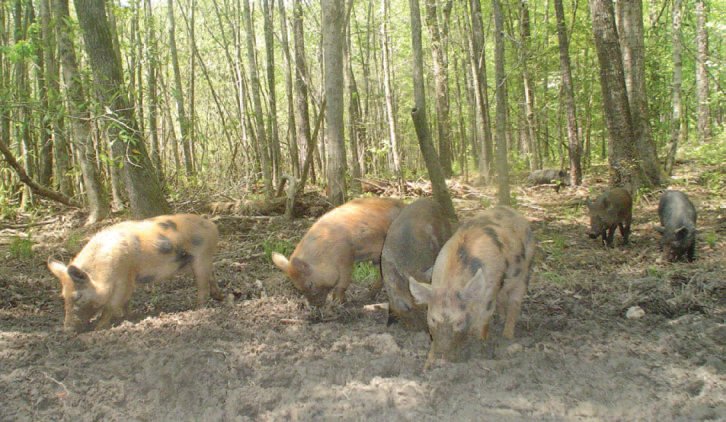
When you download images from the cameras, be sure to examine them carefully. It’s critical that you know exactly how many adults and juveniles are in each sounder. Once you have that information, then you can begin the process of trapping. If you have a sounder that is using two sites, eliminate one of the sites. If you have a site that is being used by two sounders, this indicates that the bait site is on the edge of the two territories, and you may need to establish two more sites so that each site is used by only one group of pigs.
The final thing to keep in mind is that this isn’t a race. It’s not a problem if it takes you 3 months or longer to determine the location and composition of sounders. Our data suggest that this is the most important aspect of the entire process, so don’t rush through this. In fact, just consider the surveying period as prebaiting. Failure to accurately identify the composition of the sounders could undermine this entire process.
Trapping
Once you have accurately identified the composition of your sounders, you can begin the process of trapping. The pigs are conditioned to coming to the camera sites for food, so just use those as your trap sites. The best trap style for trapping an entire sounder is a corral trap. The large size of the corral trap is essential to ensure that you can maximize the number of pigs that enter the trap. The specific details regarding bait, door style, trigger type, etc., are irrelevant. Use what works for you….what you are familiar with. I suggest using more than one trap at each site. In our study, we used 4 (3 box traps and a corral trap) per site.
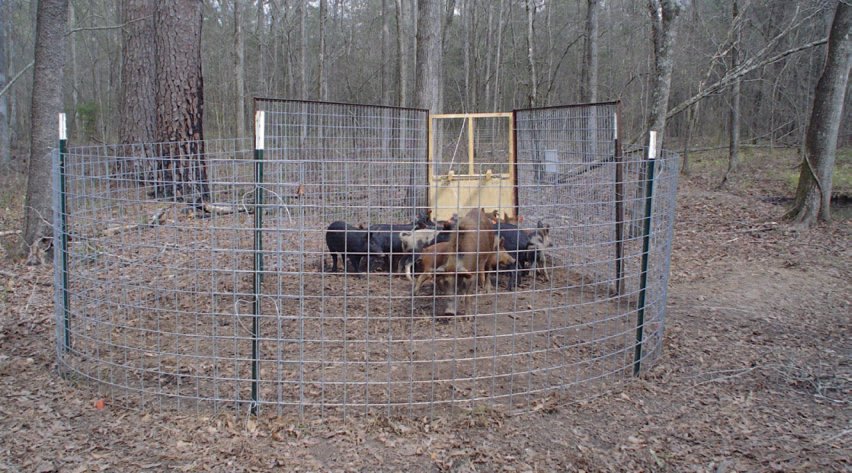
Once you have your trap set, tie the door open so that the pigs can become accustomed to it. It can take days to weeks for the pigs to become comfortable with the trap, but it is essential to the process that you give the pigs all the time they need. Monitor the acclimation process with the use of a camera. Once you have all the pigs entering the trap, it’s time to set it.
This is the point in the process where I’m about to tell you some things that will go against every bit of common sense that you have. When you walk up to check your trap the first morning, it’s critical that you identify all the pigs that are in the trap. Did you catch the entire sounder? If you did, then kill them. But…..if you didn’t, open the door and let them go. If you shoot the pigs in the trap, you will have just educated the remaining pigs, and the task of catching and/or killing the remainders will be much more difficult. But, if you let them go, you increase your chances of getting them all. It may take 3 or 4 days for them to return, but they’ll come back, and, they will have had a positive experience with the trap. We have let partial sounders loose multiple times, and they always come back. I mentioned earlier that we use multiple traps at a site. This increases the chances of catching the entire sounder. If some of the pigs trip a trap, there are more traps for the remaining pigs to enter.
If you have the misfortune of trying to eliminate large sounders (more than you can get into a trap), you will likely be forced to make a decision on whether to shoot pigs in the trap when there are others you haven’t caught. Make your decisions based upon the experience level of the pigs that aren’t in the trap. If they are young pigs, they shouldn’t be too difficult to trap. But, if they’re mature animals, they can be extremely difficult, and you will likely be forced to change trap sites, trap styles, etc. At the very least, it will take considerable effort to get the rest of the sounder. But, it is essential that you do. If you leave even one female, they will repopulate the area. If you get them all, you’ll be pig free for a while. Once you have eliminated a sounder, move to the next one. Work on two at a time. Take a break for a month or two. But, whatever you do, just don’t quit until you have successfully eliminated an entire sounder.
We also suggest that you don’t kill male pigs in the trap. If you catch a boar, let it go. Pigs often shy away from traps that have been soiled by pig blood, so shooting the boar will reduce your chances of catching the local sounder. If you just can’t swallow letting it live, open the trap and shoot it on the run…just don’t shoot it in the trap. But, always remember…males don’t produce piglets, females do. Your goal is to eliminate the sounder…males are irrelevant in the long run.
Case Study: Fort Benning
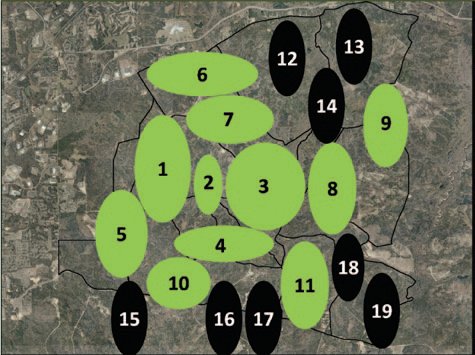
We began monitoring the sounders of wild pigs in our study area on Fort Benning in 2007. Our goal was to locate and identify all of the unique sounders, identify all of the individuals in each sounder, and develop a picture of the spatial arrangement of sounder territories. This was accomplished with the use of game cameras and GPS radio collars. Ear tags enabled us to monitor sounder composition in great detail (for research purposes), and GPS collars provided detailed data on territory boundaries. Figure 4 shows the approximate territory size and location of 19 individual sounders that were identified during this process.
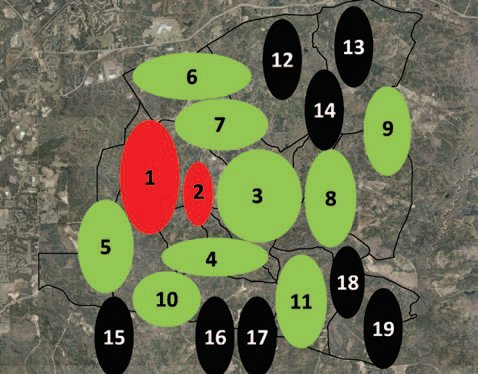
In May, 2009, we began trapping with the intent of removal. We removed Sounders 1 and 2 in 15 days of trapping, which had 28 and 7 pigs, respectively (Figure 5). This cleared approximately 3,500 acres of females and their young. Following this removal, we monitored the cleared area with baited cameras, and followed the movement of pigs in the surrounding sounders with GPS radiocollars. As of April 2010, one year later, no sounders had moved into the area. We did, however, document a few exploratory ventures of surrounding sounders into the vacated territories. Each of these exploratory ventures was documented at a camera site, and did not last for more than a day or two. These data demonstrate that expansion of female pigs into new territories occurs very slowly, and properly designed removal efforts can be successful at eliminating the female portion of a pig population in relatively small areas.
Six months later, in November, 2009, we continued with our removal experiment. We targeted Sounders 3, 4, and 5, which had 21, 13, and 7 pigs, respectively (Figure 6). After 9 days of trapping, we had removed 18 of 21 pigs in Sounder 3: we could not remove 3 adult sows with this first effort. One sow was killed by a hunter in mid-January, 2010, and it was not until the end of January that we were finally successful at removing the final two. As described earlier, incomplete removal of a sounder resulted in the remaining pigs becoming educated, and their successful elimination only occurred after considerable trapping effort. Ultimately, we had to change trap sites, modify our trap style, and change our trigger type.
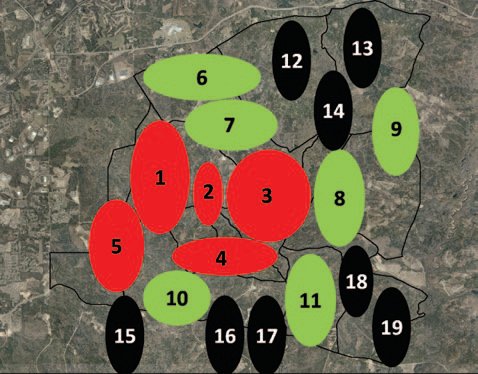
Sounder 4 also presented difficulty. We were able to remove 12 of 13 pigs in Sounder 4 in 11 days of trapping. The remaining sow was finally captured near the end of January. Prior to her capture, we caught 4 piglets that she had produced in the interim, and we captured the remaining 3 in mid-February. Fortunately, we were able to target these piglets before they had gained experience with traps. Sounder 5 (7 pigs) was successfully removed in 8 days of trapping. This second removal effort cleared an additional 3,000 acres of females and their young. This, combined with the previous removal effort totaled approximately 6,500 acres.
Since these removal efforts we have continued to monitor the former territories of the removed sounders. We have yet to document incursions of new females or young: only adult boars have been documented in the area. While boars will also cause damage, they are unable to produce young and the population will not grow. Continued removal effort (e.g., hunting and trapping) over time can be applied to target remaining adult boars. However, we hypothesize that activity of males in these areas will decrease over time as there are no females in the area. Most data suggest that movements of adult boars are driven by the urge to reproduce, and the lack of females in the area will result in boars moving to areas with greater concentrations of females.
Final Thoughts
The take home message is that wild pigs can be successfully eliminated from an area if a strategic approach is applied. Trap and removal efforts that only strive to maximize a body count are almost never successful. Rather, targeting sounders using a strategic approach clears acreage that is recolonized by surrounding sounders very slowly: cleared areas may remain sounder-free for at least a year. It should be noted that we feel that the key to this approach is in monitoring. Identify unique sounders, indentify all of the individuals in each sounder, and begin trapping only after you have good information about the pigs in the area. Only when you reach this point should you begin trapping. While we have only conducted this one experiment, others have begun to apply our technique and have reported success. Good luck.
Addendum…
Since completion of this article, we have begun our final efforts to eliminate all females and young in our study area. After 9 days of trapping, we have removed 100 females and young from 10 sounders. Six sounders have been completely eliminated, and we have 1 to 3 females remaining in each of the other 4 sounders. There are an additional 3 sounders that we plan on removing in the coming weeks. In total, we have cleared approximately 26,000 acres of females and young (with the exception of a few stubborn females that we will clean up in the coming weeks. By the time you read this article, we will hopefully have eliminated these final pigs.