

Live oaks (Quercus virginiana) donning Spanish moss dripping from limbs like icicles are true emblems of the South. The human-nature connection is often heightened with these oaks as they exude a historical and sagacious vibe, shaping the landscape of one’s mind with the likes of quail hunting in the Old South. For many, live oaks increase the aesthetic beauty when coursing the piney woods with birddogs. Personally, I can’t get enough of a big mature white oak with their thick overlapping layers of bark, like pages of a book hiding the words of a story. Aside from aesthetics, leaving select hardwoods (live oaks, etc.) provides functional value to bobwhite and the ecosystem they inhabit. However, the presence and especially overabundance of live oaks and other mature hardwoods shades understory vegetation and impedes growth of grasses, forbs, and shrubs characteristic of southeastern pine savannas.
In Part I of this article, the emphasis was on the importance of constantly evaluating forest stand conditions relative to timber density and canopy closure such that sunlight penetration to the forest floor is critical for facilitating healthy herbaceous growth needed to produce quality bobwhite cover at the ground level. When factoring hardwoods into the equation, the same sentiment is warranted to profit bobwhite, but balancing objectives and species abundance targets while managing personal connections to these majestic oaks should be judiciously considered. Determining an acceptable level of hardwoods in upland pine stands, however, without negative consequences to bobwhite habitat conditions can be tricky. As such, in this article, the goal is to give you ammunition to understand when to pull the trigger on hardwood reduction or let them go.
“The density of timber stands should receive constant attention on the well-managed quail preserve.”
— Herbert L. Stoddard, The Bobwhite Quail, It’s Habits, Preservation, and Increase, 1931
Why are hardwoods a concern?
Although hardwoods naturally occur peppered throughout the uplands in the Southeast, their distribution and density has increased substantially due to changes in fire application, such as fire suppression or exclusion, and more intensive forest management practices such as aggressive timber thinning and monoculture pine production. Anthropogenic disruptions of these regimes have played a large role in the global expansion of woody vegetation creating midstory and overstory canopy closure in once open grassland and savanna ecosystems. The reduction in burn frequency (>3-year fire return intervals) has negatively impacted bobwhite habitat by shifting cover conditions to hardwoods and vines rather than the desirable cover conditions of a mixture of grasses, forbs and legumes, and shrubs. The lost practice of burning in the piney woods throughout the Southeast has contributed greatly to the decline in bobwhite numbers.
For the past several decades, much of the forest land in the Southeast has not been managed using frequent fire (<3-yer fire return interval) and therefore does not support quail or scores of other fire-affiliated species (e.g., Bachman’s sparrow, red-cockaded woodpecker). Frequent prescribed fire remains the most effective management tool for vegetation maintenance and hardwood control with demonstrably positive effects on bobwhite populations. However, even on properties managed intentionally for bobwhite using frequent fire, forest stand conditions are dynamic and midstory hardwood encroachment is a constant battle for land managers. As stated in Part I, Stoddard said: “the density of timber stands should receive constant attention on the well-managed quail preserve.” This is true for pine timber and hardwoods alike! Midstory hardwood encroachment presents a major problem for those managing to maximize either timber or quail. Hardwoods pilfer nutrients and moisture from more desirable trees and create less desirable habitat structure for many wildlife species. Thus, keeping the good stuff good requires constant attention to the timber stand density and species composition.

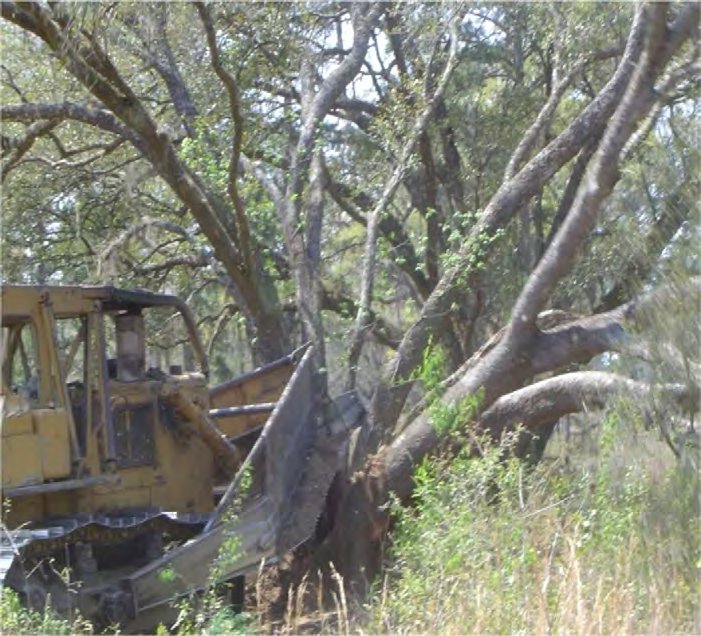
Mechanical hardwood reduction is a common management tool employed by land managers to improve upland stand conditions for bobwhite when midstory and overstory hardwoods become overabundant. Hardwood reduction is thought to increase bobwhite abundance by 1) increasing the amount of understory vegetation and overall usable space for quail, and 2) decreasing predation risk by removing key habitat of common predator species such as arboreal snakes, raccoons and avian predators that use dense canopy to stalk prey.
Given that mechanical hardwood reduction is expensive (~$125 – $150 per acre) with potential negative impacts on non-target species including disruptions to soil and ground-cover vegetation, careful consideration to its implementation is warranted. And, although hardwoods often get a bad rap, they do provide ecological value. For example, in one study in Florida, oaks were linked to facilitating longleaf pine seedling establishment (Loudermilk et al. 2016). When implementing hardwood reduction, the focus should be on selective removal of non-productive and invasive hardwoods such as sweetgum and water oak. Leaving a few dominant hardwoods such as white oak, black cherry and live oaks will add diversity, provide desirable habitat structure and food value for several wildlife species. The presence of moderate amounts of hardwoods in the uplands will also provide a source for woody structure resprout and refuge for many species including bobwhite from fire or inclement weather.
A manager in the Red Hills once told me: “I leave a fair number of live oaks because during the hunting season and poor weather like rain, and especially cold rain or snow, that is where you will find several coveys huddled together.” Research has demonstrated that bobwhite broods often loaf under live oaks during hot summer days in August and September and coveys can be found under live oaks during cold winter rains. Additionally, retention of shrubs and small hardwoods including huckleberry, wax myrtle, dogwood, and gallberry is highly encouraged as these provide excellent protective cover for bobwhite. Likewise, we often find soft and hard mast items in crops of harvested quail, especially early in the hunting season. Acorns are highly nutritious, add diversity to their diet, and take fewer to meet the daily caloric requirements of a quail than many other native or supplemental seeds. Taken collectively, leaving a select number of “legacy” or “signature” live oaks can add wildlife value and aesthetics to the forest stand while benefiting bobwhite.
Does hardwood reduction work?
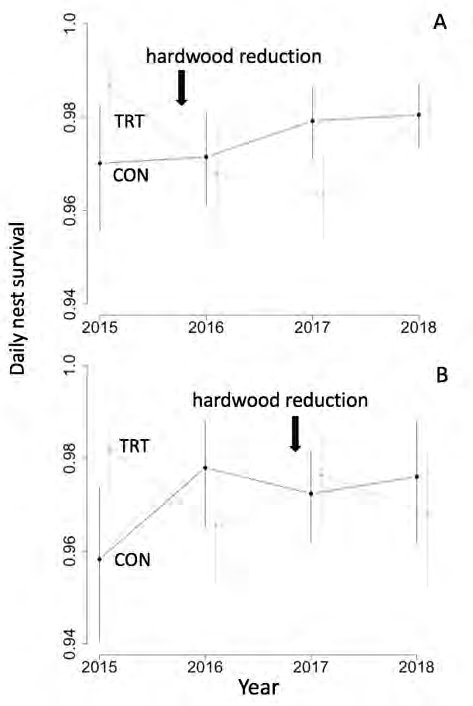
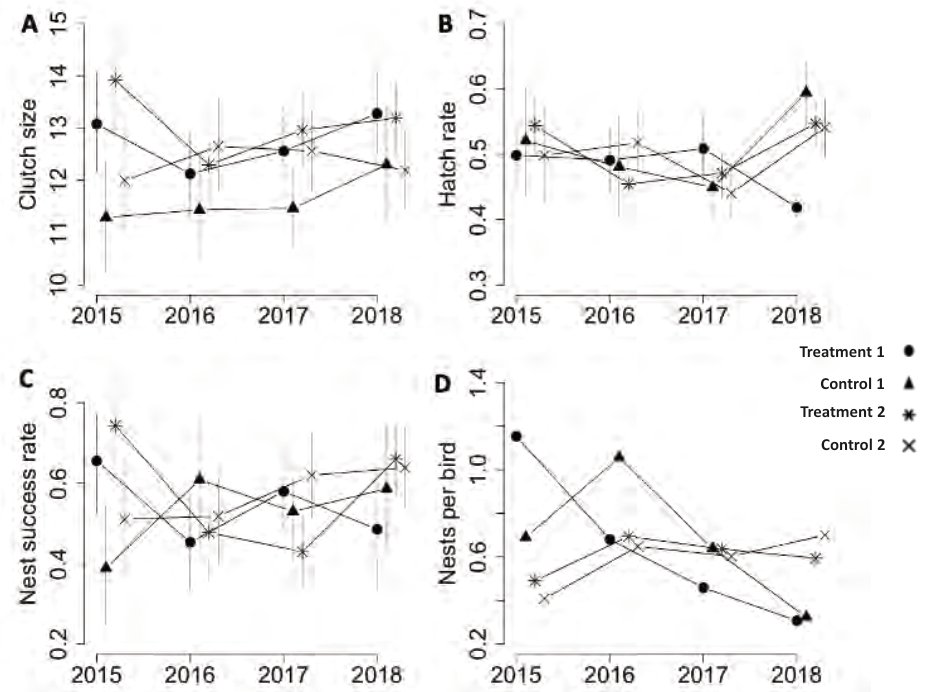
When applied at a large scale and-or when overstory hardwood levels are high, mechanical hardwood reduction can create a new ground effect bolstering bobwhite abundance. This is especially true on sites with low-quality soils. However, hardwood reduction may not always be necessary and if implemented when encroachment levels are low or at a small scale, positive results may not be noticeable. For instance, a recent study in north Florida found that hardwood reduction did not impact bobwhite survival (see Figure 1), nest survival (see Figure 2) or reproductive output (see Figure3). This study was conducted on 2 properties with high quality soils, already being intensively managed for quail, good bobwhite densities (>1 bird per acre), and hardwood density was moderate (1 mature hardwood per 2 acres, on average, with less than 15% canopy coverage). Therefore, a philosophy of “less is more” is not always the case even when it comes to hardwoods in the uplands.

The Red Hills Forest Stewardship Guide suggests that 2- 10 square feet per acre of mature hardwoods in upland pine stands aligns with historical dominance of pines, and one signature live oak may have a basal area of 8 to 18 square feet. This indicates that 1 live oak per 2 acres is reasonable for bobwhite management objectives. Thus, plucking a few hardwoods on a well-managed quail preserve with low to moderate hardwood densities is not likely to produce huge dividends and may even set you back if implemented at the wrong time of year or during times of poor weather conditions or simply have a neutral affect. However, on sites where hardwood density and hardwood canopy coverage are more extensive, positive results would be more plausible.
A study in North Carolina demonstrated that maintaining low to moderate levels of hardwoods on the landscape can increase overall avian diversity with limited negative effects on target upland species such as bobwhite (Hannon et al. 2021). They recommended 5 – 15% hardwood cover to maintain habitat diversity and ecosystem health. A common mistake when implementing hardwood reduction or controlling hardwoods is over-emphasis on precision and specificity which can result in homogenization of habitats. Reduction in habitat variability can limit options for managers trying to balance competing objectives. Thus, the goal should be to reduce hardwoods to balance the community needs rather than eradicating them or nuking them on landscape. As stated previously, hardwoods do provide ecological value such that retaining the proper balance will result in a healthier ecosystem while still observing stellar results for bobwhite.
What is the proper balance of hardwoods?
The short answer is it depends on your objectives. Maintaining the balance of hardwood density is accomplished similarly to pine timber such that when canopy closure increases, and ground-level cover conditions decline thinning or reduction may need to occur to open the canopy and allow sunlight to penetrate the forest floor. Battling hardwood encroachment comes in 2 forms: (1) midstory and understory and (2) overstory or mature hardwoods. For controlling midstory and understory hardwood encroachment, research has shown that post-burn (after a burn) mowing hardwood thickets will result in improved grasses and reduced hardwood structure which will also have the added benefit of increased efficacy of future prescribed fires. This is preferential to chemical control because it does not set the hardwoods back too much to reduce shrubs below a level that is beneficial for bobwhite. Here the objective is to shoot for the Third Rule whereby roughly one-third shrub (woody cover) is available with the other two-thirds being forbs/legumes and native bunch grasses, if bobwhite is the primary objective. This rule may vary somewhat with additional wildlife or other objectives.
When evaluating the overstory or mature hardwoods, management and aesthetic objectives should be considered prior to hardwood reduction. If bobwhite is the primary objective, shooting for less than 10 square foot per acre or 1 mature hardwood (live oak, etc.) per acre (see Figure 4a). As such, to optimize bobwhite abundance when hardwoods grow above that point, hardwood reduction should be implemented using a selective approach based on your aesthetic objectives and preferences to achieve that balance. That said, it is important to note a property can support a huntable bobwhite population when hardwood density is greater than 1 per acre or greater than 10 square foot per acre, but the carrying capacity or total abundance level may be lower. I have found that 1 mature hardwood (e.g., signature live oak) per 2 acres is an excellent goal when trying to optimize bobwhite abundance.
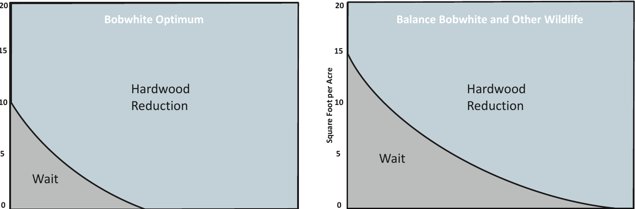
If bobwhite is one among several competing wildlife objectives (such as turkey and deer), shooting for a higher number of trees is recommended; 15 square foot per acre or 1.5 hardwoods per acre would be more desirable while not being deleterious to the bobwhite population (see Figure 4b). Of course, on higher quality soils the window of opportunity increases for carrying more hardwoods while maintaining quality cover conditions for bobwhite. Figures 4a&b are general guides, and it is not always about basal area and number of trees given that edaphic conditions and annual rainfall can influence cover conditions under and around mature hardwoods. Alternate or secondary wildlife objectives such as wild turkey and-or deer can benefit from leaving productive mast producing trees. In these situations, focusing on reducing “predator traps” will extend the window some also and mitigate potential negative impacts on bobwhite with the higher hardwood densities due to competing management objectives. Some common predator traps include hard edges along fields, wildlife opening, drains, or large mottes – hardwood reduction or edge feathering in these areas will result in improved survival of both bobwhite adults and chicks. Leaving the drains, wet areas etc. is also recommended as they will most always tend to be poor conditions for bobwhite but provide good refuge for turkey, deer, and other wildlife.

Take Home Message
Inappropriately precise management prescriptions may lead to unintended negative wildlife resource outcomes. When it comes to hardwood management for bobwhite in the uplands, as with many things in wildlife management, there is not a one-size fits all approach or an industry standard, and less is not always more. That is managing hardwoods for bobwhite and-or other wildlife is all about balance! Determination of an acceptable level of hardwoods to achieve that balance in accordance with your objectives in upland stands can be tricky, but it is very doable when carefully weighing the objectives prior to implementing habitat management actions.
Hardwoods provide ecological value to the ecosystem as well as direct value to bobwhite, so it makes sense to keep as many hardwoods as possible without negative impacts on cover conditions to maintain habitat heterogeneity and increase opportunity for wildlife. When hardwoods negative impact cover conditions, hardwood reduction may be a feasible option to restore cover quality for bobwhite and other grassland-shrub obligates. Leaving select hardwoods such as legacy live oaks can provide that value-added function for many species, including bobwhite. Similarly, removing undesirable hardwoods such as sweetgum and invasives will improve overall stand conditions for wildlife and facilitate quality understory vegetation. The magnitude of and number of hardwoods in the uplands may vary widely based on landowner preference and objectives. However, if left unchecked hardwoods can become to abundant and negatively impact bobwhite abundance as seen in much of the forested lands in the southeastern United States. But it is very reasonable to have both the Prince of Game Birds and majestic oaks on the well managed quail preserve!
REFERENCES
Hannon, Daniel R., C. E. Moorman, A. D. Schulz, and C. S. DePerno. 2021. The relationship between upland hardwood distribution and avian occupancy in fire-maintained longleaf pine forests. Forest Ecology and Management 477.
Louise Loudermilk, E, J. K. Hiers, S. Pokwinski, J. J. O’Brien, A. Barnett, and R. J. Mitchell. 2016. The path back: Oaks (Quercus spp.) facilitate longleaf pine (Pinus palustris) seedling establishment in xeric sites. Ecosphere 7.6
Malone, K. M., T. M. Terhune, II, K. E. Sieving. In Press. Demographic response of Northern Bobwhite to hardwood canopy management in pine savanna. Ecosphere.
Red Hill Stewardship Guide. 2007. Tall Timbers Research Station and Land Conservancy, Miscellaneous Publication No. 12.