
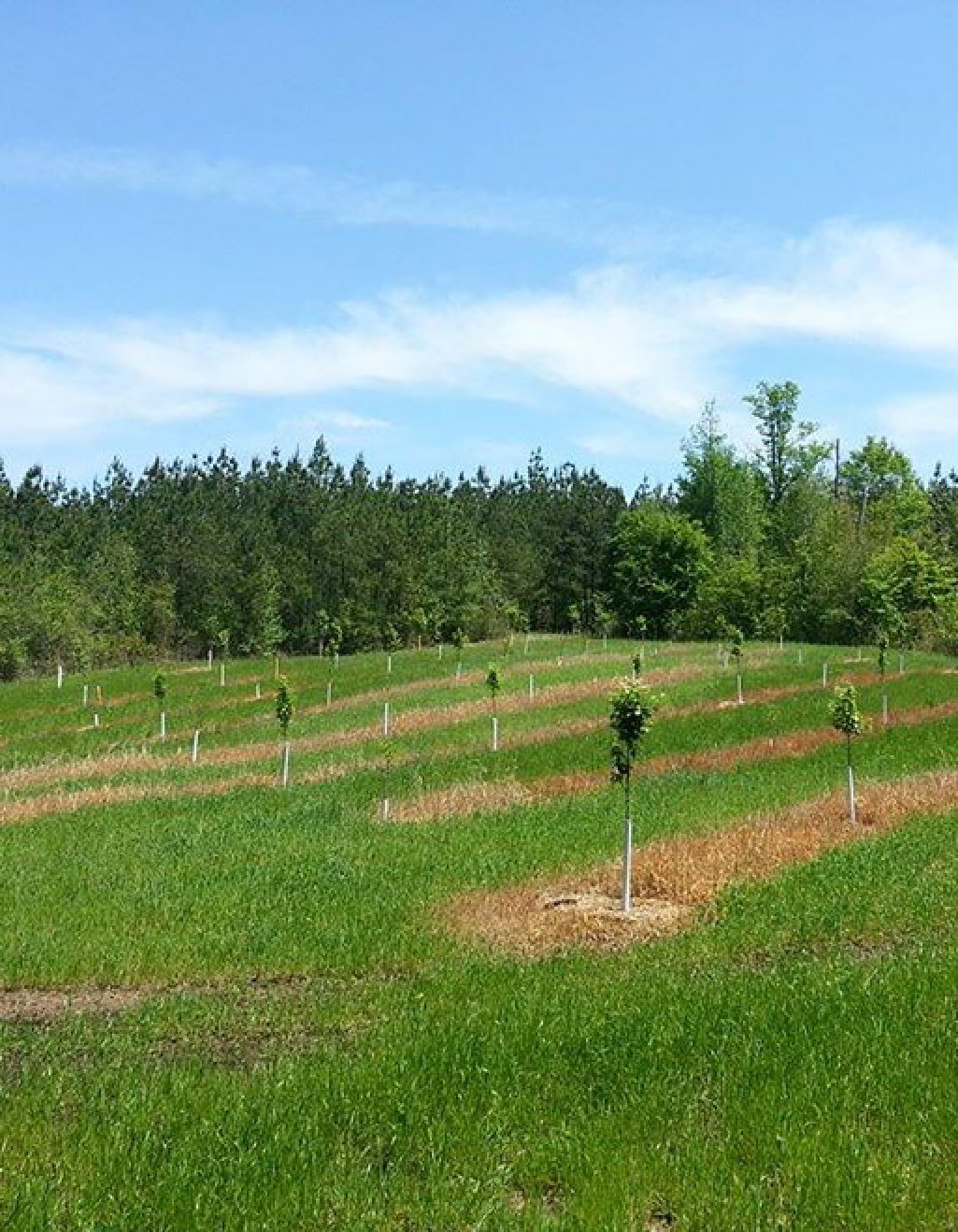
Now that hunting season is upon us and many of you have either already planted your food plots or are preparing to do so, it’s also a great time to plan for adding trees to your property this winter. At our nursery we’ve worked extremely hard all year to provide you, the landowner, with the best quality seedlings and trees. My hope is the following article will help you plant and care for my trees because we take great pride in our products. So follow these directions so you don’t screw things up! Just kidding, but seriously, this guide can really help you be more successful with your plantings.
Whether you have trees and/or seedlings delivered to you or you visit a nursery and pick out your trees, here is a good guide to go by on what to look for:
- Look for healthy one year old whips 3′ to 4′ tall, ½” to ¾” in diameter
- Container plants 4′ to 8′ tall should be 1″ to 2″ in diameter
- Closely check labels to make sure of variety and rootstock
Seedling Care
When you receive your trees, be sure to pay special attention when handling your plants that you not allow the roots to dry out. This applies to fall, winter and spring plantings. We do not suggest any plantings during the summer months unless you can get water to them on a regular basis. Plant your seedlings as soon as you can upon receiving them. If you will be able to plant your seedlings within one week of receiving them you can leave them in the original package and store in a cool place out of direct sunlight. Check the roots every couple of days to make sure they are moist. Do not allow the seedlings to freeze or to be left in an area that could potentially get too hot. If you feel moisture could be a problem, wet some paper towels or newspaper and wrap around the roots in the box to retain moisture.
Another way to store your seedlings is to simply heel them in. This works well for longer storage. Simply dig a trench in the ground deep enough and wide enough to insert the bundle of seedlings roots into the ground and cover with soil. Next you would want to water the ground to settle the soil and to keep them moist. Water the seedlings at least once a week unless you have had adequate rain fall. The seedlings will keep much longer this way and you can remove and plant as needed.
Site and Soil Requirements
If you are planting fruit trees, sunlight is the key ingredient in maximizing fruit production. Early morning sun is really important to dry the dew from the plants, thereby reducing the incidence of disease. Choose a site on your property that is in the sun most of the day. Otherwise, expect reduced performance from your trees.
Well drained soil is more important than soil fertility. Avoid soils where water is still standing 24 hours after a good rain. It is in these areas that the roots will die from a lack of oxygen. If you are forced to plant in these areas you will need to plant on raised or terraced beds.
And lastly, never plant apple trees in high alkaline soils. Apples develop many minor element problems when planted on high PH soils.
Planting Your Trees
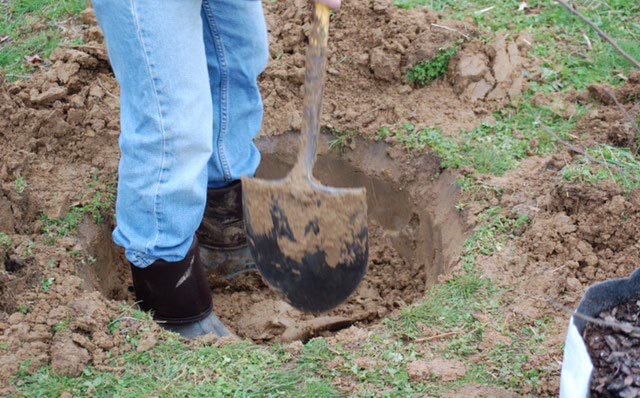
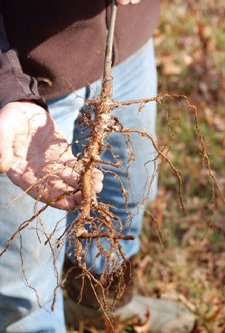
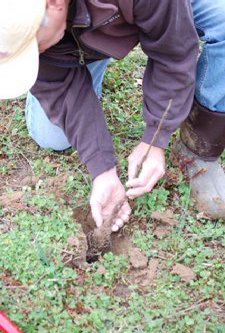
The hole that you dig is just as important as the seedling that you are planting. The hole that you dig will need to be deep and wide enough so you can easily place the seedling without J-rooting or smashing the roots together. Make sure the hole is deep enough so that you can plant your trees at the same depth they were at the nursery. You will see a slight color change from the tree trunk to the root system. Plant at that depth, maybe a slight bit deeper but do not leave any root above ground.
All fruit trees will grow better on well drained soils. Some oaks are suited for wetter soils and will do great. But keep in mind that not all trees will grow in moist bottomland. Sunlight is very important for most trees and plants. Plant in full sun where possible and remember that morning sun is more important than evening sun. So if you will only be getting 4-6 hours of sunlight, plant for morning sun if possible. Again wet soils are not acceptable for fruit trees.
Most of all take your time and plant your trees the right way. Rushing through this job causes poor plantings with poor results. I know this is to sound crazy coming from a tree salesman but I had rather you plant less trees and plant them right. Set up a 5 year plan for your property and plan in sections so that you can give your trees some extra care the 1st season.
Tree Spacing
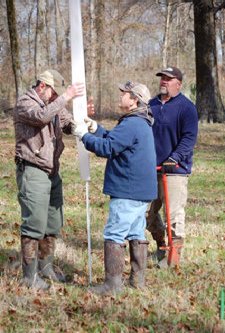
Oak and Chestnut trees should be spaced at least 25-35 feet apart. Plant these trees in groups to insure pollination as well as to provide a larger support of food in the area once the trees start to produce. Chestnuts typically start producing within 5-7 years. Oak trees will vary widely depending upon species. Early producing oaks include Sawtooth, Gobbler Sawtooth, Chinkapin Oaks, Dwarf Chinkapin Oaks, Live Oaks and Water Oak. From my experience you could have acorns within 5-8 years on the above species. Always use tree tubes and a quality stake to insure survival and increase growth.
Fruit trees should be spaced at least 15-25 feet apart depending on the species. Apples and crabapples can be planted at tighter spacing. This is because of the semi dwarfing root stock on many species. Always check with your grower to find out what root stock they are using. If they are using wild apple root stock, space trees at least 20 feet apart. Pears grow much larger and faster so the minimum spacing on them would be 20 feet. It’s best to plant fruit trees in groups mixing apples and crabapples to aid in pollination. Also, plant pears together and mix varieties for pollination. Mixing different types of fruit together not only gives you great pollination but also offers an extended drop of fruit. Keep in mind that some fruit trees will produce within three years. This is not always optimum because heavy fruiting slows growth and can damage trees. We recommend removing fruit from your trees for the first 3-4 years if possible to allow the energy of the tree to go to the trunk as well as helping to avoid broken branches from the heavy fruit. Most fruit trees will be large enough to withstand a good fruit crop at about five years after planting.
Fertilization
In the past we have recommended adding a slow release fertilizer to the holes at the time of planting. I am somewhat backing off of this statement because of recent tests I conducted on my own property. We always mixed a 3 month slow release fertilizer in the pots at the nursery when planting with no ill effects on the trees. This season I used the same method as always on my property but used a 12 month time released fertilizer and at a higher rate than I generally recommend. We had ample rainfall for most of the season but we did have a one month period in the area where rain was scarce and I lost several of my trees. I am contributing it directly to the continual release of fertilizer while not having adequate water for the plant. I still feel that a low dose of 12-6-6 will work fine but by low dose I mean a tablespoon.
With that said this is my new recommendation. At time of planting, dig a larger than normal hole to soften the surrounding soils. This will allow for the root system to easily spread. If you are able to water the 1st season, go ahead with the slow release fertilizer as previously suggested. If not do not fertilize at time of planting, my suggestion would be to pick the sight you plant your trees and prepare before planting by adding at least 3-5 pounds of lime in a 4×4 area and about ½ pound of blood meal. If you feel the need to fertilize the 1st year, only add about one tablespoon around the base of the tree about one foot from the trunk in early March and again in mid –June, and only if you are getting adequate rainfall. The 2nd year use about one cup at the same time of year, increasing each season by ½ cup. Use no more than one cup and no more than 5 pounds on a mature tree.
If you are in an area where fire blight is a problem or has been a problem, cut your application rates in half on apples and crabapples. Pears do not require a lot of fertilizer so if you have any doubts about pears do not fertilize at all. Treat persimmons much like you would pears. Be sure to soil test the areas you plan to plant. Soil Testing is the most overlooked and important aspect in any planting situation!!!!
Weed Control
One of the most limiting factors for all newly planted trees are weeds. Weed competition can result in death or poor growth of young trees. Think about it, any weeds and/or plants growing at the base of your trees are competing with your tree for moisture and nutrients. Keep a 3′-4′ circle cleaned at the base of each tree. This can be done by mulching, use of a weed mat or the use of chemicals. When using a product such as RoundUp, be careful not to get it on the tree. It is also beneficial to mix a pre-emergent with the RoundUp to prohibit regrowth for approximately three months. Again, weeds are the most limiting factor for newly planted trees.
Spraying
Your trees should be selected with the absentee landowner in mind. Strive to pick the most disease resistant trees that you can possibly get to help with the problems that may arise while you are gone. However, disease resistance does not mean immune so some spraying may be necessary at times.
We strongly recommend the spraying of dormant oil (Horticultural oil) mixed with 1 ounce of Permethrin on your fruit trees once a season in February on a warm sunny day. We sell dormant oil or you can buy it at any Lowes, Home Depot or Garden Center near you. This will smother mites and insect eggs that would emerge later to cause damage to your trees. Permethrin will also contact kill as well as have a 30-60 day residual kill. Permethrin will also kill Ambrosia beetle along with Camphor shot borers that over-winter in your trees and emerge in the spring. Never spray insecticides on your trees while they are blooming. Doing this will kill beneficial pollinating insects.
We also recommend a systemic drench for edibles. Fruit, Citrus and Vegetable Insect Control can be used on all of your mast producing trees. This soil drench protects against aphids, beetles, whiteflies, scales, psylids, leafhoppers and thrips, and is a season long prevention. A stronger version is also available for trees that will not be used for human consumption such as all your oaks and chestnuts. This is a dual action formula that delivers 12 months of insect protection along with a slow release fertilizer feed. Most of these products can be purchased where you get your trees as well as your local Lowes and Home Depot stores.
Pollination
Not all fruit trees require pollen from other varieties to set fruit. But why take that chance? It is always best to plant two or more varieties with overlapping bloom periods. Some varieties bear heavy crops when pollinated by another pollen producing variety. It is very important to mix varieties and plant in multiples to insure that pollination will not be an issue.

Pruning and Training
The day that you plant your trees is the day you should begin to prune and train them for future production. Neglect results in poor growth and delayed fruiting.
1st year -Pruning a young tree controls its shape by developing a strong, well balanced framework of scaffold branches. Remove or cut back unwanted branches early to avoid the necessity of large cuts in later years. Remove inside limbs as well as heading the central leader. Heading brings the top and the roots back into balance and causes buds just below the cut to grow and form scaffold branches.
2nd year- Again, top the main leader to encourage another group of scaffolding branches. Remove all inside limbs and tip-prune all existing limbs. The use of limb spreaders is encouraged to get the desired spread of limbs (45 degree angle with the main trunk). This will insure sufficient sunlight reaches the interior portion of the tree. Remember to always keep the central leader as the highest point on the tree and keep the ends of the scaffolds and primary limbs below the top of the tree. Prune trees every year in February.
In Summation
- Purchase your trees from a reputable company. Remember that buying trees is a long term relationship much like purchasing a piece of land. The trees that you plant on your property will benefit you and your family for a long time.
- Soil Test!
- Diversify -plant varying species of Apples, Crabapples, Pears, Persimmons and Plums not only for pollination but for a sustained fruit drop from early summer into late December.
- Spend a little time with your trees each season in late February removing old dead limbs, crossing limbs inside the tree and heading back the leaders. Remember to make pruning cuts above outward facing buds.
- Fertilization- always lean on the side of a little is enough. Remember that Pears and Persimmon do not require a lot of nitrogen, especially after about three-four years. Fertilization during the early years is very helpful in getting young trees established as well as soil testing for correct PH.
- Weeds – use weed mats, spray, mulch or all of the above. Weeds are the most limiting factor to establishing newly planted trees.
- Dormant oil on a warm February day will help protect from insect damage. This is the most important spray that can be applied to fruit trees in my opinion and it is the least toxic of all sprays.
- Lastly be patient! I hear all the time that someone at a nursery told their customers that they have trees that will produce in 2-3 years. Well, we do, but in reality even if buying large trees you will still have about a 4 – 5 year window that the tree must develop a sound limb structure and a healthy thriving root system. Only then will you start to benefit fully from your orchard. So plant with a long term purpose in mind and only plant as many trees as you can care for each season.
Planting trees can be a very rewarding project for you, your property, and your hunting buddies or as a great family outing. Seeing the results of your labor is very rewarding. When following our recommendations we fully expect that you would have 85% survival or better. Obviously things will happen out of your control and you will lose some trees, it happens to us also. Be patient and give them time and you will be planting trees for years to come.
