
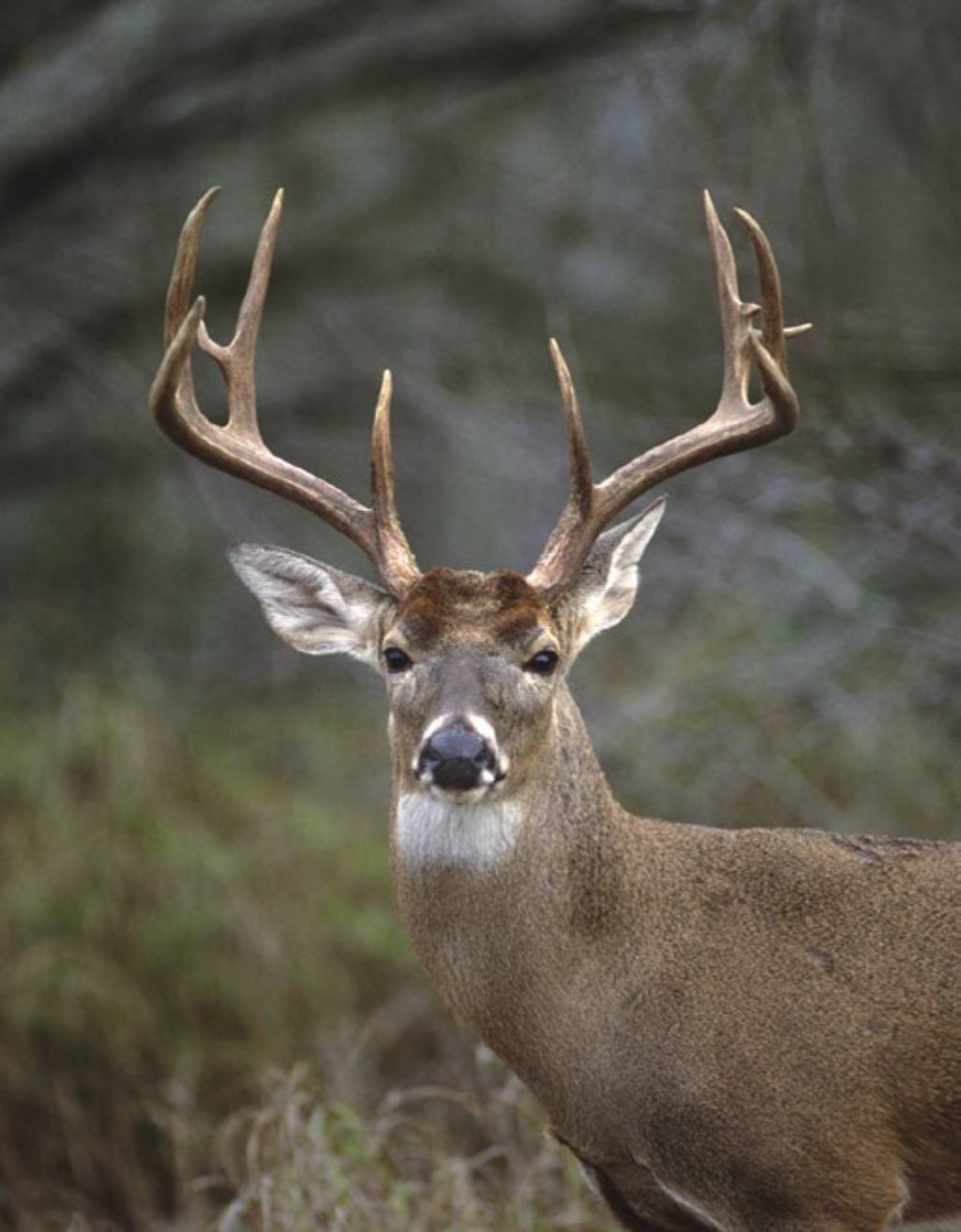
Building a sustainable buck population requires planning and effort equivalent to designing and building a new home. In this analogy, the first critical step is development of blue prints that incorporate the needs and expectations of your spouse! If you’ve built a home from scratch, you know the challenges faced during this first step. Well, identifying and gaining consensus among a group of hunters, whether this be a lease or private property, can be equally difficult. Some want to manage for “trophy deer,” while others simply want to harvest a “few good bucks” each year. These opposing hunting and management philosophies will cause debate and frustration among club members. Both strategies are biologically acceptable, so the final decision is based on social preferences and the willingness to work towards a shared goal.
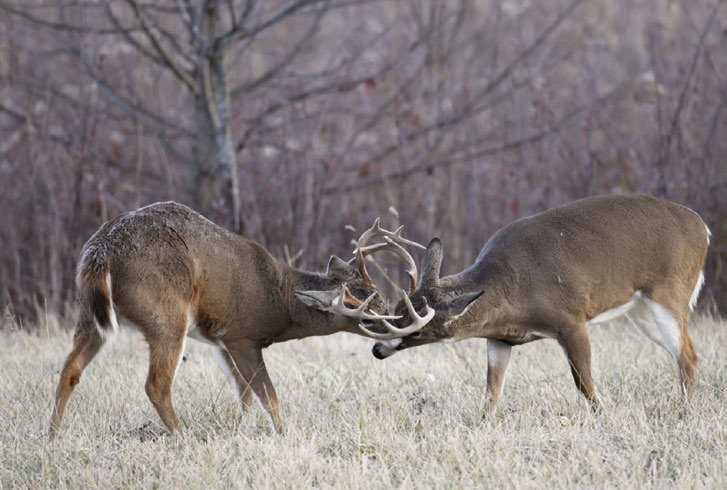
Developing a common understanding of the effort required of each management philosophy is critical to the successful completion of the ultimate management program, and this process usually includes education. Just about everyone wants to harvest “big bucks,” but some hunters are unwilling to invest the effort to learn the necessary principles and then apply the necessary effort to apply the management actions needed to consistently produce mature, large-antlered bucks. If your hunting group isn’t fully engaged and committed, our advice is either 1) accept that you will never reach your buck management goals, or 2) find another hunting club composed of more like-minded hunters. Management works, but it takes sacrifice and time.
Recipe for Bigger Bucks
The two most influential factors that deer managers can improve are nutrition and buck age structure. Genetics is commonly cited as a third factor, but there’s little a manager can do about genetics in a free-ranging wild population. Furthermore, once deer nutrition and buck age structure have been improved on a property there’s rarely a perception of a genetics problem. Deer managers can improve habitat quality and deer nutrition using a variety of timber management, managed openings, prescribed burning, and food plots. Habitat improvements are easy to see and the feeling of accomplishment reinforces the actions. In contrast, managing buck age structure takes many years, but it’s a critical step in deer management and the reward is well worth the wait.
For years biologists have preached, “let them get to maturity at 5 years,” and that was a good goal for the early days of buck management. But now we know that full antler size isn’t reached until 6 years of age, and this maximum size typically lasts for many years. For example, we had a buck at the MSU Deer Lab facility that maintained over 200 inches of antler for 5 years, and likely would have continued if feral dogs hadn’t killed him going into his 11th year.
This is important information for your buck management program. Once you protect those middle-aged bucks for several years, you can begin accumulating mature bucks in the population and harvest those bucks when they are displaying peak antler development. If a few mature bucks slip by and don’t get harvested at the first sign of maturity – that’s good! You always want to have a pool of mature bucks that hunters can chase and hopefully have the opportunity to harvest. On large properties (10+ thousand acres) many deer managers have a goal of having >30% of the buck population mature!
Critical Mass of Mature Bucks
Society suggests that “fifty is the new forty” for people, and that may be correct. Well, the latest research shows that “6 years is the new mature” in the world of buck age structure! Of equal importance, this new maturity level isn’t fleeting!
The ability to accomplish such a management strategy depends on harvest rate over a large area. (If you manage a smaller property you must create a management cooperative with your neighbors.) If every hunter expects to harvest a trophy buck each year you may never accumulate a sufficient mature buck population due to over-harvest of the best-quality antlered bucks. We believe a more reasonable expectation is 1 trophy buck every 2-3 years. The bottom line is that you have to optimize the number of hunters and trophy buck harvest rate for your property that will insure a sufficient number of higher-quality bucks remain in the population until next year.
Most mature bucks are not “trophies”
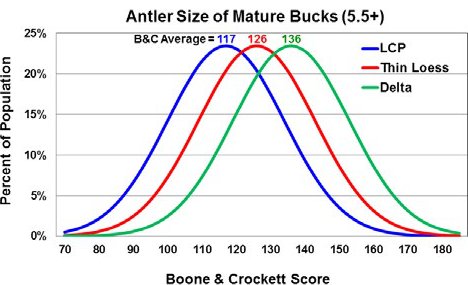
So let’s say you’ve accomplished the first step – you now have a sufficient number of mature bucks in the population – now you have to prepare yourself for the next hurdle. Most mature bucks are not “trophies.” Unfortunately, 150, 160, and certainly 170+ class bucks are very, very rare. This is equivalent to a 7 foot man – Mother Nature just doesn’t produce many. Providing sufficient nutrition and allowing a buck to grow to maturity means that a buck can fulfill his genetic potential for body and antler size. But unfortunately, this won’t turn a buck that is genetically programmed to have 120-class antlers into a buck that has 160-class antlers. So you must keep your expectations reasonable. In Mississippi, the statewide average antler size of mature bucks is about 126 inches. About half of the mature bucks will have larger antlers, while about half will have smaller antlers. Only about 10% of mature bucks will ever grow 150-inch antlers, less than 5% will grow 160-inch antlers, and a mere 1-2% will grow 170-inch antlers, which means that only 16-17% of mature bucks will exceed 150 inches. These percentages vary based on deer habitat, quality, and nutrition. In the Delta region of Mississippi, these percentages are greater, and in the Lower Coastal Plain of Mississippi, a little less. The distribution of antler size within a buck population has a classic bell-shaped distribution, which means that 16-17% of mature bucks will be at the other end of the antler size range and will never exceed 100 inches of antler score. These bucks need to be removed as early in their life as possible as part of population control. We’ve accounted for 32-34% of the bucks that are in the upper and lower end of antler size distribution, but that leaves about two-thirds of the buck population with antlers that vary within 25 inches of average, and these bucks must also be incorporated into a harvest management program.
Where do they go?
Once you’ve committed to managing for mature bucks, you have to acknowledge the next dirty little secret about trophy buck management – it’s a very inefficient process. Every young buck protected from harvest will not live to maturity. In the remainder of this article we review some of the problems encountered when managing for older-aged bucks and describe strategies to address those problems.
Dispersal
Dispersal is the process of an animal moving from where it was born to where it spends its adult life. Dispersal is an ecological mechanism for exchanging genetic material between populations and to insure that bucks don’t breed their mother or sister. Dispersal distances typically average about 2-6 miles. Buck dispersal significantly impacts your management success if it is not balanced by similar dispersal onto your land from surrounding properties.
Reported dispersal rates vary from 40% in Virginia to 70% of bucks 8-18 months old in Maryland. Researchers in Maryland found that the number of yearling bucks dispersing onto their property was much lower than the number of yearling bucks dispersing from their property, resulting in an annual net loss of young bucks. The reason for unequal dispersal was the intense harvest pressure from neighboring properties. The rate of buck dispersal drops significantly after the yearling age class, but older bucks may temporarily disperse from their normal home range during the rut. This is when large properties or co-operatives become so important. If you are surrounded by neighbors that do not protect young or middle-aged bucks it will be very difficult for bucks to reach maturity. So work with your neighbors to develop management objectives that everyone can support.
Mortality
The annual mortality rate for a deer herd is simply the percentage of the population that dies in a given year. Mortality can be attributed to hunting, poaching, vehicle collisions, predators, and disease, among other factors. Mortality rates vary by sex and age of deer and by season and region of the United States.
Legal harvest is a significant source of mortality in most areas, and is controlled with regulations and hunter selectivity. On a well-managed property, legal and illegal harvest of bucks may be much less than the average hunting property because so many young and middle-aged bucks are protected. But you still have to consider that some of these bucks will be harvested by neighboring hunters. Illegal harvest, on the other hand, is not easily controlled and has not been quantified, but can be substantial. In most of the South, legal and illegal harvests account for most of the annual buck mortality.
Populations near the northern and southern boundaries of the whitetail’s range have the highest reported non-hunting mortality. In these regions, up to 25 percent of all bucks may be killed annually by predators. Coyotes, wolves and black bears predate whitetails in the North; whereas, coyotes and mountain lions are the prominent predators in the Southwest.
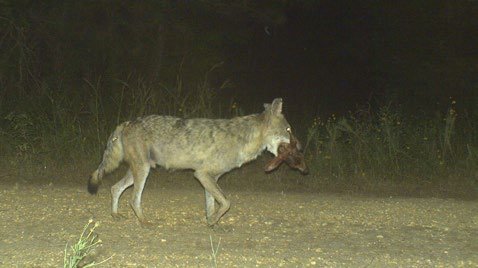
The South no longer has viable populations of large predators such as wolves and mountain lions that are capable of killing healthy, adult deer. Coyotes and bobcats are prevalent in the Southeast, and they mostly take fawns and injured adults. Landscapes with very little ground-level cover may suffer substantial losses of fawns to coyotes. However, management practices that promote ground cover should improve fawn survival.
Most health-related mortality in the Southeast can be attributed to two causes: hemorrhagic disease and malnutrition-parasitism syndrome. Hemorrhagic disease (also known as bluetongue) viruses can be significant, although mortality rates are typically less than 15 percent. Deer populations in the South are confronted with these viruses much more frequently than their northern counterparts and have adapted to the disease. Without the acquired adaptations, northern deer populations suffer much higher mortality rates.
Malnutrition-parasitism syndrome is generally associated with high-density deer populations where the habitat has been chronically over-browsed or where populations occur on very poor-quality habitats. Nutritional stress makes deer more vulnerable to parasites. Primary internal parasites include the large stomach worm and lungworm. Major external parasites include ticks and keds (deer lice). High deer densities can increase the transmission of these parasites to other deer. Actual mortality rates vary by parasite species and age and health of deer.
What this means to deer managers
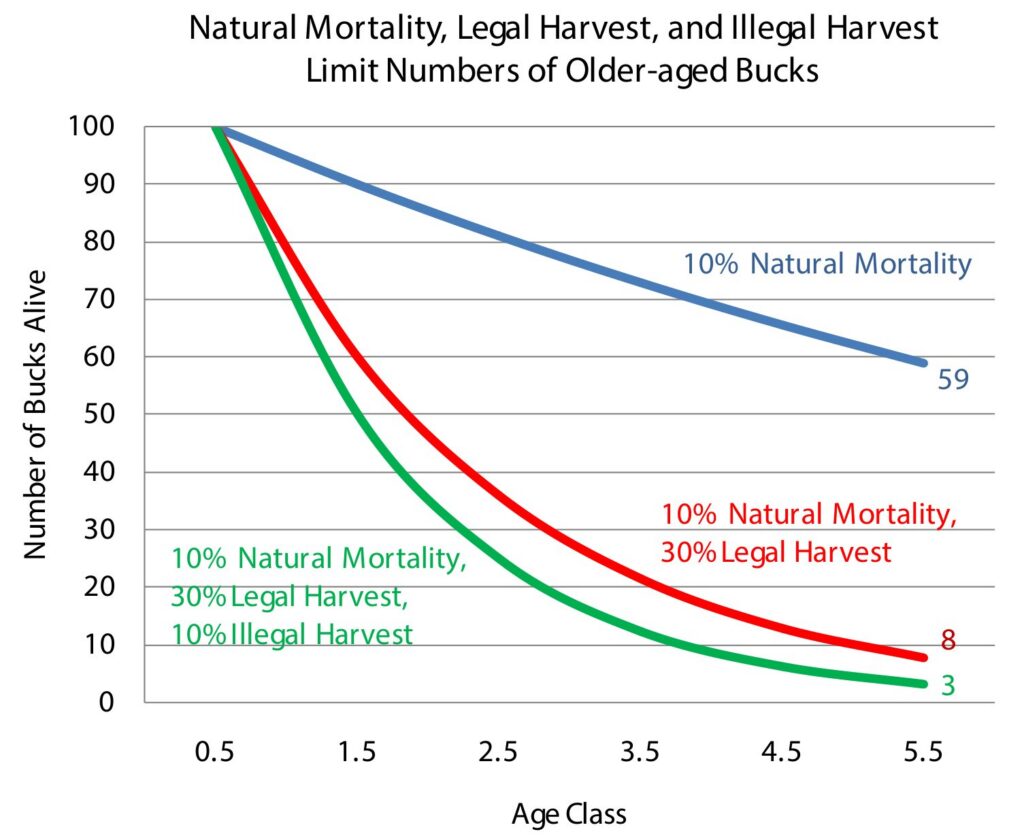
So what does this mean? As we mentioned earlier, managing for older bucks is inefficient. On average, for every 10 yearling bucks that you pass less than 6 will be around at maturity. If legal harvest pressure is intense on and around your property that number drops to less than 4. To demonstrate this point we’ve generated a graph showing how the number of bucks changes from year to year given various sources of mortality.
Starting with 100 buck fawns we’ll apply typical mortality effects and count how many survive to maturity at 5½ years of age. The blue line represents the effect that a 10 percent annual natural mortality rate would have on this group, with only 59 of the original 100 buck fawns surviving to 5½ years old. The red line represents the effect of a 10 percent annual natural mortality rate and a 30 percent annual legal harvest. Only 8 of the original 100 buck fawns would survive to 5½ years old with this combination. The green line represents the effect of a 10 percent annual natural mortality rate, a 30 percent annual legal harvest, and a 10 percent annual illegal harvest. Only 3 of the original 100 buck fawns would survive to 5½ years old with this scenario. Now imagine how these figures would change if you included unequal dispersal rates off and onto your property.
In the South, the lower observation rate of older bucks compared to younger bucks can lead the deer manager to conclude there aren’t many older bucks in the population. However, keep in mind that deer herds in the South are very productive (that is, many fawns are produced and survive to the yearling age class); therefore, there’s always a new crop of yearling bucks to see each fall.
Another source of frustration for hunters can come from differences in the susceptibility of bucks to harvest. The lack of older-aged bucks seen during hunting hours can lead hunters to believe that these animals are not present in the herd. Often older bucks do not expose themselves to hunters during daylight hours during with about the only harvest opportunities occurring during the rut. Therefore, it is possible older-aged bucks are present but are not being harvested. Trail cameras come in handy to determine this. If you regularly see mature bucks on your trail camera photos, but not during hunting hours, you know that these bucks are out there – you just have to figure out how to hunt them. Remember, these older bucks didn’t get old by being stupid. They are very aware of hunting pressure and respond by restricting their movements during daylight hours.
Conclusions
Buck harvest rates, natural mortality rates, dispersal rates, and property size all play an important role in the success or failure of a management plan. Deer managers with small properties who experience heavy buck harvest on surrounding properties may have a difficult time producing many mature bucks. If natural mortality and hunter harvest on peripheral properties limits recruitment of bucks into older age classes, forming a cooperative with surrounding landowners is the only viable answer for free-range deer management. You may be surprised what can be accomplished if you and your neighbors can agree on a common management plan – they may be willing to protect those younger-aged bucks once they know you will protect them too. The good news for deer managers of large properties is that the most significant factor limiting buck survival is legal hunter harvest. If you can control the harvest of bucks, you can someday produce a surplus of mature bucks on your property.
Landowners and hunters must have goals and expectations that are reasonable given these limitations. The degree to which a buck management program works largely depends on factors we have listed in this article. Consultation with a wildlife biologist from your specific region about these considerations can help you fine-tune your management program and increase your chances of success.