

Noted wild turkey historian and author, Brent Rogers, via a Niche To Meet You Podcast in September, 2024: “When Christopher Columbus landed in what is now known as America in 1492, it is speculated there were ten million wild turkeys on the landscape. In the 1520’s Spanish explorers discovered the Inca and Aztec civilizations had domesticated wild turkeys and some of these domesticated birds were transported back to Europe. Turkeys were vital to the diet and culture of almost all native American tribes.”
Fast forward 400 years to the early 1900’s. The speculated ten million birds had dwindled to an estimated 30,000. This tragic, almost fatal decline can be attributed to unregulated subsistence and market hunting where harvested animals and birds were sold to the public or consumed as a food source. Very few laws existed to protect wild turkeys, bison, white tailed deer, waterfowl and other game species. The combination of these circumstances almost led to the extinction of several species including the wild turkey. It did lead to the extinction of species such as the passenger pigeon. In the early 1900’s, concerned hunters banded together and lobbied to prevent the total destruction of these species by bringing attention to the dire circumstances facing all wildlife in America.
In 1900, Iowa Republican John F. Lacy introduced the Lacy Act of 1900 which outlawed market hunting by prohibiting the transportation of illegally harvested game animals across state lines. This legislation was later signed into law by President William McKinley.
Then, on September 2, 1937, president Franklin D. Roosevelt signed the Federal Aid in Wildlife Act and it went into effect on July 1 the following year. Better known as the Pittman/Robertson Act for its sponsors, Senator Key Pittman of Nevada and Congressman Absolam Willis Robertson of Virginia. the act imposes an 11% sales tax on firearms, ammunition and archery equipment and distributes the proceeds to state governments for wildlife projects.
Vital funding generated by the Pittman/Robertson Act allowed the creation of state wildlife agencies. State agencies and legislatures worked to create and adopt effective laws and funded the creation of enforcement divisions within the agencies. This marked the beginning of modern wildlife conservation.

In 1959 the first Wild Turkey Symposium was held in Memphis, Tennessee. At this symposium, turkey experts from across the country shared and discussed the situations and circumstances facing wild turkeys and began to formulate possibilities of restoring turkeys to healthy populations across the land. It would be a daunting task.
Restoration
Logically, the task of restoring wild turkeys fell on state agencies. The experimental methods first employed, however, were untried and relied on trial and error. Error was predominant in the early going. One such error was baiting turkeys with corn laced with an oral anesthetic alpha-chloralose. Another chemical used was tribromoethanol. Various dosages and delivery methods were tried and eventually a faster acting drug called methoxymol was used. In summary, this method proved to be ineffective and often fatal to turkeys and other wildlife.
Another idea was to introduce pen-raised turkeys into the wild. This proved to be a miserable failure. Turkeys raised by humans from poults imprinted on humans and did not develop the characteristics necessary to survive in the wild. They were easy prey for predators and hunters and resulted in universal failure.
“In 1948 H. H. Dill and W. H. Thornsberry invented a cannon net that could be fired over and capture flocks of birds. In 1951 Herman ‘Duff’ Holbrook captured the first flock of wild turkeys in South Carolina. News of his success spread and soon cannon netting turkeys became the go-to method for capturing wild turkeys. Captured birds were released into suitable habitat void of wild turkeys. By 1958, twenty states with wild turkey populations had a stated turkey season. In 1959 there were an estimated 320,000 turkeys in the United States and 31 states were participating in wild turkey restoration. At that first symposium in Memphis, it was decided that, “introduction of penned raised turkeys was a failure and trapping and relocating wild birds was the future of the restoration effort,” said Brent Rogers, author of the book Yelp & Gobble, Inc.
“In 1973 the wild turkey population is estimated to be 1.3 million and Tom Rogers, no relation to Brent, founded the National Wild Turkey Federation (NWTF) as a conservation group to support wild turkeys. The organization brought much needed attention to the restoration and management efforts of the states and galvanized hunters and conservation enthusiasts in support of wild turkey conservation. By the late 1980’s, 47 states had turkey populations and in 1991, for the first time ever, 49 states had turkey populations with Alaska being the exception, all due to the efforts of state agencies and the success of trap and relocate efforts.”
In 2001 the NWTF announced that turkeys had been reintroduced or expanded into every available suitable habitat in the United States and declared Mission Accomplished. At that time there were an estimated 5.5 million turkeys on the landscape in the United States.
Warning Signs
The restoration of the wild turkey is perhaps the greatest success story in the history of conservation in the United States. From an estimated low of 30,000 birds in the late 1920’s to the high of 7 million birds in 2017, two and a half million turkey hunters today, seasons in 49 states and an entire industry created to support those hunters are all testaments to the success of wild turkey restoration, management and conservation.
However, in 2008 the first red flag was raised. Despite estimates of wild turkey population levels, some agency biologists and researchers began discussing possible population declines and productivity based on data collected in the southeastern and eastern United States. In 2010 at a meeting in Florida, agency biologists representing states throughout the southeastern United States agreed that research was warranted to determine magnitude and severity of the apparent decline in production and recruitment of wild turkeys throughout the region.
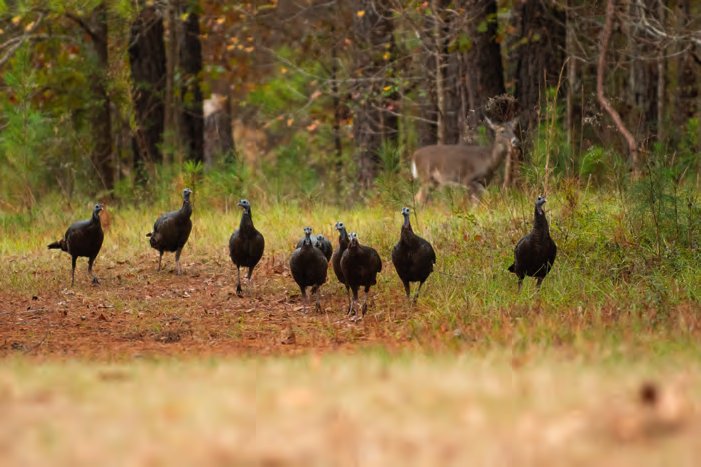
In 2019 the population estimate was 6.9 million birds, but behind the scenes, especially in the southeastern United States, there was a growing rumble of population decline by hunters, land owners and private land managers. Habitat loss, fragmentation of the landscape, feral hogs, disease, predators and nest predation were hot topics in this growing concern of population decline. Most of these concerns were dismissed by the experts as natural ebb and flow cycles of ground nesting birds. In 2021 hunters stood up again to demand solutions and Turkeys For Tomorrow was founded as a conservation organization dedicated to identifying the cause and reverse the decline of wild turkeys across the country.
Simple Solutions
The mission statement of Turkeys For Tomorrow, (TFT), is simple and succinct, We will save wild turkeys with science-based solutions for long term sustainability. In efforts to accomplish that goal, TFT and its partners are currently funding research projects in Alabama, Mississippi, Tennessee, Kentucky and Iowa.

Five additional projects will be launched in Alabama, Texas, Tennessee, Florida and the Mississippi River Deltas of Arkansas, Mississippi and Louisiana in 2025. Each of these projects are long term studies to better understand concerns such as fertility, disease, predation and habitat.
In an effort to better disseminate information gleaned from the research TFT sponsored, the Wild Turkey Science Podcast hosted by Dr. Marcus Lashley, Professor of Wildlife Ecology at the University of Florida and Dr. Will Gulsby, Professor of Wildlife Ecology and Management at Auburn University. The idea is to translate the gobbledygook of a peer reviewed study paper into plain speak language the common hunter, land owner or manager, or as we refer to them Citizen Scientists, can understand. As TFT founding member and Chief Operating Officer Kevin Matthews says, “we want to put it where the goats can reach it!”. To date there are 96 episodes and there have been over 600,000 downloads that provide listeners valuable answers and information about wild turkeys and what they need to thrive.

Jason Lupardus has a Masters Degree in wildlife biology and forestry from the University of Tennessee, Knoxville. He also serves as Chief Executive Officer of TFT. “One of the huge issues we face as turkey managers is, how do you manage something when you really don’t know how many of them are on the landscape? Throughout this article you will see the word estimated time and again. We really don’t know how many turkeys are on the landscape. State agencies do annual surveys and plug that information into a formula to come up with estimated (there’s that word again), numbers of turkeys in the population. Decisions such as season dates, harvest quotas and limits are based on that number. In reality it’s an educated guess, and we only look at trend data year to year based on harvest,” said Lupardus.
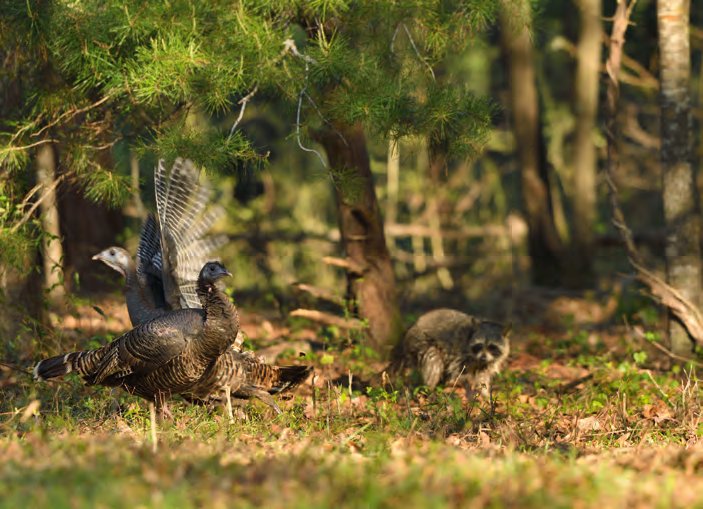
“We estimate that only 25% of hens are successful at nesting. Successful means they hatch at least 1 poult. We estimate that for the population to remain stable we need an average of 1 hen to 2 poults to be recruited into the fall flock. In recent years, surveys are indicating an average less than the 1:2 ratio, which is indicative of a declining population. What can we do to change that? First, do everything you can to improve your habitat, especially brood and nesting range. Second, where legal, trap or manage intensively for predators such as bobcats, coyotes, raccoons, opossums and skunks the month prior to average nest initiation in your area. This has proven to provide up to a 15% increase in production of waterfowl and quail. Second, don’t mow until July to protect nests and young poults within the two-week post-hatch stage. In a study by Dr Craig Harper, Professor of Wildlife and Management and Dr Dave Buehler, Professor of Wildlife Science, with the University of Tennessee, Knoxville, 12% of identified turkey nests in the study area were destroyed before hatched by mowing. It is a well known fact that at approximately two-week-old turkey poults are able to flutter off the ground onto low limbs and are more thermo regulated and protected from weather due to having actual feathers. Survival for poults reaching this age goes up dramatically,” said Lupardus.
Previously, the term Citizen Scientists was mentioned. Turkeys For Tomorrow wants to share ownership to solving the many issues facing wild turkeys with those who care about them most—hunters! It was hunters that funded the efforts to bring them back from the brink of extinction to today’s population levels. Collaboration with other organizations like the Alabama and Tennessee Wildlife Federations, state agencies, universities and independent biologists streamline the effort to unite everyone who is concerned and willing to help.

Jason Lupardus—”Nobody knows more about what is happening on your dirt than you and nobody is more willing to do the work that it will take to reverse the downward trend in wild turkey populations. You may say that you don’t manage or own enough land to make a difference but that’s not true. Imagine partnering with your neighbor, then another neighbor, then their neighbors and adopting self-imposed rules and methods to improve habitat, manage predators and voluntarily limit harvest on these combined properties. We call them private land cooperatives. TFT believes these private land cooperatives can become turkey incubators and facilitate the recruitment of more turkeys onto the landscape. After all, it’s a proven model. The Quality Deer Management Association implemented a similar plan for white tailed deer. Look at how the deer hunting culture has changed in the last twenty years. We need to influence changes in the turkey hunting and management world. If we can do that, we can reverse the downward trend in wild turkey populations and hopefully secure the future of these majestic birds and the sport of hunting them. I think all turkey hunters can buy into that. After all, we are all it for the same reason. We all want turkeys around for future generations, and we shall not have a silent spring. There is a brotherhood in the fraternity called turkey hunters. In no other aspect of hunting, any game animal or bird, is that kinship so evident. The founders of Turkeys For Tomorrow have said from the beginning, If turkey hunters don’t do this who will? If not you, who?”

Author’s Note
I would like to acknowledge the help of Wild Turkey historian Brent Rogers in writing this story. His research and input proved invaluable by providing estimated information that, to the best of everyone’s ability, support points made with the best data available. His book, Yelp & Gobble, Inc. is available on Amazon and signed copies can be ordered by calling Brent at 641-777-2467 or email him at roglodge4@hotmail.com.
I would also like to thank Dr. Will Gulsby, Dr. Marcus Lashley and the NRU podcast network for their outstanding work with the Wild Turkey Science Podcast. We truly believe the knowledge and lessons gleaned from wild turkey research from decades ago until today are available where the goats can reach it!