

If you are like me the following scene has been well-painted into your memory. It is a sunny September Saturday afternoon. The yellow goldenrods and white fall bonesets are in full bloom and there is a dry breeze stirring, giving the initial hint of something changing with the weather and seasons. You are sitting in the shade on a folding camouflage stool on the edge of millet field, listening to a college football game playing on the nearby truck radio. Other friends and relatives clad in camo t-shirts are also scattered about the field under their favorite pine tree or along their favorite fencerow. You load up your shotgun and watch the horizon for incoming birds.
Suddenly you hear that familiar whistling sound of an airborne mourning dove coming right over you. Instinctively your shotgun hits your shoulder, you take a good lead with your cheek on the walnut, and you squeeze the trigger. Man, there’s just something about a good dove shoot! And it seems there are many who agree with that. In fact it has been estimated recently that about 900,000 folks will participate in dove hunting on a given year in the United States. Many come out with the goal of killing the limit, while it seems others just come to talk. I think I now actually enjoy yelling the names of my sons, other family members, and friends (as doves approach them) as much as I do actually shooting. And I think all of the above is actually what makes shooting doves special; it’s an annual ritual that combines a wing shooting sport with comradery in a social setting. And it is typically done in near-perfect weather on dry land (unlike the typical duck hunt).
For many the memory of all this is still relatively fresh because they wouldn’t dare miss a year without going on at least one good shoot. Whether you hunt corn fields, cow pastures, or amongst milo, millet, or sunflower strips, odds are this little brown bird stirs up recollections of fun times in pastoral settings, not to mention they are pretty good fare on the grill when wrapped in bacon! In this article we will get into the mind of the mourning dove, examine its biology and habits, and then discuss effective strategies for creating and managing effective fields that maximize hunting opportunity.
Mourning Dove Biology
All doves are members of the Columbidae family. The mourning dove (Zenaida macroura) is the most widespread and common of about fifteen species of doves found in North America, although only about half of these are native to the US. Although their population is believed to have declined slightly since the 1960’s, the current mourning dove population is estimated at over 325 million individuals across the US. Similar species include the Eurasian collared dove and the white-winged dove. The Eurasian collared dove is the exotic species that has been expanding across the entire US over the past few decades. This dove is lighter colored and larger than the mourning dove and has a conspicuous black band on the back of its neck. The song is also very different. The white-winged dove is originally native to Mexico and Latin America, the southwestern US, and south Florida, but it is also now expanding its range and is showing up in other parts of the North and East. It has a more rounded tail than the mourning dove and also has conspicuous white bars on the wings. The rock dove (also known as the common pigeon) is typically more of an urban bird, is larger, and has various color phases including white, tan and often iridescent patterns. There are also a few species of smaller ground-dwelling doves (including the common ground dove, the Inca dove, the ruddy ground dove, the ruddy quail-dove, etc.) but these are less similar to, and therefore less likely to be confused with, the mourning dove.
At about 12 inches long the adult mourning dove is generally identified by its relatively small round head, its pointed wings and tail, and by its dark brown wings with black wing spots. Males and females are very similar in appearance, save for a bit more pinkish and bluish iridescent colorations on the male. Juvenile mourning doves typically have buffy tan-tipped feathers until their first molt into adult plumage. A large proportion of the 20 million or so doves harvested every year will be juveniles and they can easily be distinguished from the adults by the buffy tipped feathers, shorter tail, and smaller overall size.
Reproduction
Mourning doves are typically monogamous and mate with a single bird during the breeding season. This bond may even last until one of the birds die. The “cooing” song made by the males is used to attract females and defend the area around her. This song evidently sounds to some folks like a crying or mourning sound, thus the species’ common name. When a pair bond is established the male selects a nest site and construction begins. According to several studies, preferred nesting habitat is typically within and along edge habitat (field borders, woodland edges, etc.) as opposed to the interior habitats of large continuous forests or openings. However, interestingly a Missouri study in 1997 (Drobney et. al.) found that actual nest success in these two types of habitats (edge vs. large continuous habitats) did not differ significantly. Nests of mourning doves are typically loosely and poorly constructed using twigs and pine straw. It is actually pretty common to find an unhatched egg on the ground under a mourning dove nest that has fallen through the bottom.
Generally the nest is built at a height of 12-20 feet in the branches of one of various tree species, especially yellow pines (longleaf, loblolly, or shortleaf) in the Southeast. In the West, however, the mourning dove sometimes nests on the ground or even on the tops of houses.
After copulation, the adult female typically lays two plain white eggs (about 1 inch long) per clutch. In the Southeast, nesting season typically starts around late March or early April and a pair can raise several successful broods (up to 5 or 6) per year. In fact mourning doves have one of the longest breeding seasons of any bird in the country and broods can keep going until late July. The incubation period of the mourning dove is about 14 days. The altricial chicks are called squabs, and like many other species, they are blind and completely dependent on the adult parents for food until about two weeks after hatching.
Diet
For the most part the mourning dove is a seed eater. Mourning doves consume approximately 15 percent of their body weight each day when food is available. Doves are adapted to flying long distances to find abundant food. Most of the diet consists of wild weed and grass seeds, cultivated grains (including soybeans, corn, wheat, oats, millets, sorghum, and peanuts), and to a lesser extent, other vegetative matter (foliage, grass, and berries). Historically (pre-European settlement times) doves would have been most plentiful in early successional areas (woodlands, open burned timber stands, prairies, etc.) where seeds (of grasses, forbs, and legumes) would have been abundant. Like most granivorous birds, mourning doves swallow these seeds whole and they pass through the esophagus down to an enlarged pouch called a crop for storing seeds and other foods. Typically the dove will feed and fill the crop on the ground and then fly to a safe perch to preen, rest, and digest the seeds. Just like in gallinaceous birds (quail, turkeys, grouse, and chickens) and ducks, doves and pigeons have strong muscular gizzards that grind up hard seeds and grain. Gravel, sand, and grit is often also ingested to assist the gizzard in this process. Where this grit is limited on the landscape, some hunters have actually had success shooting over areas that are frequented by doves for this reason. However, a consistent food source is a much more reliable attractant in most situations.
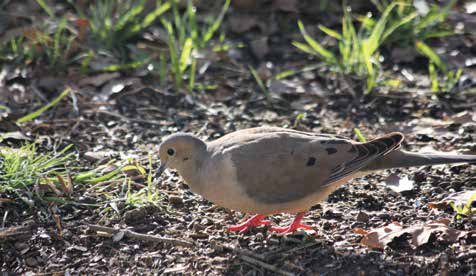
Doves do not have a well-defined sense of smell and therefore they locate and identify their food items by sight. Unlike quail, turkeys, and grouse (scratching birds) they do not dig through the litter or dirt for seeds. Their short weak legs are used only for walking and perching. Food items have to be visible and accessible in either sparse short ground cover or on bare soil or rock (always keep this in mind when preparing fields). If they can’t see it, they can’t eat it, and so they won’t waste their time on it. If there is an easily accessible source of food in a particular location, however, the doves will typically keep coming back until it is gone (if it is safe and they are not continually disturbed). Constant disruption can change feeding patterns so limit disturbance when birds are feeding. One potential problem that biologists are seeing in some areas where doves are foraging in the same areas that traditionally get hunted year after year is lead poisoning. Since the small lead shot look like weed seeds, they can get picked up and ingested. As was the case in ducks prior to steel shot becoming the norm, some samples have found dozens of shot in the crops of individual doves. One 2009 study (Franson et. al.) found the average frequency of doves that had ingested shot was about 2.5% across several regions of the country. The level of impacts are still being studied but some locations have already moved to non-lead shot restrictions to try to reduce impacts to their dove populations.
Although mourning doves are seed specialists, they are still considered habitat generalists because they live in so many regions across the country and eat many varieties of seeds and grains. They are usually especially well-fed in high agriculture production areas. Typically, a fresh water source is needed, but in some arid or desert locations they have been shown to survive drinking brackish water when fresh is not available. One other interesting adaptation that all doves and pigeons use is the ability to produce “crop milk”, or “pigeon milk”. Since doves are strict seed eaters and these foods would be tough fare for a newborn squab (most other birds feed their young insects), adults begin to produce crop milk a couple days prior to the hatching of the eggs. Crop milk is very different from mammalian milk in that it is essentially composed of fat-rich cells and tissues that separate from the lining of the esophagus of both the male and female parents. This substance is regurgitated to feed the squabs for the first several days after hatching, until they are weaned onto normal adult food items. Crop milk is extremely high in fats and proteins and like the milk of mammals, the substance has been recently found to contain immune factors and antibodies that is passed along to the squabs. Besides doves and pigeons, only a few other birds (including some penguins and flamingos) employ this strategy.
Predation
In most regions, mourning dove nest predation and mortality is significant. Other bird species like blue jays, grackles, and crows commonly detect and predate the white eggs which are visible when adults are off the nest. Squirrels and snakes (gray rat snakes primarily) also find and eat some of the eggs and chicks of mourning doves.
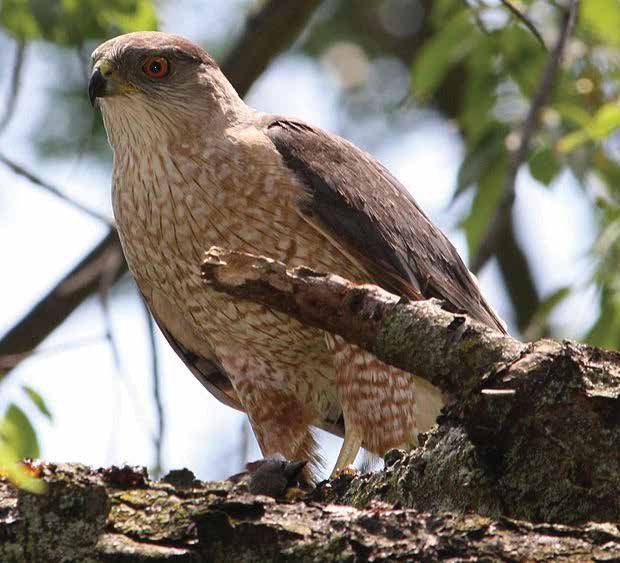
Since mourning doves have relatively large and meaty wing muscles (breasts), they are a sought-after prey species by a myriad of avian and terrestrial predators. All the usual suspects will try their luck at a mourning dove if they get a chance. However, a dove is not an easy target. They are strong and fast flyers (they have been clocked at over 55 mph) and have quick reflexes and excellent vision. Small mammal predators are therefore not usually very effective at catching adult and juvenile doves. Foxes, housecats, and bobcats may catch one every now and then by surprising it feeding on the ground, and a raccoon or opossum may accidentally run into one on the roost in the middle of the night, but mortality from mammals is generally pretty low. Avian predators on the other hand are typically more successful at taking doves. A dove’s eyes are arranged on the side of the head to detect movement and they are constantly on the watch for birds of prey. Accipiters like the Cooper’s hawk, and falcons like the peregrine, are among the few raptors that have the stamina and speed to catch a dove on the wing. Less agile buteo hawks like the red-shouldered and red-tailed hawk however, can still sometimes catch doves by surprise and make a kill on the ground while the dove is feeding. Hawks are therefore, a common sight on the dove field. The presence of the hawks does not typically ruin a shoot or permanently scare away doves from an area but it can make them wary. Remember, it is illegal to shoot any species of hawk, so it is a good idea to make sure everyone is aware of that fact before a dove shoot. As a side note, it is interesting that there are still strict laws protecting even the most common hawk species despite the fact that some populations (namely red-tailed and Cooper’s) have become extremely high over the past several decades in the East. Most mammal predators can be legally controlled, especially when management or recreational hunting conflicts arise. Perhaps at some point these laws may change.
Dove Field Management Considerations
Considering the above biological aspects of this species, land managers can consistently and predictably attract mourning doves to harvest. A “Dove field” can be many things. Local laws vary and can change from year to year so it is obviously important to make sure you know what those are before planning a dove shoot to protect yourself and guests from being fined, or worse. One of the most common strategies is of course to plant a grain-producing crop in the growing season so that it will mature and bear seed in time to attract enough birds to have a good shoot. In reality though, there are a few more things to consider before you hook up to the disk and spreader. If you are lucky enough to live in a good “flyway” county you are already ahead of the game. The fact is that not all geographic locations are equal. Some counties are highly agricultural and open while others are mountainous and heavily wooded. The former is usually (but not always) better than the latter. In my home county in central Alabama there are few open areas besides grazing pastures here and there. It is very rural but predominately comprised of hilly dense pine and hardwood forest, and therefore it is harder to attract a large number of doves to a field there than in the adjacent counties that have much more agriculture and wide open lands. If you are in hill country however, the upland ridges are typically better locations for attracting doves than the lowest bottoms.
Before we go into detail about planted and native vegetation management for doves, it is worth mentioning a few alternative situations sometimes used as places to shoot doves. If you have access to a cattle farm or feed operation, you may already have a ready-to-shoot dove field. Cattle farms often have large open spaces, low vegetation and bare ground, and lots of waste grain. Since many states allow dove hunting in and around any “normal” agricultural operations, spilled and cast cattle feed can be a pretty effective attractant in many areas. Ponds and other water sources can also be a bonus feature for holding doves but alone are usually not enough to draw large flocks in the East (since there is so much water). If you do have a pond near or adjacent to your field, mowing a large percentage of the perimeter (pond edges) would be good since high vegetation is usually intimidating to doves. Perching wires (if there are no powerlines) over or near the food source are also another simple thing that will make doves comfortable in using a particular field.
As we said before, large agricultural operations are often the most effective at pulling and holding September and October doves. Commercial corn, sunflower, or millet fields are usually hard to beat, but since these are managed by the owners or leased to farmers, they are really outside the scope of this article, and so we won’t go into any more detail on the management of these areas. The best thing to remember about these places is to be nice to folks, network, and hope that you are lucky enough to get invited to one of the epic shoots. If you are invited, bring plenty of shells and get ready to shoot your barrel hot because sometimes the doves darken the sky and make powerlines sag around commercial agricultural operations.
Vegetation Management for Doves
For most of the rest of us, we generally have to build our own place to shoot every year. History is one of the best indicators of whether a property will be able to attract large numbers of doves. If you’ve planted a field with success in the past, it stands to reason it’ll draw doves again. However, if you’ve not had much success in the past at a particular location, there may be some things you can do to improve the situation. One thing you could try is to increase the size of the field. As a general rule, a larger field is better (up to a certain extent when the concentration of doves becomes so diluted that you decrease shot opportunities). Some publications recommend a minimum of ten acres for a field, but typically only a portion of the actual field is planted at one time. But if the adjacent habitats are pretty open, a successful field can often be smaller. If you are starting a new field and you are not sure what kind of mourning dove use you will get, talk to others in the area to see what kind of numbers they typically see and what has worked for them.
As far as what to plant there are lots of choices and I have heard tell of some great shoots over what some of us would consider unconventional dove fields (such as peanut and soybean fields). However, there are five or six crops that seem to dependably draw doves and therefore are the most commonly used in modern dove field management. These dove candy crops are millets (dove proso and/or browntop), black oil sunflowers, corn, grain sorghum, and wheat. With the exception of wheat all of the above are warm-season crops and should generally be planted in the spring or early summer to mature in time to attract birds for the opening weekend of season. Wheat is planted in the fall and matures in the late spring or early summer. Therefore, it is sometimes used as a jump start attractant crop for doves earlier in the year and through the summer months to draw birds before warm season crops mature. Often, wheat fields are burned in the late summer, exposing the remaining seeds and cleaning up the ground. This can really pull in the doves pre-season. Planting an early crop of wheat, however, may or may not be worth the effort depending on the location and surrounding land use of a particular property. Wheat grain is no doubt highly preferred by doves and it is more commonly used as an “instant” attractant by planting it only a couple or three weeks before shooting. In many states this can legally be done if the wheat is planted for erosion control or wildlife food plot reasons. In Alabama for example, wheat plantings that have been planted for deer food plots (under the normal excepted planting times and preparation methods) can be used to legally shoot doves as long as no supplemental feeding or “replanting” occurs.
For the actual warm-season dove crops planted in spring there are a few things to consider prior to planting. As always with any agricultural crop operation, you need to know what your soil chemistry is and what you can expect from it. For some managers this step is often skipped and that may be ok if you are familiar with your soil’s pH and nutrient characteristics and what to add to it for it to produce. However, if not, it is simple and well worth the few minutes it takes to collect a soil sample for analysis. Do this in the fall or winter so that you’ll have time to figure out what you will need to do. We will not go into the details of fertilization and liming rates in this article because depending on what kind of soil you have and which of the above dove crops you choose, this will vary. As a general rule of thumb, you will need some lime on poor acidic regions (much of the South) and will need to add a complete fertilizer with a significant nitrogen (ammonia) component since none of the above dove crops are legumes. While native grasses like bluestem can grow well on poor acid sites, cultivated crop varieties typically cannot access and use nitrogen in the soil if it is bound to it by the low pH. The results of the soil test will provide specific fertilization and liming rates for maximizing cultivated grain crop production.
Crop Establishment and Maintenance
Among the warm-season dove crops there are advantages and disadvantages of each. Factors such as cost of seed, preparation time, drought tolerance, local soil suitability, etc. can influence which is considered best. For example, browntop millet is relatively inexpensive, more deer resistant, and is pretty drought tolerant when compared to black-oil sunflowers. But if you are able get a large good quality stand of sunflowers to maturity and mow strips through it to scatter those highly sought after seeds, you better get ready for some shooting because they are dove magnets. To mitigate effects of weather, seasonal maturity timing, and deer depredation, many managers use a combination of crops. On some of the most consistent and successful dove fields, strips (at least 10 rows wide) of different crops are alternated with bare ground maintained in between them (by herbicide or disking).
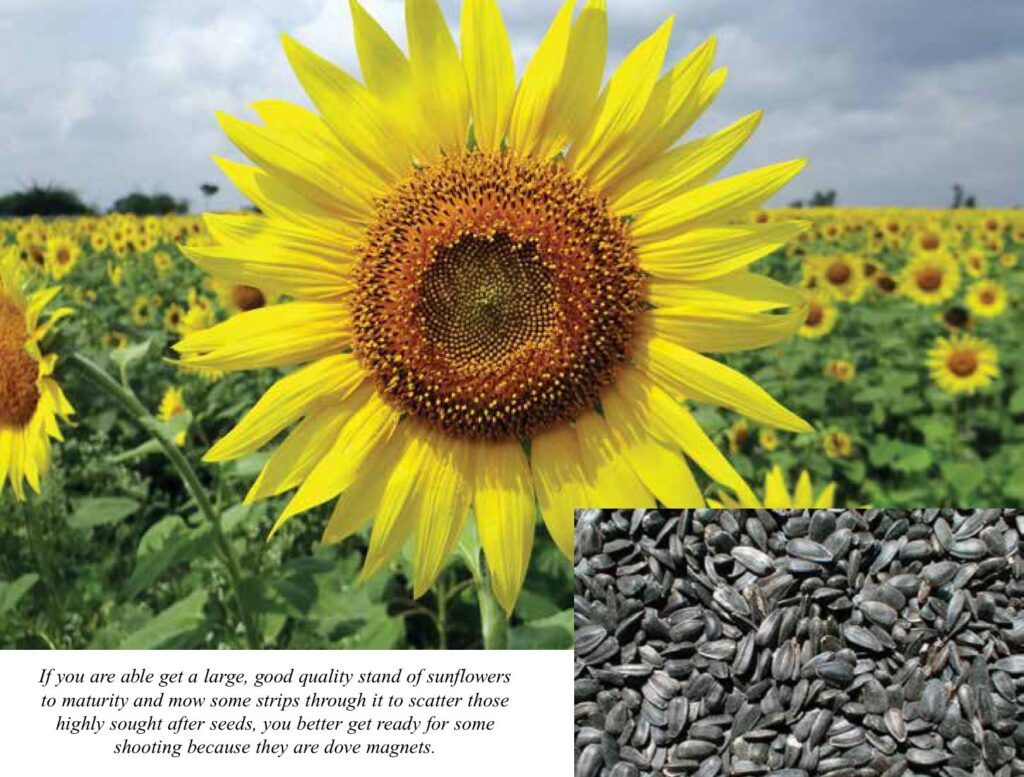
Regardless if you plant multiple crops in strips or a solid crop stand, the following planting rates and methods generally apply (on soils of average fertility) in the South. Black-oil sunflower seeds are typically drilled or row-planted, although they can be broadcasted (least preferred) at about an inch deep. For drilling or row planting (36″ width average) you should shoot for about two sunflower seeds per foot of row. This would still equal only about five pounds of seed per acre. Browntop millet can be planted as early as April 15 in most of the South or as soon as the ambient air temperatures settle into the 60-80 degree range. Browntop grows best in slightly acidic soils (pH of around 6) and can actually start to set seed in about 60 days after germination and can produce over half a ton of seeds per acre. Since it matures so fast, planting can be delayed until late May or June and it will still make seeds in plenty of time for an opening day dove hunt. The Natural Resources Conservation Service recommends seeding rates of 14-20 pounds/acre (drilled) or 25-30 pounds/acre (broadcast) for browntop at ½ to 1 inch deep. Dove proso is also fast-maturing (65-75 days) and generally grows taller than browntop (about 3 to 4 feet). It also prefers slightly acidic to neutral soils (pH of around 6.5 – 7) and can produce up to a ton of seed per acre. NRCS recommends a minimum planting area of 5 acres and rates of 6 pounds/acre (drilled) or 12 pounds/acre (broadcast) for dove proso. Grain sorghum (also called milo) can grow to ten feet tall in some cases and therefore can also be used as hunter cover strips in the middle of fields. Drill it at about 5 pounds/acre or broadcast at 15 pounds/acre on a well prepared seedbed for best results. To drastically increase yield (just as in corn) apply ample nitrogen after the sorghum is established. Most sorghum varieties mature at 70-100 days.
Corn can also obviously be a taller crop that can provide strip cover for hunters and it is tough. That is it can last longer into the season and even into the winter. Leave a portion of the corn field standing if you want to shoot again later in the season. Most corn varieties mature at around 150 days. Corn prefers a slightly acidic pH of 6-7 and as we mentioned will need a supplemental dose of nitrogen after establishment. Drill at a rate of 5-10 pounds/acre at about an inch deep for best results.
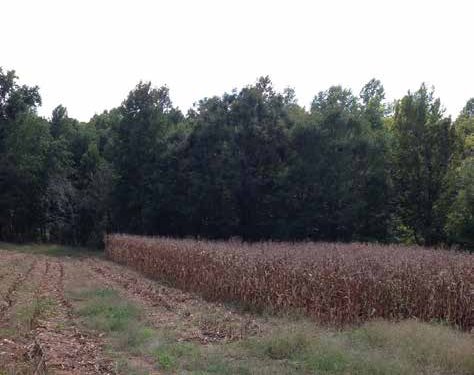
The most important thing to remember is to have food available well before the date you plan to shoot! It takes time for doves to find and use the food source especially in large numbers, so having food available for at least two or three weeks is critical (more time is better). Bush-hog, disk, or burn some portion of the crops in advance and make the seed readily available for use. If you plan to have multiple shoots, keep some of it standing and keep it going. Many folks plant second or third crops later in the season to ensure they’ll draw doves for multiple shoots (you still have to balance the shooting so as not to create too much disturbance). Doves, like most temperate and cold weather birds, need to feed during the day to generate warmth at night, so cold winter days can see some of the best shooting action. With all crop species mentioned above (especially with sunflowers) expect some level of deer depredation if densities are high in your area. Scare tactics or fencing may even be necessary to get your dove field up and running.
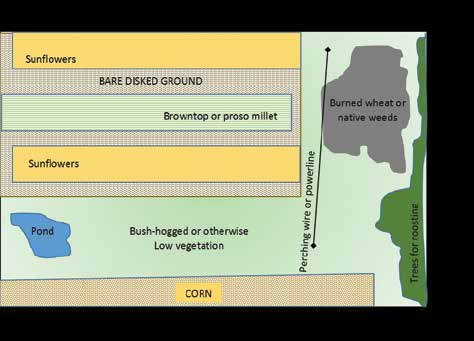
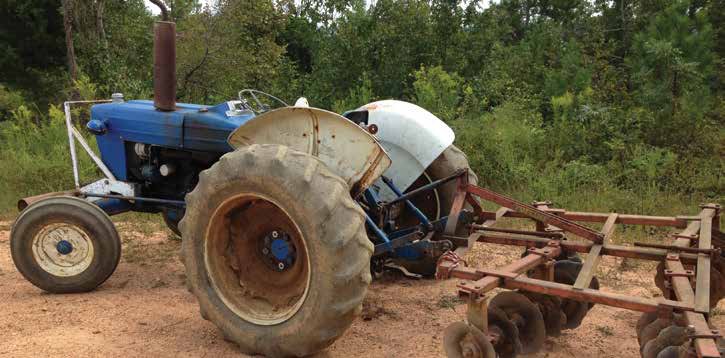
Dove field management is more similar to commercial agricultural crop operations than perhaps with any other game species we manage. This doesn’t necessarily mean you need large industrial equipment. Large machines and planting implements are nice for establishing large crop areas, but you can create a good dove field with the same equipment you use to plant food plots. The similarity to commercial agriculture I was referring to deals more with weed control and “cleaner” farming practices. In bobwhite quail management we often talk about the benefits of “dirty” farming practices and allowing weedy borders and vegetation to persist in and around agricultural fields. When using crop plantings for doves however, keeping clean bare ground within and around rows and strips for foraging is actually preferred. This is because a foraging mourning dove would rather be able to detect potential predators at a great distance and fly away at its leisure than to hunker down and hide in thick vegetation. Doves obviously do eat weed seeds and sometimes forage in high weeds but when preparing a shooting field we want to make it as attracting as possible without the undesirable tangle of thick vegetation on the ground where the feed will be. Also, nobody likes losing a shot down bird in a mass of grass thatch or dense undergrowth. Therefore, one very important thing (which seems to also too often be dismissed) to consider is whether you will need to use herbicide as a tool to creating a quality dove field. Odds are it will improve the attractiveness to your site. It is obviously critical when using no-till planting methods, but herbicide is also important in traditionally prepared fields and for weed maintenance in any type of field where plowing or disking alone can’t maintain clean and low competition crop growth. Yield of the crop as well as the accessibility of the seed on the ground is dependent on how well you can limit the amount of competition (grass and weeds) amongst the crops. Let’s look at a classic example. Many a hopeful dove hunter has attempted to plant a browntop millet crop in a pasture full of sod-forming cattle forage grass. This can certainly be done but rarely can it be done successfully without at least one herbicide site prep application. Even after being disked prior to planting, without herbicide the Bermuda, Bahia, or Dallis grass rhizomes will out-compete the millet and cause a drastic reduction in seed production, and more importantly seed access. So the hunter ends up having six or eight birds come September and a less than exiting opening day shoot. Herbicide is an effective method in maintaining stands of crops after they are planted. For sunflowers, the USDA Plants Materials Center and Mississippi State Extension Service recommends either Dual Magnum (at about 1.5 pints/acre) and/or Spartan 4F (at about 5 ounces/acre) at the time of planting for grass and broadleaf weed control, and Select 2 EC (at about 8 ounces/acre) for grass control later after seedlings are established. For millets, sorghum, and corn, glyphosate and 2,4D products are commonly used in pre-emergent applications. Using “Roundup ready” corn varieties allows a manager to essentially control weeds with one herbicide product through the entire rotation of the corn crop. Post-emergent herbicide options in millets and grain sorghum are more limited, however, so make sure you get a solid pre-emergent kill and prepare a good seedbed for these crops. Don’t be overwhelmed with herbicide tank mixes and options. Just read the label on the product you are using and remember; the take home message is to simply keep your dove crops as clean and productive as you can.
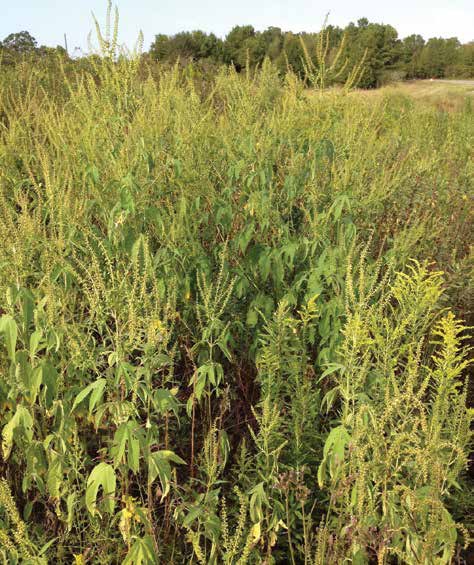
If you want to try to bring in some doves using native vegetation, some good candidates are croton, ragweed, Setaria (foxtail), pokeweed, paspalum, Desmodium (beggarweeds), and panic grasses. These hearty seed-producing species can be planted but are more commonly just encouraged as existing resources on the landscape by periodic disturbance or fertilization. Often there is nothing to be done besides bush-hog or burn patches or strips through this native vegetation and let the seeds fall onto the stubble or bare ground. Unless you have good quality stands of these naturally occurring species, however, planted crops are usually more attractive as far as concentrating large numbers of birds.
Conclusions
In summary, a knowledge of the mourning dove and its biology and behavior allows us to predictably attract it in numbers large enough to have a fun and successful shoot. It’s all about providing an abundant and consistent food source (seeds). A combination of crops and bare ground will typically pull doves in, but remember the pros and cons of the available crops as well as considering soil fertility, herbicide, and site preparation needs. Some locations will be better than others and there may be certain things (like adding water, perches, etc.) landowners can do to sweeten a spot. Remember that food must be visible and accessible for enough time to allow doves to find it prior to the hunt. It is also important to minimize disturbance as much as possible during this time (other than during the actual shoot). Using these methods will maximize the opportunity for some exiting shooting this coming season.
References
Drobney, R. D., Schultz, J. H., Sheriff, S. L., and Fuemmeler, W. J. 1997. Mourning dove nesting habitat and nest success in Central Missouri. J. Field Ornithol., 69(2):299-305
Franson, J. C., S. P. Hansen, and J. H. Schultz. 2009. Ingested shot and tissue lead concentrations in Mourning Doves. In R. T. Watson, M. Fuller, M. Pokras, and W. G. Hunt (Eds.). Ingestion of Lead from Spent Ammunition: Implications for Wildlife and Humans. The Peregrine Fund, Boise, Idaho, USA. DOI10.4080/ilsa.2009.0202
Mirarchi, R.E., and T.S. Baskett. 1994. Mourning dove (Zenaida macroura). In A. Poole and F. Gill, editors. The Birds of North America, No. 117. The Academy of Natural Sciences, Philadelphia, PA, USA and The American Ornithologists’ Union, Washington, DC, USA.
Thackston, R. 2012. Dove Field Management. Georgia Department of Natural Resources online publication. http://georgiawildlife.com/sites/default/files/wrd/pdf/management/2012_Dove_Field_Management_Guide.pdf
US Fish and Wildlife Service. Accessed March 2018. Common Dove and Pigeon Species in the United States. https://www.fws.gov/migratorybirds/pdf/surveys-and-data/HarvestSurveys/DovePigeonFactSheet.pdf