
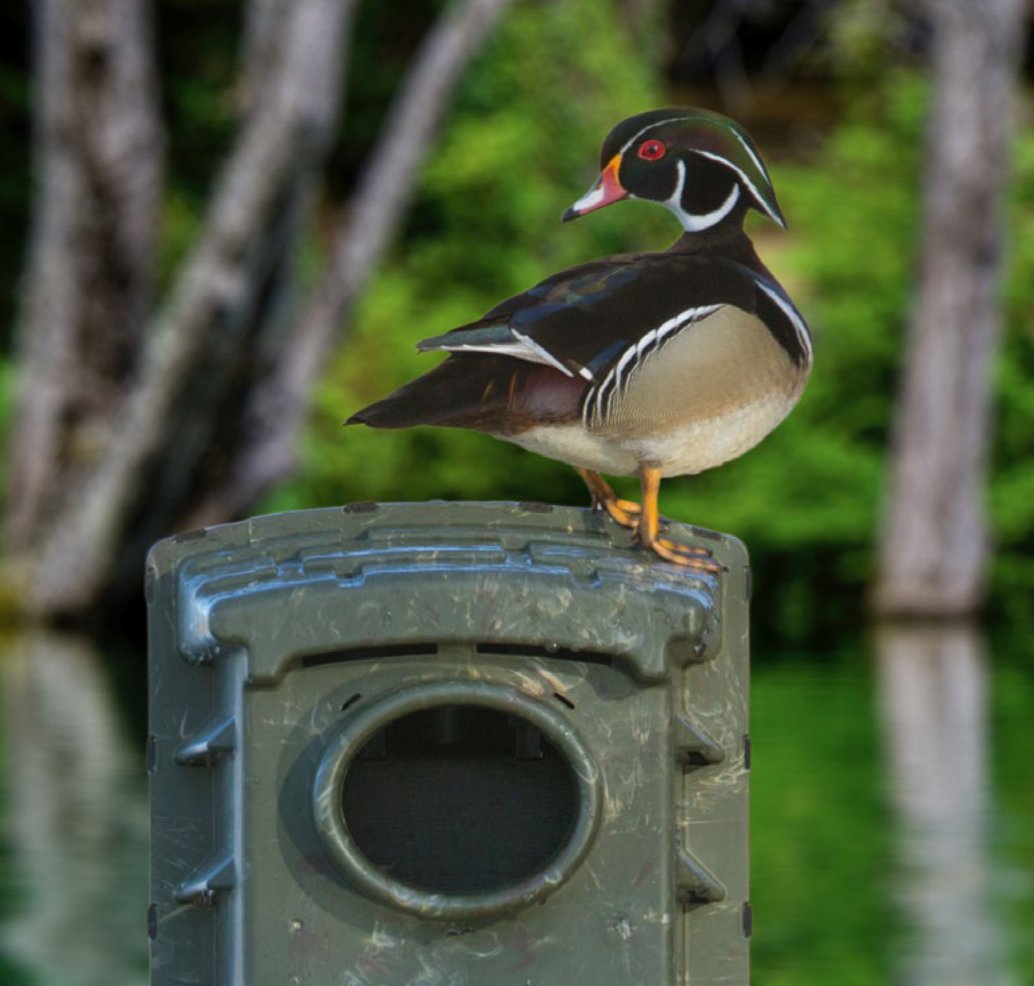
Smaller in stature but with unmatched beauty, the Wood Duck or “Woodie” is one of the most sought-after ducks for water-fowlers and wildlife enthusiasts. One of the few ducks to call the southeastern US its home year-round, wood ducks provide enjoyment for all four seasons. Encouraging wood ducks to remain on or near your property starts with creating the right habitat that supports year-round food, nesting sites and cover for brood rearing. This article discusses how landowners with suitable habitat, can take the chance out of wood duck nesting success with the right nest box and a duck-focused approach.
Easily found in many regions today, the beginning of the last century saw wood duck numbers in steep decline largely due to unregulated market hunting. The Migratory Bird Treaty Act of 1918, with specific protections for woodies, including closed seasons until 1941, may have saved this species from extinction (Bellrose 1976). In response to this legislation, wood duck numbers soon started to rebound, but with land use changes on the horizon, the Woodie was by no means out of the woods.
By the 1940’s large-scale wood duck habitat loss ensued as bottomland hardwood forests were converted to ag fields. Nowhere was the impact of habitat loss more significant than the Delta country of the Mississippi Basin where millions of bottomland acres were converted to soybeans and other uses (Bellrose 1976). From 1940 to 1970, east Louisiana alone saw its bottomland forest slashed from 4.3 million acres to 1.8 million acres; a stunning loss of over 2.5 million acres in only 30 years! That’s the habitat bad news. The good news is that dedicated conservation efforts launched on public and private lands continue to create habitat and homes for wood ducks for folks who enjoy them.
WHY YOU SHOULD USE NEST BOXES ON YOUR PROPERTY
Natural “Suitable” Cavities Are Often Scarce
Wood ducks have specific requirements for cavity size, safety and distance from brood rearing habitat. Most natural cavities in a given area may not be “suitable” for wood duck nesting. Many are too small, too easily accessed by predators or otherwise unsafe for incubation. Natural cavities that are the right size, the right height and in the right habitat are often a limiting resource for wood ducks.
A tree cavity survey conducted on the Muscatatuck National Wildlife Refuge near Seymour, Indiana in 1984-1985 demonstrates how few cavities may exist in a given area, and of those cavities, how few eventually may be used by wood ducks. Of the 789 cavities surveyed, 122 (15%) were deemed suitable for wood duck nesting. Of the suitable cavities, only 7% and 9% were used by wood ducks during the respective 1984-1985 breeding seasons. The estimated density of suitable cavities used by wood ducks in this survey only yielded about one nest per 25 acres (Robb, Bookhout 1995)
In their literature review, Semel and his colleagues estimated that the density of natural nesting cavities suitable for Wood Ducks ranged from .2/acre (0.5/ha) to 3.1/acre (7.7/ ha), with a mean of about 1.2 cavities per acre (3/ha) (Semel et al, 1988).
It should be noted that natural cavity inventory varies by forest composition and may also vary from region to region. Older growth hardwood trees produce more cavities but have often been the focus of habitat loss, especially in bottomland areas. Habitat loss of older growth hardwoods has slashed natural cavity inventory across many regions of the wood duck’s range.
With fewer suitable natural cavities available, nest boxes and a duck-focused approach can help fill the void to increase nesting success in suitable habitat. This sentiment is echoed in the words of respected author and waterfowl conservationist Franck C. Bellrose in his 1953 Housing For Wood Ducks Circular “Although nest sites are only one requirement in the management of wood ducks, the scarcity of natural cavities is so great that nest boxes represent an important and tangible means by which conservation-minded individuals or groups can make significant contributions to the welfare of these beautiful birds” (Bellrose 1953).
In the Right Habitat Nest Boxes Work!
Nest boxes offer huge opportunities to supplement natural cavity inventories. They can be made to the right size, from durable materials, installed in the best locations, protected from predators and regularly maintained. The success of nest box use by wood ducks is significant. According to the Natural Resources Conservation Service’s 2007 “Wetland Management for Waterfowl Handbook”, nest boxes may contribute an estimated 150,000 juvenile wood ducks to the Mississippi and Atlantic Flyways each fall (Nelms 2007).
One comparison demonstrating the effectiveness of nest boxes was conducted at the Chautauqua National Wildlife Refuge near Havana, IL in 1965 where Dill stated “Approximately 1.2 wood ducks were produced in nest boxes for each acre of timber on the refuge. Nest success was 81 percent in nesting boxes in 1965. Natural cavities usually produce approximately 0.1 duck per acre of timber. Nest success in natural cavities in this area averages 35 percent” (Dill 1966). Nest boxes in this example delivered more than double the nest success and twelve times the duck numbers produced per acre compared to natural cavities.
In another study over four consecutive Mississippi breeding seasons, the authors reported nest box use rates of 66% the first year, which increased annually to 96% in the last study year (Strange, et al, 1971). Nest box use rates in this study were three to more than four times the 21.4% average natural cavity use rate reported in an IL study nest cavity study (Yetter, et al. 1999).
A Nest Box Program Is Something You Can Do!
Whether you own wood duck brood habitat or have permission to use and enhance it, you can put nest boxes to work for woodies. If you’re handy with tools, preferred designs can guide you. If you would rather purchase nest boxes for sale. One way to source next boxes is through local scout troops and other organizations that build next boxes for fundraising. Whichever route you choose, it’s important to start with a proven nest box design and only commit to the number of nest boxes you have time to maintain.
Getting Started
The four critical elements to any duck-focused nest box program includes Woodie-safe nest box designs, effective placement near suitable brood habitat, predator-proof installation, and regular nest box maintenance. All four are necessary for the safety of incubating hens and the young once they leave the nest. To omit any of these elements can at best, reduce the effectiveness of your nest box program and at worst, subject hens and ducklings to needless mortality during incubation and brood rearing.
Critical Element #1 – Woodie-Safe Nest Box Design
It all starts with selecting the right construction material. Many artificial nest box materials have been tried and tested including wood, plastic and metal. Let’s look at the advantages and disadvantages of each.
Wood – The standard material for wood duck nest boxes since they were first introduced.
Advantages
- Readily available material
- Can be purpose-built for the job
- Can be cut and assembled to proper dimensions including specific nest hole size and side clean-out door
- Moderate durability if care is taken to source naturally rot resistant material like cedar and cypress
- Can incorporate sloping roof rain shield for entrance and passive ventilation to manage interior temperatures
- Can be sourced completely assembled
Disadvantages
- Low durability for rot-prone wood like pine
- Heavy and cumbersome to transport and install (and even heavier when wet!)
- Lower hygiene potential – interior wood surface may harbor pathogens and ectoparasites
- Prone to high inside temperatures – requires proper ventilation near roof to partially mitigate this effect
- Requires construction and assembly for do-it-yourself projects
Plastic – Early designs were not properly ventilated and were prone to high inside temperatures. New designs incorporate effective ventilation to achieve inside temperatures lower than wood or metal.
Advantages
- High durability – plastic can be made to be an extremely long-lasting material that won’t rot and resists photo-degradation if proper UV inhibitors are used during manufacturing
- Can be designed to have lower inside air temperature in direct sunlight than wood or metal – improved heat safety for incubating female and egg embryos
- Can be purpose-built for the job unlike re-used metal containers deigned for a completely different purpose
- Can be molded into proper dimensions including features like entrance hole complete with rain/sun shield, rain-guarded ventilation ports and easy-to-reach bottom clean-out drawer
- Weighs much less than cedar and cypress, making it easier to transport and safer to install
- Higher hygiene potential – Improved sanitation possible as plastic surface can be easily cleaned unlike wood which may harbor parasites and pathogens that cannot easily be removed or mitigated
- Comes pre-assembled
- Though higher initial cost when compared to DYI projects, durable plastic with rugged construction easily outlasts even rot-resistant wood reducing the need for wood repair or nest box replacement
- Termites won’t destroy plastic nest boxes!
Disadvantages
- Limited suppliers of Woodie-safe designs
- Slightly higher initial cost than DYI wood projects
Metal – Limited applications exist of used metal containers originally intended for different purposes.
Advantage
- Potentially longest lasting material if drain holes allow rain water to escape and reduce oxidation and rust
Disadvantages
- Low resistance to heat rating for metal means hotter interior temperatures in direct sunlight than wood or plastic
- Interior temperatures in metal can be unsafe for brooding females and egg embryos
As discussed, wood, plastic and metal materials all have potential for durability and all have the potential to provide the space needed for incubation. However, each material has different heat resistance properties that affect interior nest box air temperatures particularly in direct sunlight.
Nest box interior temperatures are a function of material construction and impact both the health of the incubating female wood duck and the developing egg embryo. This is particularly important during the day when temperatures are at their maximum. A research review by D. R. Webb reports 41°C (105.8°F) to be the maximum short-term embryo temperature for avian egg survival for most species studied including chickens and ducks (Webb 1987). It should be mentioned that metal containers installed in full sunlight conditions could exceed this temperature threshold on hot sunny days. Heat experienced in a nest box during the incubation period should be at the top of the list when sourcing a completed nest box or construction materials.
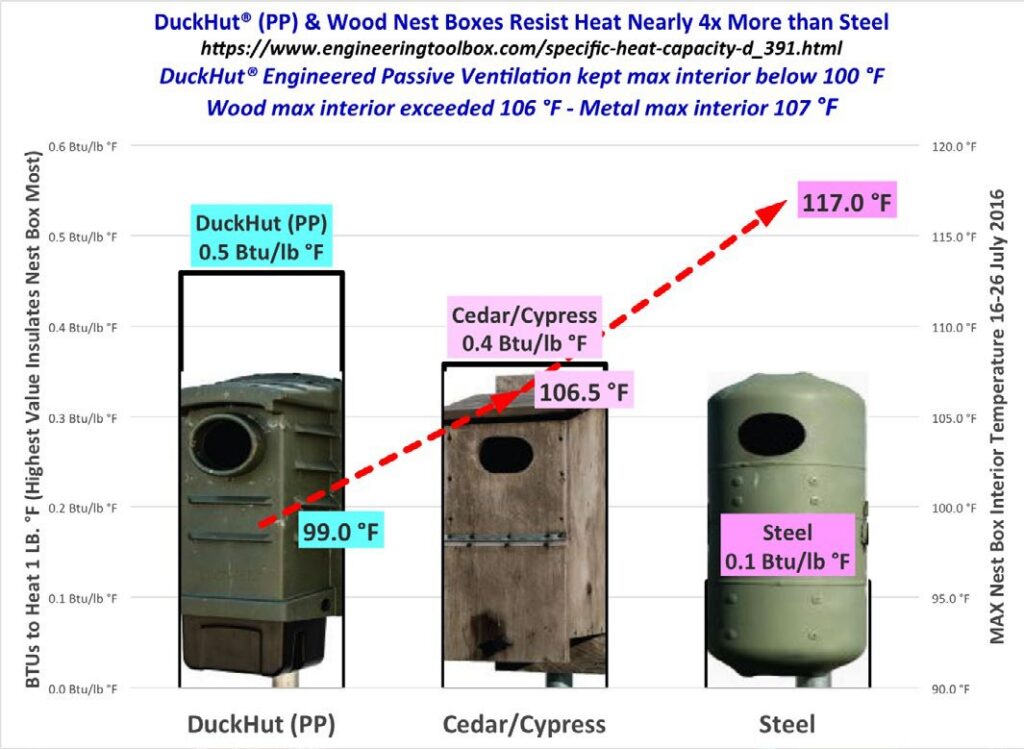
A material’s resistance to heat (Btu/lb. °F) should be considered when buying or building any nest box. Figure 1 shows heat resistance for plastic (polypropylene) wood and metal. Plastic has the highest resistance to heat of the three materials compared here. This means that plastic resists temperature increases better than wood or metal. Metal has the lowest resistance to heat compared here meaning it heats up faster (and cools faster) than plastic or wood. Maximum interior nest box temperature readings are presented for each material on the chart.
These temperatures were recorded in a temperature trial to be discussed next. They, along with heat resistance, help illustrate why metal containers heat up more than wood and plastic in direct sunlight. Imagine the impact of heat resistance on an egg or duckling that is in direct contact with these materials. Which would you prefer?
Temperature research comparing different nest box deigns and materials is limited but one manufacturer, DuckHut of Wapello, IA, agreed to share nest box temperature data for this article. This experiment (shown in Figure 2) compared interior temperatures of DuckHut’s ventilated molded plastic design to a standard wood design and a metal canister sometimes used for nesting wood ducks.
DuckHut® (PP) & Wood Nest Boxes Resist Heat Nearly 4x More than Steel
https://www.engineeringtoolbox.com/specific-heat-capacity-d_391.html
DuckHut® Engineered Passive Ventilation kept max interior below 100 °F
Wood max interior exceeded 106 °F – Metal max interior 107 °F
The results of eleven days of temperature testing from July 16 to July 26, 2016 (Wapello, IA) are presented in Figure 3. The straight horizontal double black line towards the top labeled 105.8 F (41 C) references the upper threshold for survival for egg embryo temperature. The black line across the middle of the temperature bars tracks actual maximum daytime temperatures recorded for comparison. Each treatment has color-coded maximum recorded interior temperature labels. There were two DuckHut nest boxes in the temperature study (DH 1 and DH 2). Due to limited space on the chart, only DH 2 temperatures are labeled.

Maximum interior nest box temperatures were higher than those collected at the weather station (objects warm in direct sunlight) but generally tracked maximum ambient temperatures. It’s important to note temperature comparisons for the July 26 date. Despite this day having a relatively lower maximum weather station reading, the wood and metal nest boxes recorded much higher interior temperatures, which is likely due to a higher UV index for this recording period.
Based on this experiment, temperature in the plastic DuckHut was consistently lower than wood or metal and never approached the danger zone for maximum egg embryo temperature survival tolerance. This is not surprising given what we know about the high heat resistance of plastic. Wood nest box interior temperatures were hotter than DuckHut but cooler than metal. Still, wood interior temperatures exceeded 105.8 (41 C) once and came close a second time in 11 days of testing. Metal performed even more poorly in this regard. The canister interior temperatures regularly exceeded 100 F and on two days, significantly exceeded 105.8 F (41 C) making it a dangerous choice for full sun exposure locations.
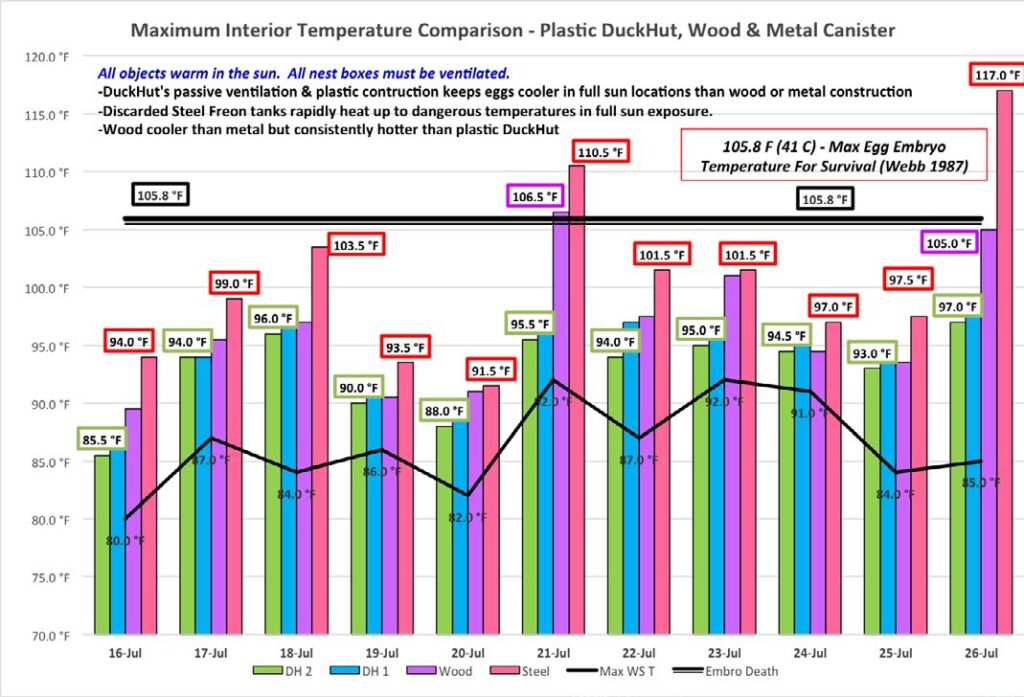
It’s important to note here that interior nest box temperature does not immediately raise egg embryos to the same temperature. Due to the specific heat of water, egg temperature lags behind interior nest box temperature fluctuations. That said, construction material and ventilation matter when choosing a nest box.
When buying assembled nest boxes, it’s best to choose a proven design made of wood or ventilated molded plastic design like DuckHut (www.duckhut.co) for full sun exposure locations. If you’re handy with tools, effective nest box plans made from wood are readily available. The best wooden materials are naturally rot resistant like rough-cut cedar and cypress. Proven wooden nest box designs are listed below and more can be found online.
Ducks Unlimited – https://www.ducks.org/conservation/waterfowl-research-science/wood-duck-boxes
Alabama Extension – Wood Duck Management In Alabama https://www.aces.edu/blog/topics/enjoying-birds/wood-duck-management-in-alabama/
Texas Parks and Wildlife – Managing For Wood Ducks In East Texas By Carl Frentress, Regional Waterfowl Biologist – Retired, East Texas https://tpwd.texas.gov/publications/pwdpubs/media/pwd_bk_w7000_1045.pdf
The Georgia Department of Natural Resources – Wildlife Resources Division Wood Duck Fact Sheet https://georgiawildlife.com/sites/default/files/wrd/pdf/fact-sheets/wood_duck_2002.pdf
Natural Resources Conservation Service – Fish and Wildlife Habitat Management Leaflet: Wood Duck https://efotg.sc.egov. usda.gov/references/public/SC/Wood_Duck.pdf
Audubon – How To Build A Wood Duck Nest Box https://www.audubon.org/news/how-build-wood-duck-nest-box
Henderson, Carrol L. Woodworking for Wildlife: Homes for Birds and Animals. Nongame Wildlife Program, Minnesota Dept. of Natural Resources, 2009.
Critical Element #2 – Effective Nest Box Placement Near Suitable Brood Habitat
You’ve heard it before; what matters is location-location-location! Choose your nest box sites carefully. Select nest box sites near beaver ponds and other shallow water areas with little or no current and with brood food and brushy cover near the shoreline. Avoid extensive open lawn/shore areas devoid of protective cover.
Installing nest boxes away from suitable brood habitat with food and cover is not only unproductive, it would likely be dangerous to both the female and her young when they leave the nest. The greater the distance from suitable habitat, the greater the risk hens and ducklings face on their trek to safety. Duckling losses can also occur even if the distance is not great, but other obstacles hinder the journey. A Burlington, IA survey reported a loss of 61 ducklings from 189 observed starting the journey from nest boxes to the Mississippi River. Nearly 1/3 of these ducklings perished negotiating a steep bluff and other pitfalls, though the distance from the nest boxes to the water’s edge was only about a city block (Bellrose 1953).
Suitable habitat is by far the most important consideration in nest box location – period. This cannot be overstated. Also important is the “placement” of individual nest boxes in such habitat. Wood ducks evolved to be solitary cavity nesting birds. This makes sense considering most natural cavities are not the right size for woodies. For those cavities that are suitable for wood duck nests, many are dispersed and located in the upper forest canopy where they are not readily visible by females competing for nest locations. Dispersed and hidden nest locations reduce competitive interactions between breeding females and increases overall nesting success.
The practice of “clustering” or placing multiple nest boxes in close proximity and where they are readily visible is common and often intended to “boost” local wood duck nest box occupancy rates. It is common to see more than one wood duck nest box on a single pole or tree or clusters of nest boxes in highly visible locations like lakeshores and marsh edges. Clustering nest boxes can increase nest box installation efficiency, especially where suitable habitat is limited. But what seems like a good idea in practice may actually have negative impacts on nesting efficiency.
Research findings suggest that clustering highly visible nest boxes reduces nesting efficiency by encouraging brood parasitism or “dump nesting.” Nest boxes placed close together in obvious locations make it easy for female wood ducks (and other cavity nesting duck species) to observe Woodie females entering and leaving nest locations. These observations trigger semi-colonial nesting behavior that leads to multiple females laying eggs in a single nest box. Dump nests, often defined by clutch sizes > than 15 eggs per nest, contribute to reduced nesting efficiency primarily by reducing hatch rates by females that can successfully incubate only a limited number of eggs. Studies have shown individual dump nests to contain as many as 50 or more eggs.
In one study, Semel and Sherman conducted research in northeastern Illinois over a four-year period from 1989-1992 that compared nesting efficiency between two methods of placing wood duck nest boxes. The first method, “visible” installation involved erecting pairs of nest boxes on single posts over water where they could easily be seen. These nest boxes were intended to replicate nest box clustering in locations easily observed by nesting female wood ducks. The second method relied on mounting individual nest boxes on deciduous forest trees in “hidden” locations away from the water’s edge.
Early in the study, visible nest boxes installed in the open experienced dump nesting at a rate more than double (72%) that for hidden boxes installed in the neighboring woodlands (35%). Over the 4-year study period, dump-nesting rates increased for visible nest boxes but remained low for hidden nest boxes despite both methods having similar use rates (87% for visible and 84% for hidden). Eggs laid in visible nest boxes experienced heavy dump nesting and hatched at lower rates (45%) when compared to eggs laid in hidden nest boxes (64%) that experienced lower parasitism rates. Both methods produced about the same number of ducklings per nest box (9.0 for visible and 9.2 for hidden) but the real story was how many eggs remained un-hatched. Visible nest boxes contained an average of 10.9 un-hatched eggs per nest box, more than double the rate for the hidden nest boxes which was only 4.4 un-hatched eggs per nest box (Semel, Sherman 1995).
The results above show a clear relationship between nest placement and frequency of dump nesting, which reduces nesting efficiency by causing lower egg hatch rates. Another negative effect of visible nest box locations that experience dump nesting can encourage physical conflicts between competing females that can lead to injury and in some cases, death.
Visible nest box sites, especially those that experience brood parasitism, are also more likely to experience predation. This is due to easily discovered locations and because of increased nest box activity resulting from use by multiple females. A Mississippi study reported that 55 dump nests occurred in a total of 168 nests. Of the 55 dump nests, predators destroyed 31 and the other 24 were abandoned (Strange et al, 1971). This and other research suggest that the best way ensure full reproductive potential for breeding female wood ducks is to install nest boxes individually, in inconspicuous locations near suitable brood habitat and predator proof each nest box.
Critical Element #3 – Protection from Predators
Proper nest box installation must include protection from predators from the get-go.
An unprotected nest box that’s an easy mark for egg and duck eating predators can be worse for woodies than no nest box at all. Wood duck nests are preyed upon by a host of critters and leaving nest boxes unprotected is inviting trouble sure to come. The eggs may be eaten or destroyed by raccoons, snakes and squirrels and an incubating hen is no match for a marauding mink, raccoon or opossum.
To compound matters, predators may quickly learn to identify nest boxes (and natural cavities) as a source of food. In a study where artificial duck nest locations were flagged to help researchers locate nests, the authors reported increased predation of these nests by predators that associated the visual cues to physical nest locations (Eric and Wend Hein, 1996). If predators can learn to associate simple flagging with nest location, they likely can do the same with nest boxes and natural cavities.
In one study, fox squirrels destroyed the most eggs but raccoons destroyed more nests in advanced stages of incubation. In these instances, raccoons killed about one incubating female for every three nests they raided (Bellrose 1953). A two-year Illinois study reported that predators wiped out 80% of nests in natural nest cavities in the first year of the study and 55% in the second year (Yetter, et al, 1999).
It’s important to note that natural nesting cavities, by definition, are essentially unprotected, but nest boxes can and should be protected. One way to minimize predation is to avoid installing nest boxes on trees. After all, a nest box on a tree is simply an unprotected cavity on the outside of the tree. This situation is no safer for woodies than a natural cavity. In fact, a tree-mounted nest box may be more vulnerable to predation because of its exposed profile, which may be easier for predators to discover.
The first step to predator-proofing your nest box is to commit to installing your nest boxes on support poles. Poles can be predator-proofed unlike trees or other supports that can be easily climbed. A next box nailed to a climbable tree is the equivalent of “wood-duck-on-a-stick” for a hungry raccoon, mink or opossum.
Tip: When deciding where to sink support poles, choose locations that offer a clear flight path from the entrance to and from water areas and that are not obstructed by over-hanging branches predators can use to access the nest box.
Support poles can be made of wood, metal or plastic. Wood poles should be pressure treated for the longest field life and should be rigid enough to get the job done. For wood, a 10-foot length is recommended (with 2ft to go in the ground) and having a diameter of at least 3 or 4 inches. Nest boxes can be secured directly to the wood with lag screws before the posts are installed.
For metal posts, 10-foot lengths (again 2ft to go in the ground) are heavy duty, 1-inch to 2-inch diameter electrical conduit are suitable options for many soil conditions. Conduit has an advantage over wood in that it can be driven into firm soils easier. Installation in soft or wet soils can be improved by using at least a 1 1/2 -inch to 2-inch diameter conduit. Attaching nest boxes to metal poles can be accomplished with U-bolts. “Schedule 40” polyvinyl chloride (PVC) pipe “blue-pipe” has also been used in a 4-inch diameter. This material won’t rot and because the material is hard and slippery, it’s almost impossible for critters to climb (Frentress, 2005).
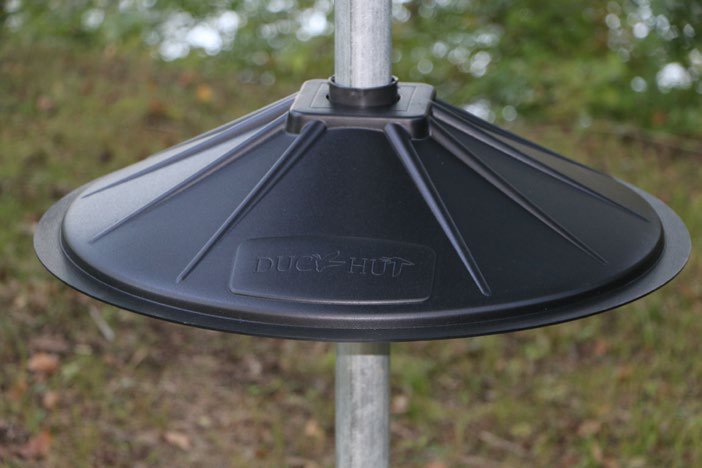
The next step in your installation is to predator-proof the support pole. For wood and plastic posts, cone-shaped metal guards can be used to prevent climbing by raccoons, snakes and other critters. Metal posts can be protected with either cone-shaped metal guards or a flatter version made of plastic shown in Figure 4. It is important to note that these guards can exclude climbing mammals and reptiles but they won’t prevent fire ants from getting to wood duck nests. To stop ants, it is recommended to coat posts with a 2ft-wide band of either food-grade, water-proof grease (may need to be reapplied annually) or a longer lasting, non-toxic paste like Tanglefoot®. Texas trials have shown Tanglefoot to last at least 6 years in demanding conditions (Frentress, 2005).
Another consideration involves the use of nest boxes by bees and wasps. More pest than predator, bees can discourage breeding females from using nest boxes. One solution comes from the folks at the Maryland Wood Duck Initiative Research Institute. They recommend rubbing soap on the inside of the nest box roof to discourage bees from colonizing nest boxes. This remedy was tried on about fifty nest boxes and the idea worked if soap was applied thick enough to fill all wood seams and if it covered the entire inside surface of the roof. It is further recommended to apply the soap before final construction for new nest boxes in the production pipeline.
In summary, an unprotected nest box is an open invitation for predator troubles. When considering how many nest boxes to employ, determine how many you would commit to predator-proofing.
Critical Element #4 – Regular Nest Box Maintenance
You know that throwing up any old duck nest box on any old tree is not worth the effort and may lead to trouble for any nesting wood duck that happens to use it. It takes commitment and effort to manage a nest box program that’s good for woodies and good for you. The same goes for nest box maintenance. Installing a protected nest box is the beginning of the process, not the end of it.
Regular maintenance improves nest box hygiene without a doubt. But letting things pile-up inside nest boxes from season to season has been shown to actually reduce nest use (Utsey 1997). Next season’s breeding female wood duck has no use for last season’s wasp nest, broken egg shells, matted nest shavings that may be infested with ectoparasites (i.e. fleas and such) and other leftovers from previous occupants. Nest boxes need regular inspection and cleaning and clean nest boxes lead to higher use and more wood ducks.
One study recommends inspecting nest boxes and cleaning them after the spring nesting peak. The cleaned nest boxes can help encourage a second nest in some cases. Mid-season cleaning should be followed by another inspection and required cleaning in late fall. At this time temperatures are cooler making inspections safer, especially where bees may be a problem (Utsey, 1997).
One inspection tip that saves time and ladder climbing involves using “borescopes” or “snake cameras” to view the inside of nest boxes from the ground. These nifty cameras can be purchased with extensions up to 3 meters, which should be more than enough range for pole-mounted nest boxes. Search online for the terms “borescope” and “snake camera” to learn more.
In conclusion, the key to ensuring wood duck nesting success is committing to an inside-the-box, duck-focused approach – where the right nest box gets used in the right habitat, in the right place, protected from critters and is well maintained. When the ducks come first in your plan…. Woodie nesting success won’t be far behind.
WORKS CITED
Bellrose, F. C. 1976. Ducks, Geese and Swans of North America. Stackpole Books, Harrisburg, PA. PP 178.
Bellrose, F. C. 1953 Housing For Wood Ducks. Illinois Natural History Survey. Cirular 45. 45pp.
Davis, B. J. 2015. Simulations of Wood Duck Recruitment from Nest Boxes in Mississippi and Alabama, Straub, J. N., Wang, G., Kaminski, R. M., And Leopold, B. D. – The Journal of Wildlife Management. 79: No. 6: 907-916
Dill, H. H. 1966. Meeting Management Objectives For Wood Ducks On Midwest National Wildlife Refuges. Wood Duck Management & Research: A Symposium – Wildlife Management institute
Frentress, C. 2005. Managing For Wood Ducks In East Texas. Texas Parks And Wildlife. PP 1-20
Hein, E. W. And Hein, W. S. 1996. Effect of Flagging on Predation of Artificial Duck Nests, Journal of Field Ornithology. 67: 604-611
Nelms, K. D. 2007. Wetland Management For Waterfowl Handbook. Natural Resources Conservation Service. PP 53-69
Robb, J. R. And T. A. Bookhout. 1995. Factors influencing wood duck use of natural cavities. Journal of Wildlife Management 59: 372-383
Semel, B. And Sherman, P. W. 1995. Alternative Placement Strategies for Wood Duck Nest Boxes. Wildlife Society Bulletin. 23: 463-471
Semel, B. 1988. Effects of Brood Parasitism and Nest-Box Placement on Wood Duck Breeding Ecology. Sherman, P. W. And Byers, S. M. The Condor 90: 920-930
Yetter, A. P. 1999 Natural-Cavity Use by Nesting Wood Ducks in Illinois. Havera, S. P. And Hine. C.S. The Journal of Wildlife Management. 63: 630-638
Strange, T.H. 1971. Use of Nest Boxes by Wood Ducks in Mississippi. Cunningham, E. R. And Goertz, J. W. The Journal of Wildlife Management. 35: 786-793
Settle, A. 2010 Five Year Monitoring Of Wood Duck Nest Usage Of Nest Boxes Installed On The Melvin G. Bosley Conservancy Property, Edgewood, MD. Brenner, F. J. And Stambaugh, A. Journal of the Pennsylvania Academy of Science. 84: 67-73
Utsey, F. M. And Hepp, G. R. 1997. Frequency of Nest Box Maintenance: Effects on Wood Duck Nesting in South Carolina – The Journal of Wildlife Management. 61: 801-807
Webb, D. R. 1987. Thermal Tolerance of Avian Embryos: A Review. The Condor Vol. 89: 874-898