
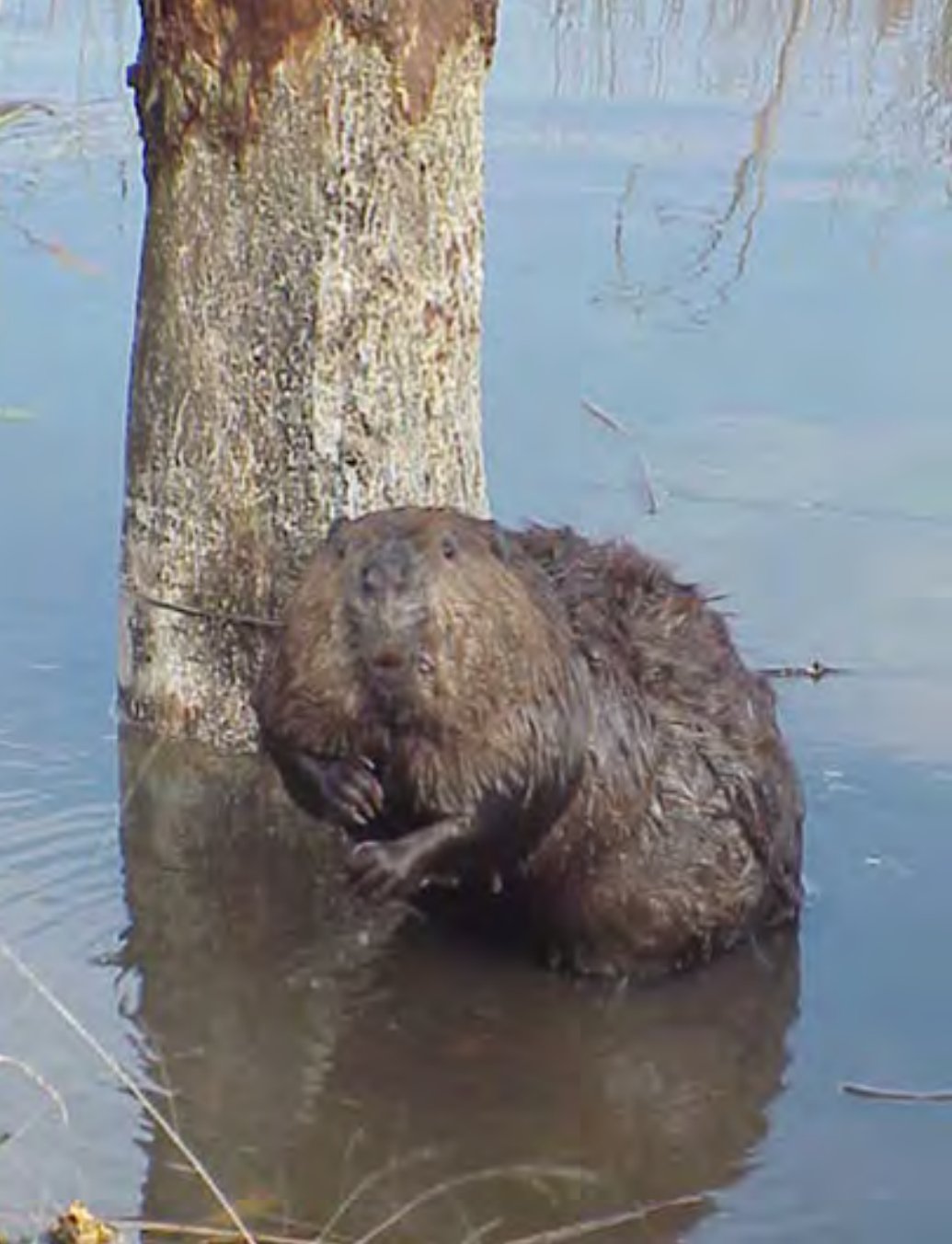
Depending on one’s focus and management plan for their property, some landowners enjoy having beavers around. They are amazing engineers that work tirelessly doing something that most other animals can’t do, making their own habitat. To beavers work is never complete. They are constantly building, repairing, and extending their dams. Some dams are so large they can hold back hundreds of acres of watershed. The world record is a nearly half mile long dam in Wood Buffalo National Park that measures 2,790 feet, surpassing the previous mark of 2,139 feet by a beaver dam in Three Forks, Montana. The amazing fact about the Three Forks dam is the height, 14′ tall at the center. Beaver dams that are 100 feet long holding back 30 acres of water are common. Once the dam is built, it becomes a wetland that is used by a host of creatures, both aquatic and terrestrial. If you are a waterfowl hunter and the focus of the property is to make an amazing duck hole with little investment, let a few beavers move in and give them a year or two.
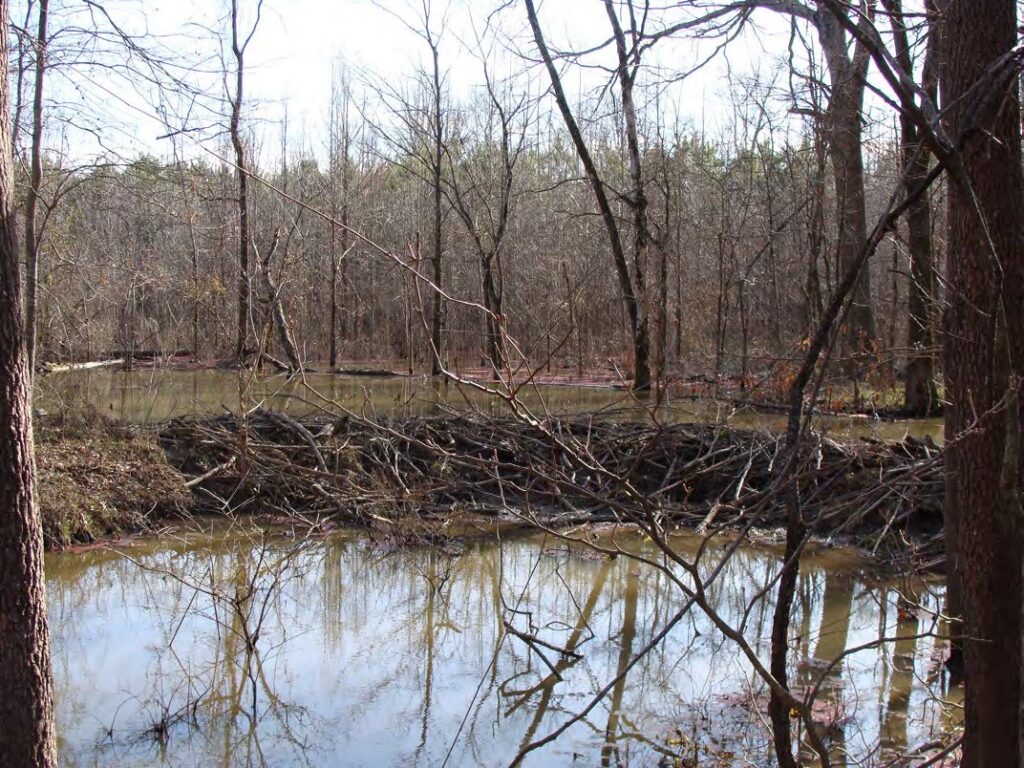
Other landowners view beavers as destructive rodents that cost them thousands of dollars yearly. A beaver’s instinct to create wetland habitat leads to flooding of hardwood and pine timber for extensive periods of time that ultimately results in the death of the timber. This can equate to large financial loss depending on the acreage flooded. Girdled trees can die due to falling or the loss of transporting nutrients. Pasture and crop land can be unusable if dams start holding water back to these areas. Clogged culverts can cause road flooding and major erosion. Finally, beaver bank dens in pond dams can cause leakage or possible blow out. Although they can be wonderful to have on your property, if they are becoming a massive juggernaut the decision to live with or without them must be made. Costs vary but hiring a professional trapper can range anywhere from $1000 to $5000 depending on factors such as the severity of the situation, topography, access, and historic beaver activity.
A Little Beaver Biology
Beavers are in the Rodentia Family which also includes squirrel, mice, gerbils, gophers, porcupines and any other animal that has one pair of continuously growing incisors in their upper and lower jaws. Their incisors don’t have enamel on them which allows them to wear down with use. If these mammals don’t chew, their incisors could kill them. Beavers are herbivores which means they only eat vegetative material. They do not eat fish or any other meat. That pile of fish scales in scat on the pond bank is from an otter, but that’s an article for another day.
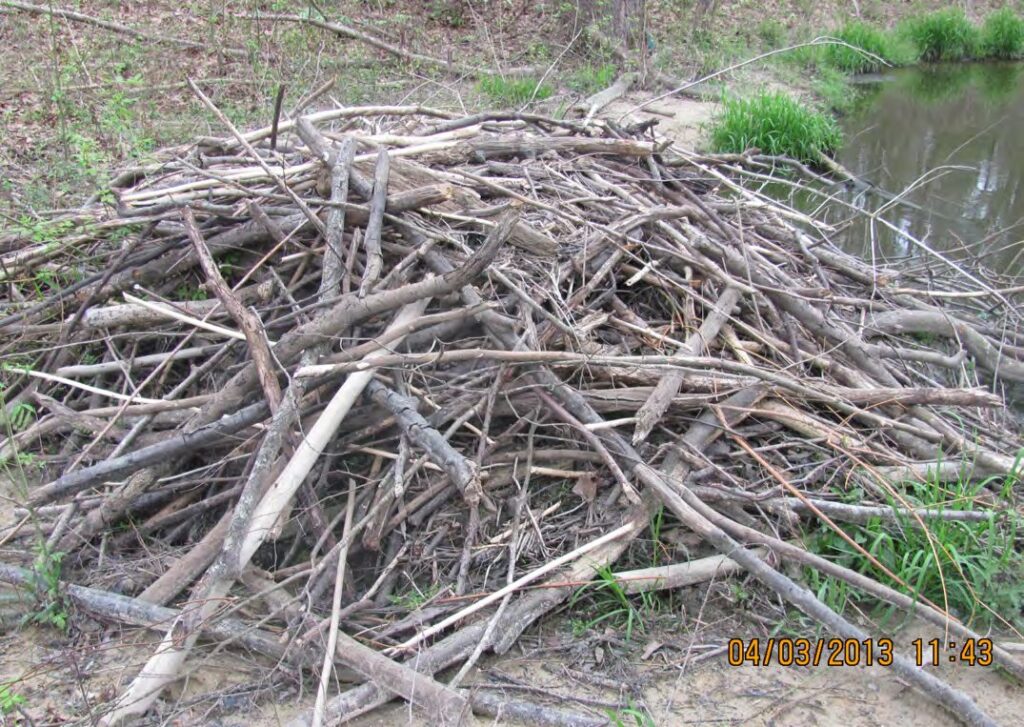
Beavers are a little more active in the winter when green vegetation has died off. Once the lily pads, cattails, and other aquatic vegetation begins growing they don’t move as much and stay closer to their den unless the dam has been breached. Even then, they might choose to hang around the lodge. Lodges are the large mound of sticks and mud often visible in the middle of the swamp or next to the shore. There is an underwater entrance which leads to numerous dens connected by travel corridors leading to an area for them to dry off and then to a main family den.
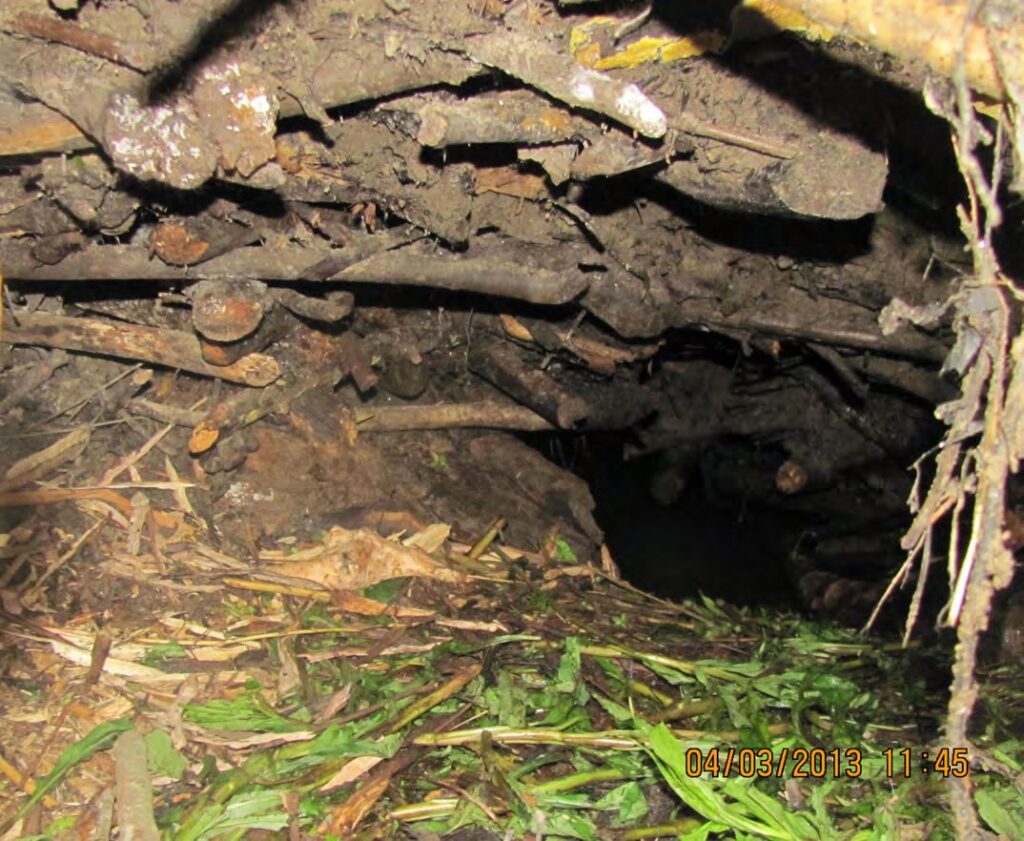
Another beaver home is the “bank den”. If beaver sign starts to show up and no lodge is present, start looking next to a steep bank. They will make an entrance under water and create their cavities and tunnels above the water line. Over time they may begin to collapse. If this happens on a pond dam, it could be detrimental; one day you head to go fishing and the pond is no longer there.
Beavers usually live in family groups made up of and adult male and female with their sub adults and juveniles. They are monogamous but will find another mate if one of the adults dies. Some family groups can have more family members and may have multiple lodges in large areas. In most scenarios, a single lodge is all a family needs. While juvenile subadults assist with some of the work such as dam building, gathering for food cache’s and helping raise kits, the adults do most of the work.
Beavers are territorial and will defend their homes if an intruder is near. A family group can identify each other by castoreum, a substance secreted from their castor sacs located near the tail. They will make castor mounds around their pond to identify their territory. If they smell the castoreum of any other beaver, they will encounter it with serious aggression.
Beaver Management
Whether you just purchased your dream property with a 30-acre swamp, or just noticed that a culvert was getting clogged by sticks stripped of their bark, a decision must be made to live with or without beavers. Watershed, topography, historic beaver activity, and access all play crucial roles in developing a beaver management program. Should one decide to live without beavers, there are lethal and non-lethal approaches that can be used to remove beavers, and in certain situations, both methods are beneficial. There are some instances in which accepting that beavers will always be present is inevitable. One thing is for sure, a property owner must understand that whatever methods are used for beaver control, there is never a guarantee that they will work long-term and beaver issues may always be something with which to contend.
Non-Lethal Control
Non-lethal control techniques are viable options for beaver management in many circumstances. In areas where beaver swamps pass through numerous properties, it may not be difficult to get neighbors to invest in beaver control. On the other hand, landowners may not care enough about the issue to invest in a control effort. In the case of duck hunters, the beaver swamp is their waterfowl attraction. Others enjoy having them around because of the positive effects a beaver swamp can have on the environment. When a culvert is joining two large swamps, attempting to trap all the beavers out may be unrealistic, and non-lethal methods are a better option.
A method known as the “Clemson Pond Leveler” has been used by landowners for many years. It was developed at Clemson University for the purpose of controlling water levels in timber and agricultural areas. This method has also been used for water level control in green tree reservoirs, duck impoundments, and occasionally in small culverts. Landowners who enjoy duck hunting use the Clemson Pond Leveler to draw the water down to plant in the spring, but raise it before duck season.
The Clemson Pond Leveler is 20 feet of PVC pipe in two sections with holes drilled in one of them. The diameter will be contingent on how much flow is expected, but 8″ to 10″ minimum is recommended. There is a mesh screen placed around the end that will be in the water behind the dam. The section on the downstream side can have an elbow or valve installed to control the water level. A break in the dam is made and the pond leveler is installed below the water line. This is important because the sound of water attracts the beavers, but if the whole device is under water on both ends beavers have trouble figuring out why the water in their home is not at full pool. The recommended time to install the Clemson Pond Leveler is in the cool months when they are more active working on their dam.
There are some issues with these devices though. Sometimes beavers just build another series of dams below the leveler if it’s feasible. If the device is not held off the bottom one- or two-feet, siltation could compromise it over the years. If water levels fall below the pipe, beavers may begin to pack mud around it.
Extensions or fences are another non-lethal method that are typically the best option for culverts. Fencing is nothing more than installing 16-foot panels around the opening of the culvert. It needs to reach far enough out that it deters the beavers from trying to block it. Openings should be 4″X 6″ to allow for small debris to flow through. The farther out the fence is from the culvert, the more effective it is. Fences should be tight to the bottom, otherwise beavers may burrow under it. Because beavers are poor climbers, having it 2 or more feet above the water level will make it more effective. Finally, it needs to be constructed in a manner that keeps beavers from coming in from bringing material over the top. Triangles, squares, and rectangles have all been successful in this type of exclusion device.
Culvert guards are also an effective method of beaver control. Culvert guards are welded rods that are put in front of the culvert to keep beavers from packing the culvert with mud. The downside of this method is that the guard itself provides a beaver a starting point for building a dam. With bars set horizontally in front of the dam, it is simple for beavers to float large logs and pack them in front of it perpendicular. It is also easy to put a layer of sticks in front of these guards and then pack it with mud, leaves, and other debris. The guard can, however, be lifted periodically to allow for the removal of any debris that can’t flow through it.
Finally, live trapping in specialized traps can be an effective non-lethal method for beaver control. Beavers can be caught and safely loaded into a vehicle and transported to another area. First, check with state regulations to check on the legalities of relocating any animal in your state. Although it is an option for non-lethal control, the trapping method should be scrutinized and many questions answered before implementing for several reasons. Once a beaver is caught, when will they be relocated, immediately or until the entire family group is caught? How long will you trap before catching the entire family? How do you know how many are in the family? On large swamps where multiple family groups reside, how do you know if the ones being caught are from the same family? Are they going to be released into public or private waters? Once relocated and released into unfamiliar areas, because beavers are very territorial, they are exposed to aggressive encounters with other beavers. Beavers new to the area have no lodge constructed; therefore, they are exposed to predation all day until one has been built. Lastly, the traps themselves are large and difficult to carry into a swamp requiring landowners to consider additional manpower and assistance.
Non-lethal control methods should be considered in any beaver management program. As with any technique, it’s just another tool in the toolbox. Used solely and without monthly maintenance, many of these methods may fail in time. There are other approaches that were not discussed, but a simple internet search into beaver control will give landowners enough reading material for the next few days.
Lethal Control
For hundreds of years, commercial trappers kept beaver populations in check. From the 1600’s to the 1850’s, beaver furs were highly valued, and the time spent trapping was worth the financial return. Fur was used to make hats that reflected an individual’s social status. Over time, though, the demand for the fur decreased followed by a sharp decrease in its value. The beaver population had also declined due to heavy exploitation. Most recently, at the North American Fur Auction in 2018, the average price for a beaver pelt was $13 in the East and $8 in the West. The 2019 fur market forecast for beaver is $10 to $13. Finding someone to trap beavers simply for their fur will be difficult these days as the time spent is no longer worth the financial return.
Lethal control of any animal is controversial and, when the animal is not used as a resource for something else, can be socially unacceptable. Unfortunately, there are times when the decision to remove animals for damage and financial reasons must be made. Trapping can be the most efficient and affordable option without having to invest money in materials and labor. By combining such lethal with non-lethal control techniques, landowners can get damage issues resolved quickly while leaving an environment that discourages other beavers from setting up their homestead. Small family groups can be removed in a few days to a few weeks during certain times of year. Depending on the situation, sometimes removing a few dispersal beavers will solve the problem for years. In some instances, trappers could be working full time, with what seems like very little results. Just like other methods of beaver control, trapping is just another tool in the toolbox.
Trapping yields the best results during certain times of the year. Beavers are most difficult to trap during the Spring season when green foliage has started to grow. Beavers don’t have to move far from the lodge to feed. If the female has young, she may only leave the lodge a few times a day. Others may venture out on occasion during the day to grab a lily pad or two, but for the most part they stay relatively close to home. Until this foliage dies off, and beavers must venture further from their lodge for food, trapping can be tough. Additionally, in the warmer months, when beavers are not using their runs, crawl-overs, and trails out of the swamps as much, it makes trapping more difficult. Also, thick vegetation can make access to trapping areas quite the challenge. Beaver runs that are active all winter may not get used again until the first frost kills off the aquatic vegetation, forcing them to venture out. As a result, it can take twice as long to catch a family in spring and summer compared to fall and winter. Therefore, the cost of trapping can be much greater in the warmer seasons.
There are 4 main tools used for lethal beaver control; body grips, footholds, snares, and firearms. Each tool has a place depending on the situation. The 330-body grip is the most commonly used tool. Trappers with decades of experience and beginners setting their first trap line have the body grip in their arsenal. They are relatively inexpensive costing between $15 to $20 each depending on the store and brand. They are available in local large outdoor retail outlets or can be ordered online.
Body grips are versatile. They are heavy and bulky but probably take more beavers than all other tools combined. They can only be set in dive sets, dam crawl overs, runs and castor mounds just to name a few. They can also be held up with a 330 stand or 2 sticks. Body grips should be purchased with a setting tool as well as a safety grip. These traps can be very dangerous for amateurs and professional guidance is highly recommended before beginning beaver control plan that includes the use of body grips.
The snare is another common trap that can be a little more difficult to use. Beaver snares are made from small diameter cable and have a lock that can slide down the cable and hold the animal. They are usually 5 to 6 feet long and can be tied off to a tree or other solid object. They are very effective on many types of sets including swim runs, castor mound sets, and where beavers are crawling to shore. They are safe to use, but more difficult to master. Advantageously, 100 snares will fit in a backpack along with all the necessary setting tools and a trapper can set all day if he wants. In Alabama, snares are required to be in the water. Snares do not kill beavers so upon capture, the trapper may use a small caliber firearm to dispatch the animal. A “choke stick” can also be used to release any non-targeted species accidentally caught in the snare.
A foothold can be one of the most difficult to master and can be dangerous, therefore, they should only be used with the aid of a professional. Footholds are set in water and can be used on castor mounds and dam breaks. Properly set, they are designed to catch the beaver’s back foot and when it dives to the bottom it can’t resurface and drowns. Footholds are very effective on beavers that have become wary of body grip traps and snares.
The use of a firearm is the final lethal method of effective beaver control. A common technique, when using a firearm, is to break a small hole in the dam to get water flowing. A beaver will come to inspect the dam to fix it which will provide a prime opportunity to shoot it. This could take 15 minutes or 8 hours and is ultimately a waiting game. Having multiple shooters positioned 30 to 40 yards apart may yield a better result. Many people want to sit on their pond dock and shoot the beaver with their rifle while it swims across the pond. This is not recommended because of the high probability of the bullet missing the beaver and possibly ricocheting. It would be safer to be positioned above where the beaver may swim to reduce the possibility of a ricochet. This technique may have good results in areas with abundant beaver populations for an initial removal, or when that last one seems untrappable.
Conclusion
If you put 10 beaver trappers in a room and ask them what the best beaver control method is, you’ll get 20 different answers. Each trapper will approach a project differently and most will be successful. One beaver project might be solved using only a 330-body grip in a week, while another may take multiple lethal and non-lethal methods and 6 months to be successful. If you’ve identified a beaver problem, call multiple professionals and get their opinions. There may be a small fee for a site visit, but it would be worth it. Every situation requires a different approach and watching a video, then trying to set a foothold or 330 body-grip on your own could end up in a trip to the emergency room.