
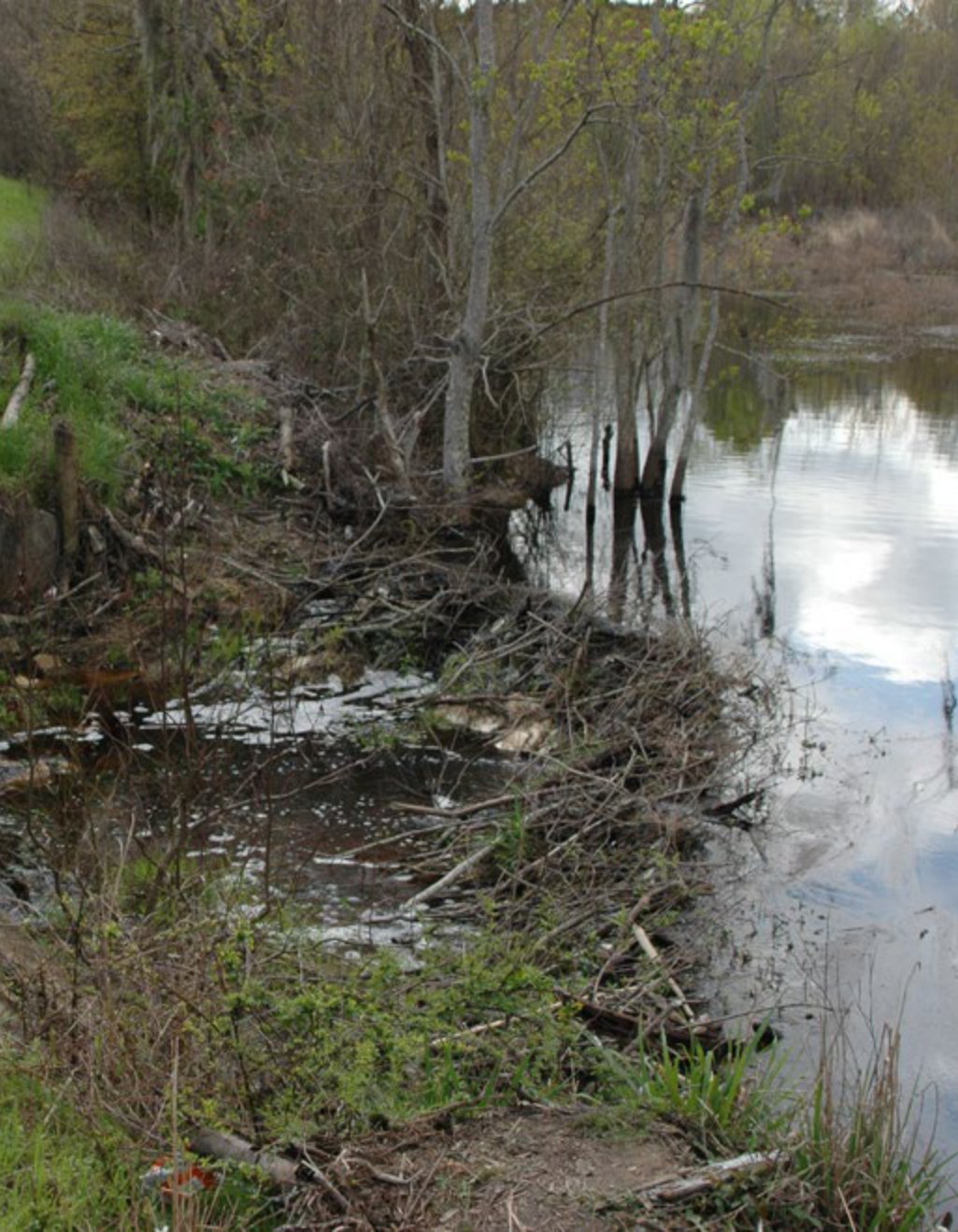
This article serves to complete the three part Trapping Deconstructed series, covering an overview of contemporary trapping equipment and its preparation, followed by the basics of predator trapping using a collection of land sets and this article, the basics of water trapping. Beaver, muskrats and otter will be the primary targets for this article, as they typically induce the most financial impacts to landowners.
In certain situations, beaver can play a vital role in creating wetland habitats, providing habitat for a wide array of wildlife. However, these same actions can cause significant economic damages, impacting a wide collection of resources. While the damage to timber by flooding represents their primary impact, they also damage trees by girdling, clog culverts and flood roads, flood and consume agricultural crops, and weaken roads, dams and levees through their burrowing activities.

Beavers construct dams to provide themselves increased accessibility to food sources such as tubers, roots and the bark of young trees, and to assist in predator avoidance. They’re quite responsive to the sound of running water and will repair any damaged dams on a nightly basis. They fare equally well in huts constructed of mud, sticks and cut saplings or in dens excavated into the banks of stream or ponds. They typically breed only once a year and reside in an area ranging from 6-12 individuals in the colony.

Muskrats will utilize any permanent aquatic environment including ponds, lakes, canals and irrigation ditches. They normally live in small family groups of 4-6 individuals. In the northern states they commonly build muskrat houses from mounds of herbaceous vegetation. While in the Southeast they typically reside in burrows excavated into the bank of a waterway with an underwater entrance. Damage by muskrats tends to be restricted to their burrowing activities damaging roadbeds, pond banks, dams and levees. They’re proficient rodents, having two to three litters per year with 6-8 young per litter. While the majority of their diet consists of herbaceous material, they do occasionally feed on mollusks, crawfish, fish and turtles.
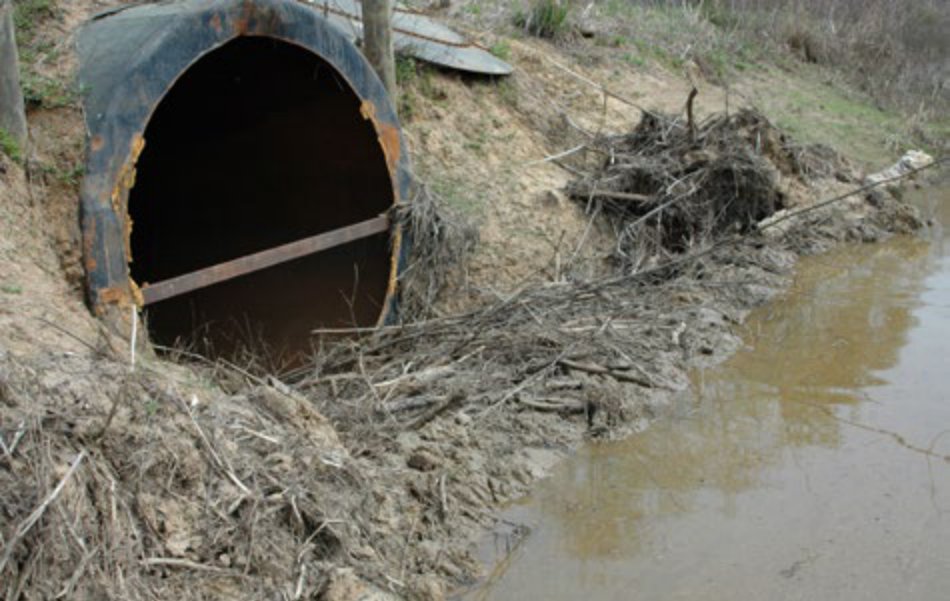
River Otters usually inhabit an area in loose family groups and have a relatively large home range. It might take several days for them to pass through the same area. They tend to use bank dens excavated by another animal such as a muskrat or beaver. Otters are well known for their impacts on commercial hatcheries and aquaculture operations, as well as farm ponds, and can also be a factor in the commercial crawfish industry as their preferred diet focuses not only fish, but crawfish as well.
In contrast to land trapping, typically performed not too far from a vehicle, water trapping usually requires a substantial increase in effort to be effective. The equipment is cumbersome and heavy, it’s performed in wet and/or muddy conditions and it usually requires a decent amount of walking to access optimal set locations. But on the bright side, the animals are much easier to catch.
Baits and Lures
Water trapping differs from land trapping in that it relies more on the knowledge of an animal’s use of its habitat than trying to attract an animal to a set. While there are multiple lures on the market, they are not something I’ve used to any extent except for scent mound sets that target beaver, capitalizing on their territorial defense. On those sets, any castor-based lure, such as Backbreaker by Dobbin’s Lures, will be effective in this application. Fortunately, the castor-based lures are much easier on the nose than those lures targeting canines.
Traps
Body-gripping traps, often called Conibears after the inventor Frank Conibear, are by far the most effective trap utilized for water trapping applications. They basically consist of two squares constructed of metal rod, connected and hinged at the center, with springs encircling opposite sides of the connected squares. As the springs are compressed, the squares rotate and are held open in the set position by a notched dog fitted into a notched trigger. As the animal swims through the trap, the trigger is dislodged from the dog, allowing the depressed springs to rapidly open, rotating the squares, closing the trap on the animal’s neck or chest area. It is an extremely quick trap and very effective in providing a quick dispatch of the animal. The smaller traps in the 4″-5″ width, commonly referred to as a #110, are geared towards muskrat and mink while the larger 8″-12″ width traps, commonly known as a #220 and #330, target beaver and otter. When implementing their use, one should treat these traps with a great deal of respect, as they are not very forgiving. As one would expect, prudent care should be exercised in setting and placing this trap to avoid any possibility of non-target catches.
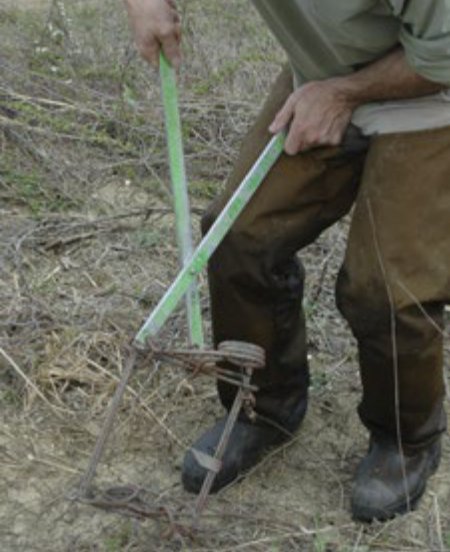
Multiple manufacturers produce this style trap and are somewhat equally effective. While the smaller versions for muskrat can be set by hand, setting the larger body-grips are most efficiently accomplished with manufactured setters to compress the springs and apply the safety latches. Though in a pinch, a rope can be looped through the base of the spring and pulled taught to compress the spring to engage the safety latches. While using these traps, it’s always wise to carry a rope prepared for this purpose in case the setters are misplaced or an unfortunate triggering of the trap engages the trapper. The rope in your pocket may be the only route to remove the trap, particularly when trapping alone.
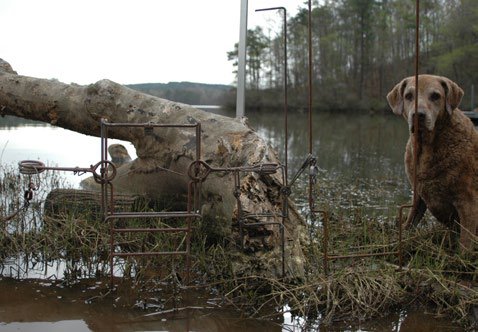
Body-gripping traps must be securely stabilized in order for the triggering mechanism and springs to function properly, and H-Stands make this task much easier. Prior to the advent of H-Stands, sticks from beaver dams or those in close proximity to the set were typically used to insert through the springs to stabilize the trap. After the stand is set in place, the set trap simply straddles the outer legs of the stand. When using this stand, the trap must be oriented with the trigger on the top, as the stand could impede the action of the trigger if oriented with the trigger on the bottom. H-Stands can be acquired for several trap sizes and in short and tall models, which are used according to water depth and provide a much simpler solution to secure and stabilize the body-grip trap. The trap should then be anchored to a small tree, root or securely driven stake with wire or cable. Following the placement of this trap and the set is complete, the trapper must make a mental note to rotate the safety latches open to ensure there’s no chance they will impede the action of the spring. There is a device available, termed safety grippers, that holds the trap safely open in the set position, preventing it from accidental closure that provides an additional measure of safety. This device is removed once the set is complete. And again, be cautious on this step, as the trap does not discriminate between a beaver or a trapper’s hand!
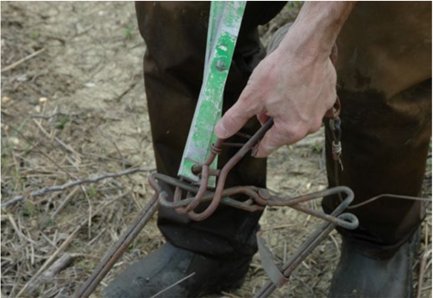
Appropriate foot-hold traps for muskrats can be either single longspring or coilspring in the #1 to #1.5 sizes. While a #5 long/coilspring or a MB-650/750 coilspring is appropriate when targeting beavers with their much wider jaw width to account for the beaver’s large back feet, and will work equally as well for otter. When using foot-hold traps for water applications, incorporating a drowning rig will decrease the likelihood of lost catches. Drowning rigs consist of a cable or rod slide that allows travel one direction to deeper water from the set location. While cable has been used historically, a 10′ section of ½” rebar rod, although cumbersome to transport, provides a tangle-free alternative when the trap is coupled to a one-way rod slide.
Equipped with washers welded on the ends, the rod can be pushed into the creek bottom and staked through the washer into the bank adjacent to the trap location. The washer at the other end provides a stop that prevents the rod slide from coming off the rod in case the end is pulled free of the creek bottom.
While snares are not the top choice for otter or muskrat, they can be very effective for beavers. Snares represent a much lighter alternative for those areas that require extensive walking. They are typically constructed of 3/16″ to 1/8″ aircraft cable, and equipped with a locking cam and aluminum stops. They can be purchased complete or cable by the spool and associated parts to assemble for the tinker-type minded folk. Set locations are similar to body-grip applications, supported and secured in place by tying the snare cable to an angled stick driven into the bank over a travel route. A short stick ¼” in diameter can be inserted in the waterway bottom to place the bottom of the snare loop on to adjust the snare loop roundness if needed. The snare terminal end should be secured to a root or tree at least 2″ in diameter to firmly anchor the snare. The drawback of snares is the resulting de-vegetated catch circle created by the captured beaver, resulting in the search for a new set location after one capture.

Set Location
Not unlike land trapping, trapping in water focuses on the primary travel routes of the intended targets. When searching set locations for water trapping, learning to identify places that restrict animal travel through a constricted area will increase your catch rates exponentially.
Muskrats are targeted with foot-hold or body-grip traps at the water’s edge where established trails leaving the water are identified, typically going to feeding areas or traveling to adjacent waterways. Body-grip traps can also be very effective when placed at subsurface bank den entrances or other subsurface excavated burrows. Using the metal traps stands makes for short work when establishing these subsurface sets.
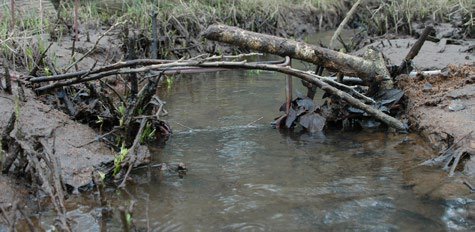
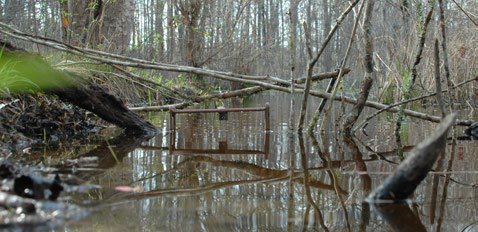
Body grips and snares set for beavers, will catch otters as well, as they commonly travel the same routes. As beavers and otters travel through their surroundings, they pass through multiple areas that constrict their movements. This can be a narrowing of a creek due to collected woody debris or rocks, trail exiting the water, narrow channel or other natural feature that pushes them to a confined corridor. As beavers or otters typically show no aversion to blocking, the constriction of blocking can be man-made using dead tree limbs, logs and sticks to steer the animal’s movements to one desired location. This desired location will be the location of the snare or body-grip trap.
Castor or Scent Mound Set
Beavers are territorial by nature and mark territory by constructing scent mounds. They’re made by piling leaves, pond-bottom debris mixed with mud in mounds about a foot in diameter and about 6″ in height. They then deposit castoreum on these mounds; a secretion from their castors sacs, to communicate to other beavers the area is occupied. Commercially based castor based lures can be very effective by simply applying a teaspoon sized application to the top of the mound to mimic an outsider marking in their territory. When no mounds are located, they are easily constructed from debris off the water bottom, just as the beaver does, and apply lure to the mound top. Wetting and smoothing the mud at the water’s edge in front of the mound adds a bit of realism to the set to increase its attractiveness. If using a foot-hold trap, position the trap to one side 6″ off center in order to target the left or right foot, place at a depth of approximately 8″ and 18″-22″ from the bank edge to target a back foot. Firmly bed the trap and position the spring levers oriented towards the bank to lessen the possibility of the trap jaw pushing the foot out as it is sprung. The trap should be equipped with a locking device on a cable or rod slide to drown the animal quickly and efficiently. Body-gripping traps can also be effective at these sets, using dead sticks and limbs to funnel their movement through the trap.

Feeding Station Set
This set is constructed similar to the scent or castor mound set, but in lieu of the mound, a pile of shaved sticks is used to attract the beaver. Beavers are attracted to the lighter exposed wood simulating leftovers from another feeding beaver. Simply use a knife to strip the bark from smaller sticks from willow trees, ensuring the stripped bark and light colored wood are visible from the beaver’s point of view. A small application of castor lure can add an additional attractant if desired.
Crawl-over Set
This set takes advantage of the path beavers and otters take when traversing from the higher water elevation, over the beaver dam, to the lower water elevation. If searched, most beaver dams will have an established crawl-over trail indicated by the darker color and smooth mud, as otters and beavers travel this route on a regular basis. A productive technique is to use a foot-hold at the top of the dam equipped with a drowning rig, set in the same fashion as listed above at the scent mound, and a body-gripping trap at the lower water level as the animal enters the water. In most cases, blocking is not needed as the animal is consistently traveling this same route. This will be a continually productive set location.
Constricted Access Sets
If natural constrictions are few and far between, don’t hesitate to use natural material to construct a fence of debris to channel their movements. Just be sure to use only dead material, because if it’s green, the beavers will likely take it to consume. Beavers will typically swim the length of their dams on a nightly basis performing repairs to cease the flow of any trickling water. Erecting fencing material along this travel way provides an effective route to constrict movements thru a given location to install a body-grip or snare.
Beavers also create their own areas of constricted movement as they continually take the same path with traveling over pond dams and out of the water to feeding areas. Nearly every pond dam will have an established trail from the pond to the waterway created from the pond drain or overflow that beavers and otters commonly travel. Snares, footholds and body-grip traps all have their application at these set locations.
After the Catch
The fur market is as volatile as any market on Wall Street, but any trapper can tell you he’s made more money trapping than he ever has deer hunting. The preparation of pelts for market does take some effort but can provide a viable source of funding to acquire additional gear or the annual allotment of lures. Most do best by shipping their furs off to auction markets and avoiding the middleman, but some prefer to sell to their local buyers.
These past three articles should provide a foundation to initiate your trapping efforts to establish a furbearer control program on your owned or leased lands. Just be sure to become familiar with and follow the set laws and regulations established for trapping in your state. Trapping represents a historic outdoor activity that provides a great outlet to get out into the outdoors and become intimately familiar with an animal’s behavior and how it utilizes its habitat. It also provides an excellent opportunity to continue our outdoor heritage with the younger generation to carry on this outdoor tradition.