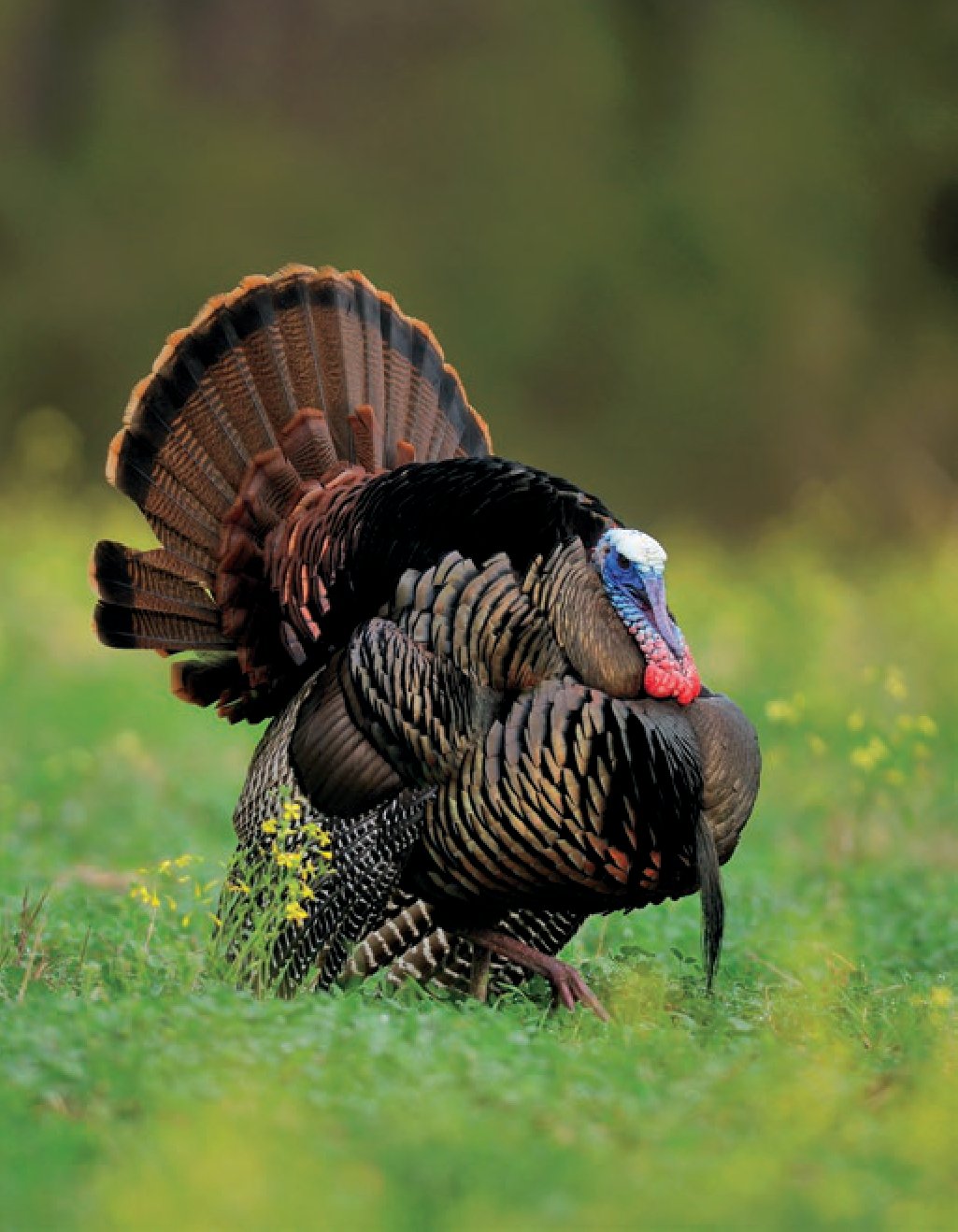
All good things in wild game management require patience, persistence and hard work. There are no magic bullets that allow you to accomplish your goals overnight. If you are a turkey hunter few things warm your heart more that the sight of a hen with a brood of newly-hatched poults. If the sighting is on your property it’s even more gratifying.
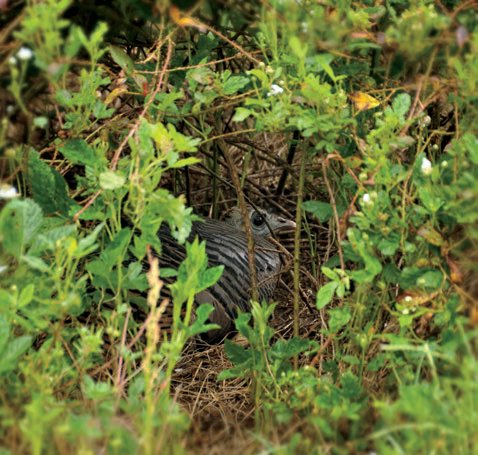
Considering the odds, a hen that successfully hatches a clutch of eggs is a miracle worker. She has beaten the odds of predation and weather. Her six-week ordeal of laying and incubating eggs is counted in only 35% of attempts that are successful. During the twenty-eight day incubation period she has fed and watered sparingly. She has spent her nights and most hours of those days sitting on eggs in a nest located on the ground. Her camouflage and natural instincts have brought her this far. When the eggs hatch she is then faced with rearing her young.
During the first two weeks after hatching, the mortality rate of poults is estimated as high as 75%. Weather and predators take a terrible toll. Once poults reach two weeks of age survival rates go up dramatically. Feathers begin to replace down and poults are able to flutter up onto low-hanging branches, out of reach of most predators. These feathers also repel water and help regulate body temperature giving survivors better odds against disease and exposure.
The come-back of the wild turkey is truly one of America’s greatest conservation success stories. In the early 1900’s wild turkey populations were estimated as low as 30,000 birds. The work of the National Wild Turkey Federation, state and local agencies and private landowners have paid tremendous dividends. Today that estimate is over seven million wild turkeys nationwide. When you realize just how difficult it is for a hen wild turkey to brood and raise poults the story becomes even more remarkable.
It Begins With a Nest
The mating ritual of wild turkeys begins as early as February and runs as late as May, depending on location. Soon after a hen is bred she starts looking for a place to lay eggs. Typically hens choose a nest site in an area covered with moderately wooded vegetation. When a site is chosen she digs a shallow depression and adds leaves, sticks and her own feathers to form her nest. Hens need seclusion and cover with food and water nearby.
Several years ago my wife Tes and I decided to do what we could to help turkey hens and brood poults on our 200-acre Alabama farm. The farm was blessed with a diverse range of habitat ranging from rolling hills and ridges on the East side to hardwood creek bottoms and swamp land on the West and South sides.
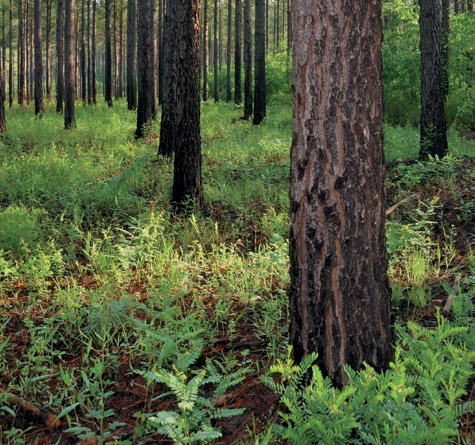
This diverse topography provided many of the basic needs wild turkeys sought. The mixed hardwood-pine hills and ridges provided acorns, beechnuts, hickory nuts, wild grapes and tender bud forage sought by turkeys throughout the year. The swampland provided tupelo berries, acorns, and invertebrates, such as snails. The creeks provided constant water and an all-important source of grit and gravel essential for a turkey’s digestive systems. These areas also provided preferred turkey roost sites over or near water.
We identified three areas that attracted nesting hens. In addition to suitable nesting cover there was a water source in each area. To improve nesting cover we began selecting small areas on the edge of hardwood drains where we killed undesirable trees like sweet gum and hickory with hack-and-squirt treatments of Arsenal®. After treated trees were dead I dropped random trees with a chain saw to add cover and speed the natural regeneration of under story vegetation.
Another issue we faced was areas on the farm not suitable for turkey recruitment. One area consisted of two fifteen-acre pine plantations. These plantations were twelve years old and had canopied-over preventing sunlight from reaching the ground. Between the plantations was a strip of pastureland seeded with bahia grass. In the spring of 2006 we sprayed a quart of glyphosate per acre at green-up. This was to burn down the pasture grass. In May we tilled the pastureland with a chisel plow and let the natural seed bank reclaim the land. By fall natural vegetation including dog fennel, briars, ragweed and sedge reclaimed the land. Today we manage this natural vegetation by mowing strips on a two-year rotation in the summer. Every third year we apply a cool season fire to control volunteer pines and hardwood saplings.
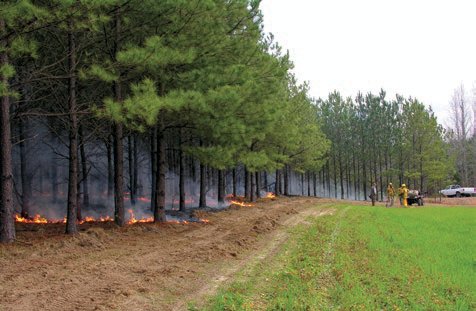
In March the following year, when the pines were thirteen years old, we applied our first cool season fire. This was to reduce the fuel load of pine straw and duff accumulated over the years. Three years later, when the pines were sixteen years old, we thinned the pines in July and burned again in February. All this was an effort to release the natural seed bank in the pine plantation and encourage growth of natural plants beneficial to deer and turkeys. The thin-and-burn management plan in our pines, combined with the spray, till, mow and burn management of adjacent pasture created another forty acres of habitat rich with insects, plant and seed forage as well as nesting cover sought by wild turkey hens.
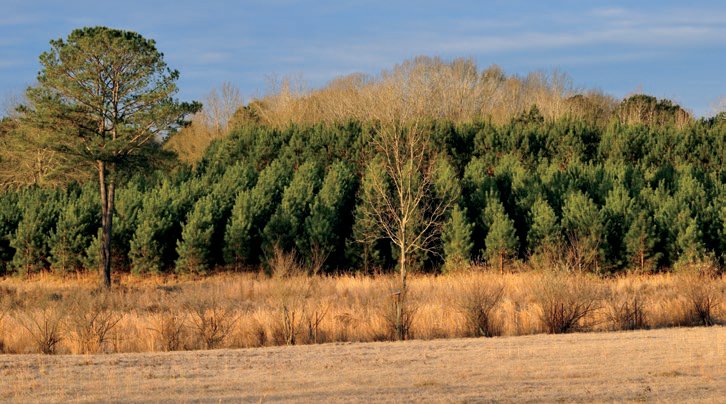
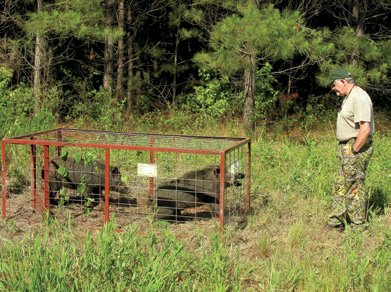
In all three areas we allowed portions of field edges and fencerows to grow briars and other nesting cover by simply not mowing specific areas. We also allowed overhanging tree limbs to grow along clover field edges. These low-hanging limbs made perfect escape sites for young turkeys flushed by predators. They also served as shady loafing sites for turkeys and protected young turkeys from predators like hawks and owls. To reduce predation we set live traps baited with sardines to catch raccoons and opossums. Improved nesting cover and fewer predators resulted in more successful hatches.
Hatched!
Turkey poults hatch 28 to 30 days after incubation begins. Poults use a primitive egg tooth to pip the large end of eggs and break free of the shell. Normally all eggs hatch in a twenty-four hour period. As the eggs begin to hatch the hen communicates with the poults with soft clucks, purrs and whines. This communication ensures the poults imprint on the hen. Once the poults hatch, visual identification coupled with the vocalization completes the imprinting process from poults-to-hen. Imprinting forms a bond between hen and poults that is essential to their survival.
Newly hatched poults utilize a yoke sac for nutrition the first forty-eight hours after hatching. After the yoke sac is gone poults must find protein to survive. That protein comes in the form of insects. Hens typically lead the brood away from the nest after 24 hours in search of food and to avoid predators.

The second phase of our program was to ensure we had nutrition available for young poults. To accomplish this we planted clover fields in the fall near each of the three nesting areas. Clover attracts and holds hoards of insects. To make it easy for the poults to forage in clover fields we mow lanes in late spring. Before we mow we walk the fields to insure no poults or nesting hens are in the field. Lanes are mowed the length of the field at 40 foot intervals. Cross lanes are mowed to make a checker-board effect. This gives poults easy access to the insect-rich clover and escape routes from the field to cover.
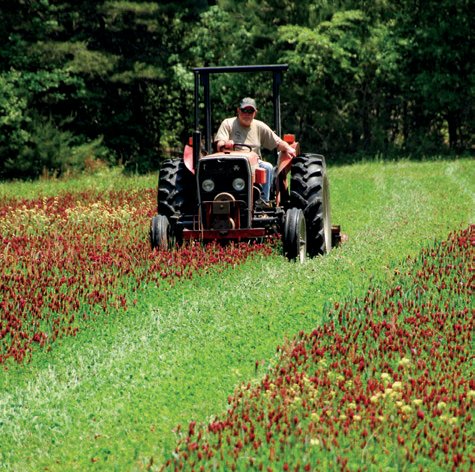
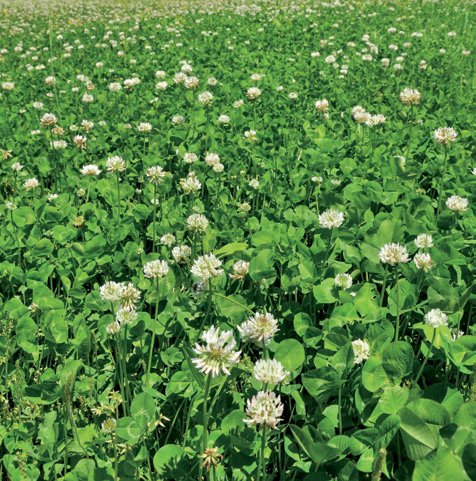
Perennial clover fields are located near food plots planted with cool season seed mixtures to attract deer in fall and winter. These mixes include annual clover types, brassicas, oats and wheat. Throughout late spring into summer we check these fields to insure no turkeys are present, then mow strips to scatter the matured cereal grains. When most of the scattered grain has been eaten we mow another lane. These grains help attract the hens to the area where they find the insect-rich clover fields. We also mow small areas around water sources taking care to leave escape cover nearby. This allows small poults easy access to water.
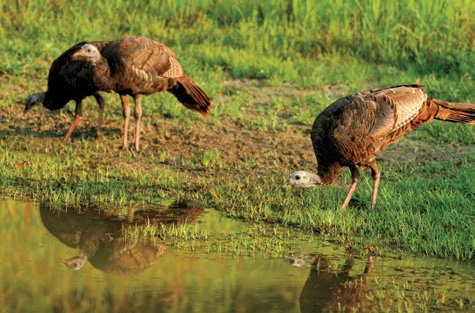
The final touch is to disk dusting lanes along the field edges. These lanes are only one disk pass wide but we make multiple passes to create deep, loose dirt. The finely chopped dirt is perfect for a turkey dust bath that helps the birds deal with mites and insects.
Flocked!
As surviving poults age they grow at a phenomenal rate. At one month old they are comparable in size to an adult pheasant. With size comes strength and mobility. Now the hen leads her brood further and further from where they were hatched in search of food.
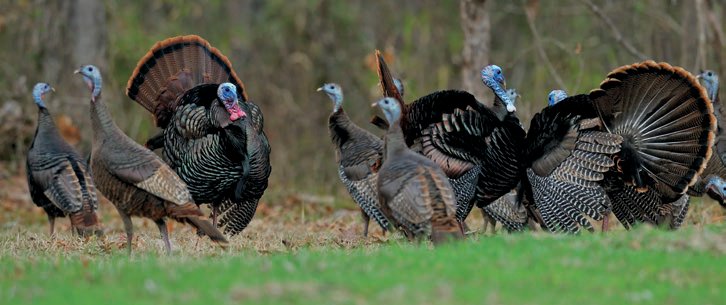
At this stage poults still feed on insects but increasingly depend on seeds and vegetation for sustenance. At this time it is common for hens with poults to join with other hens with poults. It could be that there is safety in numbers or just the social nature of wild turkeys, but within these groupings the social status of each individual is established. Older poults dominate younger poults and large poults dominate smaller poults. The hens dominate all poults and one hen dominates other hens in the flock. This behavior is called establishing a pecking order and hierarchy is established by fighting for it.
By five months of age male poults, or jakes, are driven out of the flock and form jake flocks. Mature gobblers gather in small flocks soon after breeding ends. Hens and female poults, or jennies, comprise the large flocks commonly seen in fall and winter. In the spring these flocks disperse and the mating and nesting ritual begins again.
One thing we do to encourage these flocks to remain on our farm in summer and fall is to allow pastures to grow seed heads. Bahia grass is common in pastures in our area. When allowed to mature, bahia seed is a preferred food source for wild turkeys. They move through the grass stripping seed heads as they go. Along the way they find larger insects such as grasshoppers and crickets.
Another effort to hold turkeys on the farm was planting fruit and mast bearing trees. We dedicated two acres in the center of the farm for this purpose. Within this orchard we planted persimmon, plum, pear and crab apple trees for soft mass. Scattered among the soft mass trees are Chinkapin, Dwarf Chinkapin, Gobbler Sawtooth and Sawtooth oak trees for hard mast. The result was hard and soft mast food available for deer and turkeys from late summer through early winter.
No-Fly Zone
Perhaps the most important lesson we learned during our ten-year effort to attract and hold turkeys on our farm was that flying turkeys almost always landed on the neighbor. To deal with that problem we adopted a no-fly policy. To accomplish this we made a conscious effort to allow any turkeys sighted on the farm to move away at their own pace. That meant immediately stopping in place anytime turkeys were sighted. Early on this stop-and-wait practice produced mixed results. Turkeys are strongly imprinted with run-or-fly instincts to escape danger. Eventually turkeys encountered on the farm became more tolerant of our presence if we stood in place and allowed them to move away at their own pace. I believe this practice adds one more layer of appeal for turkeys on your land.
Home
Wild turkeys spend their lives in a home range. When poults first hatch, their home range can be as small as 100 acres. As they grow older and larger the hen leads them where they need to go to find food, water and cover. Basically she is introducing her young to her own home range, which can be as large as six square miles.
By the time poults reach breeding age they have adopted the area in which they were reared as their own home range. They will likely breed, nest, and rear their poults in that same area. If you desire more wild turkeys on your property the best way to accomplish that goal is by providing everything possible that hens need. They are the key to having wild turkeys on your property!
You Can’t Rush Mother Nature
All good things in wild game management require patience, persistence and hard work. There are no magic bullets that allow you to accomplish your goals overnight. If there is one lesson to be learned about managing small acres for wild turkeys is that you can’t rush Mother Nature. Everything takes time. Almost everything you do to improve your land and wildlife will take years to pay dividends.
I wish I could say that we are unique in some aspect of our management program. In reality we are the same as everyone who strives to improve the land for the wildlife we so love. The Randle Farm is a work in progress. That work started in 1987 when Ned Randle bought an overgrown, abandoned farm that had stood idle for eight years. Twenty-eight years later we find ourselves heading back in that direction with parts of the farm. There are times when we think we have done all we can to make the farm a better place. That is a great feeling. But it has never lasted more than a week because there is always more you can do.
Many of our dreams have come true. Today we have more turkeys on the farm than ever before. Each spring we find hens on their nest in habitat we have altered for their benefit. Tes and I both manage to shoot at least one mature buck each season. We even had quail making a comeback.
My happy dreams today are much different than those of my youth. They are still about big whitetail bucks but now each buck has a name. He lives on our land and we know him. We have watched him grow and mature while taking advantage of the bounty of the Randle Farm and its neighbors. My dreams are about long-spurred gobblers that frequent our land and the young jakes and jennies vying for their place in the pecking order on our farm.
Being a wildlife manager is a lifestyle that is all consuming. It requires most of our play money and spare time to achieve the goals we set. The rewards are greater than the sacrifices and we seldom have a problem falling to sleep at night. Time changes everything. The reward is that the changes on the Randle Farm are all better for the wildlife that calls it home!