Thanks to the advent of new state laws providing the opportunity for landowners to obtain year-round trapping permits in many southeastern states, predation management has become a valuable tool for bobwhite quail management. In the previous 3 parts of this predation management series, we have discussed the history of predator populations and management, the life histories of individual predators, and various factors influencing predation management and bobwhite abundance on specific types of properties. In this installment of the series, however, our intentions are to provide you with some insight – based on lessons “learned the hard way” – on how to put your knowledge to practice and get started managing mammalian predators on your property. We will discuss the types of traps used and the benefits and limitations of each; provide some tips and techniques that have worked for us; give you a general idea of trapping effort versus trapping efficiency; and help you develop a trapping plan relative to the timing (i.e., season or months) and duration of trapping in order to obtain your desired goals.
Developing a trapping strategy is important and can save time and money when conducted objectively. Some questions that should be asked include: How much time will be available for trapping? What time of the year can trapping occur? What are the target species for management? Where does the trapping need to occur? Are quail predators or nest predators of greatest concern? How much money do you have budgeted for a trapping program? Can I monitor the effectiveness of my trapping efforts? Answering the previous questions will provide a good start to developing a trapping plan – one that should prove effective and beneficial when applied correctly.
Getting started: Terminology and Techniques
Types of traps and their utility
There are two main types of traps currently being used by trappers for predation management among properties managed for quail: leg-hold (or “steel”) and cage (i.e. box, live) traps. The decision regarding which trap type optimally fits your trapping plan depends on several factors: (1) available funding; (2) time availability – for setting traps and running a trap-line; (3) time of the year; (4) climate; and (5) target species. There are other factors that may affect this decision, but these are the most important.
The initial purchase and maintenance of traps (cage or steel) are typically the more costly factors associated with the start of a predation management program. Cage traps can be expensive up-front when compared to steel traps which cost approximately one-fourth that of cage traps. However, this shouldn’t be the determining factor; cage traps have some distinct advantages over steel when used in certain situations. The time (which most of us know equates to money) required to set and maintain a steel trap-line, in many cases, exceeds the upfront cost of purchasing cage traps. Furthermore, weather is not typically a limiting factor with the use of cage traps, however weather, namely rainfall, can drastically affect the utility of leg-hold traps. A single afternoon thunderstorm, which is all too common in the South during the summer, can erase an entire day’s work of setting steel. Conversely, cage traps will remain set and effective as long as the bait has not washed away during summertime rain showers. Soil type and conditions will also limit the effectiveness of steel, while cage traps can be set on various soil types including dry-sandy soil; mud; or hard, red-dry clay in about one-sixth the time with the main caveat being that the cage trap needs to be somewhat stable.
Steel does have the advantage of being easy to transport and store, due to its small size, when not in use, but the added labor associated with dyeing and waxing steel is very time consuming and essential for steel to be effective. Waxing and dyeing helps to preserve traps, provides traps a more natural look (dyeing), allows mechanical parts to move faster, and prevents excessive rusting. However, dyeing traps seems to be more important than waxing. For more information on how to wax and dye traps visit your extension office websites (or see: www.npwrc.usgs.gov/resource/mammals/furtake/prep.htm).
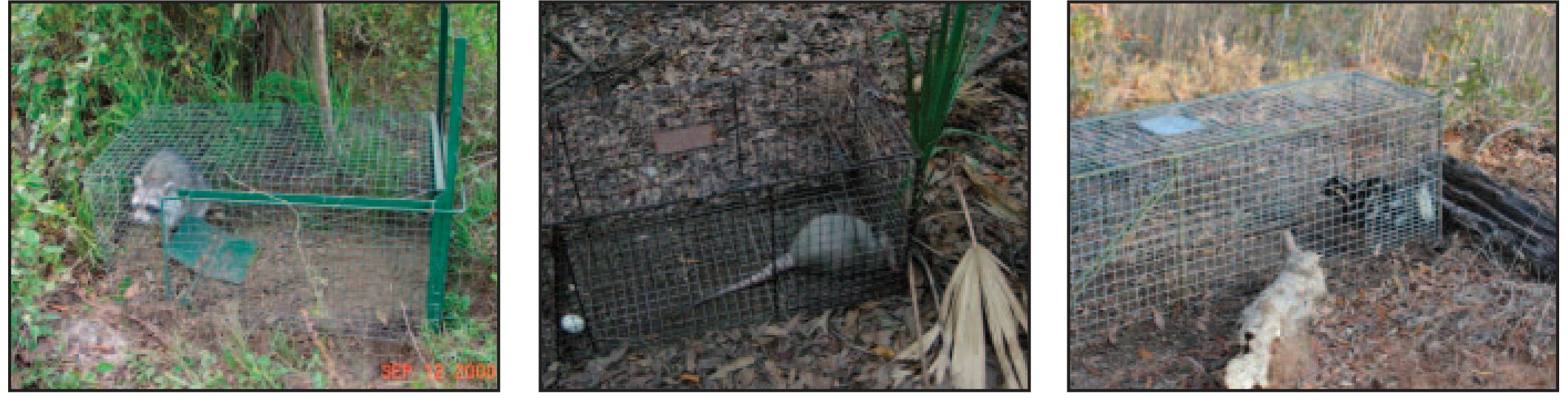
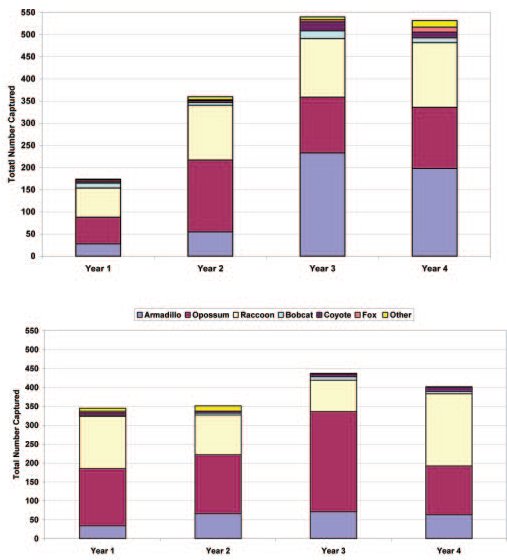
Steel also facilitates capture of adult bobcats and coyotes, neither of which is commonly captured when using cage traps, but this does occur on occasion. However, the capture of these animals may not be an issue where common nest predators are the species targeted for control (the predator composition is frequently skewed towards nest predators anyway). In fact, on 2 different sites we observed that capture rates were highest for raccoons, opossums, and armadillos (see Figure 3). Thus, it may be beneficial to focus trapping efforts on nest predators using cage traps 2-3 months prior to utilizing steel when targeting the capture of coyotes, bobcats, and foxes. Otherwise, raccoons and opossums will likely inhibit the effectiveness of their (bobcats, coyotes, and foxes) capture by either being captured themselves in the leg-holds or stealing the bait without being captured.
The efficiency of steel is greater than cage traps in terms of animals caught per trap night. We have observed a capture rate of approximately 30 % using steel whereas only a 2 to 6 percent capture rate has been observed when using cage traps. In addition, when the trapping opportunity or window is short, leg-hold traps may be the best option. However, experience has shown that a five month nesting season with abundant rainfall and/or extremely dry weather will make for a long trapping season because much time will be spent resetting steel. Notably, for optimal predation management among landscapes managed for bobwhites, we recommend the combined use of steel (leg-hold traps) and cage traps whereby cage traps can be used to capture nest predators and leg-hold traps can be utilized to capture other target species (e.g., bobcats and coyotes).
Utility of Baits and Lures
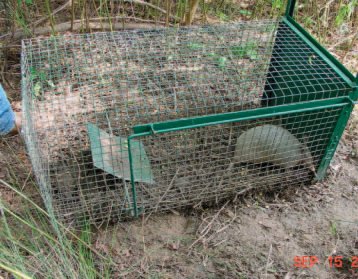
There are numerous commercial baits and even more homemade concoctions used by today’s trapper, but the list of summertime baits is comparatively short. The type of bait used depends on how much time one can spend both making or preparing the bait and setting the traps. Soured corn, eggs, and sardines are popular, easy, and efficient choices for year-round trapping. We have experienced that many commercial baits and lures are more effective during the traditional trapping season (i.e. winter). Fire ants are also a limiting factor when choosing summer bait(s). We have discovered that sugar-based or meat-based baits will be devoured by ants in a short period of time (often within 24 hours). There are also some fruit-based baits that we’ve used with moderate success, but we have also observed that it’s hard to beat an egg that’s been ripening in the sun for a week or more in terms of capture success. A single chicken egg provides a visual as well as an olfactory stimulus, particularly when left to “ripen” a few days. Eggs don’t have to be left in the sun for a few days before being placed in the trap, but if you choose to use ripened eggs, care should be taken during handling. Corn that has been soured in water and/or granular molasses works well but can be messy and time consuming to prepare. A can of sardines placed under the trigger platform, or under the trap itself, will catch raccoons and opossums for a few days, but as the bait is consumed by ants and gradually replaced by grubs and worms, the chance for capturing an armadillo increases. Sardines should be replaced after roughly ten days or so depending on the weather and thieving occurrence(s). We have noticed that if a cage trap catches an armadillo, it would be wise to leave the trap and simply reset it where it is because the chance of capturing another armadillo appears to increase dramatically. The olfactory glands of armadillos are quite large – in fact they are about 3 times the size of their brain – and a natural scent trail leading to a trap is a good one to have.
The efficacy of scents and/or lures during the summer is only moderate, whereas their use during the fall and winter is much more beneficial. If time can be given to using a variety of different baits and lures then we suggest you do so. However, if time is limiting, we suggest you stick with the more popular choices of soured corn and sardines. It cannot be emphasized enough that: experience goes a long way towards being an effective trapper so be patient, be persistent, keep good records, and learn from your mistakes and successes.
Trapping Effort and Trapping Efficiency
Timing and Duration for Optimal Trapping Efficacy
A good starting point in terms of timing, for capturing nest predators, is January or February (see Figure 1). Larger quail predators (bobcat, fox and coyote) can be caught for several reasons during this time: food has become scarce and greater distances must be traveled to sustain them through cold nights and breeding/mating. In the Southeast, bobcats begin breeding and, as a result, they expand their home ranges in order to find a mate which renders them more vulnerable to capture. Similarly, other smaller mammalian predators such as raccoons and opossums (see part II of this series) are also beginning to mate and thereby increasing their home ranges which renders them more susceptible to capture. Further, the weather this time of the year allows for the use of meat-based baits and lures which, when used in conjunction with steel, captures both predators of adult quail and bobwhite mammalian nest predators. This jump-start on nest predator removal is beneficial because March and April are popular months for other types of woods work including burning, mowing and timber harvest and these activities may interrupt trapping. In addition, April and May are known to mark the onset of mating, nest building and incubation (beginning in late April), for bobwhites. Thus, the more predators removed prior to this point in time, the greater the chance of increasing nest success and productivity through predator management.
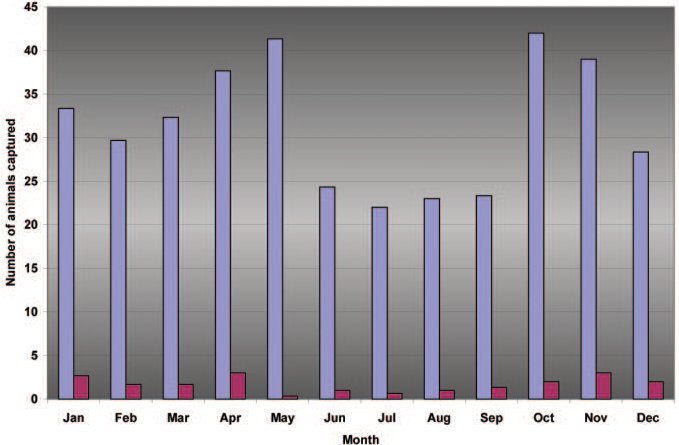
We have also observed that predator capture success is relatively low during much of the bobwhite breeding season (Jun – Sep; see Figure 1). This may be caused by either: lower overall predator abundance during this time of year as a result of trapping effort and success during January – May or the availability of alternate food resources (e.g. soft-mast, quail eggs) for predator consumption, although it is likely a combination of both.
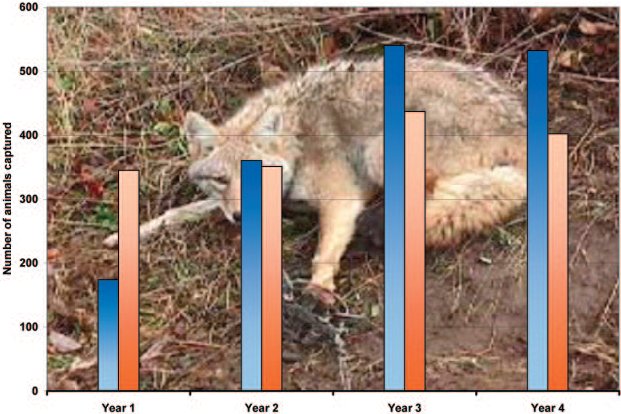
Based on data collected from 2 different sites (Figure 2), we recommend implementing an annual predation management program (when permitted via state regulations). We have observed that both small isolated properties and large properties surrounded by other similarly managed properties warrant continual predation management to keep predators at a threshold which optimally benefits bobwhites. Figure 2 illustrates this necessity for continual annual predation management whereby even after 3 years of management (trapping) >400 critters were removed on each site.
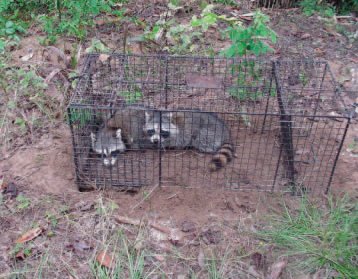
As time and working conditions permits during the spring, cage traps should be set to begin the reduction of nest predators. While running cage traps in the spring, a certain amount of planning should be done to avoid ongoing habitat management-related work. Cage traps don’t stand a chance against a harrow, mower or tire of any size, and once damaged, it’s hard to repair a cage trap and have it function properly. In order to keep track of your traps, you may find it beneficial to mark trap locations using a GPS unit or aerial photographs. Marking trap locations will help to ensure that each trap is checked (note: traps must be checked daily, once every 24 hours, according to most state laws) when running your trap-line, and it will make it easier to remove traps from an area when necessary. Much to our chagrin, we speak from experience when we say that failure to plan properly may result in high trap loss, which equates to increased costs (i.e. purchase of new traps) and effort. Furthermore and perhaps more importantly, the more traps that are damaged means the fewer trap nights and fewer animals caught. To offset woods-work and other spring projects while still maintaining some trapping effort on your property, try setting traps in both wet areas that don’t typically burn and other locations where no activity is planned (e.g. drains, oak hammocks, &c.). This will help to “keep the pressure on” and, hopefully, continue to decrease the predator population during the breeding season.
As temperatures increase, so does the activity of fire ants which is why meat- or sugar-based baits are marginally effective at best during late spring and summer. If time is limiting, it is best to stick with soured corn and/or eggs for baiting traps. At a minimum, we recommend that trapping effort continue throughout nesting season. By doing so, predator populations will be better managed (compared to no trapping during breeding season) during the critical reproductive season – potentially producing higher nest production and success thereby rendering a higher probability for a bobwhite population increase.
Fall woods-work in preparation for hunting season and habitat management endeavors marks the end of trapping for many. However, fall and winter trapping with steel helps to “keep the pressure on” because there will likely be an influx of animals onto a site taking the place of those removed during the summer in addition to the growth of on-site predator populations resulting from offspring produced by predators. Resident adult predators can be removed during this time as well.
During the quail hunting season, leg-hold traps will need to be pulled or triggered, to avoid ensnaring a bird dog – one trick you might try is to place buckets over the leg-hold traps, keeping them set, during hunting hours and pull the buckets when hunting ceases. This trick will save a lot of time by preventing the triggering and re-setting of leg-holds – not to mention the human scent factor involved with resetting traps.
“Lessons Learned the Hard Way”
- Cage traps don’t always have to be washed after a capture unless substantially soiled with blood.
- Random placement of traps is not the best option for optimal capture success; use your knowledge of species habits and life-history information for optimal trap placement.
- Baits and lures that are sugar-based or meat-based are not very effective during summer months due to ant consumption.
- Wise use of scents and lures can be effective whereas imprudent use (such as excessive amounts) may inhibit their utility and your overall success.
- Keep vegetation from growing into cage traps.
- Cleaning the ground with a hoe or rake prior to setting a cage trap will increase trap success – we don’t know why, but its works!
- If a raccoon or other surreptitious critters steals your bait from beneath your trap, try placing logs or other “natural” debris behind and around your trap.
- Some opossums and raccoons are small enough even to sit directly on the trigger without releasing the trap door; thus by setting the trap door on the very edge of the trigger-hook you will improve your chances of capture and help to prevent them from stealing your eggs or other bait.
- If you see varmint tracks close to your trap and don’t capture it, try turning your trap 180° where the entrance is facing the opposite direction – again, we don’t know for sure why this works, but it does!
- Do NOT move a cage trap if you catch an armadillo, reset it where it is – we have experienced that this will often lead to multiple armadillo captures on consecutive nights.
- Pick up all cage traps in areas where woods-work and/or logging is taking place. Failure to do so will likely result in flattened traps.
- Larger cage traps, in general, tend to catch more animals.
- Bright, shiny traps seem to be less effective than more natural colored traps. Thus you might want to dye traps or spray-paint them (cage traps) black or brown.
- When setting steel traps during extreme cold conditions (i.e. frozen ground) you may want to cover your traps with your own sand mixture – we have found that using a mixture of 3 parts sand with 1 part potassium chloride or pickling salt will render sufficient results.
Monitoring Trapping Efforts
Perhaps one of the most overlooked techniques in a predation management program is monitoring the overall success and the effects predator trapping has on predator abundance. Is predation a limiting factor of bobwhites on your property? Are your trapping efforts good enough to improve bobwhite reproductive success and survival? Is your current trapping effort adequate or do you need to increase your efforts? These are just a few of the questions you can answer by implementing a simple predator index. Although a predator index is not an adequate means to completely enumerate (census) predator populations, it does provide a relatively good representation of the overall predator abundance and composition for a particular property. Furthermore, a predator index allows you to evaluate the efficacy of your trapping program by comparing predator indices through space and time.
“Good Areas for Trap Placement”
- Drains, small creeks, hardwood hammocks, and bottomlands.
- Road intersections.
- Soft-mast producing trees, vines, and shrubs such as plums, persimmons, muscadines, mayhaws, american beautyberry, and blackberries during mast production and maturation.
- Creek – road intersections
- Water-holes, or even water puddles in roads.
- The base of hollow trees.
- Ecotones – where two different habitat types come together (the edge).
- Close to any hog traps and/or deer feeders.
- Fence rows and/or property boundaries.
The general idea of conducting a predator index is to place scent stations (a sand and mineral oil mixture sifted onto the ground in circular shape, about 1 meter in diameter, with a scent tablet in the middle; see a picture of a scent station in part 2 of this series) throughout your property. Predators investigate these scent stations by smelling the scent tablet, and sometimes even eat the scent tablet, leaving behind their track(s). Calculating the percentage of scent stations “hit” during a five day period will give you an overall index to predator abundance on your property. In general, a visitation rate of <10% indicates that predation is not likely a limiting factor, whereas a predator visitation rate in excess of 20% may indicate predation is a limiting factor of bobwhite populations, and thus, predation management is warranted or predation management efforts should be increased. This data will also allow you to assess the relative predator composition and provide a means to alter your trapping efforts to focus on those species most prevalent on your property. For more information on conducting (how and when to implement) a predator index visit Tall Timbers Research Station and Land Conservancy’s website: http://www.talltimbers.org/research/gamebirdpep.html.
Pursuit of Success – Developing a Trapping Strategy
If the amount of time available to trap is limited then contracting with a professional trapper might be an option to explore. Likewise, it may be beneficial to hire a professional trapper to kick off the breeding-season trapping efforts and to get a jump-start on predator reduction prior to the onset of bobwhite nest building and egg-laying.
Predator trapping is a continual process that has no end, unless of course the benefits observed don’t out-weigh the costs of a trapping program. Given just two years with little-to-no trapping effort, nest predators can repopulate even the largest land holdings managed for quail. In certain habitats, raccoons have been documented as having large home range sizes (see part II of this series) and have been known to disperse as far as 70-80 miles. Thus, it’s easy to see the importance of seasonal or, better yet, annual trapping pressure is to keeping these varmints in check. The monitoring of predator abundance will provide you invaluable information to assessing your trapping efforts and will help to best guide your predation management program.
Habitat type and tract size will dictate the number of traps needed to implement an effective trapping program. Unfortunately, there is not a magic formula stipulating that “x” number of traps is necessary to effectively manage predators for “y” acres. However, we have found that a general rule is to have approximately 80 – 120 cage traps (box traps) and 20 – 30 leg-hold traps for every 1000 acres being managed. The number of traps will also be dependent on the amount of roads, firebreaks, and trails you have to run a trap line.
We have found that running 1 cage trap every 8-12 acres (depending on landscape and habitat) and 1 leg-hold every 40-50 acres can yield respectable results. On large areas (> 3000 acres), we recommend breaking the property into smaller parcels (500-1000 acres) and alternating trapping implementation amongst parcels to focus efforts on smaller areas – thereby increasing trapping efficiency. In addition, another strategy that works well after a property has already been trapped intensively for 1-2 years is to saturate areas close to property boundaries and alongside drains, hardwood hammocks, and other late-succession habitats with cage traps while setting leg-hold traps dispersed throughout the remainder of the property (the core).
Oak hammocks, wet bottoms, ponds, creeks and river edges are good places to start. Any place that holds water for a week or two during the summer will be productive in a number of ways. Raccoons and opossums will use hollow trees, if available, as cover and with available water this habitat becomes favorable. As water holes and wet bottoms dry up, armadillos will dig in the soft soil for grubs and worms increasing the chances of that first catch.
When starting a predation trapping program the lessons learned from trial and error will go a long way towards making the program efficient. The best thing to do if you’re serious about bobwhite quail and predation management is to buy some traps and get started. Effectiveness and success will come with time as the program is fine tuned for a particular location, but the most important lesson learned by all successful trappers is: get out and trap.