
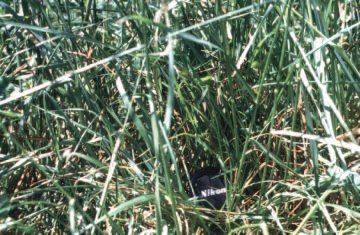
I visit a lot of properties across the South each year. Without exception, there is one recommendation I have given everyone—get rid of the tall fescue and/or bermudagrass. I have never made an initial property visit in the South (or Midwest or Northeast, for that matter) where I didn’t find one of these grasses.

Few landowners realize that just by eradicating these grasses, they can enhance habitat for white-tailed deer, cottontail rabbits, wild turkeys, bobwhite quail, mourning doves, field sparrows, indigo buntings, dickcissels, blue grosbeaks, yellow-breasted chats, American goldfinch, loggerhead shrikes, and many other species. And tall fescue and bermudagrass aren’t the only culprits. In my opinion (and in that of a whole lot of other biologists), you can add orchardgrass, timothy, bluegrass, johnsongrass, crabgrass, goosegrass, bahiagrass, vaseygrass, velvetgrass, japangrass, and, certainly, cogongrass. Why? None of these grasses provide quality cover, forage, or seed for wildlife, none are native to North America, some are extremely invasive, and they all displace more desirable plants. Yes, I know deer may eat some of them at various times of the year, turkeys may eat bahiagrass seed, and quail and several other birds may eat crabgrass or johnsongrass seed. But why have a plant(s) that provides marginal cover, forage, or seed take up space where more desirable plants could grow?!? Make no mistake, you can increase the carrying capacity of your property for many wildlife species just by eradicating these grasses.
Now, before you think I’m a native plant purist, let me explain. I do encourage people to promote native plants when possible and practical, but I think foremost about landowner objectives and what would benefit wildlife. Thus, I’m also a proponent of food plots, for example, if they fit in with the landowner’s objectives. Of all the food plot plantings I might recommend, only a couple are native to North America. Therefore, I don’t have a problem with someone using a non-native plant to meet a specific objective, as long as that plant is not invasive and there is not a more valuable native plant that would meet the same objective. Please be aware, however, that food plots are only a very small component of habitat management and often are not necessary for landowners to meet their objectives. Also, it is important to remember food attracts wildlife, but cover holds them. If you want to hold more wildlife on your property, you should be most concerned about enhancing cover, and that includes cover within your woods and your fields. For those wildlife species listed above, if you want to see more of them on your property, one of your top priorities should be renovating your fields and eradicating undesirable plant species (whether native or not).
What do you want?
Aside from food plots and other agricultural areas, you need to manage your fields to provide quality “early successional” habitat required by the wildlife species listed above. Quality early successional habitat includes certain grasses, forbs, and scattered shrubs that represent distinct resources for food and cover. Many native grasses, such as broomsedge bluestem and little bluestem, provide quality nesting cover for bobwhites and enable you to use prescribed fire to maintain an early seral stage. Forbs, such as pokeweed, ragweed, partridge pea, native lespedezas, and beggar’s-lice, provide forage for deer, brooding cover for young quail and turkeys, and seed for a variety of birds. Scattered shrubs, such as blackberry, wild plum, and sumac, provide soft mast and seed for many wildlife species, as well as loafing cover for quail and rabbits, nesting structure for several songbirds, and one of the most important factors for quail and rabbits—winter cover. Before you think of winter cover as thermal cover, please realize winter weather is not a limiting factor for quail or rabbit populations in the South. A place to hide from predators, however, is often a limiting factor during winter.
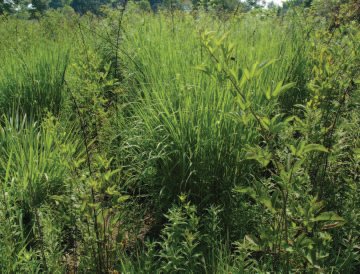
Underneath this cover of early successional plants (at ground level) should be an open environment. This is provided when thatch-forming grasses (such as tall fescue and bermudagrass) are removed. The forbs present should provide what I have called an “umbrella canopy,” with cover overhead, yet open below. This enables small wildlife to travel throughout the field and not just along the edge of the field. This open ground structure also enables young quail and turkeys to easily pick up seed and search for invertebrates. It is not desirable for quail to expend more energy trying to navigate through a field than they obtain from the food they find! As they feed, they should be protected from overhead predators, not exposed and forced to use the woods where they are hammered by Cooper’s hawks.
Be aware, properly managed early successional habitat does not look “pretty” to most folks. Many landowners, especially farmers, absolutely cringe when they see a field of “weeds” and “wild grasses.” Think of it this way—when you walk into a field, you should feel just as likely to jump a rabbit or covey of birds in the middle of the field as you are along the edge. “Edge” species are looking for desirable structure. That type of structure is often found along the edge of the field because the interior of the field is not managed accordingly to suit their needs. Your objective should be to create a field of edge. Without question, this is just as attractive to deer and turkeys as it is to quail and rabbits.
How to get there
Your first step in removing tall fescue and bermudagrass is to prepare the field. A very common mistake is for landowners to spray problem plants with a herbicide before the field is ready. It is absolutely critical to get the site ready and spray at the correct time. If you try to spray a field of tall fescue or bermudagrass with plant debris from the previous growing season over the field, you are not going to be happy with the results. “Clean” the field by burning, haying, or grazing. You want to spray fresh growing grass, not senescent stems and leaves from last year.
Tall fescue
Tall fescue is a perennial cool-season grass. It makes most of its growth during the cool months of the year, not in summer or winter. In spring, tall fescue grows rapidly using carbohydrates stored in the root system prior to winter. If you spray tall fescue in the spring, you will typically not get as good of a kill as you will in the fall because in the fall, tall fescue is sending carbohydrates down into the root system, preparing for winter senescence. When you spray in the fall, you don’t have to use as much herbicide and you will get a better kill.

Prepare tall fescue fields for spraying by burning, haying, or grazing in September. This is critical. If you simply mow (bushhog) the field, there will be considerable material left on the field and much of your herbicide application will not contact growing grass later when you spray. If you have no other option than mowing, then do so fairly frequently through the summer to keep vegetation height relatively low and prevent thatch build-up. Next, allow the grass to grow through October and spray with 1.5 quarts per acre of a glyphosate herbicide (with surfactant) when the tall fescue is 6 – 10 inches high in early November.
The field should appear brown and dead through winter. Winter annuals (such as henbit, purple deadnettle) may germinate through winter. If so, spray with 1 quart per acre of a glyphosate herbicide. If quality early successional habitat is your object, an imazapic herbicide (such as Plateau or Journey) may be used at this time, but I prefer to wait until spring, just before green-up. This provides better residual control of undesirable warm-season plants (such as johnsongrass, crabgrass, broadleaf signalgrass, curly dock, sicklepod, jimsonweed, wild mustard, wild onion, and cocklebur) that are about to germinate. If you intend to plant a food plot, do not use Plateau or Journey because they are not labeled for agronomic crops and the residual imazapic may kill your crop as it germinates (depending on what you are planting). There are other preemergence herbicides you can use prior to planting a food plot (such as Pursuit or Prowl H2O).
Bermudagrass
The same process should be taken with bermudagrass, except the timing and herbicides are different. Bermudagrass is a perennial warm-season grass. Therefore, it should be sprayed in summer when it is actively growing. Prepare the field for spraying the previous winter or spring. Burning in March is recommended. Just before or during flowering (about mid- to late June, depending on your location) is the perfect time to spray, but don’t let it produce seed before spraying! Bermudagrass is tough. There is no single herbicide application that will completely eradicate all the bermudagrass. There will always be a few areas that need spot spraying the following year. Nonetheless, the best herbicide application that research has identified is 48 ounces of Chopper or 24 ounces of Arsenal AC (both with surfactant) per acre. These herbicides do a fantastic job of eradicating bermudagrass, but expect to do some “mop up” next summer.

What’s next?
Your next step is to be patient and evaluate what germinates from the seedbank. The seedbank is that collection of seed occurring naturally in the top few inches of soil. Usually, tall fescue and bermudagrass form a carpet over the ground, precluding the vast majority of seed in the seedbank from germinating. When you remove this carpet, you stimulate the seedbank to germinate. Often, a most desirable composition of early successional plants await release. Sometimes, however, another layer of undesirable plants must be eradicated. For example, you might remove the carpet of tall fescue only to find bermudagrass, johnsongrass, and/or crabgrass awaiting release. Don’t be discouraged! The only way to get rid of these non-native scourges and enhance your field is to treat them methodically with the appropriate herbicides. Spraying is not a one-time deal. Don’t be surprised if you have to spray a field 3 or 4 times with selective herbicides over a 2- to 3-year period to get rid of problem plants. And you may still spot-spray some later, such as sericea lespedeza, whose hard seed continues to germinate from the seedbank for several years after spraying the existing cover. But, by that time, you will be fine-tuning the plant composition in the field and enjoying a positive response by wildlife.
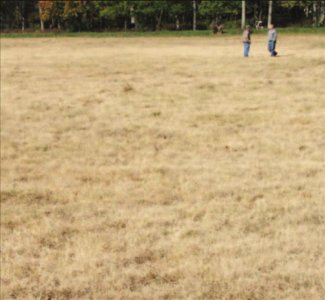
Seedbanks vary dramatically from area to area and site to site. Most often, on sites that were recently cleared of woods, a desirable seedbank is intact. However, in some fields, the seedbank has been depleted of desirable species and planting is necessary to develop quality early successional cover. This is easily accomplished by planting a variety of native grasses and forbs readily available through seed dealers. Various shrubs (such as wild plum, staghorn sumac, American crabapple, elderberry, and hawthorn) are also available for planting if needed.
How to keep it
Early successional habitat becomes late successional habitat if the site is not managed (disturbed) periodically. Over the course of 3 – 5 years, fields often become rank with senescent vegetation and the attractiveness for wildlife lessens as the structure and composition changes. Fields are best managed by burning and/or disking. Mowing (bushhogging) is not recommended, as it only piles debris on top of the ground, reduces seed availability, makes travel by small wildlife more difficult, and suppresses the seedbank.
Burning
Burning consumes the old vegetation, creates an open structure at ground level, and recycles nutrients, which stimulates additional fresh growth. Fields are normally burned in early spring, just before spring green-up. This retains cover in the field through winter and does not disrupt any nesting season. Woody encroachment can be problematic, especially sweetgum, winged elm, red maple, boxelder, and green ash. To control undesirable woody growth, burn late in the growing season (September). Burning at this time reduces woody stem density as effectively as herbicide applications. If you see undesirable woody stems becoming numerous, hold off burning in spring and simply wait until September to burn. If undesirable woody species are sparse, you can simply spot spray them using Arsenal AC or Garlon 3-A (depending upon species). Fields usually need burning every 2 – 4 years, but the fire return interval is entirely dependent upon the responding vegetation composition and structure.

Burning fields requires firebreaks. A disked strip 1 to 2 tractor-widths wide around the field helps preclude fire from escaping the field. Firebreaks can be left fallow to encourage plants from the seedbank, or firebreaks can be planted to warm or cool-season forages or grains to provide an additional food source. The arrangement of a block of cover and a strip of food, as opposed to a block of food and a strip of cover, is very important in terms of holding wildlife on your property.

Disking
Many folks are reluctant to burn, or are in areas where they cannot burn. In these situations, disking may be used to set back succession and influence plant composition. Disking, like burning, improves the structure at ground level, facilitates decomposition of senescent vegetation, and stimulates the seedbank. Disking old-field habitats, however, usually requires a fairly heavy off-set disk.

Disking can also be completed following burning to influence vegetation composition. If grasses dominate the site, disk areas in November through February to stimulate additional forb growth. If you are in the Mid-South, you can disk into March. Disking later than this will stimulate undesirable warm-season grasses (such as johnsongrass, crabgrass, and broadleaf signalgrass) if they are still present in the seedbank. I like the vegetation composition to be approximately 50 percent native warm-season grasses and 50 percent forbs, with an open structure at ground level and scattered shrubs not more than 100 yards apart. If grass coverage exceeds 70 percent, I will disk in late winter or burn in September to encourage more forbs.
Frequency of disking is similar to that for burning; however, if you want to stimulate more annual forbs, disk more frequently. If mourning doves are a primary interest, for example, annual disking will promote seed producers, such as ragweed, tropic croton, 3-seeded mercury, redroot amaranth, fall panicum, and foxtail grasses. Without a perennial grass component, heavy disking is not necessary. You can even retain several perennial forbs with light disking, such as pokeweed, native lespedezas, beggar’s-lice, trailing wild bean, and perennial sunflowers. These plants produce seed eaten by bobwhites and many other birds, and provide excellent brooding cover for quail and turkeys.

An increase in forbs also improves forage for white-tailed deer. Across the South, diet studies have consistently shown forbs represent 50 – 80 percent of a deer’s diet during spring and summer. Perennial grasses are ranked last. Regardless, wildlife habitat is improved by simply getting rid of the tall fescue and/or bermudagrass cover and working with the natural seedbank.
Perspectives
It is difficult for most people to appreciate the beauty of “weeds.” It is not difficult, however, for a bobwhite, a cottontail, an indigo bunting, a wild turkey poult, a field sparrow, or a white-tailed deer to appreciate them. If you want to see more of these species on your property, you must learn to view broomsedge, beggar’s-lice, and brambles differently. You must realize “clean, green, and even” is not a good thing for wildlife. Eradicating tall fescue, bermudagrass, and other species of non-native perennial grasses will promote native grasses and forbs and enhance habitat for wildlife, often without planting anything.
References
Barnes, T.G., A.L. Madison, J.D. Sole, and M.J. Lacki. 1995. An assessment of habitat quality for northern bobwhite in tall fescue dominated fields. Wildlife Society Bulletin 23:231-237.
Bond, B.T., C.D. Baumann, M.W. Lane II, R.E. Thackston, and J.L. Bowman. 2005. Efficacy of herbicides to control bermudagrass for enhancement of northern bobwhite habitat. Proceedings of the Southeastern Association of Fish and Wildlife Agencies 59:191-199.
Gruchy J.P. and C.A. Harper. 2006. When is the best time to disk native warm-season grasses for wildlife? In, M.A. Sanderson (editor). Proceedings Eastern Native Grass Symposium 5:296-302.
Gruchy, J.P., C.A. Harper, and M.J. Gray. 2007. Methods for controlling woody invasion into CRP fields in Tennessee. Proceedings of the Sixth National Quail Symposium.
Harper, C.A., G.E. Bates, M.J. Gudlin, and M.P. Hansbrough. 2004. A landowner’s guide to native warm-season grasses in the Mid-South. UT Extension PB 1746.
Washburn, B.F., T.G. Barnes, and J.D. Sole. 2000. Improving northern bobwhite habitat by converting tall fescue fields to native warm-season grasses. Wildlife Society Bulletin 28:97-104.