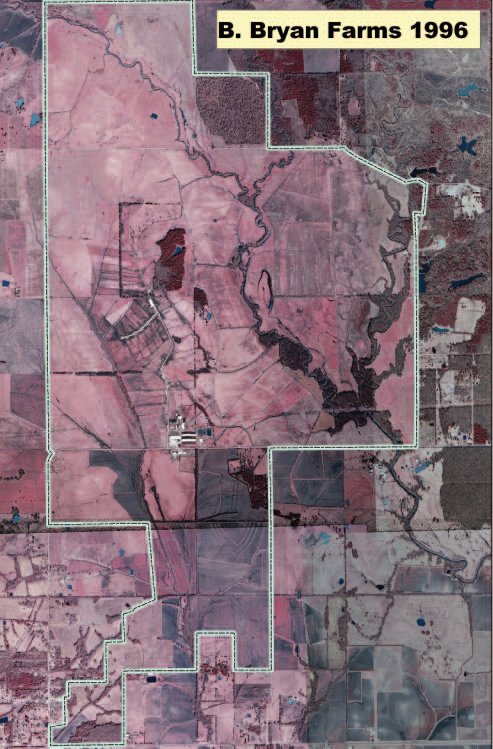
Jimmy Bryan has been operating his 5,200-acre B. Bryan Farms, Inc. (BBF) in northeast Mississippi for more than 45 years. A successful cattle and rowcrop operation located in the Black Prairie Physiographic region of Clay County, the farm is diversified with a profitable cattle operation (cows/calves, stockers, and a conditioning facility) and corn and soybean production. The rowcrop fields are situated in the floodplain of Town Creek and Hanging Kettle Creeks, which converge near the southern boundary of BBF.
Mr. Bryan fondly recalls bird hunting as a boy along the many miles of Osage orange hedgerows that criss-crossed this family farm, but until recently, it had been several decades since he had seen a covey rise over his bird dogs. As the farming operation grew in size and efficiency, his business boomed, but bobwhite populations plummeted. Nine years ago, Jimmy decided it was time to do something to restore the quail hunting that he enjoyed as a young man. Additionally, he developed a new appreciation for the magnitude of soil erosion created by the cattle and cropping and its effects on water quality in Town Creek. He started looking for ways to integrate conservation into his farming operation. “What I’m trying to accomplish here,” he states, ” is to go back to what I remember as the best days on this farm. My goal is to bring it back to that, [to] try to make it as productive as I can, along with having all the recreation and entertainment that I can have, and to pass this on, not only to my children, but to my grandchildren, and whoever might come down the line.” (See sidebar for information on how to order a copy of the DVD in which Mr. Bryan and other producers describe how they have integrated conservation practices within working farms).
Historically, wildlife habitat and populations in agricultural settings were a by-product of farming practices. In contrast, in today’s highly-mechanized farm landscapes, creation of wildlife habitat must be intentional. But this often means that producers have to decide between the personal cost of lost commodity production and the more elusive societal and personal benefits of “conservation.” But the tradeoff is not necessarily “acre per acre” or “dollar per dollar.” Farmers are aware that portions of their farm are not as productive as others. For example, poorly drained areas, field margins, and highly erodible lands are often lower yielding and can be net-negative profit regions (costs more to plant than returns in yield). Enrolling these areas in a conservation practice with financial incentives can actually increase net profitability. Producers also recognize that continued soil loss through erosion is not a good long-term strategy and everyone benefits from clean water.
Fortunately, a suite of federal farm programs are available to help landowners convert these low-profit or high-erosion areas into wildlife habitat while still maintaining successful commodity production. A new planning product from the NRCS Wildlife Habitat Management Institute called “Creating Early Successional Wildlife Habitat Through Federal Farm Programs” (http://www.whmi.nrcs.usda.gov/technical/fieldborder.html) assists landowners in applying a systematic planning process for defining management practices to meet specific wildlife conservation objectives and identifying the government conservation programs under which these practices can be implemented. It also contains descriptions of cost shares and incentive payments associated with the various programs. In this document, the planning process is illustrated with 3 real-world case studies. One of the featured case studies is B. Bryan Farms in Clay County, MS. The Bryan Farm case study is expanded upon in this article to illustrate how one landowner integrated conservation practices across his working farm
The Problem
B. Bryan Farms had several resource concerns common to many agricultural systems.
The Osage orange hedgerows Jimmy remembered hunting during his boyhood had been removed to increase farming and grazing efficiency; those that remained were trampled by cattle, which diminished their effectiveness as wildlife cover and streamside stabilizers. The prairie grasses native to this part of Mississippi had been replaced with sod-forming, exotic, forage grasses (fescue and Bermuda), thereby eliminating nesting habitat for bobwhite and grassland songbirds. Heavy grazing of sloping pastures left little residual cover, and run-off during rainfall events created substantial head-cutting erosion and stream bank destabilization. Annual plant communities – what farmers call “weeds” and quail use as brood-rearing habitat— had been eliminated from rowcrops, field edges and pastures. “Hard” edges, rather than “softer” transition zones, stood between rowcrops or pastures and woodlots. The net effect of all these situations was the loss of nesting, brood-rearing and winter cover for quail and other wildlife species and the degradation of riparian habitat and water quality.
As the quote at the beginning of this article demonstrates, Jimmy Bryan’s goal for BBF is to run a profitable, diversified cattle and rowcrop operation in the context of a land ethic based on environmental stewardship. Working with resource professionals (including the local NRCS office and Mississippi State University), he identified a suite of conservation practices that would minimally impact his production systems, but provide substantial returns on soil, water, and wildlife conservation. His specific management objectives were to control erosion in pastures and croplands, improve bank stability and water quality in Town Creek, and restore bobwhite populations to huntable levels. A comprehensive soil and wildlife conservation plan was developed, one that used a combination of federal conservation programs (primarily buffer practices available in the Continuous CRP) and voluntary practices to accomplish his conservation objectives.
The Solution
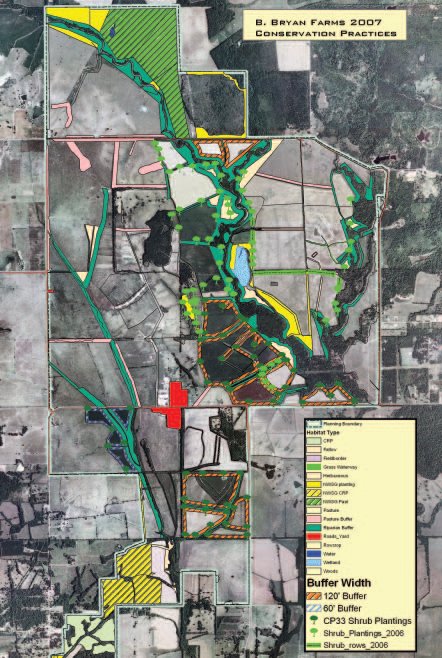
With the availability of Continuous CRP (Conservation Reserve Program), the implementation of conservation buffer practices began in 1998 on Bryan Farms. Conservation buffers can reduce soil erosion, enhance water quality, provide escape cover for bobwhite, and forage and breeding habitat for deer. Forested Riparian Buffers (CP22) are a specific type of conservation buffer designed to restore shrubs and trees in streamside zones. Riparian areas in both croplands and pastures are eligible for the CP22 Forested Riparian Buffer practice and Jimmy implemented this practice across his entire operation. In pastures, cattle were fenced out of 100- or 150- ft-wide zones along streamsides, and a mixture of 5 oak species were planted. To improve seedling survival and enhance habitat for bobwhite, fescue was eradicated prior to seedling planting using 1.5 qt of Glyphosate/ac. Cost-share assistance was provided through the CRP to offset 90 % of the establishment expenses. Signup incentives and annual rental payments offset opportunity costs of taking this land out of production. In 2000, BBF enrolled an additional 35 acres in 180-ft-wide riparian buffers under CP22. However, when he established these fences he left an additional 20 – 30′ between the fence and the buffer. The extra width inside the exclusion fence was to allow for maintenance of an annual herbaceous community or food planting adjacent to the riparian buffer. Although no incentive payment or cost-share was associated with this 20 feet, Mr. Bryan voluntarily added it to the conservation practice to provide flexibility in bobwhite management. Today, 358 acres are protected in riparian buffers.
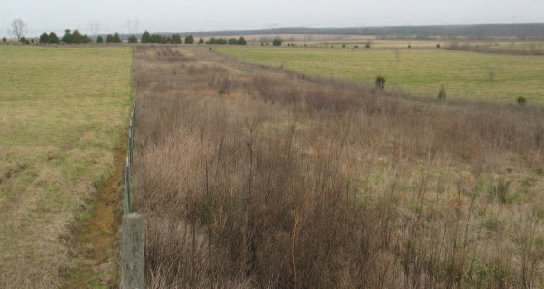
Patches of wildlife habitat in an agricultural landscape historically would have been connected through corridors of additional cover, such as fencerows or fallow field borders. Recreation of these corridors across BBF upland pasture was not a program option in CP22. However, in Mississippi the Wildlife Habitat Incentive Program (WHIP) and Environmental Quality Incentive Program (EQIP) had wildlife corridor practices that were applicable, allowing Mr. Bryan to create a total of 100 acres of 30- to 100-ft-wide fenced pasture buffers (Photo 1). These strips were planted to a variety of cover types, including mixed upland oaks and lespedeza/partridge pea, Chickasaw plum shrub plantings, native warm-season grasses and food plots (Photo 2). Prior to planting of these corridors in 2001, fescue was eradicated in the buffer areas with 1.5 qts of Roundup®./ac. Today these pasture buffers are providing soil conservation, improved water quality, bobwhite nesting and brood-rearing cover, winter covey headquarters and grassland songbird habitat.
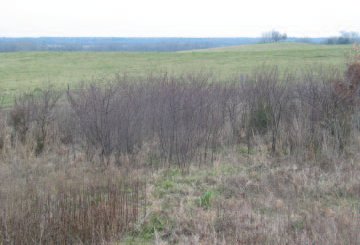
In addition to riparian buffers and WHIP/EQIP corridors, Mr. Bryan also installed 32 acres of voluntary buffers with no incentive or cost-share payments. Several miles of fence needed replacing, but rather than removing the old fence, the location of the new fence was moved 30 – 60 feet into the pasture to create a boundary corridor. Within this fenced region, 3 rows of mixed upland oaks or plum thickets and 20’of kobe lespedeza were planted.
In 2004, 194 acres of upland habitat buffers (CP33) (Photo 3) were established around agricultural field margins. Habitat buffers 60- to 120-ft were planted to native warm-season grasses (Indian grass, big bluestem, little bluestem) and wildflowers (partridge pea, wild sunflower, and black-eyed Susan). These borders are allowed to succeed naturally, but are maintained in an herbaceous community with periodic disking on a 3-year rotation. The specific objective of this practice was to add brood-rearing and nesting habitat to the rowcrop landscape and to further enhance connectivity between cover types.
To further enhance loafing and winter cover for bobwhite, in 2004 and 2005, Jimmy established 120 chickasaw plum shrub plantings. Each planting was a 36’x 36′ clump of plums planted on 3′ centers. Within 4-5 years these plantings will develop into thickets that will provide loafing cover for broods during the summer and secure covey headquarters during winter.
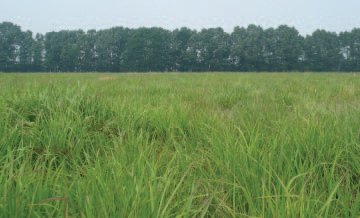
Additional nesting and brood-rearing habitat for quail and songbirds was created by converting 232 acres of fescue pasture to native warm-season grass pasture (Photo 4). Substantial conversion costs (~ $140/ac) were offset with cost-share assistance through the US Fish and Wildlife Service’s (USFWS) and Wildlife Mississippi Partners Program and EQIP. A regime of herbicide, prescribed burning and planting was used to eliminate fescue and establish native warm-season grasses. Mr. Bryan began rotationally grazing this native grass pasture in 2006. Despite an exceptionally dry growing season, the cattle pastured on these drought-tolerant grasses still achieved acceptable daily weight gains. Research conducted through Mississippi State University is currently underway to determine the specific benefits to cattle grazed during summer months on these native grasses as compared to those on non-native cool-season grass (fescue)(Photo 1).

Although his management focus is on creating year-round habitat, Mr. Bryan also plants several miles of grain food plots. He uses conventional tillage coupled with Roundup Ready, soybeans in areas that he wants to kill fescue. After 2 seasons of cropping, the fescue is eliminated and the site is prepared for native grass establishment or shrub planting. Alongside his riparian buffers and shrub corridors he plants strips of milo to provide winter food. He rotates the locations of food plots to create fallow annual weed patches that provide brood habitat. Throughout his CP33 buffers, along field margins, and in odd areas he has liberally sown partridge pea. Periodic disking or prescribed fire will perpetuate these plantings forever.
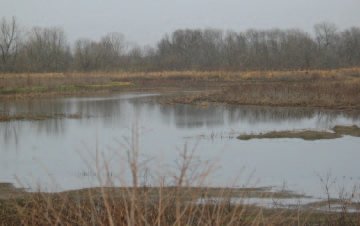
Although he does not duck hunt, Mr. Bryan enjoys seeing migrating waterfowl and wading birds using his property. To provide these species with dependable habitat and his grandson with a place to duck hunt, Jimmy constructed a 20-acre wetland (Photo 5) in a low, occasionally flooded portion of his property along Town Creek. Cost-share and technical assistance available through the USFWS/Wildlife Mississippi Partners Program and WHIP allowed him to enhance local water quality and provide migration habitat for waterfowl and shorebirds.
The Results
Jimmy Bryan has made a substantial investment in conservation. This has occurred over time as his priorities have evolved from maximizing economic profits to developing a sustainable, diversified agricultural operation that demonstrates excellent stewardship of natural resources. In implementing an enterprise-wide conservation program, BBF has used a combination of federal farm programs and voluntary practices to simultaneously control erosion, improve water quality, and enhance wildlife habitat. With the implementation of each successive management practice, wildlife benefits grew as habitat increased in quantity and quality and became more interconnected.
Before initiating his various conservation practices, BBF consisted of 58% fescue pasture/hayfields, 25% crop fields, 15% woodlands and 2% development. Today, BBF is composed of approximately 38% pasture/hayfields, 21% rowcrop, 15% woodlands, 24% conservation practice, and 2% development. Erosion has been reduced substantially and, as a result, water quality in Town Creek, Hanging Kettle Creek, and downstream water bodies has improved. Bird surveys along field margins demonstrated 6-9 times greater abundance of wintering sparrows on fields with conservation borders. During the breeding season, grassland/shrub bird species, including bobwhite, common yellow-throat, indigo bunting, and dickcissel, were more abundant on bordered edges than conventional crop-field margins. During September, hundreds of blue- and green-winged teal settle on his managed wetland. In December and January, mallards, pintails, and other big-ducks regularly loaf on the wetland, feeding on the resources he carefully cultivates. Woodducks are year-round residents, nesting in the boxes Jimmy erected.
Although it is still early in the management program, bobwhite populations are also responding. When he first began to implement conservation practices his property had only 5-7 wild coveys. A survey conducted by Mississippi State this past fall documented 40 coveys. Granted, this is still not a high density bobwhite population, and Jimmy is not yet satisfied, but it is not bad for a working farm. Mr. Bryan is optimistic. Last year he bought 2 new bird dogs. The past couple of seasons, his dogs have consistently found birds, as many as 7 coveys on one morning. But he thinks he can do even better. This year he ratcheted up his management even further, establishing an additional 171 acres of NWSG, 9500 ft of additional shrub corridors, 2900 ft of bicolor plots, and 129 acres of summer grain foodplots. Mr. Bryan is sold on wildlife conservation and he has found federal farm bill programs a valuable tool in helping him to accomplish his stewardship objectives. He calls this “a win-win” situation. “We get fair compensation in establishing [the program], we get erosion control, we get habitat for birds, and we’re building what we want for the future to pass on to our children and grandchildren.” B. Bryan farms clearly demonstrate that wildlife management can be successfully integrated with cattle and rowcrop production on a modern working farm.
The lack of idle native grass and weedy habitats limit bobwhite populations in agricultural landscapes. In late 2004, USDA Farm Service Agency’s (FSA) launched their Northern Bobwhite Quail Habitat Initiative aimed at creating 250,000 acres of native grass buffers along agricultural field borders in 35 states. Under the Continuous CRP, financial incentives are available to producers for creating Habitat Buffers for Upland Birds (CP33) on cropland. Eligible producers will receive annual rental payments for the length of the contract (10 years), plus bonus incentives and cover establishment and maintenance cost-shares. Besides benefiting bobwhite quail and farm economics, these buffers will also benefit other birds, mammals, reptiles, amphibians, and aquatic species. Additional environmental benefits include reduced soil erosion from wind and water, increased soil and water quality, and improvement of the overall on-farm ecosystem. Program sign-up is underway at local FSA offices and eligible land may be enrolled at any time until a state’s allotted buffer acres have all been enrolled or December 31, 2007. Producers interested in CP33 should contact their local FSA office for more information. Mississippi State University, along with number of cooperators, recently developed a DVD to promote the CP33 practice. The DVD was developed for agricultural producers, and explains both the economics and wildlife benefits of the CP33 practice. A brochure was also developed to assist national promotion of the practice. Both the DVD and brochure are effective tools that can be used by natural resource agencies, conservation groups, and others to promote the CP33 practice to producers. Anyone interested in obtaining a copy of the DVD or brochure should contact Wes Burger at Mississippi State University, Department of Wildlife and Fisheries, Mississippi State, MS 39762-9690; phone: 662-325-8782; email wburger@cfr.msstate.edu. Single copies are free, and larger orders can be purchased for a nominal cost. Don’t miss out on this opportunity to promote quail habitat practices in your area!