
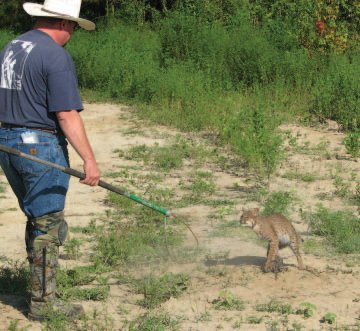
The name bobcat (Lynx rufus) is an abbreviation for bob-tailed cat, referring to the animal’s short tail with its dark rings. The first part of the scientific name, Lynx, is a Greek word given to lynx-like cats; it comes from two Greek roots meaning, “in lamp” and “to see”, and may refer to the bright eyes of the animal as seen in reflected light. The second part, rufus, is the Latin word for “reddish,” describing the general body color. The common name refers to the short or bobbed tail. Other vernacular names include bay lynx, barred bobcat, pallid bobcat, catamount, lynx cat, wildcat, loup-cervier (French), lynx roux (French), pichou (French Canadian), chat sauvage (French), gato monte (Spanish), and red lynx.
In the wild, bobcats may live to 10 or 12 years of age and in captivity up to 25 or more years. Adult bobcats usually weigh 20 – 30 pounds but have been known to exceed 40 pounds. Bobcats have a very strong odor, and their dens also develop this characteristic smell. The secretion from anal glands may be used along with urine as a scent marker. Marked fluctuations, related to their food supply, often occur in bobcat populations. They are very capable of swimming and readily cross streams and small rivers.
Home range size of bobcats increases as food abundance decreases. Adult male bobcats have an annual home range of approximately 18 to 28 square miles, depending on locale. They are more active and move more in winter and spring than summer and fall with the most restrictive range occurring during the hot months of July and August. Transient males have considerable larger home ranges and may make extensive movements of up to 40 miles. Females have a home range of 5 to 12 square miles from January to March. In spring and summer they live in a more restricted area because they are caring for kittens.
Unlike coyotes, there is little social interaction between individual adult bobcats. Depositing of fecal matter and urine is used to establish boundaries of their home range. These scents serve to prevent encounters of resident individual bobcats and to notify transients that a range is occupied. Within these home ranges, some individuals travel between 3 and 7 miles a night and often move distances of 2 to 7 miles between resting places. Their greatest movement occurs when food is scarce or, for males, during the mating season.

Even though bobcats are seldom seen by people, they are both nocturnal and diurnal with most hunting occurring around sunrise and sunset. Bobcats can and will kill animals as large as adult whitetail deer by biting the throat at the esophagus or jugular vein, eventually suffocating the animal. Whitetail fawns are a preferred prey and are often preyed upon by bobcats. Bobcats gorge themselves when food is plentiful, and may not feed again for several days. They waste considerable meat and may kill more than they eat.
The breeding season of the bobcat varies with latitude, longitude, altitude, and climatic variations. However, breeding season normally begins in December and may extend into June with usually a peak in March. After a 50 to 70 day gestation period, 2 or 3 (with extremes of 1 and 5) young are born. Litter size is normally higher for adult females than for yearlings. Most litters arrive from mid-May to mid-June, but some are born as late as September or October. Weaning of the kittens occurs around 2 months of age, but the young stay with the female until fall or even later. Females mate when 1 or 2 years old, but males do not breed until approximately 2 years of age. Bobcat kittens are born blind and remain so for approximately 3 – 11 days. The kittens are raised by the female. The adult male bobcat provides no parental care.
Young bobcats start accompanying the female when 3-months old. At 6-months of age, bobcats will travel alone, but always close to the den. Early bred female bobcats may have a second litter late in the year. Young bobcats disperse before the next litter is born.
The following parasites are known to occur on or in bobcats: fleas, mites, lice, ticks, roundworms, flukes, tapeworms, spiny-headed worms, and protozoa. The known diseases that bobcats contract are distemper and rabies. The bobcat is also the known host of a fatal disease (Cytauxzoonasis) of domestic cats.
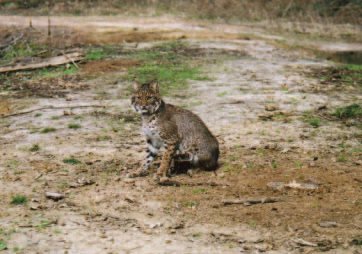
Coyotes can be detrimental to wildlife populations, especially whitetail deer. However, bobcats are grossly underestimated in their capabilities as predators. One wildlife research project in South Carolina reflected where one adult male bobcat had killed eight (8) adult white-tailed deer prior to its neck-attached radio transmitter ceasing to properly function.
Wildlife managers should recognize the importance of having a well-rounded wildlife management plan. Predator populations (i.e. bobcat) have to be controlled and maintained in order for prey populations (i.e. deer, turkey, quail, rabbit, etc.) to stay healthy and viable. If one aspect of a wildlife management plan does not exist; the entire goal of the plan will suffer negative affects.
Wildlife game/prey species are most vulnerable to predation during the spring and summer months. This is because the young are born in early to late spring and are less able to provide defenses for themselves at such a young age. As earlier stated, bobcat kittens are weaned from their mother’s milk at approximately 2-months post birth. This means that they will immediately need red meat in their diets. In addition to teaching their kittens how to hunt on their own, the female bobcats will also provide meat for their young.
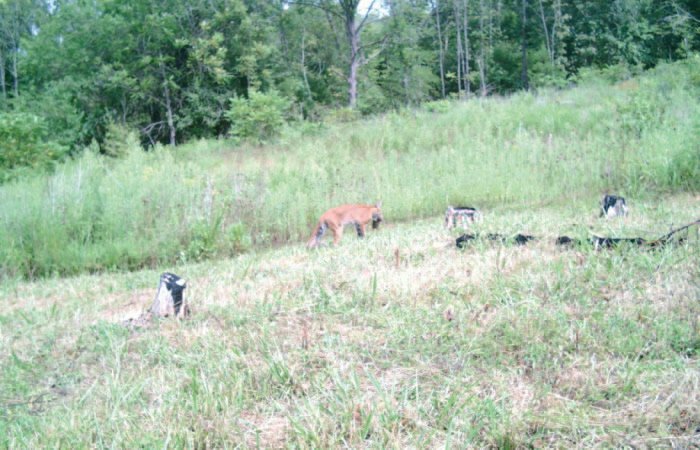
Bobcats are mostly solitary and hunt with stealth-like precision. They are visual predators, typically approaching prey in utter silence, pouncing upon them in a burst of speed, and killing swiftly by applying a crushing bite directly to the head and neck. With retractable claws on their hands and feet, bobcats can latch on to the shoulders of large prey and steady themselves for the accurate, killing bite. Excellent hearing, and the ability to climb, adds to their hunting efficiency.
Bobcats tend to live their lives in and around natural cover. Bobcats prefer grassy and brushy areas, while mature stands of pine and oak are avoided. They inhabit a variety of environments, including subtropical swamps in the southeast, arid areas in the northwest and temperate forests in the north. Habitat preferences throughout the year strongly reflect prey abundance. In winter, habitat selection is greatly influenced by snow conditions, and bobcats prefer low elevations, south-southwest facing slopes, rocky terrain, and open areas.
During my predator control work, I find that almost every wildlife manager is amazed at the actual population of bobcats on their property. As stated, bobcats live their entire lives in and around natural cover. Therefore, they are not often seen by humans, such as coyotes and red fox, which are most comfortable with open-type terrain. It is my experience and professional opinion that bobcat populations have dramatically increased in most areas since the 1980s.
I find that a lot of trappers think that bobcats do not have a good sense of smell. However, my experience has taught me that bobcats actually do smell very well. When conducting professional trapping instructions, I always instruct my students to place their sets as close to the bobcat’s normal travel route as possible. This is not because I think bobcats cannot smell well; it is because bobcats travel in a lackadaisical fashion while mostly utilizing their sense of sight and hearing. Once they have located a point of interest (i.e. prey, lure, etc.), they tune in to their sense of smell upon approach.
As most any seasoned trapper will tell you, one has to think like a bobcat in order to become proficient at catching them. It has been many years since I caught my first bobcat and I have grown to respect this animal as being one of the most effective and prolific predators that exist in North America.