
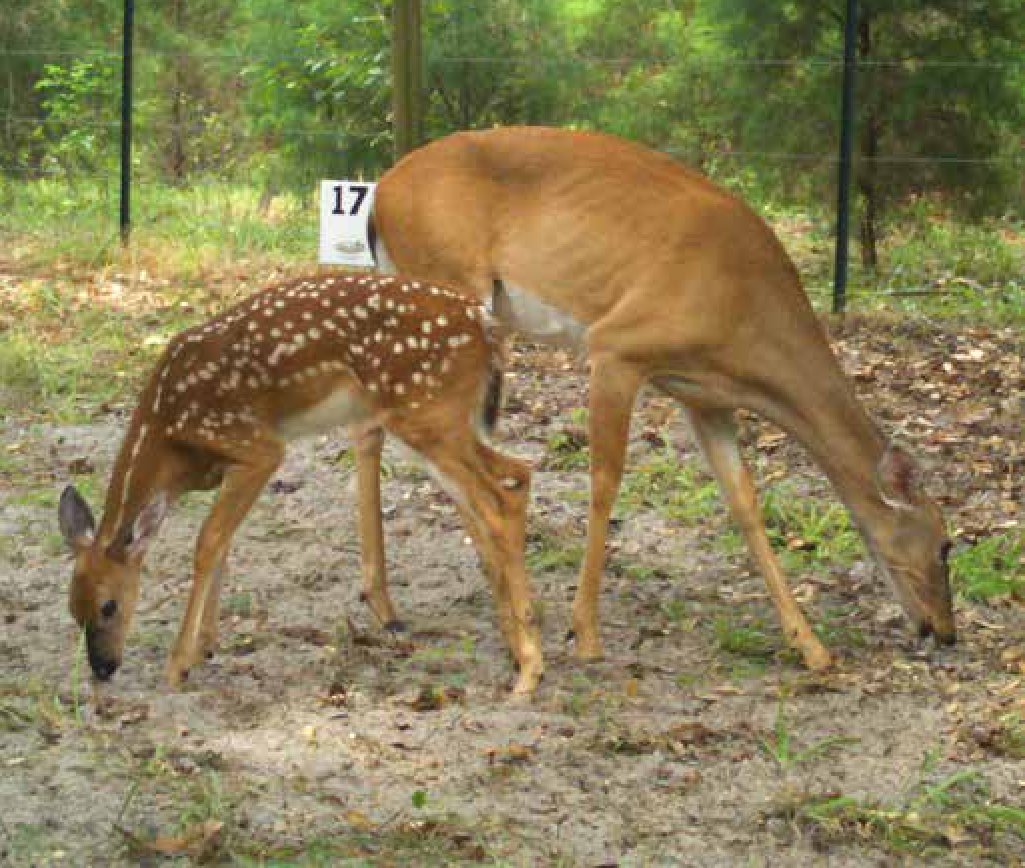
Collect fetal data from harvested does
If breeding season or rut occurs in your deer herd before or around Thanksgiving, and your hunting season extends into late December or January, you should be able to collect and measure fetuses in does harvested later in the season. Similar to human fetuses, the age of deer fetuses is determined by their length. Commercially produced fetus scales are essentially rulers that can be used to measure and ultimately determine age of the fetuses. White-tailed deer fetal scales can be obtained from the Quality Deer Management Association. Knowing the date of harvest along with the age of the fetus allows you to determine the day of conception. With an adequate sample size of fetal data, this information can provide much insight to your deer herd’s reproductive performance as well as the length and peak of the rut in your deer herd. This not only helps you determine when to put in for vacation next year (during the rut), but the length of the breeding season will shed light on the adult sex ratio of the herd. A tighter sex ratio will result in a shorter more intense rut due to increased competition for mates, while an unbalanced sex ratio will likely be represented by a long, weak rut due to less competition and length of time it takes bucks to “service” the abundant doe population. This information, along with hunter observation data, is a great and free way to help assess the status and success of your deer management program.
Strip disk areas to promote beneficial natural habitat for wildlife
Strip disking is simply one of the easiest, cheapest, and most effective management practices to implement to create high quality food and cover for wildlife. Strip disking is as simple as it sounds. To strip disk, you merely drop the disk far enough into the soil to lightly break the surface of the ground. Lightly disking the ground will provide enough disturbance to stimulate the natural seed bank of wildlife friendly weeds the following spring and summer. Heavy disking like you were preparing a clean seedbed for planting a food plot is not needed. One pass is generally enough to stir the ground up and expose bare soils that will promote germination of desirable weeds. While not necessary, I often mow areas I plan to strip disk ahead of time. This makes disking more effective if vegetation is relatively thick or tall. It also knocks back/reduces competition of the undesirable or overgrown plants I am trying to replace. Strip disking at different times of the year will result in different plant communities. While disking can be conducted any time of year, it is normally done in spring or fall. Fall/winter disking normally results in a broadleaf plant response, while spring/summer disking promotes native grasses. Alternating the season in which you strip disk will add diversity to your property. Strip disking can be done in thinned pine plantations, relatively open mature pine stands, along the edges of food plots, or in open fields. Basically anywhere sunlight can reach the ground will work. To optimize the benefit of strip disking, avoid disking straight lines. A serpentine pattern that winds through the habitat will provide the most edge and diversity.
Create a wind map for deer stands to assist in making good stand choices next year.
A deer’s nose is its best defense. Through my career as a wildlife biologist I have been fortunate to have worked and hunted with many “lucky” hunters – those that seem to cross paths with the biggest bucks on the property year in and year out. These are the guys you see in magazines standing under a barn wall full of mounted bucks. Generally speaking, I am not one that believes in “luck”. To me, luck is where preparation and opportunity meet. All of these hunters did their homework to understand how and why deer (particularly the mature bucks they were hunting) used the property and set up stands accordingly. They all seem to have different thoughts on where and when to hunt the stands. However, the single common strategy used among ALL of these hunters was they closely monitored wind and only hunted stands under favorable winds. That is, they only hunt areas when the wind is right – carrying their scent away from where they expected deer to come from. Although I often wear ScentLok and spray myself with odor neutralizers before heading to a stand, I am a firm believer that if a deer gets downwind, it is over (at lease in most cases). On properties that have hills or draws wind will behave differently across the property. As wind hits ridges or tree lines it is diverted and results in the wind changing directions at given points on the property. You may be surprised that a true north wind can generate a south wind in some locations on a property. Something else that will cause “odd” winds is large bodies of water such as a lake or river. In the morning, cool air in the woods is often drawn out to the warmer water area creating different wind currents than the true wind reported. The opposite can occur in the evening. These situations often occur under light wind conditions. To create a wind map, simply record the true wind (wind direction without interference – wind the weatherman reports), then visit various spots on the property where deer stands are located and record the actual wind at these spots. Many hunters collect and record wind information over time, like while they are hunting, then compile what they have collected to create a wind map. Once generated, a wind map is a valuable tool that will help you select which stand to sit, resulting in more successful hunts. Obviously, you still need to be in the right place at the right time. But these “lucky” moments happen more often when you have prepared and selected a stand where your scent is not a factor.
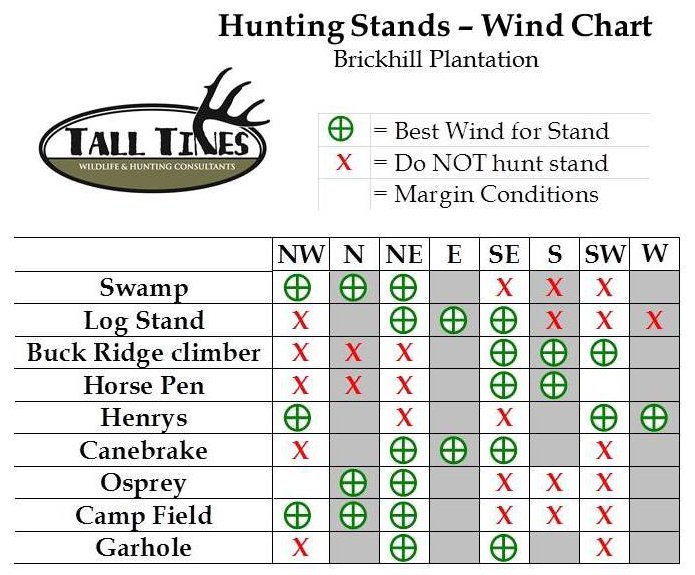
Hunting Stands – Wind Chart
Brickhill Plantation
Legend:
⊕ = Best Wind for Stand
X = Do NOT hunt stand
(blank/gray) = Margin Conditions
Scout now to improve hunting for next duck season
Doing a little homework this season, even if it means missing a hunt or two, will help you have better duck hunts next year. By this I mean take time to watch and glass wetlands, moist soil impoundments, beaver ponds, lakes, and flooded fields to find new areas to hunt. While food sources and water can change from year to year, in most cases ducks will be attracted to the same areas each year. Simply stage yourself somewhere that you can see the area you are scouting without spooking ducks. In most cases, a high vantage point that offers a landscape view is best as it often allows you to see where ducks are coming from as they approach and which direction they go when they leave. Good vantage points are often hills, highways, bridges, barns, and sometimes deer stands. The point is to get as high as you can so that you can see the sky where ducks are flying. I can’t tell you how many times I have set up and scouted like this and found an even better spot by being able to see flocks from a landscape level verses getting into the actual area (tight) where I thought ducks would be. In some cases, you may not see ducks go down but notice that lots of flocks headed in a certain direction. Relocating closer to the area you saw ducks headed on the next scouting mission will often reveal a new honey hole. As you begin to pin point areas ducks are using, close in tighter and start learning exactly where ducks want to be and how they approach when coming in. If it is still duck season, this is when I like to hunt the spot a couple times. Doing so will help you identify exactly where to build a blind this summer. So by next season, you will be sipping coffee after putting out your spread of decoys while waiting on daylight and ducks to start flying.
Assess and flag or mark wildlife improvement projects such as new food plots, plot expansions, wildlife clearcuts, new roads, and roadsides that will be widened.
Because temperatures are cool (or cold) and the leaves are off trees where you can generally see better in the woods, winter is a great time to assess and mark areas where trees will be harvested or dozier work will be needed. Having the leaves off is certainly a big help because you can see what you are doing and visualize areas that you are flagging. Projects that may need to be marked or flagged include small bedding areas that will be created with chainsaws (can run the chainsaw during the winter too while it is cooler), new food plot areas or expansions on existing plots, areas along roadsides that need attention next spring, etc. Besides flagging areas that will require heavy equipment and drier conditions, winter is also a good time to flag areas that will be planted in wildlife friendly orchards, supplemental hardwoods, areas to plant hedgerows for quail through fields, etc. Marking these areas in winter will not only be more pleasant for you and allow you to see what you are doing, but will ensure you are ready to tackle these projects when conditions are right. Also, flagging in winter gives you time to think more about the areas you have flagged out before the project is implemented. The last thing you want is to be flagging just ahead of a logging crew and having to make hasty decisions on where you want a new food plot to be created.
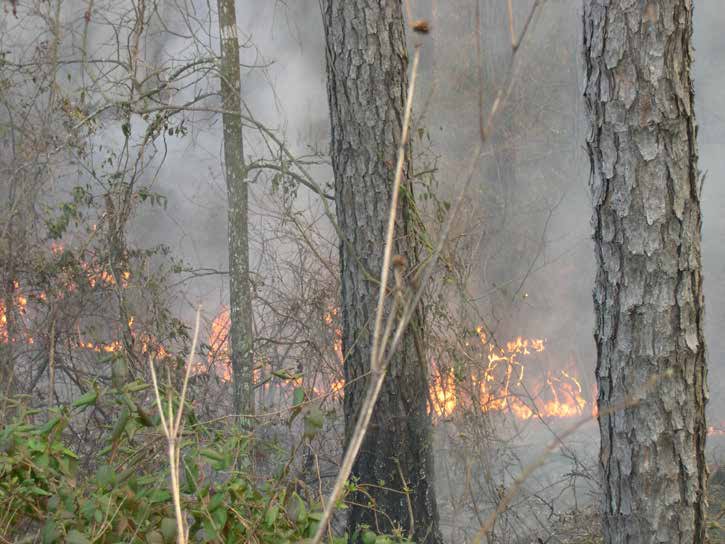
Prepare dormant season prescribed burn plans and initiate burns as weather permits.
Fire is a management strategy that is relatively cheap to implement and results in better habitat for wildlife. If you have pines on your property, fire is an essential tool to improve wildlife habitat and should be on your annual task list. However, burn plans need to be well thought out and completed well ahead of time. With the exception of longleaf pine/coastal plain areas, most understory burning in the Southeast is conducted during the winter dormant season. Acceptable relative humidity, temperature, fuel moisture, and steady, persistent winds often occur during this period. Cool season burns are generally conducted between December and spring green up. In the Deep South, try to conduct burns before March 15 to avoid destroying turkey nests. Cool season or winter burning is not only a good way to reduce fuel loads and control undesirable hardwoods in a pine stand (which reduces the chances of a wildfire that can be detrimental), but is also a great way to stimulate new understory plant growth which will result in quality food sources for wildlife. Fire rotations (interval of time between burning the same area again) vary depending on your goals and habitat types but are generally every 2-5 years to promote quality wildlife habitat. It is also a good idea to strategically plan your burns so that you always leave some areas unburned. How much area to burn will depend on your specific property and habitats. However, do not feel that you have to burn large areas (50-100 acres or more) to make a difference and create quality wildlife habitat. Relatively small burn areas in the 5-10 acre range are easily done in a couple hours and will make a difference. Always check local burning laws and consult with an experienced burn manager before lighting a woodland fire. The U.S. Forest Service or your state forestry commission are great sources for obtaining more information regarding burning in your area. Check with the US Forest Service for information regarding prescribed burning as well as examples of a burn plan. It is also a good idea to coordinate your burns with a professional land manager that has experience burning.
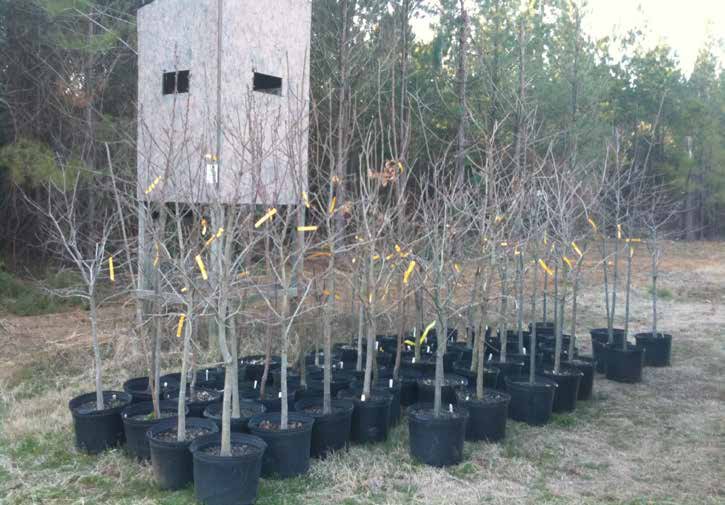
Tree planting activities – start planning, ordering supplies, and planting
Strategically adding beneficial trees to your property adds habitat diversity, wildlife value, aesthetics, and can be a very gratifying project – especially once the trees mature and you see the value they provide. However, planting trees is more than just randomly plopping trees in the ground. For the best results plantings should be well thought out with the future in mind. Besides the obvious “where” to plant trees, you need to consider which species are suitable and do well in your soils/climate, how large they get, and future maintenance needs. Once trees are planted, they will require a bit of care to ensure good survival and growth during their first couple growing seasons. Site preparation is important to reduce competing weeds to enhance tree seedling survival during the first growing season. Depending on the situation, an initial mowing may be needed to provide a clean working area and reduce weed competition. There are many species and varieties of soft (e.g., fruit trees) and hard mast (e.g., oaks) trees available that will benefit wildlife on your property. I generally like to plant a diversity of trees that will provide various food sources throughout the year. Supplemental tree plantings not only provide additional food resources for wildlife on your property but can provide exceptional enhancements to the aesthetics. Common areas to add supplemental tree plantings include road intersections, roadside management areas, old field habitats, and in or along the edge of fields or food plots. The key is to plant them in areas that will receive sunlight. Some trees require cross-pollination to produce fruit so, if needed, be sure to plant them in small groups. I recommend contacting your tree supplier/nursery, such as the folks at The Wildlife Group, well ahead of planting time. They can help you determine which trees will grow and produce best on your property, help you develop a planting plan based on your goals, and ensure the trees and other supplies are ready when you are.
Provide supplemental feed for deer
Even in the South, late winter can be a nutritionally stressful period for deer. They have endured the rigors of breeding season and natural food sources can be limited. Providing supplemental feed during this time can boost energy and nutrition. This recommendation/activity is directed towards landowners or managers that have done a good job managing their natural habitat, food plots, and deer herd conditions. That is, before thinking about starting a supplemental feeding program for deer on your property, you need to take care of the “important” things first. In other words, you cannot hang shutters if you do not have a house – and you will not grow big bucks and a healthy herd with supplemental feed alone. It is a supplement to other management strategies and activities. However, when done in combination with other core management practices, supplemental feeding can be valuable for deer. Be sure to check your local game laws before providing feed on your property. Many states do not allow the use of feed during hunting season. Ideally, providing supplemental feed throughout the year is best, but supplemental feed will be most used and most valuable for deer in late winter and summer. These are periods when natural food availability is at its lowest. So if you have a limited budget and cannot or do not want to feed throughout the year, provide it during the periods deer need it most.
