

Most landowners with lakes want a quality fishery, and most of those are targeting quality or trophy largemouth bass. But there are a few single lake owners and several multiple lake owners that can afford to designate a second, or more, lakes to other species that interest them, usually for food, sometimes for sport and possibly for both. Today, more lake owners want to grow quality bream (bluegill, redear, pumpkin seed and even warmouth) than channel catfish. This trend away from channel catfish has been gradual over the past several decades, but lake owners ordering channel catfish are much less now than years past.
The bluegill is one of the most common pond fish in the country and are native to the eastern half of the United Sates. However, they have been stocked and relocated to waterbodies throughout the country.
Your waterbody objectives will dictate how you stock and manage your bluegill. For new waterbodies, designated as panfish or bluegill lakes, stocking rates are about 500 per acre depending on the size fish stocked. The larger the fish, the more expensive. However, with no predators present you will have a high survival rate even if fingerlings are stocked. The initial stocking can be any size fish your budget allows, or mix the sizes so some will reach breeding and harvestable size sooner, while others grow into those size range. They will reproduce and growth rates will be determined by how much habitat and supplemental food is available.
With no predators, it may become overpopulated with stunted bluegill and lots of mid-size individuals if not enough are being harvested and/or if the supplemental food supply is insufficient. If you have bass present, but want a quality bluegill fishery, not harvesting small bass is recommended. Let them become stunted so there are fewer that consume larger bluegill. If you do catch a bass over 14 inches, remove it from the population.
There is nothing more enjoyable than catching large bluegill on ultralight tackle or fly rod. Small flies, similar to common area insect species, small beetle spins, small hook with split shot on bottom or suspended by float with worm or even a small piece of hotdog. For kids or novice anglers, a piece of softened fish feed on a small hook suspended or on bottom works well where supplemental fish feed is used. But the go to bait for bluegill are crickets. On surface, suspended or on bottom, have all produced harvestable fish throughout the year. In spring and fall, bluegill may bite any time. In summer just after daylight and just before dark. During winter, midday when waters at the surface get warmed by the sun. Small and light is the key when choosing line, bait, hook or lure. In waterbodies with high fishing pressure, they can become educated, and periodically changing angling techniques may be required.
Harvest numbers and size to harvest depends on the size and numbers of bluegill your waterbody can grow and support. In a highly productive lake with a feeding program, allowing bluegills to reach 9 or 10 inches before harvesting is advised. In colder climates or less productive areas, harvesting 7-8-inch bluegill may be necessary to reap benefits from your efforts. As you progress in the management of your lake, you will learn what the bluegill growth potential and carrying capacity is and adjust size and harvest number guidelines accordingly.
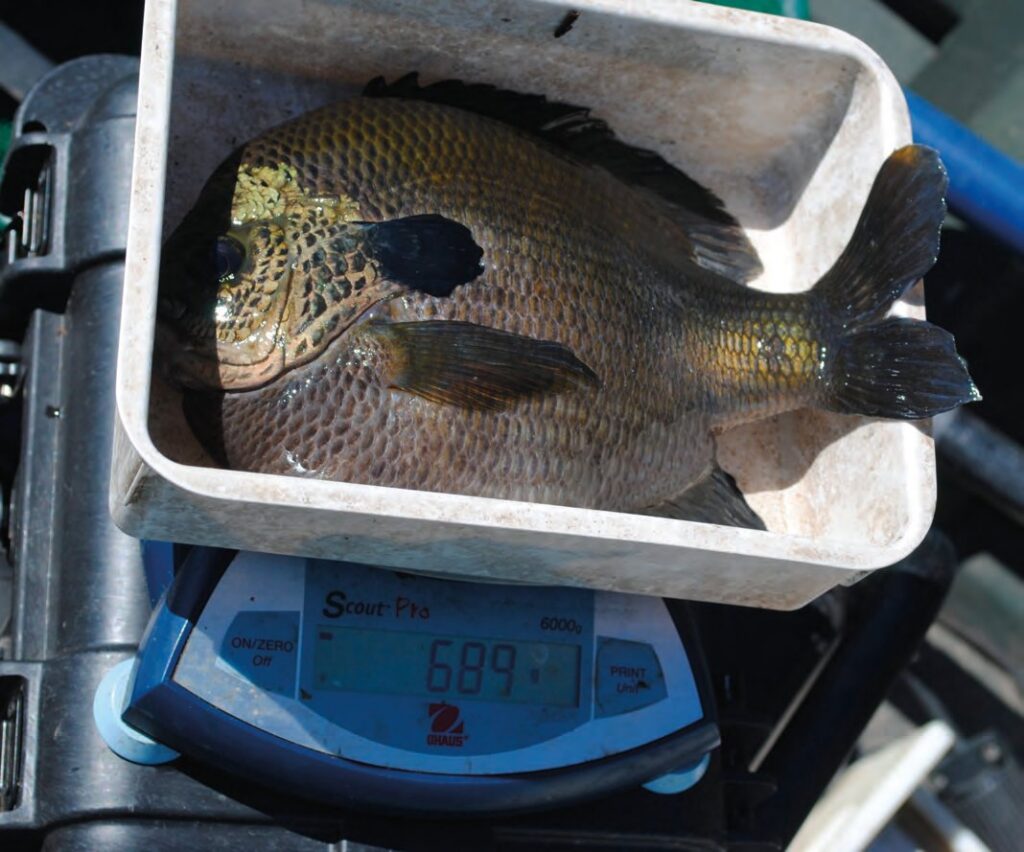
The redear sunfish, (identified by the red edge of the ear flap), is usually stocked in conjunction with bluegill. A common stocking ratio is 75% bluegill/25% redear. Their main forage is snails and small clams, hence the name “Shellcracker.” These fish rarely feed near the surface. They can reach over 12 inches and not uncommon weights around two pounds. The best bait for redear is worms, grubs and beetle spin fished deep. We only recommend stocking redear sunfish if there is a food source. Walk or ride around your pond and look for snail and clam shells in the shallows. If the pond does not have a good supply of snails and/or small clams, they will not do well. Redear sunfish will generally not consume floating fish feed, but have been documented to intake sinking feed once it has settled on the bottom.
The redbreast and pumpkinseed sunfish don’t grow as fast as the redear or multiply as often as the bluegill. These species can reach lengths of 10 inches and weigh 0.5-0.75 lbs. These species feed on insects and their larvae, grass shrimp, snails, and small fish. They traditionally like gently flowing clearer water with gravel or sandy bottom, but on occasion do appear in ponds. They create beds similar to bluegill, but prefer spawning in water temperatures around 68 degrees. They will consume fish feed. If targeting these two species, similar angling tactics for the bluegill are recommended.
The warmouth, (identified by its large mouth and 3-4 dark bars coming from the eye back and stopping at the edge of the gill plate), has a ravenous appetite and competes with small bass for food. The only way to manage these is in a bass free ecosystem. These fish prefer organic, (muck or muddy bottoms), with little or no flow. They feed similar to a bass by waiting in vegetation, around woody snags and rocks to ambush their prey. Warmouth can get to 12 inches and weigh up to two pounds, but typically reach eight inches 0.5-0.75 lbs. They like to spawn at about 71-degree water temperature and will spawn all summer. Their nests look like other panfish, but usually next to some cover such as vegetation, woody snags or stumps, as opposed to being in the open. Small minnows and beetle spins are the best baits, but also worms, grubs and tiny rattle traps work. In a traditional management strategy, this species is unwelcomed, as they do compete with small bass for food. However, we know land owners that like to catch and eat them, so if desiring to encourage their success in an old waterbody with an abundance of vegetation and/or stumps and woody snags, stocking fathead minnows and/or mosquitofish annually will help them grow.

The green sunfish, (identified by its large mouth and turquoise spots), at one time had a limited range in the United States, but is now found almost everywhere in the country. It can be found in a wide variety of waterbody types and is very adaptive. Green sunfish feed on insects and their larvae, small fish and crayfish. Due to its ability to quickly over populate, out compete more desirable panfish, desire and success rate to hybridize with other sunfishes and its small size compared to other species, it is not welcome in ponds. Unfortunately, through intentional and unintentional stockings, this species can and is causing issues in both public and private waterbodies. Green sunfish rarely exceed 10 inches in most areas. When angling for green sunfish, use similar baits as when targeting the warmouth.
The final type of sunfish that is available for pond stocking is various crosses of males and females of different species to create a hybrid, which I refer to as “genetically enhanced”. There are several out there and all claim to be better than the next. Growth rates of these original individuals after stocking are very impressive if on a properly run supplemental feeding program, but because of the hybridization, as future generations arrive, those individuals get smaller and smaller and grow slower and slower, until starting the population over may be required. Before stocking these, check your state’s regulations, as some states have created laws prohibiting the stocking of hybrid fish to protect the pure genetic strain of native species.
Many lake owners ask about improving their crappie fishery or creating one in a lake they are not currently present. In my opinion, there is no better eating freshwater fish than fried crappie. Sometimes a crappie population is easily created and/or maintained, but in other situations it’s a disaster or not recommended in the first place. Crappie require a larger waterbody and a different forage other than bream. Their forage of choice are threadfin shad, and silversides, (glass minnows). A few small pond owners questioned me for my caution regarding crappie in small ponds and said their small crappie pond has been quite successful and my response is to enjoy it because once they are there, it takes drastic measures to get them out. There are genetically altered crappie that do not multiply, so those can be stocked into small waterbodies with the appropriate forage and restocked to replenish those that have been removed. Minnows or small jigs with ultralight tackle make for some exciting fishing for both experienced and novice anglers.

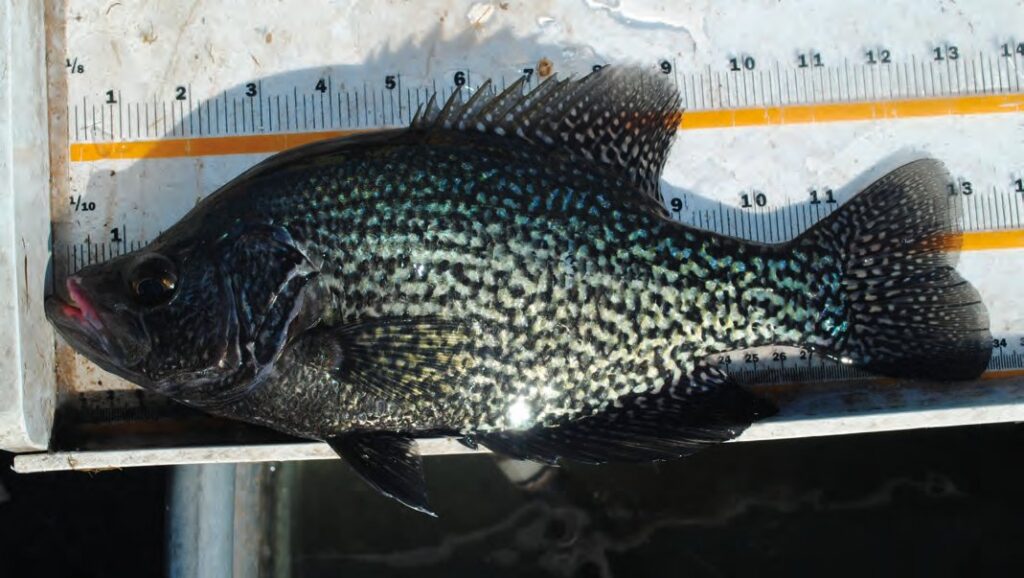
The two fish attractors that you can add to your waterbody that will help your panfish (bream and crappie) population are brush piles and gravel beds. Everyone is familiar with fish attractors using oak treetops, cedar type, (Christmas trees), trees or synthetic materials arranged in a tree-like form to create brush piles. Besides providing an area for these species to hide from predators, they create areas for the larger individuals of these species to congregate and catch. Installing areas of gravel in 3-6 feet deep water provides spawning habitat for some panfish species. These areas can be created in a new lake, or the gravel can be spread from a boat in older lakes that may not have an abundance of quality spawning habitat. We use #57 limestone gravel to create these sites and have seen bluegill spawning on them within two days of installation.

Not all panfish consume floating fish feed. Use a mix of floating and sinking, variable sized pellet feed to benefit more species and various sized fish. Set the automatic fish feeders to go off twice per day (mid-morning and mid-afternoon) when water temperatures are 55-70° F. Feed four times per day; twice in the AM and the same in the PM when water temperatures are between 70° and 85° F. During hot weather, (water temperatures between 85 and 90 degrees), feed at daylight and dark when fish are most active. In extremely hot weather, (water temperatures above 90° F), stop feeding if fish are not consuming the feed. During cold weather, (water temperature below 55° F), do not feed, or feed once per day during the afternoon, (warmest part of the day), in 4-8 feet deep water. Feed dispensed on the bottom of the deepest part of the lake in the winter or summer may not get consumed if there is insufficient Dissolved Oxygen, (DO), present. If all feed dispensed is not consumed within 15 minutes, reduce time dispensed to reduce waste. If all feed is consumed in less than ten minutes, increase feed dispensed per feeding. We recommend one feeder per five acres. Most feeding attracts fish, so feeding times throughout the day need to remain the same for long periods of time so the fish will be nearby when the feed is dispensed to ensure most is consumed and waste is reduced. Feeder locations can be points to sight and evaluate bream and catfish populations while fish are at the surface consuming floating feed. If you have a newly stocked pond, use high protein Fingerling or Grow-Out sized pellets. Various fish feeds are sold at feed stores, but use a 32% protein or higher feed. Be sure the feed is fresh and not moldy. Certain feed molds can be toxic to fish.
A less common sportfish in pond management than the largemouth bass is the hybrid striped bass. These are sometimes referred to as the hybrid striped bass or more specific the Sunshine Bass, (white bass [Morone chrysops] female crossed with a striped bass [Morone saxatilis] male or Palmetto Bass, (white bass male crossed with a striped bass female). Some other names may be Morone hybrid or “Wiper”. For decades this fish has been developed and stocked by State and Federal fish and wildlife agencies as an alternative sportfish in public waters and occasionally in private lakes and ponds. In some situations, this species may be right and desired for your situation and lake management goals.
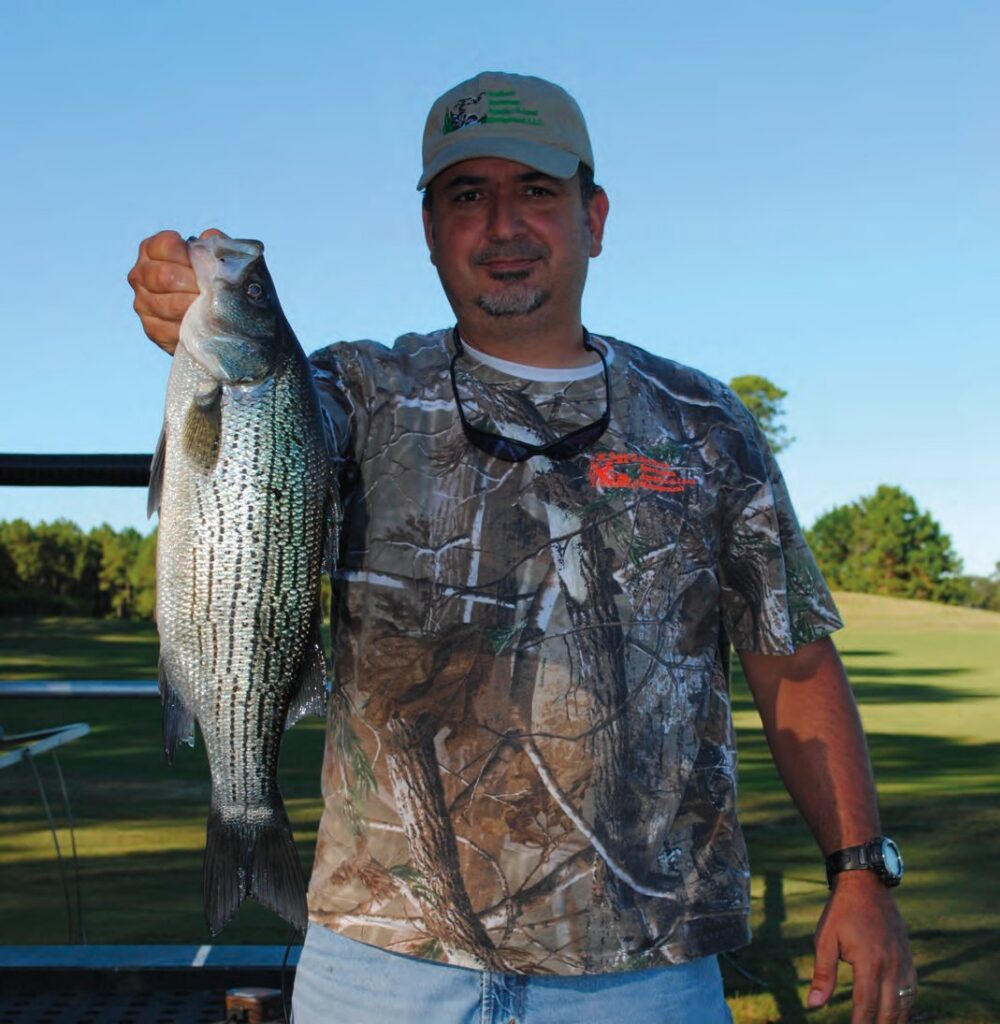
As with any sportfish, only stock hybrid striped bass where they are supported by proper forage. Trying to get these fish to adapt and target shoreline forage species such as shiners or bream does work, but does not promote the best growth rates or survival. The presence of threadfin shad and silversides is the best scenario we have found. If no other predators exist, golden shiners will add to their growth rates and size. Stocking Hybrids as opposed to largemouth bass in small ponds to regulate predator numbers is feasible. Stocking multiple years, two years apart, helps create a more natural fish population and alleviates allowing all Hybrids present from one single year class and one size. If all individuals are the same size, they will need to be replaced as they die out or are harvested. One scenario that works well for hybrid striped bass is a small one-acre pond, where controlling predator numbers is desired. Largemouth bass numbers are hard to control in small waterbodies one acre or less, where the hybrid striped bass is controlled by the numbers stocked.
Stocking rate recommendations vary from 50-100 per acre. If multiple year classes are desired so the fishery will have various year classes and sizes, staggering stockings will work. Year one stock 50 per acre, and follow-up every other year with 50 per acre. This will spread the predation out on various forage sizes and alleviate a boom/bust where all fish disappear the same year or two and you will not have to wait for individuals to grow into that quality size range, as they will already almost be there as the year class ahead diminishes through natural mortality or harvest.
The smallmouth bass, (Micropterus dolomieu), is in the Black Bass Family Centrarchidae, and it is a close relative to the largemouth bass, (Micropterus salmoides). Many say the smallmouth bass is a stronger, harder pulling, longer fighting sportfish than the largemouth and is highly sought after, only second to the largemouth bass in angling effort. Several pond and lake owners have, (some successfully and some unsuccessfully), tried to create a smallmouth bass fishery in their private lakes and ponds. It can successfully be done, but the right water temperature, water chemistry, habitat and forage need to be present before it should even be attempted.
For the greatest success, your waterbody objectives will have to be entirely addressing smallmouth bass. These fish are slow reproducing and slow growers compared to the largemouth bass and other common species. Eliminating largemouth bass from an existing waterbody or not stocking them at all in a new waterbody is mandatory. It is also recommended that waterbodies up-stream from the smallmouth pond be rid of largemouth bass so they cannot be washed in from upstream flooding or natural migration. To start an existing fishery, over use Rotenone, (fish toxicant), applied by a licensed and insured professional. Applying Rotenone at lethal levels to remove all fish present is necessary, as a partial treatment will not work for bass. You cannot hook & line or electrofish all the largemouth bass out of an existing waterbody. What little literature there is regarding smallmouth bass in ponds advises that these two species will not coexist in a pond and the largemouth will outcompete smallmouth for food and reproduction numbers.
To be successful with raising quality smallmouth bass providing quality water chemistry, habitat and forage they need is crucial for success. The presence of clean water, hard bottom, gravel, larger rocks like rip-rap and even boulders will help the smallmouth. Some habitat will benefit the fish directly, and some will benefit the forage species it needs to flourish. Smallmouth do not need flowing water, but they do prefer water with no sediment, (suspended dirt particles), but the waterbody can have a mild to medium algae bloom. Hypereutrophic, (excessive algae bloom), water is not ideal for smallmouth growth and reproduction. Good dissolved oxygen levels from top to bottom in the water column is required. This can be achieved by installing a bottom aeration system. When water temperatures approach 80° F, these fish will be seeking deeper, cooler water, and the more oxygen present deeper, the better for the fish.
Most small lakes and ponds lack the smallmouth habitat and it needs to be added. This is much easier with a dry lakebed, (either new or old lake drained), than a full lake. Boulder piles in various depths can provide hiding areas for smallmouth bass. These surfaces can also be areas where algae and small invertebrates will be for juvenile smallmouths to feed. Rip-rap along the dam will provide areas for crayfish to hide, feed and reproduce. The rip-rap will also help prevent erosion on the dam. Gravel (#57) along the shoreline in 3-6 feet deep water near cover or drop-offs will supply the smallmouth bass with bedding areas. Beside boulders found on your property, concrete rubble or pipes can also be used if available to improve habitat.
Smallmouth bass like soft finfish such as fathead minnows, golden shiners, threadfin shad, crayfish and large insect larvae for forage. They do eat bluegill, but they are only the consumable size for a short period of time before they get too large. Large bluegill can be a competitor for forage with small smallmouth bass. We have seen lakes with bluegill and smallmouth bass do well when both are present with abundant quality habitat and forage for the smallmouth and a supplemental feeding program for the bluegill. If you are lacking much of the previously mentioned habitat, stocking redear sunfish only as your panfish may be a better alternative for your particular situation if bream are desired. At minimum, stock forage fish species and crayfish the fall prior to smallmouth stocking and if possible, stock forage a year before smallmouth are stocked to allow the lake to have maximum forage available for new smallmouths. Recommended crayfish stocking rates are 50 lbs. per acre for forage. If small, smallmouth bass are stocked, it will be a while before they can utilize crayfish due to their size. Once crayfish begin reproducing, they will provide smaller forage and become beneficial to smaller smallmouth bass. For larger waterbodies, this crayfish stocking rate can be reduced to help cut costs. Fathead minnow stocking rate 1,000-2,000 per acre. Threadfin shad can be stocked at 1,000 per acre if there is a supporting algae bloom. There are few hatcheries around the country that supply smallmouth bass and locating a hatchery and reserving your smallmouth bass in the fall prior to spring stocking is advised. Stock smallmouth bass at a rate of 50-100 per acre (depending on fish size). Obviously, the larger the better for survival, they are more expensive per fish, but you would stock the lower rate, so costs may be nearly the same. Do not stock smallmouth smaller than two inches. Continually monitoring forage and restocking, when necessary, will be required to keep smallmouth numbers up and growth rates accelerated.
Harvesting these fish, (thinning the population), is not as important as with creating a quality largemouth bass fishery. Once a good smallmouth population is established, removing a few fish where the bottleneck size occurs will be necessary. This is identified by large numbers of the same size fish being caught and they are skinny.
Most freshwater anglers that want catfish, want the channel or blue catfish. Bullheads are rarely desired and it is preferred to not be introduced, as they can easily become overpopulated. The most common catfish stocked in both public and private waterbodies and raised for food fish, is the channel catfish. The channel catfish grows quickly in a pond with supplemental feeding and under most situations will not reproduce in small, manmade waterbodies. It is easy to control numbers when channel catfish are stocked in most private lakes and ponds, and occasionally need to be restocked when numbers become depleted. Historically, every lake and pond owner wanted channel catfish stocked so they had a fish to eat. They are relatively easy to grow and catch, which makes it appealing for novice and youth anglers, and lake owners. I have seen them caught on anything from artificial lures, stink bait, liver, hotdogs and live bait, (worms, nightcrawlers, minnows, crayfish, bream, golden shiners and threadfin shad). Their growth can be accelerated by supplemental feeding commercial fish feed. Routine feeding also concentrates them to increase angling success.

Hard to believe I wrote an entire article on fish management and hardly mentioned the King-of-the-Lake, the largemouth bass. As stated in the beginning, the largemouth bass is the most targeted freshwater species in the country and managing in private reservoirs, lakes and ponds, but there are situations where managing an entire waterbody for another fish species is possible and not that unusual. So, if you have a small waterbody, or multiple waterbodies, consider managing for another species that makes for great flyrod or conventional sport tackle fishing, table fair or the grandkids to fish for that’s not a largemouth bass.