

Quail and turkeys, while significantly different critters, have very similar needs for reproduction. Turkeys, quail, various grouse species, partridge, prairie chickens, etc. are all gallinaceous gamebirds and all share similar traits. All nest on the ground and incubate nests for 26-29 days and share similar behavioral traits in breeding. All the chicks hatch covered with down, are mobile, leave the nest immediately and forage on their own guided by the adult(s). Both quail and turkeys are basically similar versions of the same animal of different sizes.
While quail can build a fairly elaborate nest, turkeys “build” a nest as well. Both focus on, and do best, nesting in “shrubby” grasslands and nests are made mostly of dried grasses and pine straw. Both suffer significant nest predation rates. Both suffer high chick predation and mortality rates. Chicks of both species take about 2 weeks to become capable of flight at which time mortality declines significantly with their ability to escape ground predators.
Chicks of both species depend on an abundance of insects that they can readily catch to fuel the high growth rates required to reach flight stage as quickly as possible. Hens of both species lead the chicks from the nest, watch out for predators and take them to “bugging areas”, but chicks fend for themselves in feeding. While this reproductive “window” is 2 months or so for individual hens, the season for turkeys is generally March – June and for quail May – September. Both require essentially the same habitats for nesting and brood rearing and these two important habitat requirements are what this article will focus on.
With some of the current turkey research, potential declines and season changes across the Southeast as well as information distribution outlets like the wild turkey podcast, more and more information is becoming available to managers about the necessity for nesting and brood habitat. A lot of questions are being asked about what it is, why it’s important and how to manage for it.
While nesting and brood rearing is similar for quail and turkeys, chick and egg size is, obviously, quite different. Several studies have been conducted on nest and brood mortality. These reported mortality figures vary widely on both species depending on the study, methods of monitoring and where it was conducted. In summary, in the southeast US, successful hatch rates for both species commonly range from 50-25% of nests hatching a clutch. Put another way, 50-75% of nests fail, most commonly from predation, although weather and abandonment causes occur occasionally. Even with the size difference of eggs, the nest predators appear to be similar as well with raccoons, opossums, fox, snakes, coyote, skunks and crows ranking highest.
Poults and quail chicks have similar, dismal, survival rates. Both chicks and poults are hatched with down instead of feathers and cannot fly for about 2 weeks, so weather in those first 2 weeks of life are important. Heavy rains and cold, wet weather can decimate a brood through hypothermia in short order. Many more predator types are after these chicks so, in addition to the “normal” ground predators, we now add other predators like bobcats as well as in avian predators like coopers, red-tailed, broad winged hawks and owls to the mix of predators targeting chicks. Thankfully, once the chicks are able to fly well, their mortality rate drops significantly.
Monitoring brood survival is more complicated than monitoring nests. We are only just beginning to develop transmitters small enough to radio tag chicks without influencing survival and most brood survival estimates are “flush counts”. However, the numbers of surviving chicks is similarly low for both turkeys and quail. If half of the chicks hatched survive to flight stage it is considered excellent. Typically, only 25% of chicks survive until they can fly. There is a lot to these numbers as well. Individual hens vary in their success with some raising a high percentage of their chicks and some losing all of them. Some are better nesters; some are better mothers. With turkeys, some hens successfully nest and raise broods year after year. With quail, some hens successfully nest and raise multiple broods in a summer. In addition, with quail, males often incubate a significant number of nests and can raise and protect broods on their own.
Thankfully, both quail and turkeys have evolved to 1) lay large clutches of eggs 2) hatch large broods that grow rapidly and 3) often renest throughout the summer if a nest is destroyed. This helps compensate for large nest and brood losses.
So now we know the impressive odds turkeys and quail face attempting to replace themselves in their lifetime. The question is, what habitats do they need and how do we go about creating more of it?
While timing may be somewhat different, each species moves through the seasons similarly. As spring progresses, hens begin to feel the urge to search out nesting cover and begin to use upland habitats more. Burned, grassy, open, upland pine stands are a choice habitat type at this time. Hens MUST have nesting cover to successfully lay and hatch a nest. The better the quality and quantity of cover, the better the chance that a nest will hatch a brood of chicks. In addition, turkey hens are known to pack up in the spring and travel MILES to access good nesting habitat if it is not available where they wintered.
Many studies show that greater than 50% of turkey nests are found in pine or pine/hardwood stands and less than 15% of nests are found in other areas like hardwoods, young pine, or fields. For quail, an even higher percentage of nests are in open pine stands, fallow fields or shrubby areas and very few in hardwoods or young pine.
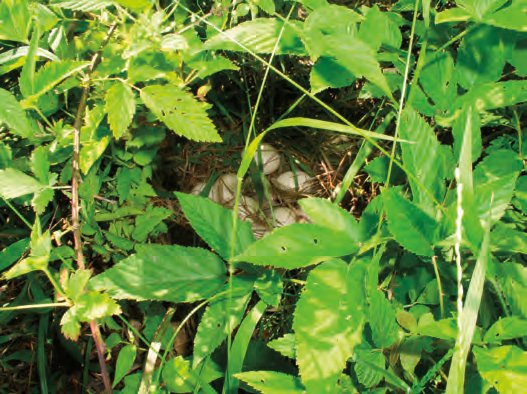
So, what would a quality nest site look like? Turkeys and quail select for habitat types that provide nest concealment and while hens will occasionally nest in poor cover, the success rates of these nests is low. Simply put, manage for broomstraw and other native grass habitats. Grassy areas with broomstraw and other native grasses interspersed with light shrubby cover and/or blackberry thickets are the most often selected and successful. If quality nesting cover is available, hens will use it heavily. Turkey nests are often located on the lower and midslopes of a ridge, closer to a hardwood drain edge where fires typically go out. While fields and field edges that have not been planted or mowed for several years characterize this habitat type and are used, nesting cover is best if created and maintained in larger blocks of open pine woodlands. Nests located in larger blocks of good habitat also have higher success and those in narrow habitat types, (like field edges and powerline ROW’s), usually result in lower success. This is probably due to the ability of predators to easily hunt narrow habitat types for nests. Large blocks of habitat are much harder for predators to search. Nests are also often located near a road, forest edge or other “habitat edge” where one habitat type is adjacent to another. For instance, nests might be located in a pine woodland but within 30 yds. of a road, field edge, or a block of young pine.

Nests found in poor nesting cover would be characterized by those, for example, under a downed limb in a hardwood bottom, under a pine top in a pine/hardwood or planted pine stand with solid pine straw groundcover or other places with little grassy or shrubby cover available to conceal the nest. If this is all hens have to nest in, they are lacking quality nesting cover. In addition, the further away from prime predator habitat they nest, the better. Most predator species are closely tied to hardwood bottoms and turkeys and quail nesting in upland areas have less potential for a predator to encounter their nest.
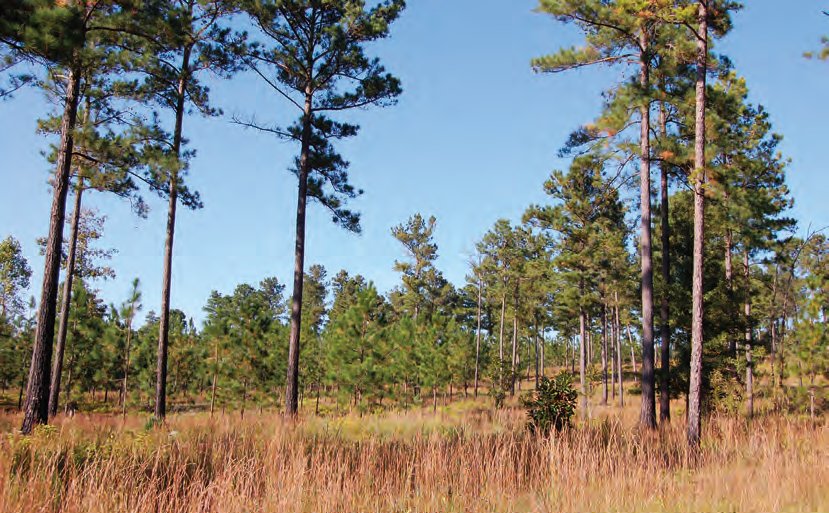
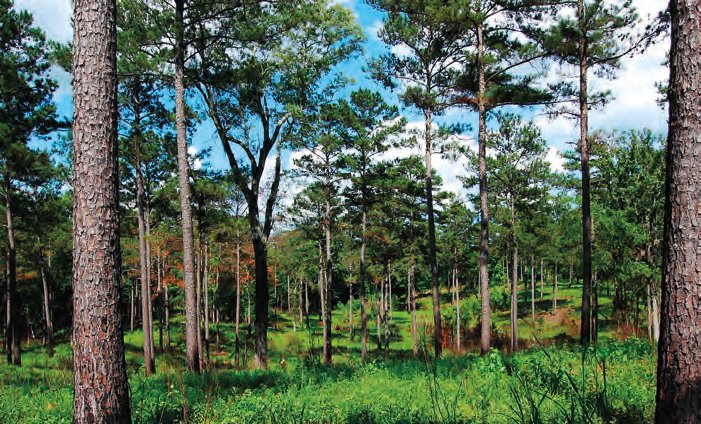
Typically, the best nesting cover is found in mature, open, burned pineywoods and fallowed fields. Pine stands need to be maintained at a low basal area, (low density of trees), with ample sunlight coming through the canopy of the trees to grow the grasses necessary for nesting. To maintain these conditions, on most sites, they need to be burned on a 2–4-year rotation. Managed like this, pineywoods can offer hens an abundant supply of some of the best nesting habitat available. The best condition for nesting is typically 2–3 years after the stand is burned. Pine stands that are burned but too shady will either have only sparse weed growth with little grass or nothing but pine straw on the forest floor. Pine stands that are unburned will have a thick midstory of sapling hardwood and pine shading out the good plants that grow close to the ground.
Fallow fields that provide good nesting cover are those that have been left undisturbed for 2-3 years. In the first year after fallowing a field, lots of annual weeds and some grasses colonize the site. After 2-3 years, they are usually covered with more perennial grasses and shrubs/blackberries – ideal nesting cover. They will, however, need to be “recaptured” after that and either mowed, burned or disked to set them back and prevent them from becoming too thick for good nesting cover.
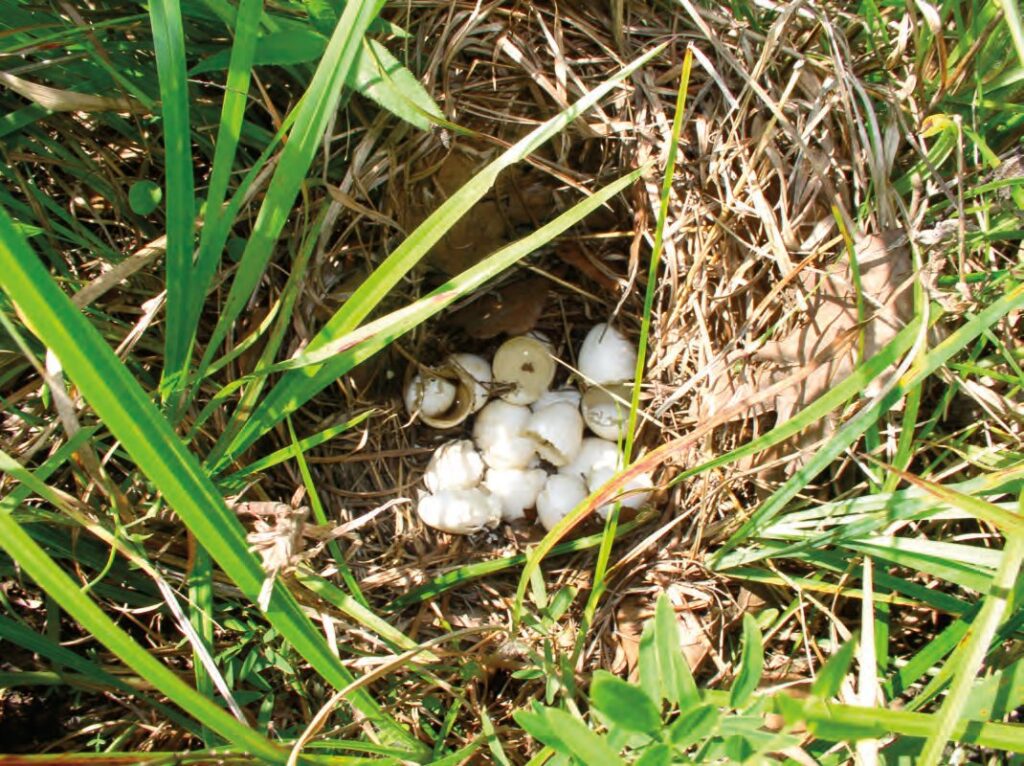
While burning nesting cover seems counter-intuitive, fire and both quail and turkey nesting is closely related. Regular burning maintains the grasses, forbs, and the shrub/sapling layer in a condition that is ideal for good nesting habitat. Even burning during the nesting season, while possibly burning a nest or two, has a much greater positive effect on overall nesting success than not burning at all.

An excerpt from “Lightning-Season Burning: Friend or Foe of Breeding Birds?” notes Sisson et al. (1990) found that 62% of all turkey nests occurred in mature pine forests that had been burned within the past two years. Moore et al. (2005) monitored 22 turkey hens in areas subjected to lightning-season fires and found only 2 nests destroyed by the burns, and one of these hens re-nested. Similarly, for 64 turkey nests monitored in Mississippi, (National Wild Turkey Federation 2006), only four were located in areas scheduled to be burned and only two nests were actually destroyed by lightning-season fires. Allen et al. (1996) also found that areas not burned within the past two years were almost entirely avoided by hens. The point here is that the best nesting cover is created and maintained with fire, even fires that may occur in the nesting season.
Patch size is also important. For turkeys, which are larger and have larger home ranges, burn blocks can be from 50-200 acres and still be fully utilized and provide good nesting cover throughout. For quail management, burn blocks should be on a finer scale of 10–50-acre blocks. There should also be a good distribution of burn blocks next to unburned blocks to provide good nesting adjacent to good brood cover.
The following plants are the ones to look for and those that commonly characterize good nesting cover and many are typically found at nearly every nest. Broomstraw, Indiangrass, any of the bluestem grasses, panic grass covering most of the area and small sapling or shrub gum and oak, wax myrtle, cat or green briar (smilax), blackberry and or grape vines, scattered throughout.
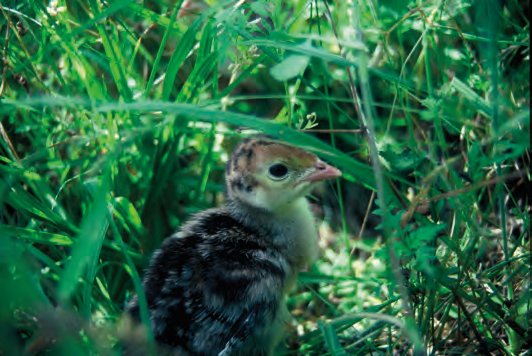
Once poults and chicks hatch and for the first 2 weeks of their life, they need access to abundant insect populations to fuel high body and feather growth rates. Only after reaching 2-3 weeks of age and ability to fly, do they begin to switch over to more vegetation and seeds in their diet. These first few weeks are critical in the life of a quail or turkey chick and brood habitat can often make or break a fall population. Remember, while the chicks are flightless, they are susceptible to predators of all sorts and suffer high rates of predation, often losing up to 75% or more of the chicks hatched. Because of this, brood habitat that supplies plenty of cover to hide them while they are feeding and plenty of insects to feed on is essential.
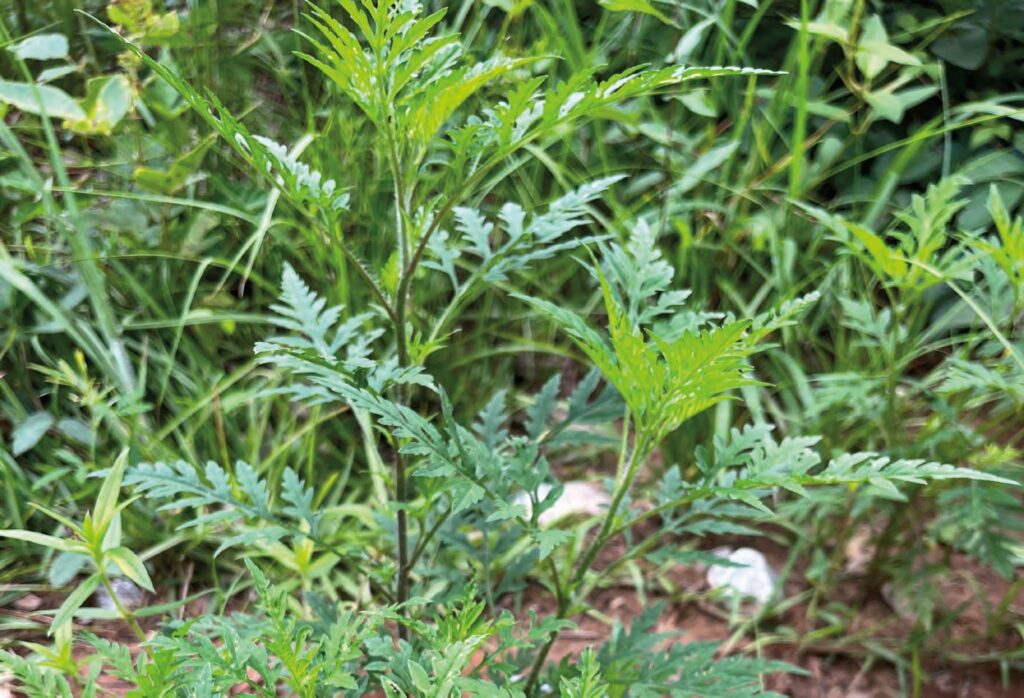
Fields of annual weeds such as ragweed and partridge pea can be ideal, and in many cases, superior brood habitat producing large, easy access bug populations and high-quality cover. In addition, burned pine stands can also produce high quality brood habitat in areas that were burned the same year that the chicks hatch. Areas burned in February and March are greened up by April and May when the first turkey nests begin to hatch and the lush growing vegetation is a natural producer of high insect populations. Both the structure, plant species and insect populations are ideal for broods in recently burned woods. Later burns can produce similar results for nesting quail.
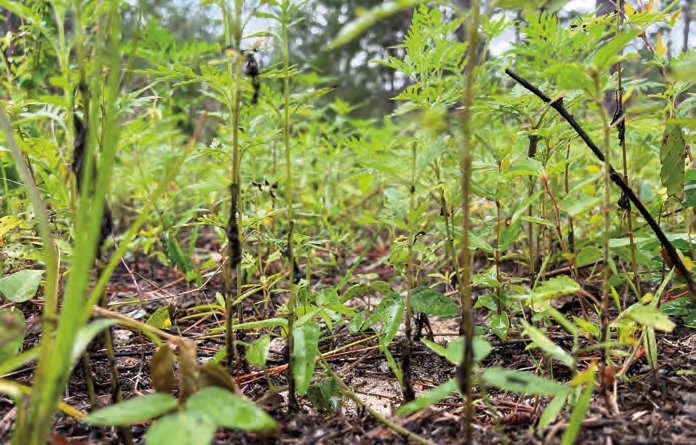
So, what are the characteristics of good brood habitat? Ideally, the structure is fresh, succulent, growing weeds and forbs that have recently sprouted. Freshly harrowed ground, (November through February disking), or recently burned ground provides these conditions ideally. Lots of bare ground is necessary for unimpeded chick movement. Think of walking through a clean forest of tall saplings or trees with a closed canopy above your head providing shade. That is the structure chicks need with plants like ragweed providing the structure and canopy above the chick’s heads and keeping the bare ground clean for easy movement. These plants need to be insect rich so that there are plenty of small bugs like grasshoppers, beetles, ants, etc. available for chicks to catch. The ability of chicks to move through the field is important for both the ability to catch escaping insects as well as to be able to escape approaching predators.
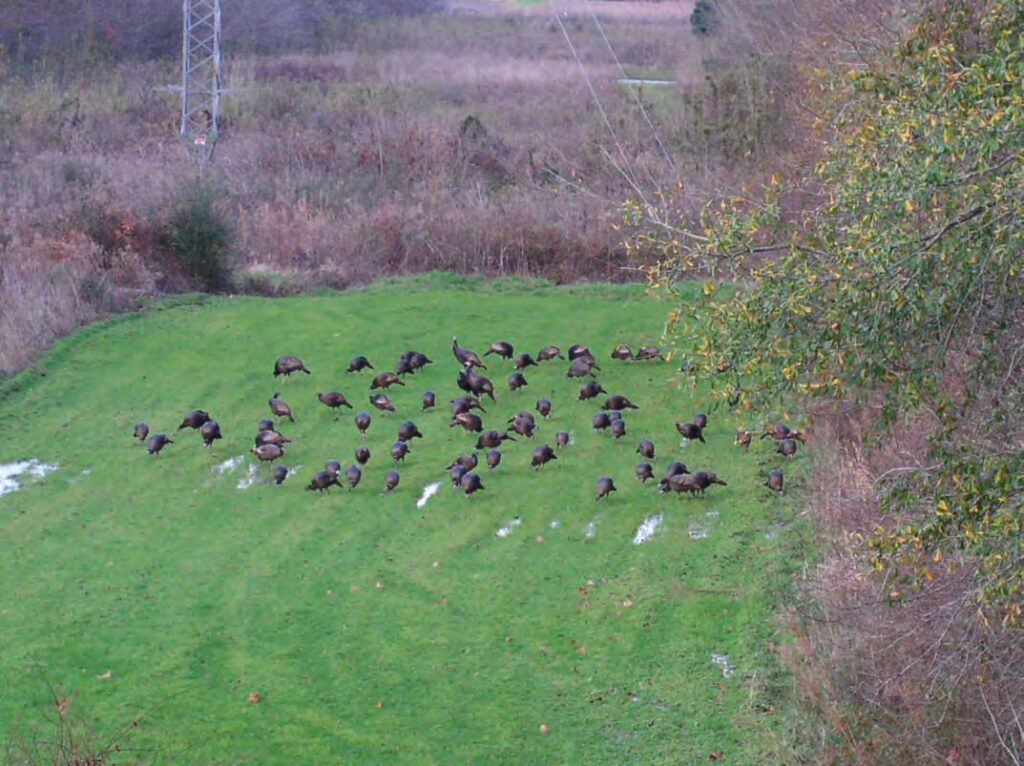
These weedy bugging grounds are also typically the right height not only for chicks to forage on the ground under the canopy of the leaves but also allows hens the ability to keep an eye out for predators. Hen turkeys, especially, will bring broods to these fields and “periscope” their heads above the vegetation to look out for both ground predators and avian predators trying to capture one of their chicks.
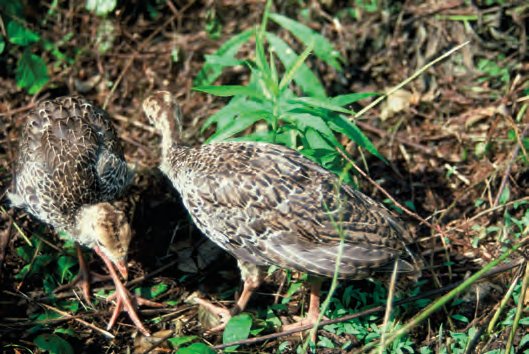
Because of this open ground nature requirement, it is also important that there be no pasture grasses present. Non-native invasive grasses like Fescue, Bermuda, bahaia and ryegrass will essentially ruin a field for chicks. These grasses become too thick on the ground and prevent chicks from being able to navigate the fields. They also out compete good weeds and grasses that attract insects and allow movement. In this case, think of trying to walk or run on a hard floor vs. trying to run on a floor covered with thick mattresses. Which one would you be able to run fast enough to evade a predator? That is what chicks face in thick vegetation and why they need lots of bare dirt.
When setting up a “brood field layout”, we often shoot for a well distributed amount of 1–3-acre fields. When managing for quail, we might establish a brood field per 15 acres or so. For turkeys, we may shoot for a brood field per 50-100 acres. These fields can be simply disked in the fall/winter each year and larger fields can be disked ½ per year. Ragweed or a mix of ragweed and partridge pea is an excellent brood field planting and often comes in on most sites on its own. Occasionally it needs to be planted. While winter greenfields can be good and can suffice as brood fields, they are often infested with ryegrass making the fields basically useless as bugging fields for chicks. Ryegrass is one of the “bad” grasses that form a thick mat on the ground and crowd out good plants, both native and planted. They die back right at the time when turkey poults are hatching thereby making these greenfields useless. However, well managed winter greenfields without ryegrass have good structure and are also insect rich.
The following plants/forbs/weeds are the ones to look for and those that commonly characterize good brooding cover in both fields and woodlands. As mentioned, ragweed and partridge pea are the quintessential brood cover plants and can be encouraged in both fields and woodlands. Native legumes such as beggarweeds and lespedezas grow erect with good structure. Viney legumes like Milk pea, wild bean and butterfly pea are good insect producers like all legumes. Erect weeds that provide good standing structure are plants like croton, golden rod, horseweed and dogfennel. Coneflower, asters and sunflowers are also common native plants in quality brood habitat.
So, the bottom line for pineywoods is it needs to be open and burned! From replanted clearcut to about 3-4 years of age, there is nesting value in young stands of pine, but as they grow out to 8-10 years old or so, are often too thick for any usage by quail or turkeys. However, as the stands mature and become merchantable, timely and regular thinning to a low enough density to get plenty of sun on the ground and grow lush, grassy understories is in order. Burning these stands regularly will keep the understories in good shape and promote quality plant species. Young stands of pine can be burned at 5-7 years of age and will receive little usage by hens; however, they will not create good habitat until first thinning and then only of thinned enough and not choked out by hardwood brush. They will provide good brood rearing in the year they were burned and provide good nesting cover in the following 2-3 years until it is back on the burn schedule again.
The bottom line for brood fields is they need to be disked and left to grow annual weeds that are lush and growing in summer without competition from grasses or planted crops. The structure needs to provide both cover and the bare ground chicks need to navigate in addition to providing the insects they need to grow. Provide these two habitat types in abundance and quail and turkeys can thrive. Generally, for the rest of the seasons, the adult birds can make it fine in the available habitat types on a property.
References
DeVos, T. and B. S. Mueller. 1993 Reproductive Ecology of Northern Bobwhite in North Florida, National Quail Symposium Proceedings: Vol. 3, Article 12
Sisson, D.C., D.W. Speake, J.L. Landers, and J.L. Buckner. 1990. Effects of Prescribed burning on Wild Turkey habitat preference and nest site selection in South Georgia. National Wild Turkey Symposium 6:44-50.
Moore, W.F., J.C. Kilgo, W.D. Carlisle, and M B. Caudell. 2005. Chapter 6. Wild Turkey. Pages 359-366 in Kilgo, J.C. and J.I. Blake (Eds.). Ecology and management of a forested landscape. Island Press, Washington, DC.
National Wild Turkey Federation. 2006. Spring fire is good for wild turkeys. On-line version: http://www.nwtf.org/nwtf_newsroom/press_releases.php?id=11901
Cox, J. and B. Widener. 2008. Lightning-season burning: friend or foe of breeding birds? Miscellaneous Publication 17, Tall Timbers Research Station, Tallahassee, FL. USA.
Chamberlain, M. J., B.S. Cohen, N.W. Bakner, B.A. Collier. 2020. Behavior and Movement of Wild Turkey Broods, The Journal of Wildlife Management 84(6):1139–1152
Crawford, J.C., W. F. Porter, M. J. Chamberlain, and B. A. Collier, 2021. Wild Turkey Nest Success in Pine-Dominated Forests of the Southeastern United States. The Journal of Wildlife Management 1–10