
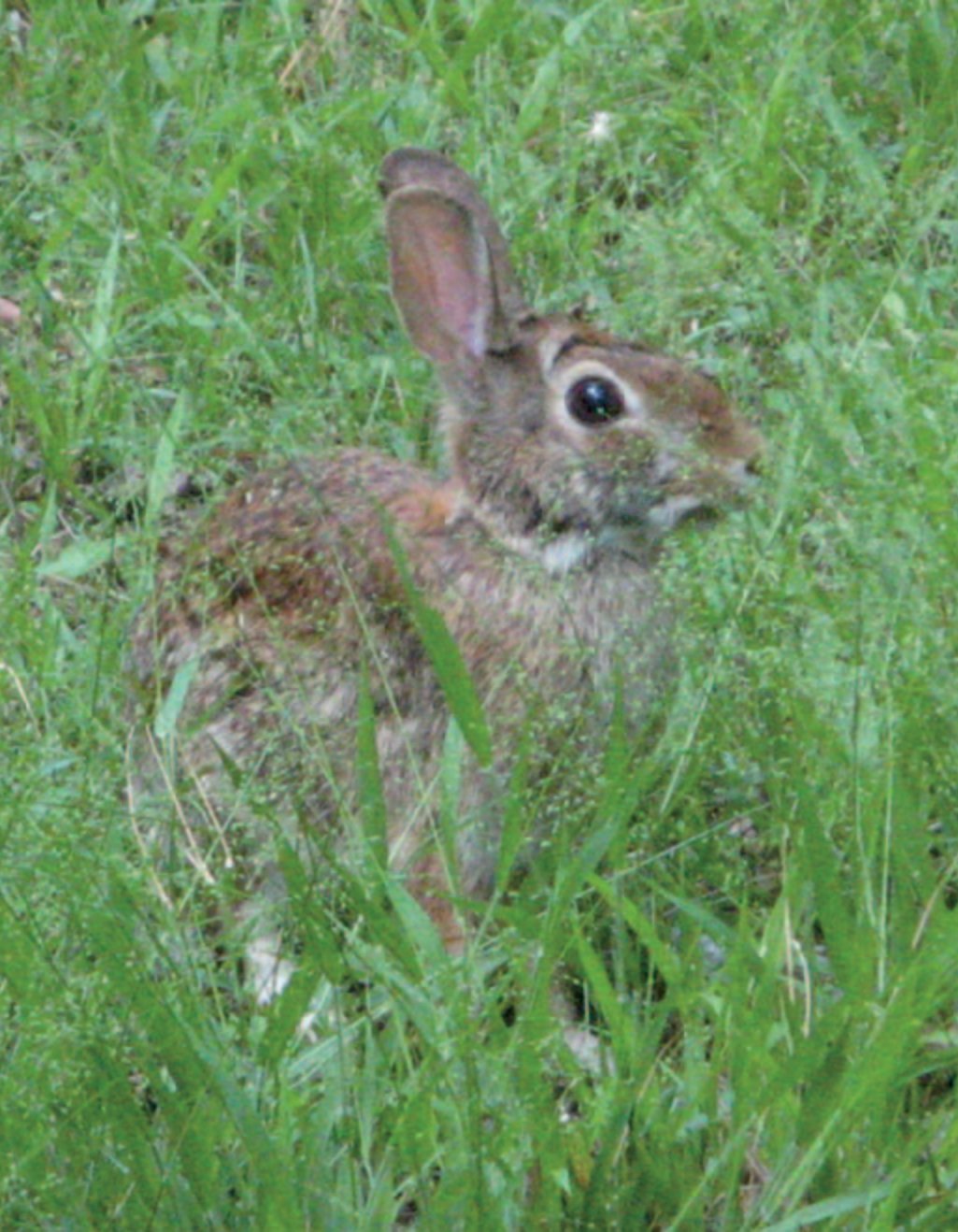
“Tally ho!” (If you are a rabbit hunter, you’ve heard that cry many times.) I remember back when I was in high school and owned a kennel full of beagles, “walkie-talkies” as they called these slow field trial types. Some Saturdays, I would ride with an older gentleman and his hounds to various field trials across the state of South Carolina—places such as Black Jack Beagle Club and Savannah River Valley Beagle Club. I think I was the only person under 50 years of age to attend and definitely the only female there! Despite the looks I sometimes got from the old-timers, my dogs still managed to win a few trophies. It always made me proud when one of my females put a “check” on the other dog in the brace, tracking every turn that rabbit made until the judge called time. That is where I first learned about rabbit behavior and habitat preferences. However, there is so much more to the species than what you observe within the artificial confines of a rabbit pen.
Rabbit species across the Southeast
There are numerous species and subspecies of rabbit and hare in the United States, but the most familiar and widest ranging of these is the Eastern cottontail (Sylvilagus floridanus). Other species often hunted include the swamp rabbit (S. aquaticus) or “canecutter” and the marsh rabbit (S. palustris). The Southern Appalachians also harbor pockets of New England cottontail (S. transitionalis) populations. Swamp rabbits are becoming rarer across their range due to alteration of their specific habitats—bottomland hardwoods—and are considered imperiled in some states such as South Carolina, Missouri, and Oklahoma. Habitat alteration also affects the New England cottontail with its need for shrubby openings and conifers in the higher elevations. Marsh rabbit populations, however, appear to be stable.
It is often difficult to tell these Southeastern species apart, but there are some physical and behavioral characteristics that should help. Marsh rabbits have shorter ears than Eastern cottontails and are the only eastern US species with a dark underside to the tail. They are mostly found in brackish marshes along the coast. Swamp rabbits, as their name implies, prefer riparian forests and resemble the marsh rabbit in appearance but are much larger. They often defecate on logs in order to mark their territories and have been known to try to elude predators by hiding in hollow trees or logs. The New England Cottontail is smaller than the Eastern cottontail and often has a black spot between the ears as well as a dark edging to the ears. They are confined by habitat preference and competition with the Eastern cottontail to the higher elevations in the Southern Appalachians where they specialize in being able to digest conifer needles. Determining what rabbit species is prevalent in an area can best be done by identifying the habitat present and ecoregion. For ease of discussion, this article will mainly discuss the life history and management strategies associated with the Eastern cottontail as it is the most wide-ranging and well known of the species.

Eastern cottontails (or simply “cottontails”) aren’t the only rabbits with a white patch on the underside of the tail. The white flag raised in alarm is thought to divert the predator’s attention away from the escape path the rabbit is taking and instead focus attention on where the last white flash occurred.
Rabbits, in general, are most often active at night. Daytime resting or loafing areas are typically in thick grasses or against a tree where a “form” (depression) is created. It is in these forms that the rabbits often re-ingest soft pellets they excrete in order to harvest more nutrients. The round pellets often seen are the final excrement. Dung re-ingestion is called coprophagy and is believed to benefit the rabbit by allowing it to eat quickly and return to shelter to properly digest the plant material it ingested.

Reproduction and habitat requirements
The cottontail’s breeding season can be long, especially in the South, and can last from February to September. Mating displays often involve chases and acrobatic leaps. After a 25 to 35-day gestation period, the female gives birth to 3 to 6 young in a 5 by 7 inch nest she has constructed of grasses, leaves, and her belly fur. The nest is often placed in a field or open woods. Newborn rabbits are born hairless and with their eyes closed. The mother visits the nest at dawn and dusk to nurse them and then quickly re-covers the nest with vegetation. After 12 to 15 days (typically 14 days), the young are weaned and leave the nest to forage on their own.
Like the jokes remind us, rabbits are very prolific breeders. They have to be since they are prey for a variety of predators, especially foxes. Three or four litters a season are not unheard of with a new nest constructed each time. Many young fall prey to foxes, bobcats, large hawks, great-horned owls, mink, snakes, skunks, coyotes, and even crows. About half of the young will reproduce during the same year as their birth. Rabbits are capable of living 8 to 10 years but rarely make it to one year. In fact, 80% or more of the population at any given time is made up of juveniles. If the predators don’t get them, parasites and disease can shorten their lifespan. Bot fly infestations, tapeworms, and rabbit horn disease (a skin growth caused by a virus) are mainly just irritating, but tularemia (caused by a bacteria), is deadly. Infected individuals appear tame since they don’t run from a human’s approach. The internal organs also appear speckled with white. Hunters should always be careful when dressing rabbits as tularemia is transferable to humans.
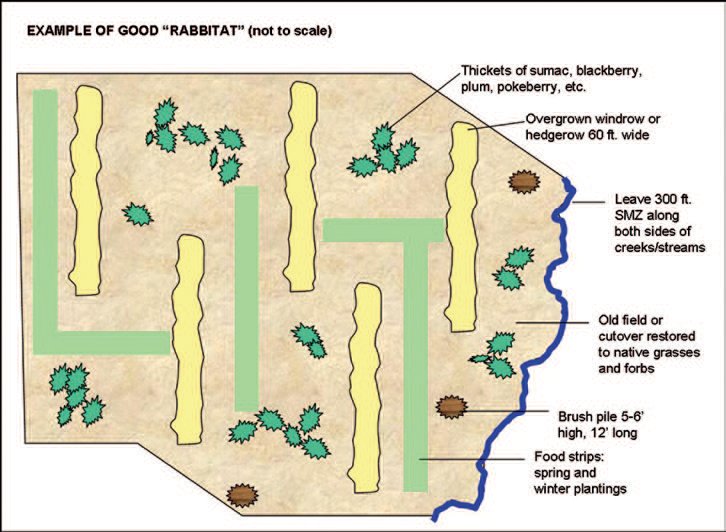
Rabbits do not require large acreage for home ranges, and cottontails in particular are very versatile in their habitat usage. Depending on the quality of the habitat, season, and population size, the average home range is 5 to 10 acres per individual. In areas with good food and winter cover, one rabbit per acre can be achieved. This is possible because cottontails are not territorial, so to speak. They have a hierarchy in which one individual is dominant and the others fall in line according to their rank. Because cottontails are most associated with openings and edge habitat, such as where a forest meets a field, they share many requirements with Bobwhite quail and can be managed simultaneously with them. In good rabbit habitat, or “rabbi-
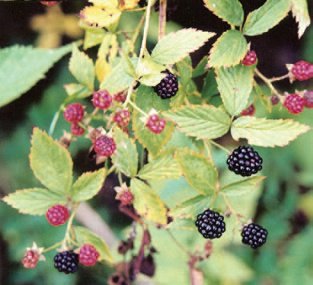
tat” as it has been called, 10% or more of the tract should include native grasses, thickets of shrubs and seedling trees, and brush piles. Grasses should be those of the native warm season variety as fescue is exotic, invasive, mat-forming, and often carries an endophyte fungus that decreases the fertility of rabbits if consumed.
When looking for rabbit signs on a property, droppings are definitely a clue but so is the diagonal cut made on plant material by a feeding cottontail. In contrast, deer bite straight down on a plant and pull back, leaving a level, ragged edge. Important summer foods for cottontails include grasses and broad-leaved forbs while winter foods include blackberry stalks and the buds and twigs of shrubs and small trees. A favorite is sumac bark. To supplement the rabbit’s diet, the land manager may choose to install ¾ to ½-acre food plots of white and crimson clover in the spring or wheat, millet, vetches, and alfalfa for winter feeding. These food plots should be located next to escape cover such as blackberry thickets or brush piles.
Brush piles can be constructed by placing large logs in a criss-cross pattern and then adding smaller branches on top until the pile is 5 to 6 feet tall. These brush piles can be any size but 12 to 15 feet wide makes for a good amount of shelter. Rabbits will enter the brush pile and gnaw their way deeper as the wood rots. Every 3 to 5 years the brush pile will need to be replaced. Encourage blackberry thickets and native grasses to grow up around the brush pile to enhance the cover potential of the site.
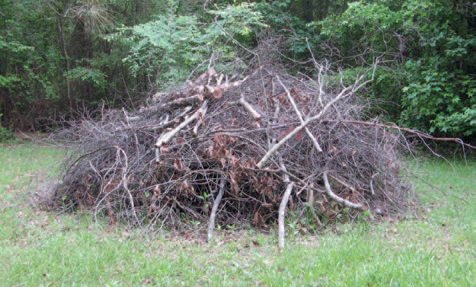
Good locations to establish brush piles and other thickets include odd corners in agricultural fields that have been taken out of production or along ditches and fence rows. A good spacing between piles is every 50 to 100 yards, again near food sources such as waste grains, food plots, or native vegetation in idle fields.
Just like quail, rabbits do not like to travel into large openings without having travel lanes of cover to conceal their movements. Overgrown windrows are excellent to use for this type of cover. These cover strips should be about 60 feet wide and be maintained by bushhogging, burning, or disking half every 2 to 3 years, but not during the nesting season. Instead, wait until winter. In idle fields where grasses are getting too thick for even the rabbits and quail to utilize (in other words, there is greater than 50% thatch layer), a back burn in strips across the field and/or disking may be in order. This usually happens when a field has been idle for approximately 2 to 6 years.
Although openings are needed for the growth of food and shelter plants, forests are not off-limits to rabbits. Cottontails also utilize open pine stands such as 5 to 7 year old plantations that have a healthy assortment of native legumes, grasses, and forbs underneath. For swamp rabbits, which utilize forested bottomland hardwood stands, Streamside Management Zones of 300 feet or more in width would be beneficial to retain when creating an adjacent stand of pine. This also insures adequate nesting areas for many bird species that utilize the same habitat. New England cottontails do well with 25-acre patches of young pines to mixed pine-hardwoods with openings interspersed throughout the stand.
Despite the downward trend in rabbit numbers, they are still very much a harvestable species. The spring breeding population should not be affected by even a 65% harvest of the fall population. However, be aware that rabbits undergo normal cyclical patterns in their population densities, and some years may require less harvest pressure in order to allow the population to replenish. Depending on local game laws, rabbits can be released for hunting. Often 25% of these released rabbits are harvested if they are put out right before a hunt compared to only a 4% harvest rate for rabbits released earlier in the hunting season. Therefore, the best approach is to manage natural habitats in order to grow the local population. With a little time and commitment, the landowner can have a successful rabbit population while also benefiting other edge-dependent species.
Harvest
There are actually more cottontails around now than when European settlers arrived, but their numbers have been decreasing over the years due to the conversion of farms to pine plantations. When these pines mature and become thick, sunlight is blocked from reaching the forest floor making an impenetrable barrier to forbs and grasses that would otherwise comprise the understory. It isn’t until thinnings open up the canopy that forage and cover species can grow and rabbits can once again utilize the stand.
This article is dedicated to the late W. G. “Tip” Senn, my fellow beagler, who started it all with FCH Tip’s Billy Bob.
References
Huckabee, A. 2003. Elusive New England Cottontail can be found in Jocassee. Jocassee Journal 4(2).
NatureServe. 2009. NatureServe Explorer: An online encyclopedia of life [web application]. Version 7.1. NatureServe, Arlington, Virginia. Available http://www.natureserve.org/explorer. (Accessed: May 23, 2009).
Patterson, B.D., G. Ceballos, W. Sechrest, M.F. Tognelli, T. Brooks, L. Luna, P. Ortega, I. Salazar, and B.E. Young. 2003. Digital Distribution Maps of the Mammals of the Western Hemisphere, version 1.0. NatureServe, Arlington, VA, USA. http://www.natureserve.org.
Whitaker, J. O. and W. J. Hamilton, Jr. 1998. Mammals of the Eastern US, 3rd ed. Cornell University Press, Ithaca, NY. 583 pp.
Yarrow, G. K. and D. T. Yarrow. 1999. Managing Wildlife. Sweetwater Press, Alabama Wildlife Federation, Montgomery, AL. 588 pp.