Most wildlife management plans and schemes are based on either timber management and/or plantings. Plantings are generally divided into annual plantings such as greenfields and dove fields or perennial plantings that include trees, shrubs, weeds, and grasses. Annual plants grow from seed every year and either have to be replanted yearly or are prolific seeders that can reseed themselves each year. Perennial plantings are those that either re-grow from rootstocks each year or live for many years. Some of the plants discussed here are heavy seeders and will reseed themselves (perennial reseeders) therefore act like perennials. The beauty of planting perennials is that once established, they do not need to be planted again, just maintained. This usually makes them attractive from a management standpoint because they are easy to maintain and are cheaper over the long haul. Plantings can also be native or non-native. Many of the non-native plantings (especially those from the last few decades) can be very aggressive and hard to kill once established so be careful. Some aggressive, introduced species such as cogon grass have come here accidentally but many were specifically planted for wildlife habitat and/or erosion control (kudzu, privet, sericia lespedeza, etc). The following will be a general discussion of some of the more common perennial plantings used in the southeast.
With all the emphasis put on foodplots over the past few decades, we rarely see properties where winter food is a limiting resource. Most properties have plenty of mast producing hardwoods and many landowners usually plant an adequate number of winter “greenfields”. Spring/summer foods are important too, however, cover which is another important habitat component is often poorly understood and on many properties is usually low in both quantity and quality. The beauty of native perennials is that they usually provide both food and cover value. It is also interesting that while most of our annual foodplot plantings, which provide good food quality and quantity, are non-native (Europe and Asia), there are a lot of excellent choices of perennial natives that can provide both food and cover. An excellent resource for identifying and learning wildlife value of southeastern plants is Forest Plants of The Southeast by James and Karl Miller.
Trees
A huge number of trees are planted each year specifically for wildlife management purposes. Both pines and hardwoods are used and are planted for cover, food sources and timber management. Pines are often used to “break up” large open areas as well as to provide thick bedding areas. Pine rows and blocks are often used to provide “definition” and edge in habitat management. The most common species planted in the deep southeast are Longleaf and Loblolly pine and both are well worth the effort.
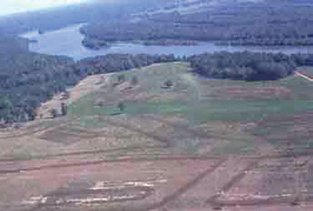
Hardwoods are often seen as “limited” on properties and wildlife managers often feel that more acorns equal more deer. This theory, typically, is not often the case but hardwood plantings are common on recreational managed properties. A large number of hardwoods are available for planting and most eventually will provide some form of mast or fruit for wildlife. Native fruit producing species include dogwood, persimmon, cherry, mulberry, black gum. Non-native species include apples and pears. Note that non-native fruit producers can become invasive. Fruits will not change the health of wildlife nor increase the carrying capacity on a property, but often provide a “treat” for wildlife and good locations for early bowhunting, etc.
Sawtooth oak is one of the most commonly planted hardwoods in the deep southeast. While it does tend to produce acorns at an early age, it also produces them early in the year, often before hunting season opens. Sawtooth (and its varieties) is a non-native oak originally from eastern Asia but has been widely planted throughout the southeast. In some areas it has begun to establish itself through natural seeding and is being considered an invasive. Most people would be shocked to know that given the same cultural treatments (tree tubes, fertilizer, weed control, pruning, etc) some of our native oaks will begin producing acorns nearly as fast as sawtooths (see photo).
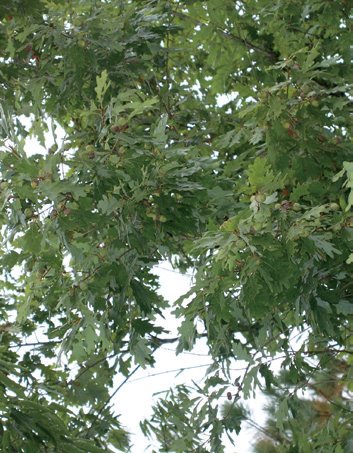
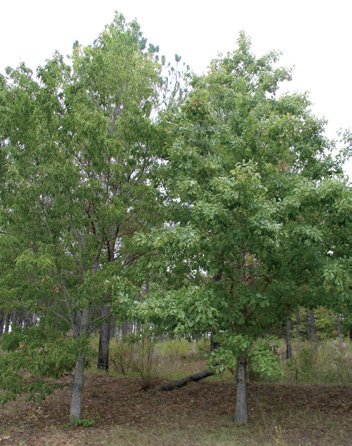
The list of native oaks is long but nearly all are excellent wildlife plantings in areas where hardwoods belong. Species to consider for upland (dry soil) hardwood plantings in the white oak group are White, Post, Live, and Bur. In the red oak group, common upland species are Southern and Northern Red, Water, Shumard, Turkey and Black. Bottomland and lower slope white oak species most commonly planted are Swamp White, Swamp Chestnut, Overcup, Bastard, and in the Red oak group are Pin, Willow, Cherrybark, and Nuttall. While there are many more species that are available, these are the most common and are all excellent acorn producers.
Shrubs and vines
A wide variety of shrubs and vines can be planted for wildlife and not only provide excellent food sources but cover as well. Shrubs can be used for breaking up large fields as well as providing hedgerows and field edge cover. Open, grassy areas interspersed with shrubby cover are one of the more productive habitat types for many species of wildlife. These areas provide bedding and fawning areas for deer, nesting habitat for turkey as well as cover and nesting for quail and a variety of songbirds. Shrubs are also commonly used in quail management schemes to provide excellent cover blocks to help reduce predation.
Two of the most common shrubs planted are Chickasaw plum and wax myrtle. Plum is a deciduous shrub that looses its leaves each winter but it has intricate and abundant branches that provides good protective cover. It also provides a fruit in the summer that is eaten by a variety of wildlife. Wax myrtle is deciduous and makes excellent screens on roadsides as well as evergreen cover thickets when planted for quail and other birds. Its seeds, however, are utilized pretty much by songbirds alone. Blackberry and other “briar” bushes are also a nice addition for both summer fruit production (eaten by all forms of wildlife) as well as impenetrable thicket cover for deer, turkeys and quail. Blackberry and dewberry are also high on the list of selected deer browse in spring and summer.
Non-native shrubs often planted are Autumn and Russian olive, both of which are qualified as invasive species in the United States. Autumn olive is deciduous and produces a berry that is eaten by many birds including turkeys. Russian olive is an evergreen with a less-selected berry. Bicolor lespedeza is another commonly planted shrub that provides excellent cover and seeds for quail and songbirds as well as highly selected deer browse, however it is also an aggressive invasive, often taking over large acreages of habitat. Thuinburgii lespedeza is a less-aggressive species that is more suitable for plantings in the southeast. Sericia lespedeza was heavily planted in the southeast for erosion control and has also become an aggressive invasive that provides virtually no food value though some cover. Privet was also planted in the early-mid 1900’s for thicket cover. It has now become one of the “most-wanted” species for eradication due to its aggressive, habitat dominating nature. It has been championed by birds who eat the abundant berries. Elderberry, blueberry, Beautyberry, and sumac are also commonly planted native shrubs that provide excellent soft mast sources for birds and other wildlife.
Native vines that are both useful and available include grapes, greenbriar, poison ivy, and Virginia creeper. These vines provide excellent browse for deer and fruits/berries that are highly selected by all wildlife species. Because they are typically climbing species, they have little cover value except for squirrels, however they are still valuable for wildlife management purposes. Honeysuckle is a non-native and considered an aggressive invasive, however it is highly selected by deer and produces a large volume of quality browse. Honeysuckle also provides a berry selected by songbirds. It typically climbs on low fences, etc and creates thickets that are used by ground dwelling wildlife. The last in our vine category is the notorious Kudzu. Often considered the scourge of the south, kudzu is a rapidly growing vine that was introduced in the early 1900’s. While eradication programs are in place to reduce the coverage of kudzu, it still dominates large acreages of habitat in the southeast. While it is a problem plant, it does provide some wildlife value. Rapidly growing stems provide high quality deer browse and the thick mats of vegetation climbing on low shrubs and small trees provide good thicket cover.
Grasses
Grass plantings for wildlife have been typically limited to bahaia grass for turkeys. More recently, however, the value of native grasses for all species of wildlife has led to more and more plantings of native varieties of grass.
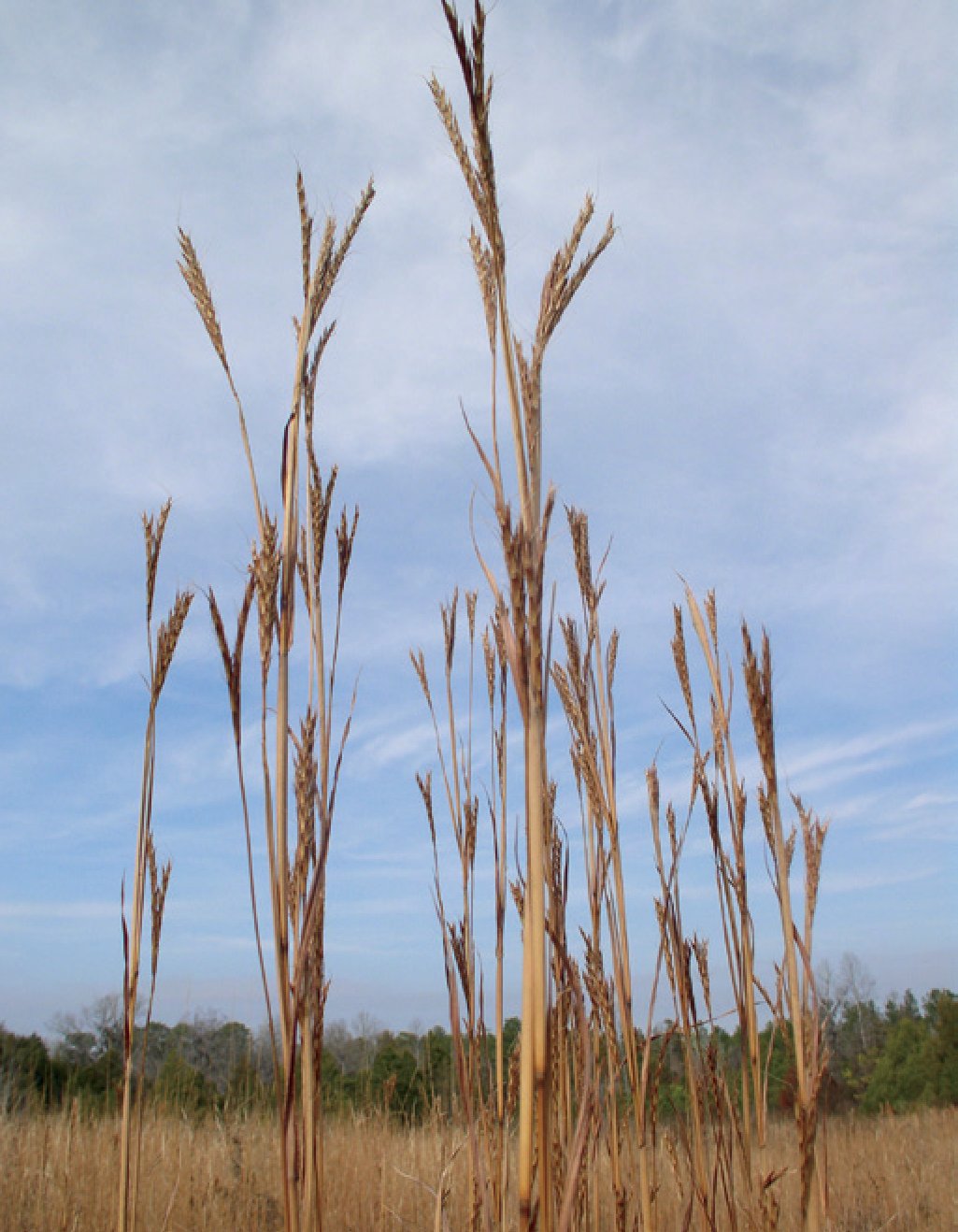
During the growing season, deer can be considered “weed eaters”, selecting growing stems of forbs, legumes and vines. While deer heavily utilize grain plantings in greenfields in winter, they do not utilize true grasses much if any. Because deer are not grass eaters, most grass plantings have not been oriented towards deer management. The cover value of these taller native grasses, however, cannot be over emphasized. Native grass stands provide the best fawning cover available and increase survival rates of fawns. Bedding by adult deer is also excellent in native grass stands. These grass stands provide the best turkey and quail nesting cover as well as cover for the remaining seasons of the year.
Commonly available native grasses include Switch, Indian grass, Big Blue, Little Blue, broomsedge, purpletop, foxtail, and gama grasses. All will provide tall cover and nesting/fawning habitat. Many other native grasses are growing in the wild and some are available on a limited scale. Some, like panic grasses, are important food sources for quail and turkey chicks. Bear in mind that not only are most non-native grasses aggressive and invasive, but imported pasture grasses have the wildlife value of cement parking lots.
While planting shrubs and trees is usually as simple as digging a hole, putting your seedling in and taking care of them for the first year or 2, planting native grasses is much more complicated. Seedbed preparation, planting and pre-post herbicide application and selection are all important to establishing a successful stand. It is highly recommended to consult with someone experienced with native grass establishment before attempting to plant native grasses.

A few non-native, perennial grasses have been used in wildlife plantings and include timothy and ryegrass. Timothy is a more central/ northern grass that is eaten by deer. Ryegrass is a commonly planted and seldom eaten grass that is very aggressive and dominating in foodplots. While in the winter ryegrass will grow with grains and clovers, once spring warmup occurs, ryegrass usually dominates the plot and chokes out all other plants making mixed plantings a waste of money.
Forbs/legumes
There are undoubtedly more perennial forbs, legumes, weeds and assorted small plants with wildlife value than any other group of plants. Non-native species used in foodplots are pretty familiar and include clovers, chickory, reseeding soybeans, kobe lespedeza, vetches, trefoil, and alfalfa. Note that all but chickory are perennial legumes with high protein content. Some are perennial farther north and annual in the south, some visa-versa. Very few of these imported forbs become aggressive in foodplots nor spread out into fields and woodlands.
While the native selections are highly varied, they are also very limited in availability if you wish to try to get seed. Forest Plants of the Southeast lists 192 pages of just the most common forbs found. Native legumes provide the same benefits of planted legumes, mainly high protein browse and high quality seeds available to wildlife. Native beggarweeds, lespedezas, butterfly pea, milk pea, wild bean, and all common weeds in open areas and burned woodlands and excellent food sources for deer, turkey and quail. Commercially available seed sources are limited for these species.


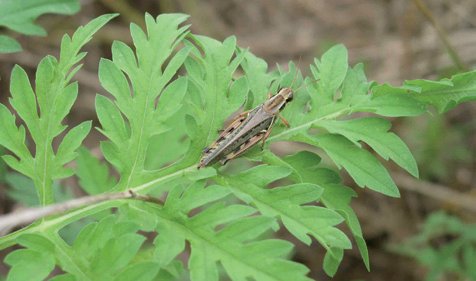
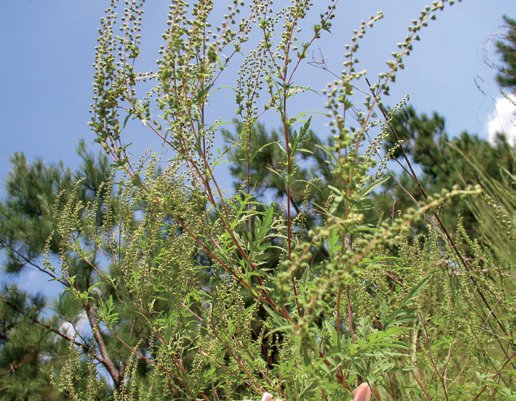
Two commonly available species are ragweed and partridge pea. Ragweed is a much overlooked species. Forage value is high for deer as well as providing excellent brood cover for turkeys and quail. This plant has a 20% protein level through most of the summer and grows fast. It produces abundant bugs for quail and turkey chicks and provides great overhead cover protecting them from predators. It also has a highly selected seed in the fall for quail and songbirds. Partridge pea also has good cover value for deer and quail, is a high protein deer forage and produces an excellent seed for birds. Both these two plants are easily established and easily maintained. While not true perennials, they both are perennial reseeders and only need occasional disking to maintain a field of them.
Another interesting forage forb is Florida pussley. This coastal plain, old-field plant is highly selected and high quality for deer forage. It is a low growth plant and is maintained by disking occasionally in summer. It produces a high value quail seed as well, but provides very little cover for wildlife. Other plants like native sunflowers, pokeweed, wild vetch, wild lettuce, etc are common in fields and woodlands and all can be seasonal food sources and cover.
It is obvious that not only is there an abundance of perennial plants with good wildlife value, but also there is enough selection that managers can work with native plants and have all the variety they want. Native plants are adapted to our climate and environmental conditions so they survive and grow well. Usually, once established, all they take is a little “maintenance” to keep the stand healthy and productive. Seasonal disking and burning are the most common methods to maintain these perennials. Give them a try; I think you will learn to love them!!