

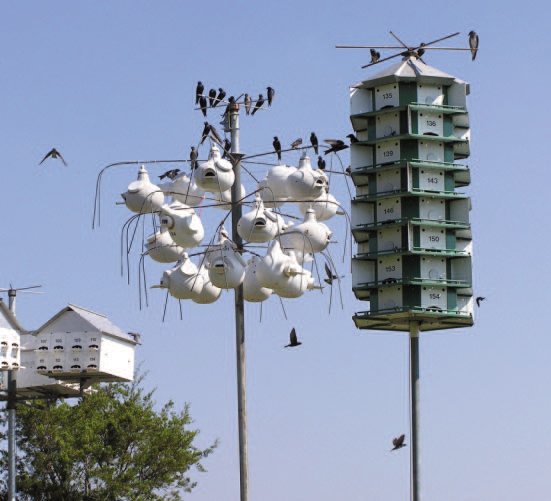
Here in the Southeast it seems that everywhere you look you see white gourds and apartment houses clustered on poles where landowners hope to attract purple martins. How successful these landlords are in creating and maintaining purple martin colonies depends on a simple education in martin ecology, for the purple martin is a picky tenant. Once attracted to a colony site, though, watching martins make themselves at home on your property can be entertaining and gratifying. If you are not in a location to attract martins, there are still other ways to provide for the species since pre-migratory roosts and prime stopover habitat are often located on private property.
The purple martin (Progne subis) is the largest swallow species in North America at 8 inches long and with an 18 inch wingspan and a slightly forked tail. Others in the swallow family (Hirundinidae) include barn swallows, cliff swallows, northern rough-winged swallows, bank swallows, and tree swallows. Adult male purple martins are blue-black in color while adult females have a lighter, speckled breast and a gray collar. Considered “Neotropical migrants” because they breed in North America and winter mainly south of the Tropic of Cancer, purple martins winter in eastern Bolivia and Brazil, South America. Southeastern populations of breeding martins are most numerous in the western half of their range (Mississippi, Alabama).
Dependency on people
In the evolution of swallows, one group (clade) went from the primitive mode of nesting in constructed burrows to building mud nests while another group chose the route of utilizing natural cavities. Martins are members of the later clade. In addition, the eastern population of martins has undergone a “behavioral tradition shift” since the early 20th century in which they no longer utilize natural cavities (e.g. clusters of woodpecker holes along a dead snag) and have instead become solely dependent on man-made homes. This has earned them the distinction of being the only bird species totally dependent on man-made nest sites. Native Americans began this tradition shift when they hung gourds near their villages, possibly because martins sometimes dive at predators approaching too near to their nest. Crows trying to pilfer corn crops and vultures circling drying meat and hides would be met with a colony on the alert as individual pairs defended their nests. Gourd usage by Native American tribes in the Carolinas has been documented as far back as 1712.
Western populations of purple martins have not undergone the same behavioral modifications as their eastern relatives and still nest in traditional sites such as natural cavities in trees and in giant saguaro cacti (Arizona, New Mexico, and Mexico). However, recent evidence from landowners in the Pacific Northwest shows that martins are beginning to use gourd clusters and individual unit boxes that are grouped together. This is in addition to the use of cavities among man-made pilings located along rivers and the coast.
Colony establishment and nesting
Purple martins are restricted to fields and other open areas such as residential lawns and around ponds, lakes, and the coast. This is where they have room to catch their flying insect prey since they rarely land to feed. The popularity of the species as a backyard inhabitant comes from the idea that these are colony nesters that are fun to watch and useful for mosquito control. The truth is quite different. First, these “colonies” are really more accurately described as “aggregates” because territorial defense does occur and egg-laying is not synchronized. The loss of an entire colony cannot be blamed on bad weather during migration, predation, poisoning at their wintering grounds, etc. due to the fact that these are random aggregations of birds that do not necessarily stay in contact with each other during the non-breeding season and travel independent of one another. Usually, there is a problem with the nest site that has made it unattractive to the martins causing them to move on to another site. Natural annual mortality is 50% for adult martins and 75% for the young.
Secondly, purple martins are not the “mosquito killers” they are made out to be. Martins catch insects on the wing and forage higher than other swallow species, out of the range of low-flying mosquitoes. Also, mosquitoes are mostly nocturnal while the martins are not. If mosquito control is what you are after, put up bat boxes as these nocturnal hunters will take thousands in a night. Martins, however, prefer dragonflies, butterflies, bees, wasps, damselflies, and beetles, to name a few. Rainy weather can bring the birds down from their 160 foot foraging altitude to take aquatic insects hovering over the surface of water bodies. When rain, drought, or cold spells are prolonged, insect prey may not be very abundant and martins may begin to starve to death after 3 or 4 days.
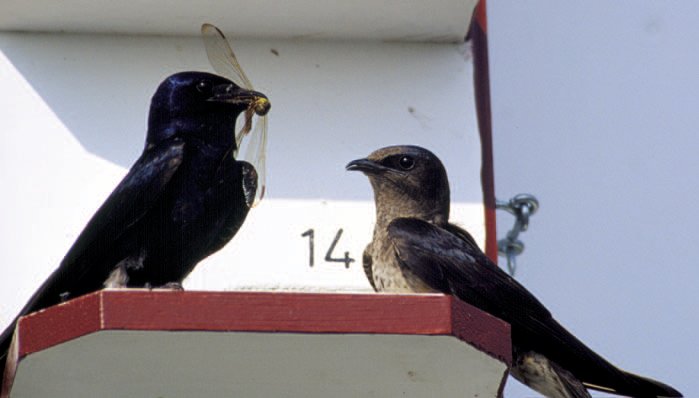
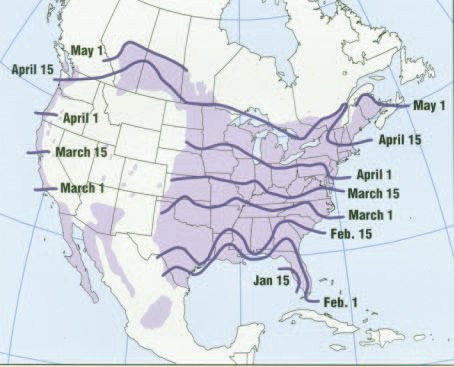
The first martins to migrate to their breeding grounds in North America are adult males who fly across the Gulf of Mexico or overland via Mexico, arriving in the Southeast (Florida, in particular) around late January to mid-February reaching Tennessee and Virginia by mid-March. Females and yearling males typically arrive 4 to 6 weeks later (and can continue arriving even up to 12 weeks later in the South). Since purple martins are single-brooded, they are able to arrive as late as June in the South and still have time to raise their young before migrating again. Adult males locate previously occupied colony sites and begin circling high above the houses just before daylight, calling loudly. This “dawn song” is thought to attract other martins to the colony site—other adult males and females that used the site the previous year as well as new yearling recruits. These adult males are often mistaken for “scouts” looking for new nest sites. Adult martins exhibit the most site fidelity while the yearlings find new locations to nest. The later arriving yearling males are the birds that usually create new colonies which dismisses another myth that birds return to their natal colony to breed. In actuality, tracking studies have shown that this is very rare. The previously discussed “dawn song” may not only attract new recruits to the colony but may have an ulterior motive involving cuckoldry (having another bird raise your young). The naïve yearling males often lose their females to extra-pair copulations by the more experienced males who have lured them to the site with the dawn song. One study found that only 29% of yearling males’ eggs were really theirs demonstrating polygamy within purple martin colonies. However, the yearling males eventually inherit the better nest cavities in the colony and recruit new yearling males and their females to the site so the cycle continues. Perhaps this is the advantage of colonial living, and since the oldest martin on record was 13 years, 9 months old, that is a long time to inhabit a colony and breed!
Landlords can expect to see their martin colonies begin returning within two weeks of last year’s return dates. Dominant adult males usually claim the top floors of martin condos where there is increased safety from predators. They also tend to hoard several compartments until a nesting chamber is chosen. Afterwards, they slowly relinquish nest cavities to other males and their mates. Because of this hoarding behavior, a landlord wishing to have a large colony should construct a large apartment house with at least 24 compartments so that 12 to 15 breeding pairs can be accommodated. (A colony of over 35 pairs is extremely rare.) The typical breeding season for martins is April to May for egg laying and May to early August for raising young (example from a north Texas study). Males display and call to females who choose their mate along with his associated nest cavity/cavities. Nests take about 10 days to build and are mostly constructed by the female out of grass, mud, small stems and twigs, and fresh green leaves. An egg is laid each morning until the clutch is complete, usually 3 to 6. Both sexes incubate the eggs although the female probably does the majority of it. When the parent leaves the nest, the eggs are often covered with leaves for protection. Some of those extra nest cavities the male claimed are useful for other things as well. Adults not on the nest often sleep in spare cavities, even packing several individuals into one box if it is cold.
Both sexes feed the young which hatch after 15 to 20 days. On hot days, females have been seen soaking their breast feathers with water for presumably cooling young back at the nest. Another interesting observation is that adults will also eat crushed chicken eggshells spread on the ground around their nest sites, probably for calcium and grit. However, they do not eat their own eggshells and discard them some distance from the nest site. Young fledge after about 28 days but often return to the nest for several days thereafter before finally departing the colony site with their parents and begin flocking together at roosts. Late-summer roost sites are typified by tall stands of trees near open land and water. Martins depart for their wintering grounds in South America between August and November. Once there, they flock in open country such as agricultural fields, lowland pine savannahs, and residential areas. It is thought that they then move to higher elevations.

Roosts, migration, and stopover habitat
In the last 24 years, radar ornithology has become important in shaping conservation strategies and giving us fresh insight into martin post-breeding (pre-migratory) behavior. New roost sites have been located by looking for their characteristic “ring echoes” on the WSR-88D (NEXRAD) Doppler weather radar screen. As purple martins depart their roosts near dawn, they do so in an organized annular pattern that shows up on the radar screen as a ring. The radar can measure direction and speed of the traveling birds until they move beyond radar coverage to forage. Many new roosts have been discovered in the Southeast (especially Georgia and Alabama) by looking for these signature rings. The largest North American roost known to date is on Bomb Island in Lake Murray, South Carolina, where it is estimated that over 700,000 birds flock in July and August before migrating to South America. Although the departures are impressive, the return to the roost at sunset is much less dramatic with individuals and small, scattered flocks making their way back over an extended timeframe of one to two hours and flying below the radar beam. This same Doppler radar can track mixed species flocks as they fly over the Gulf of Mexico giving biologists exciting images of their progress and how they avoid storm fronts.
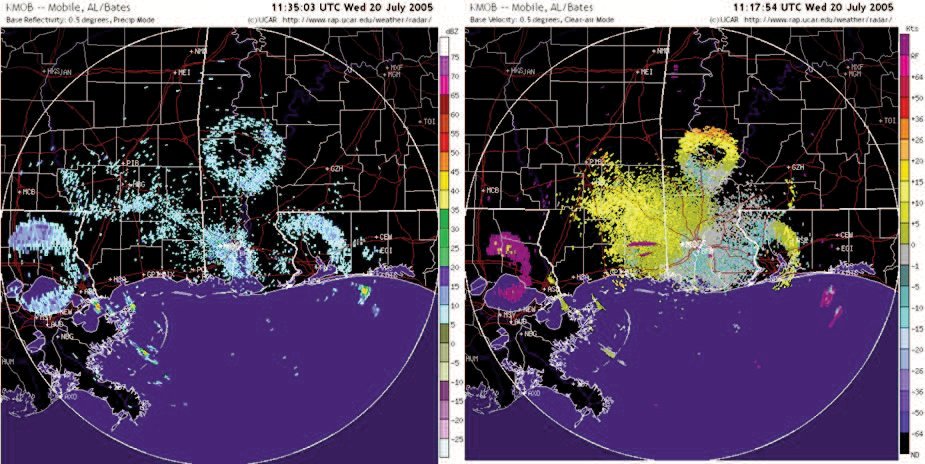
Radar has also given us a better understanding of the type of habitat migratory birds in general utilize as stopover areas. As most birds depart from their stopover habitat shortly after dark, they rise into the radar beam. This image can then be overlaid onto a land cover (Landsat) map where usage patterns emerge. The density of the birds coming from riverine floodplains (in particular, bottomland hardwoods) is tremendous compared to upland hardwoods and pine flatlands. Obviously these food-rich floodplains are very important for migratory songbirds seeking to “refuel” as they travel to and from their breeding grounds.
Management implications
Due to the fact that purple martins are dependent on artificial housing, the ramifications of no longer managing this species in this way would be disastrous. In addition to nesting site availability, the loss of bottomland hardwoods (especially floodplains) and roost sites through clear-cutting, conversion to pine monocultures, and development threaten the survival of martins. Landowners who have suitable habitat for these activities should consider Neotropical migrants in their management plans. Another challenge the birds face is competition for nest sites from non-native, invasive species such as house sparrows and European starlings. The entire North American population of purple martins is in a long-term decline, possibly due to these introduced species as well as free-ranging cats and habitat loss. Providing more suitable nesting sites and foraging habitat would greatly benefit the Eastern population of martins, but there are right and wrong ways to go about it.
Landlord responsibilities: House site placement and design
For those landowners wishing to become purple martin landlords, there are specific guidelines to follow when constructing housing and maintaining the colony. Research has demonstrated that martins prefer open flying space around their houses which means the placement of the apartment house or gourd cluster should be 10 to 20 feet high on a sturdy pole and 40 to 60 feet away from the closest trees. However, the threat of predation from rat snakes, raccoons, squirrels, crows, hawks, and owls makes placement near human habitations important as well—30 to 120 feet—for security reasons. This alone will not deter all predators so predator guards should be placed around the base of poles at least 4 feet off the ground to prevent bypass. If aerial predators attack, the best remedy is to construct a hardware cloth mesh cage around the entrance holes. Ants may be repelled by a greased or Teflon-coated pole. Materials for houses may be untreated wood (cedar, pine, or cypress are good choices), natural or thick plastic gourds, or aluminum. Some biologists suggest wood for its insulating properties while others argue the merits of the aluminum designs which are easier to clean. Whatever the material, the outside should be painted white or another light color to reflect heat. Adequate ventilation and drainage holes should also be a part of the design.
Apartment houses should be designed to attract martins and exclude other species, especially non-native English sparrows and European starlings. (Additional single unit bird houses can be built for other native species requiring lodging such as bluebirds, wrens, and great-crested flycatchers which may compete for nest cavities.) The purple martin house compartments should be rough-floored and at least 6″ x 6″ but larger, deeper cavities such as 7″ x 12″ afford more protection from the elements and predators. The internal height of the individual compartments should be 6″ or 7″. Entrance holes need to be 2″ in diameter and placed 1″ above the floor. A starling-resistant entrance is an option and is crescent in shape and has the following dimensions: 13/16″ H x 2¾” W and ½” above the floor. Since male martins are territorial and exhibit “porch domination”, separating the apartments with a wall will reduce cavity hoarding while at the same time increasing occupancy rates. The dividers will also reduce the risk of young wandering into empty compartments or stealing food from younger nestlings. Porch railings at each entrance hole will help hold in eager nestlings and make perching easier for the adults. Extra perches can be placed on the roof of the apartment so martins can “socialize.”
Gourds should have the hole drilled facing straight out so that young don’t fall out and rain doesn’t fall in. The suspension wires should be of a material that will resist rot. The inside of any nest cavity should be accessible for regular nest checks for determining the health of the active colony as well as cleaning in the off-season with a 10% bleach solution (1 bleach : 9 water). Never use a pesticide in nest compartments! To ease the job of cleaning and conducting colony health assessments through nest checks, a telescoping pole with a winch is advisable to use. Most importantly, nest boxes should be cleaned and closed up at the end of the season to keep out paper wasps, dirt daubers, squirrels, and other interlopers. Raise the poles and reopen the houses when adult martins are spotted circling the site of the established colony. Opening the houses too early will only invite other species to claim the cavities first. For landowners hoping to establish first-time colonies, open the new housing 4 to 6 weeks after the first adult males arrive in your area. (The map associated with this article shows the approximate dates the first martins arrive in certain regions of the United States.) Some researchers suggest playing a recording of the “dawn song” (around 4:00-6:00 AM every morning) or even “daytime chatter” from an active site in hopes of luring prospective tenants. These recordings should be broadcast from close to the martin housing for the association to work.
Purple martins are one of the most, if not the most, popular backyard birds in America. There is a seemingly never-ending supply of information in books and on the Internet. One great source of accurate and reliable information, and the provider of most of the data presented above on house design, is the Purple Martin Conservation Association out of Erie, PA (www.purplemartin.org). This national organization provides books and CDs as well as a Colony Registration Program, forum, magazine, and grant opportunities. They also provide great downloadable information sheets on record keeping tips, solutions to common problems with colonies (e.g. parasite overload), and emergency care for nestlings. Armed with the best knowledge of purple martin life history and behavior, you too can successfully manage purple martins on your property and help perpetuate the continued survival of the species.
Literature Referenced:
Bailey, Mark A. Attracting and Maintaining Purple Martins. Wildlife Trends 1(2):15-17.
Brown, Charles R. 1997. Purple Martin (Progne subis). In The Birds of North America, No. 287 (A. Poole and F. Gill, eds.). The Academy of Natural Sciences, Philadelphia, PA, and The American Ornithologists’ Union, Washington, D.C., 32 pp.
Clemson University Radar Ornithology Lab. 2007. Roost Rings. Retrieved September 5, 2007 from the World Wide Web: http://virtual.clemson.edu/groups/birdrad/COM4G.HTM.
Gauthreaux, Sidney A., Jr. and Carroll G. Belser. 2003. Radar ornithology and biological conservation. The Auk 120(2): 266-277.
Gill, Frank B. 1995. Ornithology, 2nd ed. W. H. Freeman and Company, New York, NY. 766 pp.
Hamel, Paul B. 1992. The Land Manager’s Guide to the Birds of the South. The Nature Conservancy, Chapel Hill, NC. 367 pp.
Purple Martin Conservation Association. 2007. Erie, PA. Retrieved September 5, 2007 from the World Wide Web: http://www.purplemaritin.org/.
Purple Martin Society, NA. 2007. IL. Retrieved September 28, 2007 from the World Wide Web: http://purplemartins.com/default.asp.
Russell, Kevin R. and Sidney A. Gauthreaux, Jr. 1999. Spatial and temporal dynamics of a purple martin pre-migratory roost. Wilson Bulletin 111(3): 354-362.
Sibley, David A. 2003. The Sibley Field Guide to Birds of Eastern North America. Alfred A. Knopf, Inc., New York, NY. 294 pp.
Sibley, David A. 2001. The Sibley Guide to Bird Life and Behavior. Alfred A. Knopf, Inc., New York, NY. 588 pp.
US Fish and Wildlife. 2007. Homes for Birds. Retrieved September 28, 2007 from the World Wide Web: http://library.fws.gov/Bird_Publications/House.html#2h.