
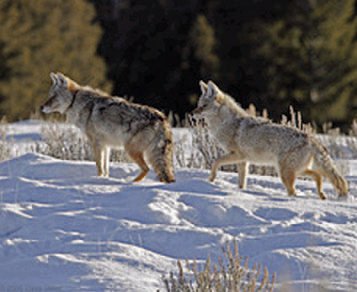
The coyote’s (Canis latrans) scientific name, Canis, is the Latin word for “dog”; latrans, is the Latin word for “a barker” and refers to this animal’s habitual barking. The common name is from the Aztec Indian word coyotl and should preferably be pronounced in the Mexican Spanish version “ki-o-tee” rather than in the corrupted form “ki-ot”.
Once an animal automatically associated with the West, coyotes now live in every state east of the Mississippi River. I can easily state that in my 30-years of predator control work, the coyote is the smartest predator I have ever pursued. Whether trapping, snaring or calling, the coyote’s defensive senses are more in tune than all other commonly found furbearing predators combined. One would think by having virtually no natural enemies that the coyote would become more susceptible to letting their guard down. This is not the case. To date, I have pursued coyotes in 10 different states and no matter what the habitat or terrain, coyotes are, without a doubt, the most prolific and creative predators that exist.
I firmly believe in proper wildlife management which includes predator control. However, I feel the need to debunk some myths about coyotes which I have heard all too often. These myths are just that, “myths”. One would be that coyotes readily attack small children. No, the big bad wolf did not really eat little red riding hood’s grandmother. There have been a few incidents in the northeastern United States where coyotes have attacked people. Why is unclear, but those who study these animals believe the coyotes mistook the humans attacked as wildlife prey. However, coyotes do not readily seek out, stalk and attack humans, even small children.
Even though coyotes are carnivorous, they are also termed as being, “omnivorous”. This means that coyotes eat a diversity of plant and animal material. In fact, the coyote’s diet during the hot summer months primarily consists of approximately 70-percent plant matter (i.e. berries, plums, watermelons, grass, etc.). I do know that when conducting coyote control work during the summer months, the coyote’s diet mandates me to utilize a different array of lures and scents than I normally use during fall, winter and early spring.
Now, I do not want to be misconstrued, coyotes are probably the most effective and devastating furbearing predator on game animals that exists today. Additionally, coyotes will predate on carrion, domestic cats and birds of all types. However, with being more and more encroached upon by humans, coyotes always seem to acclimate to their surroundings as well as to available food sources.
I have a friend who owns property in south central Alabama that, during the summer months, is overrun with cottontail rabbits. During late fall, winter and early spring, it’s hard to find a rabbit. This property has always had a high population of coyotes. It has always amazed me that the coyotes will not readily pursue the rabbits as a food source from late June through late September. However, when the weather turns cold, it’s bunny time!
The Eastern coyote is a social animal that generally selects a lifelong mate. Coyotes are quite vocal during their January to March breeding season. Both parents care for their young, occasionally with the assistance of older offspring. Four to eight pups are born in early May.
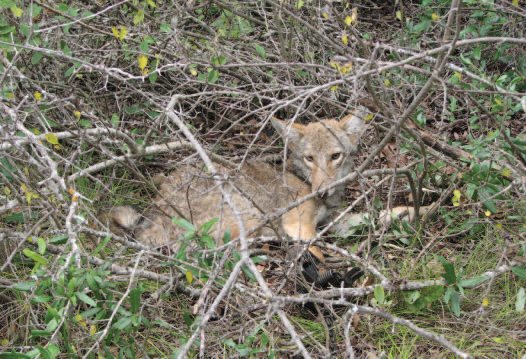
Unfortunately, whitetail fawning season and coyote denning season run concurrently. Coyote pup dispersal is approximately four to five months post-birth. During the latter half of coyote denning season, the adult coyotes will be on the hunt for red meat (i.e. adult and fawn white-tailed deer, exotics, quail, wild turkey, rabbits, etc.) Once dispersed, coyote pups can and will travel up to 30-50 miles from their den in an attempt to find a new home range. Coyotes are social animals and do maintain family groups. Additionally, they are very protective of their family’s home range which usually averages approximately 3-square miles when the young are being fed or as great as 25 – 30 miles in diameter during the rest of the year. Established coyote family groups will fight transient coyotes to the death, if needed, to protect their home range.
Coyote family groups usually consists of one Alpha male, one Alpha female, 4 – 8 subordinate adults and the Alpha male and female’s pups. I can immediately tell whether I have caught an Alpha coyote, subordinate adult or pup. The Alpha pair will be barking, howling, snarling and teeth snapping upon my approach. However, the subordinate adults, along with any pups, will be cowered down and very reserved.
Even though coyotes can be found in almost any type of habitat or terrain which exists today, they prefer to live in brushy country, along the edge of timber, and in open farmlands. During most of the year they merely sleep on the ground in some concealed, protected spot. However, during the breeding season, which usually peaks around February 15 each year, they have dens for their young. There may be several dens belonging to one family group; one for the young and others for escape or for use in case of a heavy flea infestation in the home den.
Dens are usually located in areas such as unused fields and are often close to timber or some other type of natural cover. They may be in a bank, under a hollow tree or log, in a rock cavity, or even under a deserted building. The den is frequently remodeled from one previously used by a skunk, fox, woodchuck, or badger. However, the coyote does sometimes dig its own den in loose soil. The one or several openings, usually well concealed by brush, are approximately 10-inches wide by 20-inches high. The one or more tunnels are from 5 to 30 feet long and 1 to 2 feet in diameter with an enlarged chamber at the end. This may contain some nesting material such as grass or fur. The pups occasionally dig pockets for themselves, considerably enlarging the den.

About 70 percent of a coyote population has to be removed annually in order to cause a population decline. Coyotes, like many other wildlife species, have demonstrated the ability to off-set population declines by increasing their litter size. It’s spurred by a built-in biological mechanism that responds to population deficits. Therefore, wildlife managers should understand that there is no quick fix in predator control and that it needs to be a continuous tool which is used throughout their long term management plan. For example, if feeding high protein deer feed to your deer, would you consider filling up your feeders just one time and expect that to sustain adequate protein supplement forever?
In my role as a Predator Control Specialist, I have clients who are becoming increasingly more aware of the fact that even if their whole population of coyotes, bobcat, etc., on their property is nullified that a transient population will soon move in and establish themselves. Therefore, in order to maintain protection for their wildlife resources, continuous predator control techniques must be utilized throughout the year.
Coyotes are the most prolific dry land predators that exist today. I highly encourage all wildlife managers to seriously consider incorporating a predator control program into their overall wildlife management plan. It only makes good sense to protect your hard earned investment!
Look for part 2 of ths article in the next issue as we check out the “hows” and “whys” coyotes do what they do as well as movement patterns and more.