
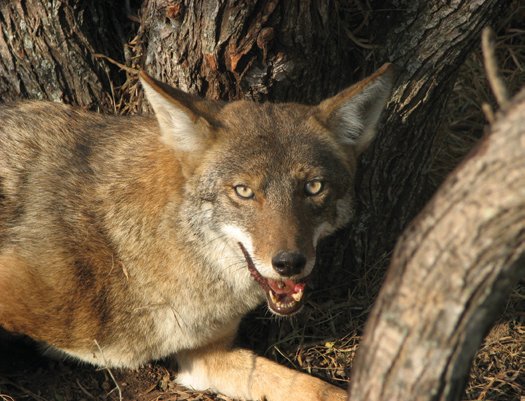
In Part 1 of this article, I touched on the fact that coyotes are omnivores, meaning that they eat both plant and animal matter. Additionally, coyotes are also widely known as being, “generalists”, meaning that they will take what they can get. They are usually not finicky about what they eat. During the late spring and summer months, berries, fruits, insects and amphibians are usually plentiful and the coyote takes full advantage of these minuscule offerings. However, coyotes are first and foremost carnivores and will most often go out of their way to enjoy a meal of fresh red meat such as the occasional field mouse, wild turkey poult and the ever so vulnerable fawn whitetail deer.
During late fall and winter, the colder weather mandates the coyote’s need for protein energy. Additionally, during this time of year, there are not many berries, fruits and insects available. Therefore, the coyotes acclimate to their habitat offerings and target animals such as cottontail rabbits, bobwhite quail, wild turkey, whitetail deer and various forms of livestock and poultry which may be available. In my job as a Predator Control Specialist, I must understand and take advantage of these facts in order to be most effective in my pursuit of coyotes and other predators.
The coyote is at or very near the top of the food chain wherever it may live. Humans are the number one predator of coyotes and the main reason is because coyotes and humans compete for many of the same things. Most of my clients are individuals who spend a great deal of money, time and effort in managing their habitat for wildlife species such as whitetail deer, bobwhite quail, wild turkey and sometimes, even exotic species. As you can imagine, these individuals do not take predation of their wildlife lightly and welcome my services in curtailing and dramatically decreasing their coyote populations.
There are two basic methods of catching coyotes; snares and traps. There are also two basic methods of setting these devices to catch coyotes; either as a “blind” set or as a lured or baited set. Sound easy? Well, its not and it can get quite complicated. Any veteran coyote trapper will tell you that it takes years to become proficient at catching coyotes. The transition I went through from being a part-time “hobby” trapper to becoming a professional full-time Predator Control Specialist changed my way of thinking and pursuing coyotes and other predators immensely. Spending every day pursuing coyotes led to my knowledge being expanded and to start actually thinking like a coyote.
During the late fall and winter months, I take advantage of the coyote’s habits and diet by utilizing a lot of meat-type (protein) baited sets, along with skunk based type lures and scents which will emit odor better in colder weather. I have found that coyotes will more readily work these types of sets if they are more interested in eating protein based type foods, etc. During the months of January, February and March, I will include “matrix” type lures and scents which cater to the coyote’s mating instincts. Knowing the predominant habits and diet of the coyote during the late spring and hot summer months, I minimize the use of those meat-type baits and overly strong pungent odors. I utilize sets which are lured with what is called “curiosity” type lures and scents. Some of these scents and lures may even emit a “fruity” type odor.
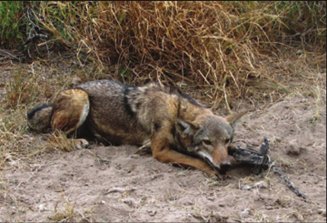
When conducting professional trapping instruction, the actual setting of the traps are just a small part of the knowledge I share with my students. I have to break their thought pattern down and get them to look at coyote (predator) trapping in a different way. Once I have successfully accomplished this task, all other technical information pertaining to trap placement, bait and lure type, set type, wind direction, etc., just falls into place.
This is the time of year (post deer season) that I most often hear from my clients that due to my consistent efforts in reducing their resident coyote populations, they have for the first time, been seeing successful twin and sometimes triplet fawn whitetail deer recruitment within their deer herd. I have numerous friends and professional acquaintances all over the Midwest, Eastern, Southeastern and Southern United States who are wildlife biologists and professional wildlife managers. Some of them do not feel that predation on whitetail fawns is a significant problem. However, as a Professional Predator Control Specialist and one who makes their sole living by reducing predator populations (i.e. coyotes), I can personally attest that there is a direct reflection on increased whitetail deer fawn recruitment and additional wildlife prey species due to significant coyote population declines, via effective and consistent predator control efforts.
Coyotes have been known to live up to 10 years in the wild and 18 years in captivity. They are, without a doubt, the most abundant wild member of the dog family in the United States. The overall population is increasing because of a natural extension of range, an increase of density within the range, and transplants by humans.
Last year was the very first year in 29 years of trapping predators that I did not catch a single fox during the entire fall or winter months on my fur trap lines. However, my coyote catch dramatically increased in those areas that I previously harvested a fair amount of red and gray fox. Foxes are natural enemies of coyotes because they predate on the very same prey species with the exception of live whitetail deer. Coyotes will kill every fox that provides them the opportunity. Last year’s results on my own winter trap lines reflect that the areas that I personally trapped currently have a much higher population of coyotes than foxes. You can bet that if you are not seeing any or very few foxes in your area that the coyote population has exploded. If there is no concerted effort in incorporating and maintaining a predator control program on your property, the only predators left standing will eventually be coyotes. Coyote populations can be very invasive to all predator and prey species alike. Manually controlling their populations is fundamental to healthy wildlife management.
Coyotes will occasionally hybridize with domestic dogs and produce fertile offspring. These hybrids are commonly known as, “Coy-dogs”. The resulting young may resemble one or both parents and, in some instances, may look so much like the coyote parent as to mask its mixed inheritance. A laboratory scientific examination of the animal’s blood is sometimes the only way to positively identify accurate genetics of these particular animals. However, actual coy-dogs will, most of the time, be larger than a true 100 percent full-blooded coyote.
This has always been my perception as to why the Eastern coyotes are, on the average, much larger than coyotes of the Western and Southern (south Texas) United States. The average weight of all coyotes that I harvest in south Texas does not exceed 25 pounds. In turn, the average weight of coyotes that I personally harvest in the east and southeastern United States is usually around 35 pounds or more. Think about it: areas of the United States with the greatest human populations also have the greatest domestic dog populations and therefore, provide the greatest opportunity for domestic dogs and coyotes to mate and reproduce.
It is significant that coyotes show a great adaptability to live in man’s world and to survive under other than pristine conditions. I have had many individuals who share with me their ideas on what they think is the most effective method to control coyote populations. I will be the first to admit that I do not know everything. However, some of the methods that these individuals “think” are the ultimate solution just right out scares me. It has become very apparent to me that a lot of wildlife managers, livestock owners, etc. have not been exposed to a professionally operated predator control program and how scientifically based it is premised and how effective it can be, if continually practiced.
If you are a wildlife manager or a landowner attempting to manage wildlife species on your personal and/or hunting land, I urge you to consider seeking the services of a professional Predator Control Specialist. Be certain to require multiple recommendations of previous work history. Honesty and credibility should be at the top of your requirement list. Good luck with properly managing your wildlife resources!