
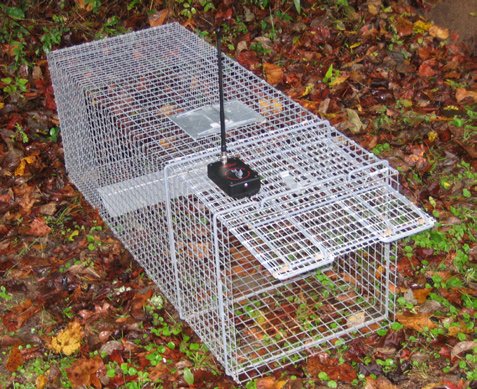
Over the past several years the role of predator control has been brought to the forefront of quail management. Recent research at Tall Timbers Research Station (TTRS) and the Albany Area Quail Project (AQP) have conclusively demonstrated the positive population impacts of integrating an aggressive mammalian nest predator control plan into an overall quail management program. Predator control forms one of the three principal legs of the quail management triangle. The other two legs of the triangle are effective supplemental feeding and development and maintenance of a diverse and productive understory vegetation.
TTRS and AQP have worked cooperatively on a multi-year predator control study that uses a classic “cross-over” design. Two pairs of large acreage tracts were selected in both the Thomasville and Albany area. During the first 3 years of the study only one site at each location was intensively trapped while the other site was not trapped. After the initial 3-year period the treatment (predator control) was “crossed over” to the other paired property and the initial trapping area was not trapped. While the completed data from this project is still being analyzed the preliminary findings show dramatic differences in all measured reproductive parameters such as higher nesting success and more chicks produced per hen on the trapped sites. When treatments were reversed, predators quickly re-colonized the previously trapped areas and substantially reduced quail reproductive output and fall population levels. Conversely, the newly trapped sites responded in a predictable manner by having higher reproductive output. What was remarkable is how quickly predators moved into the previously trapped areas and how effective they were at reducing the overall quail population.
Quail managers in recent years have responded to this information by initiating aggressive trapping programs using large numbers of box, or live, traps. The key to the success of these box trap programs is that large numbers of traps are utilized on a permanent or semi-permanent basis, thereby providing an aggressive and consistent predator deterrent. Traps are commonly placed at a density of one trap for every 10-20 acres of habitat. Capture rates vary from plantation to plantation and throughout the year. On well-managed properties capture rates average about 2-5% daily (2-5 captures per 100 trap nights). The main drawback to this type of a trapping program is the large labor, fuel and equipment costs necessary to “run” several hundred traps on a daily basis.
American Wildlife Enterprises (AWE) has developed a telemetry-based system that remotely monitors individual box traps and provides the manager with daily information on trap status. This system will allow a manager to check the status of 100 traps in just 5 minutes. Up to 800 traps can be monitored by this system. Therefore, on a classic 3,000-acre plantation with 200 box traps, the manager can simply listen for 10 minutes while having his morning coffee to decide which 4-10 traps he needs to visit. The “heart” of this system is a powerful radio transmitter that has a unique frequency allocated to a specific trap. Upon closure of the trap door, the transmitter sends a uniquely identified radio signal to a centrally located scanning receiver indicating that a trap has been closed. The base receiver and antenna are normally set up at the plantation office; however, the system has tremendous flexibility and can be used in remote and non-permanent locations. An LED has been included on the transmitter that blinks once the trap door has been closed. The LED will turn off once the trap door has been opened, therefore allowing the trapper to know that the system has been properly re-set. One additional benefit of this system is that it allows for placement of traps along principal predator movement corridors as opposed to a standard trapping system that uses primary and secondary roads for speed and efficiency of trap checking. When using a box trap monitoring system (TMS) traps are only visited when they have been closed or during re-baiting. Therefore, traps can be located in remote areas of the property. A good quality aerial photograph or map is all that is required for establishment of this system. If needed, AWE can develop a cost effective map with trap locations clearly marked.
The key to making a TMS cost-effective is developing a series of baits that will last approximately one month. A considerable amount of experimentation has been done over the past year by experienced local trappers to develop long-lasting and effective baits. While chicken eggs are fairly effective we have also had good success with a modified “cray fish” bait or plastic eggs filled with a “stink” bait or lure, which should last approximately 3-4 weeks. The improved effectiveness of these types of baits means traps only need to be visited once monthly. We are beginning to understand the efficiencies of baits over time; however, more experimentation is needed. Future research should help to develop more effective and longer lasting trap baits.
While the “start up” cost for this type of system is fairly high; the savings in labor, fuel and vehicle maintenance should allow for recovery of initial expenditures within 1.5-2 years. This system is currently set up on properties in Florida, Georgia and South Carolina and on these sites the managers feel that a 1.5 year “break even” time is very realistic. Transmitters should last for several years and have been designed so that the user can change the batteries. With proper care the monitoring system should provide many years of quality service. A minimal amount of training is all that will be required to operate this simple system.
For further information on the feasibility of this system for your property please contact Brad Mueller at (850)-997-3551. I look forward to discussing your particular situation in more detail.