

Despite notable successes with species such as white-tailed deer and eastern wild turkey, not all species have thrived in modern landscapes. Throughout the Southeast over the past 30 years, some species of wildlife have declined to historic lows, specifically songbirds and small game species associated with early successional habitats and grasslands. Although it’s perhaps more appealing to blame these losses on single issues, like fire ants or predators, the most important reason for these observed declines is the alteration of an entire ecosystem. Granted, by the early 1900’s the Southeastern landscape was already highly altered by the land use practices of Europeans’ settlement and agricultural development. But these land use practices created a diverse mosaic of row crops, native grasslands, fallow fields, and forest to which bobwhite and other early successional species were ideally suited. The high bobwhite populations of past decades were an accidental by-product of those agricultural times and the early successional habitats created through timber harvest, primitive agriculture, land fallowing, and broadly applied fire. Today, by necessity, modern land use practices strive to maximize food, fiber, and forest products and have the net effect of simplifying the landscape. These land use practices, coupled with interruption of natural disturbance regimes (e.g. fire exclusion), have contributed to a reduction in landscape complexity, or heterogeneity, and reduced the number of places where bobwhite can prosper and the population size which a given location is able to support. Declining habitat quantity and quality has produced fragmented and isolated bobwhite populations that may be more vulnerable to harvest and predation.
Although it is not feasible to return to those days when farming was done by mule or 1-cylinder tractors and natural fire regimes will never be restored on historic scales, it is possible to provide wildlife habitat in the context of today’s agricultural and forested systems. In the July/August 2007 issue of Wildlife Trends, we described how one landowner in northeast Mississippi has been able to improve wildlife habitat and enhance wildlife populations while still maintaining a productive working farm of 5,200 acres. However, recreational properties are typically much smaller than that and most landowners have limited resources to allocate to wildlife habitat management. In this article, we would like to show you how the owners of a newly acquired smaller property (338 acres) could manage their lands primarily for wildlife recreational opportunities in an agricultural landscape.
Property Description
The property that is the focus of this article is located in Monroe County in northeast Mississippi. The native vegetation of this region was warm-season native grasses and scattered hardwoods. This is in the Blackland Prairie region and fire was an important historical factor that shaped plant communities. However, today most of this region has been cultivated or converted to exotic-forage grass pasture. For the past two decades, this property has been used for recreational hunting and for generating income through the Conservation Reserve Program (CRP). Eighty-seven percent of the property (294 ac) is enrolled in CRP and the remaining 13% is wooded. Although CRP grasslands can provide excellent quail habitat, most do not. On this property, the CRP currently provides little bobwhite habitat. One hundred seventy-one acres (51% of the property) is CRP grassland dominated by a mixture of fescue and Johnson grass with scattered native grasses (broomsedge) and forbs. Seventy-eight acres (23%) is CRP with encroachment by sapling hardwoods (primarily green ash); 42 acres (12%) is CRP with advanced (diameter >1″) hardwood invasion. Thirteen percent (45 acres) of the property is in forest, characterized by cedar, Osage orange, green ash and other low-quality hardwoods located in hedgerows, drainages, and an old pond site.
Like many properties in the Southeast, active land management on the area has been limited to maintenance mowing and establishment of a few, small, rye-grass deer food plots (totaling 3 acres). These practices have had little or no positive impact on carrying capacity or habitat quality for focal wildlife species. Most southeastern landowners strive to produce large bucks on their property. Many are willing to implement the principals of quality deer management to achieve this objective. However, effectively controlling harvest on a scale sufficient to manage sex/age structure of the population requires control of several thousand acres. This property, like many in the southeast, is too small to independently manage harvest and production in a way that produces quality bucks. However, through cooperation of like-minded adjacent landowners, a management cooperative could be developed to achieve harvest/age structure objectives on a larger scale. Furthermore, a property of this size can be managed so as to produce an abundance of high-quality white-tailed deer forages that are distributed in a manner so that viewing and harvest opportunities are maximized.
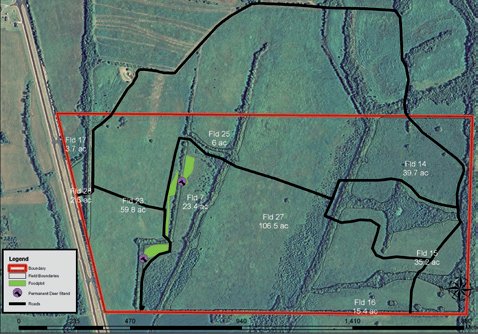

Many landowners would also like to support bobwhite populations reminiscent of past decades. Like quality deer management, successful bobwhite management is scale-dependent. The same intensity of management, conducted over a larger scale, will normally produce a greater response. Population modeling studies have suggested that, depending on the frequency and nature of catastrophic weather events, harvest rate, and bird density, as much as several thousand acres may be required to support viable bobwhite populations independent of surrounding habitat over the long run. Furthermore, achievable sustained densities may be a function of total area under management. But most landscapes, even today, support low density bobwhite populations (1 bird/10 – 20 ac). When appropriate habitat is created and maintained local populations will respond and increase. On this Mississippi property, advanced natural succession, exotic forage grasses, historic land use practices, and lack of appropriate periodic disturbance limits habitat for bobwhite and other early successional or grassland species. However, nearly all of the property is conducive to bobwhite management and could provide habitat that would support sustainable bobwhite populations. Additionally, the property lies in a portion of the state that has been identified as having high potential for bobwhite habitat development. Although the surrounding properties are in row crop and pastures, habitat improvements within 5 miles of this property have already been made through establishment of several thousand acres of native warm-season grass pastures and CRP buffer practices. The new landowners would like to implement a plan that would provide sustainable bobwhite populations that would allow for quality dog training opportunities and some recreational hunting. This article will outline a suggested course of action that could achieve their ownership objectives.
Habitat Issues
The various seasonal habitat needs of bobwhite are provided by different stages of early successional habitats, those plant communities that develop after some form of land disturbance. Bobwhite thrive in areas that have high interspersion of several different plant communities including perennial native grasses, annual weeds, grain crops, mast-producing shrubs or trees, and shrubby cover. The subtle changes associated with just a few years’ growth can dramatically alter the value of habitat to meet the bird’s seasonal needs. Because bobwhite are relatively sedentary, it is essential to provide all of their seasonal habitat needs in a relatively small (40 ac) area. Consequently, the distribution of habitat components is as important as the amount.
Successful bobwhite management entails identifying those components that are lacking in either quantity, quality, or distribution, and then managing the landscape to increase the proportion that is usable to bobwhite. An evaluation of the Monroe County property revealed that four essential resources – nesting habitat, brood-rearing habitat, shrubby cover, and winter food – are limiting.
Nesting cover is characterized by 2-3-year-old idle native grasslands with moderate litter accumulation. Perennial grasslands dominated by native bunch grasses such as broomsedge, little bluestem, or Indian grass provide excellent nesting cover. Bobwhite often nest in proximity to low shrubby cover. The time since disturbance (i.e. prescribed fire) will influence the degree of litter accumulation, and hence suitability for nesting. During the first growing season following a dormant season burn, little or no residual grass cover remains and the grass stand does not provide nesting habitat until late in the nesting season. In the Southeast, native grasslands provide just the right amount of residual litter during the second growing season following a dormant season burn. By the 3rd growing season, litter accumulation may have become too dense to provide optimal nesting cover. Periodic disturbance, on about a 2-yr rotation, is therefore required to maintain appropriate nesting cover.
Brood-rearing habitat is typified by 1-2 year-old fallow annual weed (forb) communities with abundant (25 – 50%) bare ground and high insect density. Broods also use clumps of woody shrubs for shade and loafing. In contrast, the property in question is dominated by exotic grasses which have formed a dense, thick mat of vegetation unsuitable for nesting or brood-rearing. Prior cropping created a poor seed bank, further reducing plant species diversity. Management of the CRP fields by mowing has created a dense duff layer, reduced bare ground, inhibited germination of desirable native forbs and legumes, and shifted the plant community to a relatively monotypic stand of perennial grass. Mowing also did not provide long-term control of encroaching hardwoods, because it simply top-killed them, allowing them to sprout again from the roots.
The open nature of the property and interspersion of wooded hedgerows and drains are an asset and will provide some escape and winter cover. Roosting cover, however, is poorly distributed in the property’s CRP fields, many of which are covered with exotic grasses on the ground and green ash in the overstory. Roosting cover is best provided by a mixture of annual or perennial weeds, bare ground, and shrubby, woody cover. The absence of grain crops, annual weeds, and mast means fall and winter food resources are also absent on the property.
In summary, the 338 acre tract provides opportunity for bobwhite habitat management. However, existing grasslands are poor in plant species richness and dominated by fescue, Johnson grass, and in some places advanced natural succession. Little nesting cover or brood-rearing cover is available, and year-round food resources are limited. Management activities will need to be focused on creating and maintaining habitat that meets all the seasonal needs of quail, particularly nesting and brood-rearing habitat. The goal will be to maximize usable space on the property in an attempt to approach 100% usable.
Managment Recommendations
Bobwhite management in the lower coastal plain of the Southeast is primarily vegetation management to maintain a diversity of early- to mid-successional plant communities. Annual disturbance is essential to maintain the plant community in a suitable stage. The primary management tools used to achieve this are rotational rowcropping, disking, prescribed fire, judicious use of herbicides, and timber thinning where appropriate. Where exotic plants dominate, the first step is eradication of these invasive species so that native plants to which bobwhite are adapted can be reestablished. The objective of a management program should be: (1) make every square foot of a managed landscape usable to bobwhite; (2) ensure an interspersion of plant communities that are readily accessible for these short distance fliers; (3) address factors such as energetics and predation which may inhibit population growth.
CRP grasslands can provide essential nesting, brood rearing, foraging, and roosting habitats for quail. However, the CRP grasslands on the Monroe County property are dominated by fescue and Johnson grass and, over much of the area, are quickly becoming a hardwood forest. Therefore, the first step for quail management on this property will be to eradicate exotic grass species and invading hardwoods, then plant appropriate native warm-season grasses (NWSG), legumes, and forbs.
CRP fields in this condition are not only poor bobwhite habitat, they are also out of compliance with the CRP contract which states that the fields will be maintained in grass cover. Re-enrollment of these fields in the newly-developed Continuous CRP practice CP38 will provide annual income and offset the costs of more-intensive management. The CP38 is a state-specific practice under the continuous CRP program designed to restore and maintain high-priority habitats. Each state identifies the wildlife species and habitats that are highest priority in their region and develops a practice that provides the desired habitat. In Mississippi, restoration of native grasslands within the Blackland Prairie physiographic region is an approved CP38 practice. However, to be eligible for re-enrollment, the fields must be “physically capable of being cropped”, which, in their current state, they are not. Consequently, the woody encroachment will need to be eliminated.
Native Grass Restoration for Nesting Brood-rearing Habitat
Native warm-season grasses (NWSG) are annual and perennial grasses that were present prior to the introduction of non-native grasses such as Bermudagrass and Tall Fescue. Native grasses are regionally adapted to climate and rainfall and local wildlife species are adapted to these native communities. “Warm season” means these grasses primarily grow during summer months (and also during portions of spring and fall). When we replant native grass, we also establish some of the native forbs (e.g. wildflowers and legumes) that historically occurred with these grasses. Some of the most common NWSG species include Broomsedge, Big Bluestem, Little Bluestem, Broomsedge, Indiangrass, Switchgrass, and Eastern Gamagrass. Common forbs include partridge pea, ragweed, native wild sunflowers, coneflowers, butterfly weed, black-eyed Susans, and many other species.
In some situations, a native warm-season grass and forb community is already present but is suppressed by competition with non-native grasses. Use of either a selective herbicide to which NWSG are tolerant (i.e. imazapic) or application of a non-selective herbicide (i.e. glyphosate) during a time when the cool season vegetation is actively growing and NWSG are dormant (i.e. fall or spring) may release the native plants and satisfactorily restore that community.
For some sites native plants are scarce and the seed bank is impoverished. This is the case on the Monroe County property, and undesirable vegetation will need to be eliminated so desirable plants can be established. To eliminate the fescue in the property’s CRP fields, an herbicide-burn regime will need to be applied. In the fall, fifteen-foot firebreaks will need to be disked around the perimeter of each field and around areas of hardwood encroachment to prepare for fall and winter prescribed fires. These disked lanes will also later serve as brood plots and food plots. Both fescue and glyphosate are herbicides that are effective in eradicating fescue. Research by Dr. Tom Barnes in Kentucky and Dr. Craig Harper in Tennessee has shown that either a spring or fall application can effectively eradicate the fescue, but in many cases a fall applications works better. These herbicides can be used individually or in combination, as is marketed under the product named Journey®. For this property, I recommend that the landowners apply 64 oz. (2 qts) glyphosate (Roundup-Pro®, Roundup-Ultra®, or generic glyphosate) + 0.5% non-ionic surfactant in the 20 gallons of water per acre when the fescue is actively growing in October or November. Roundup® is a foliar active, non-selective herbicide, meaning that plants absorb it through the foliage and it will kill or injure most plants (read labels prior to use). During February or early March, fields that were sprayed with herbicide during the previous fall will be burned to remove residual dead grass prior to planting. Approximately 2-3 weeks after the fire and 2-3 weeks before planting to NWSG, an additional application of 11 oz. Journey® + 32 oz. of glyphosate and 1 pint methylated seed oil in 20 gal H2O per acre will be needed to help control competing weeds. Journey® is a foliar- and soil-active herbicide with residual activity that will kill any remaining fescue and control Johnson grass seedlings released by the fescue eradication and prescribed fire.
In April – early June, the locally-adapted NWSG and forb seeds will be planted at appropriate rates. The recommended mix for the Monroe County property is a 3-species mixture of Little Bluestem (2 lbs PLS/ac), Indian Grass (1 lb PLS/ac), and Big Bluestem (1 lb PLS) with addition of 2 lbs/ac total forbs that include partridge pea (1 lb/ac), Black-eyed Susan, Maximilian Sunflower, Purple Coneflower and Coreopsis to add diversity, visual appeal, and abundant insects. The fluffy seeds of Big Bluestem, Little Bluestem, and Indiangrass are best planted with a no-till NWSG seed drill specially designed to handle these seeds. No-till establishment is generally preferred, but if the site must be plowed before planting, a firm seedbed will need to be prepared prior to planting to prevent seeds from being buried too deeply. Cultipacking following plowing or discing can prepare this firm seedbed.

Prescribed fire is an essential tool for management of grasslands for bobwhite. Regular application (2-yr interval) controls native grass density and stand composition without accumulating litter as mowing does. Burning only half of the area each year in late February to early March provides annually available nesting habitat. Prescribed fire is permitted, and even cost-shared, under the CRP program, however, it must be incorporated as part of a management plan in the CRP contract and be conducted within guidelines established by NRCS. In Mississippi, landowners must: (1) have a written, notarized burn plan, including a description of smoke management; (2) have a burning permit from MS Forestry Commission issued the morning of the burn; (3) conduct the burn with a Certified Prescribed Fire Manager; (4) establish a fire break between areas to be burned and surrounding areas; and, (5) execute the fire within the parameters specified in the plan.
Hardwood Control
Prescribed fire on a 2-year rotation will inhibit invasion of green ash; however, in many places on the Monroe County property, these stands have succeeded beyond the point of control with fire alone. Dormant season fire would simply top-kill these trees, but would not kill the rootstock, allowing prolific re-sprouting. For areas with seedling and small saplings (<1″ diameter), a combination of herbicide (one that will eradicate both the saplings and the fescue), followed by prescribed fire, disking, and site preparation for planting to NWSG will be needed. In the fall, after the fescue has greened up but before leaf-fall, landowners will disk 15-ft. fire lanes around the units needing control, then apply 2-5 quarts of glyphosate + 0.5% non-ionic surfactant in 20 gallons of water per acre. Alternatively, 32 oz of Chopper® (active ingredient imazapyr) could be used. Between January and February, but after the fescue and trees have completely browned down, prescribed fire will be applied to the unit. Disking, harrowing, and cultipacking may be necessary to prepare for NWSG establishment, depending on amount of residual woody stems. As an alternative to herbicide application, recent research by Dr. Craig Harper has shown that prescribed fire applied in September can also be effective in eliminating green ash saplings.
Those fields with advanced tree invasion (saplings 2-3″ diameter) will require even more pre-planting treatment. Mechanical removal alone would leave well established root-stock that would re-sprout. Herbicidal application could kill the trees and the rootstock, but would leave the stems standing. For complete conversion back to open land, these areas need a combination of herbicide, followed by mechanical removal, disking, and site prep for planting to NWSG. After nesting season (approximately August 15) and before September 15th, the Monroe County property owners will need to apply with a skidder- or tractor-mounted sprayer 4 quarts of Garlon 4 ® + 0.5% non-ionic surfactant in 20 gallons of water per acre. Alternatively, 32 oz of Chopper® would also work. Larger trees, or trees in stands too dense to penetrate with equipment, will need to be treated manually by using “hack and squirt”– hacking a cut into the tree trunk with a small hatchet and spraying 1 ml of 25% Arsenal AC ® solution into the cut. After complete leaf fall, these areas will need to be cleared with either a mechanical mulching machine or a bulldozer. A mulching machine will not leave dirt piles, although there will be considerable woody mulch on the surface that will have to be incorporated or removed. Clearing with a dozer/shear blade may leave less surface debris and require less disking, but debris will have to be piled and burned.
After the sites are cleared, and when soil moisture conditions are appropriate, the sites will have to be deep disked, harrowed, smoothed, and cultipacked in preparation for planting.
Shrub Plantings for Cover
Another essential bobwhite resource missing on the Monroe County property was shrubby cover. Bobwhite use low bushes for loafing and thermal cover, escape from predators, and as a “covey headquarters”. Shrub thickets should be a minimum of 20 – 30′ across and ideally be available every 100 yards, so that birds are never more than a short flight from cover. Although the property of interest has an over-abundance of wooded habitat, very little is in appropriate low-growing shrubby cover. Furthermore, the understory of fescue restricted access to the extant woody cover. Strategic plantings of clumps of shrubs such as Chickasaw plum will be established by planting 36 seedlings in a 6 x 6 grid on 6′ spacings. Shrub planting locations can be disked in the fall and new shrubs planted during the winter and early spring using a dibble bar. Either before or after planting, but prior to bud-break (February – March), 2 oz. of Oust XP® (or equivalent) in 10 gal H2O with no surfactant will need to be applied to reduce herbaceous competition.
Growth of low, shrubby cover will be stimulated along wooded corridors adjacent to grasslands through a practice called edge-feathering. This process requires removal of low-quality hardwoods, such as sweetgum, hackberry, cottonwood, sycamore, and green ash, from 30 – 50 feet from the edge, allowing sunlight to penetrate to the forest floor. Desirable hard and soft-mast producing trees (oaks, walnut, persimmon) should be left to provide fall and winter foods for both quail and deer. Periodically (3-5 yr rotation) allowing prescribed fires to burn through these edges will maintain the early successional structure, but allow development of shrubs.
Winter Food
Cultivated grain crops (corn, beans, sorghum, etc.), annual native weeds (pigweed, ragweed, foxtail, etc.), and legumes (partridge pea, Lespedeza spp., Desmodium spp.) provide important fall and winter foods to bobwhite. Although the value of foodplots has recently been the subject of considerable debate, in general, the number of coveys that a place can hold can be increased with strategic provision of additional fall, winter, and early breeding season food. The goal of a comprehensive food management program is to provide a super-abundant, continuous food supply on a year-round basis. Natural vegetative response to management practices is frequently sufficient to provide ample food, however, factors such as poor seed bank or drought can sometimes reduce production of native seed plants. Also, different food types become available at various times of the year and will persist for varying lengths of time. Therefore, if a food plot program is implemented, it should be planned so that each potential covey is provided with 2 – 4 different food resources (in addition to native seeds) to ensure a continuous and reliable food supply throughout the annual cycle and in all years.
Research on radio-tagged bobwhite during winter has shown that these birds generally forage within 50 meters of woody cover, so food plots will be well-distributed and in close proximity to some type of woody escape cover. Each year approximately half of the permanent firebreaks on the Monroe county property will be planted to ragweed (5 -10 lbs/ac)/partridge pea (1 – 3 lbs/ac) or Kobe or Korean Lespedeza (10 -15 lbs/ac)/partridge pea, and the remainder planted in an annual grain food (10 – 20 lbs/ac).
Recommendations could include broadcasting and lightly harrowing plantings (15′ x 100-200 yards) of grain crops (browntop millet, soy beans, milo) alternated with equal- length segments of native seed plants.

Maintaining approximately 5% (28 acres) of the property in a mixture of year-round perennial plantings (Duranna white clover) and cool-season forages (oats and crimson clover) will provide nutritional benefits to white-tailed deer as well as enhance harvest opportunities. These plots should be placed to utilize existing cover and travel corridors and to maximize viewing and harvest. Food plot locations will need to be prepared with herbicide (glyphosate), deep-disking, and cultipacking to produce a firm seedbed, followed by broadcasting seed.
Supplemental Management Practices
On smaller properties like the one in Monroe County, supplemental feeding superimposed onto a comprehensive habitat management program may be beneficial. A successful supplemental feeding program involves year-round feeding of an energy rich food (milo). Supplemental feeding of milo can be conducted by broadcasting grain into cover (plum thickets, bicolor Lespedeza patches, black berry patches, etc.) or through use of feeders. However, individual landowners should check the wildlife regulations on supplemental feeding in their state. In some states, hunting in areas with supplemental feeding will constitute baiting.
Research has indicated that supplemental feeding in some years, particularly drought years, may increase total production, and hence fall population size. However, research has also clearly shown that good bobwhite populations can be produced with habitat management only.
The issue of predation and bobwhite populations is emotionally and politically charged. Predation management, as opposed to predator control, is based on understanding how to minimize predation on bobwhite nests, broods, and adults through indirect and direct management of habitats, predators, and prey. The key to indirect predation management is to provide sufficient herbaceous cover with scattered low brushy woody cover over extensive areas to provide protection from predators. Simultaneously, cover that supports or harbors predators (avian and mammalian) should be reduced or eliminated. Properties with an abundance of drains, creeks, bottoms, and hardwoods are likely to support a higher predator population. In these circumstances, reducing the abundance of common nest predators, such as raccoon, opossum, skunk, armadillo, fox, and feral cat, may be necessary to achieve the desired level of bobwhite population response. However, removal of a few individuals during a short period is unlikely to be of any benefit. To be effective, predator management must be intensive, conducted on a large scale (across the entire property), of sufficient duration to offset immigration, repeated annually, and conducted during the nesting season. As such, predator management is expensive and should not be undertaken in a haphazard fashion. Mesomammal nest predators can be most effectively managed with an intensive trapping program, however, specific wildlife regulations for resident states should be consulted prior to initiating any predator removal. Should a landowner elect to implement a predator management program, all predator removal must be conducted in a legal and ethical manner. Any use of toxicants (poisons) is non-selective, dangerous, expressly forbidden by numerous statutes and would constitute a violation of Federal and State wildlife code and off-label use of a registered pesticide. As such, these activities should never be employed. Birds of prey (hawks, owls and eagle) are federally and state-protected and can only be managed indirectly by habitat manipulation.
Future Options
Bobwhite management is a function of scale of application. The same intensity of management will accrue a greater per acre response when implemented on a larger acreage. As more acreage is drawn into management, you should expect a greater level of response. Therefore, when faced with quail management on smaller acreages, acquiring additional adjacent properties or forming cooperatives with adjacent landowners who implement similar practices should be considered, whenever feasible, to achieve greater sustained population levels. Similarly, an expanded wildlife program that includes quality deer management objectives could be achieved if a cooperative of like-minded surrounding landowners could be formed such that common harvest objectives were applied over a larger (> 2000 ac) tract.
Managing smaller properties for sustainable bobwhite populations is a feasible option for many landowners. But before initiating any management, factors such as: (1) location of the property relative to historic quail range and existing quail populations; (2) types of habitat and land use practices on adjacent properties (3) land use history; and (4) the status of current habitat on the property should be considered. A 300-acre tract like the one in Monroe County is suitable for quail, albeit with considerable amount of management to reestablish conditions. However, a 300-acre tract covered primarily in closed canopy hardwood forest will not be conducive to quail management, even if the openings are planted with food plots. A 300-acre tract covered with large pines could be managed for quail if the timber was thinned to substantially reduce basal area and the forest floor managed for grasses and forbs. In any case, consultation with wildlife biologists and experienced private land managers can help a landowner decide whether quail management is possible on his property and what financial incentives might be available to offset management costs.