

Prescribed fire is one of the most useful yet misunderstood and under-utilized tools for land managers, foresters and wildlife biologists. While there seems to be some increase in the use of fire in woodlands in the last decade (roughly 1 million acres in Alabama), there are many more millions of acres that need burning and are not getting it. In this pair of articles, we will discuss the benefits, risks, and opportunities of burning during the different seasons of the year. The first article will cover use, benefits and techniques of cool or dormant-season burning and the second will cover growing-season burning.
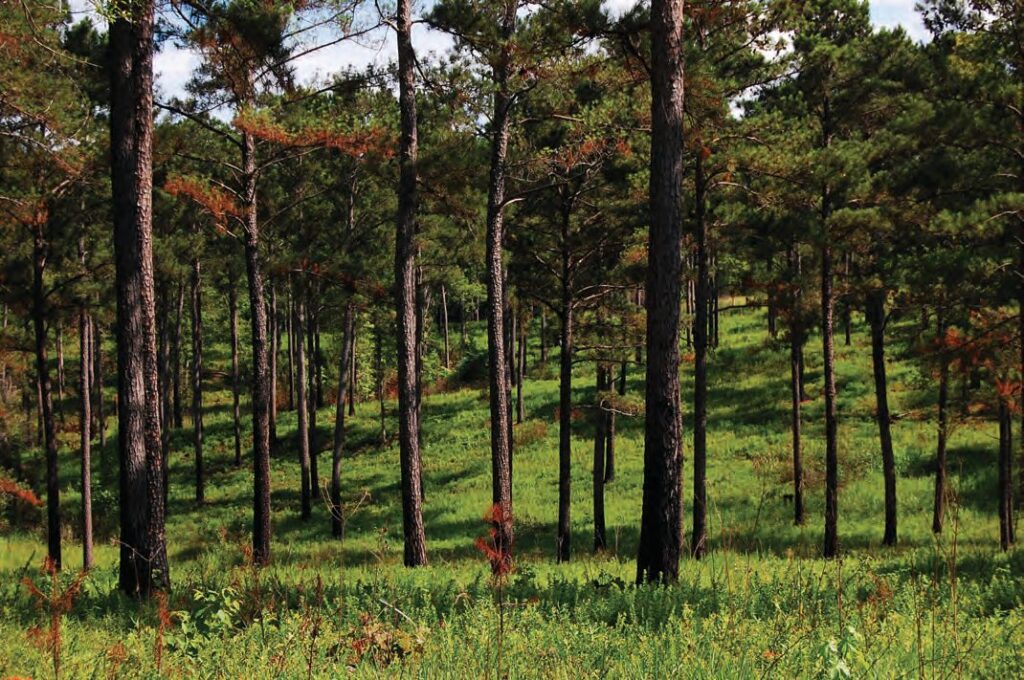
In the deep Southeast, fire has been an integral part of the evolution of our woodlands. From East Texas to Virginia, from the Gulf of Mexico to the Appalachian Mountains, the natural ecosystem has been driven by regular fire. Most of the coastal plain area south of the piedmont was forested in Longleaf pine and, historically, a burn interval of 2-5 years was the norm. Lightning or native American set fires burned vast acreages and the habitat it created was described by early explorers like William Bartram in the 1770’s. He described “a vast forest of the most stately pine trees that can be imagined”, which continued for many miles”. Another description – “passing through a level, open, airy pine forest, the stately trees scatteringly planted by nature, arising straight and erect from the green carpet, embellished with various grasses and flowering plants”. For those who think old-growth hardwood forests of oak, beech and chestnut were the natural pre-settlement condition of the Southeast, there is this account: While passing through South Carolina’s longleaf forests in 1858, Englishman Charles Mackay wrote
“Where, northward as you go,
The pines forever grow;
Where, southward if you bend
Are pine-trees without end;
Where, if you travel west,
Earth loves the pine-tree best;
Where, eastward if you gaze,
Through long, unvaried ways,
Are pine-trees evermore.
These early explorers also described abundant wildlife populations of deer, turkeys, bear, panthers, bison, elk, pigeons, etc., all dependant on the fire-maintained woodlands of the Southeast. Needless to say, fire was and is an important driving force in our woodlands.
In our business, we see plenty of properties that utilize regular burning and enjoy the benefits of it. We also see plenty more properties that either don’t burn or don’t burn enough to make much of an impact. The benefits of prescribed fire are many. Regular burning:
- “opens up” the understory of pine woodlands allowing easier wildlife access
- increases visibility and hunter access, thereby increasing hunter success and enjoyment of the land
- increases aesthetic values and promotes wildflower production
- helps control the density of shrubs and hardwood saplings, allowing more sunlight to reach the ground
- encourages a more open understory grows more grasses and weeds providing food for all wildlife species
- promotes legumes and perennial grasses for food and cover for wildlife
- acts as fertilizer for some understory plants
- reduces hazardous fuel buildup that leads to wildfires
- Helps control some insects and diseases
- Helps increase timber growth by controlling competing vegetation
- Helps increase timber value by allowing loggers visual access to all timber so they know what they are buying
- Helps decrease negative impact of logging by cleaning up sapling hardwoods before loggers are on site
Remember though, if you have a pine site that has never been burned and is choked up with midstory hardwood saplings, one burn will NOT make a significant impact. However, regular burning, especially in conjunction with mechanical or chemical control of the hardwood saplings, will clean up and maintain a beautiful and productive pine woodland.
Most burning in the Southeast is conducted in the winter or “cool season”. It has become the traditional time to conduct burns because 1) no nests or young-of-the-year wildlife are at risk and 2) regular fronts pass through leaving consistent winds and 3) dead vegetation is abundant and available as fuel. Cool temperatures and lower humidity are very conducive to burning. While only focusing on this season limits the time and acreage you can burn in a season, this is the season we will focus on in this article. Growing season burning will be discussed in the following article.
Because of the lower humidity and consistent winds of late winter/early spring as well as dry fuels on the forest floor, winter/spring is a relatively simple season to burn. A large amount of acreage can be burned in a relatively short window of time. Dry broomsedge and pine needles and even hardwood leaves act as a good fuel base for fires. This is an excellent season for “maintenance” burns to help keep fuel loads low and control the density of shrubs and small saplings. It is also a good time for first burns to reduce fuel accumulation while acclimating the area to burning where fire has rarely been used. Some conditions dictate winter burns only:
- Longleaf less than 15’tall
- Sites that have not been burned in the last decade
- Hardwood sites
The caveat is that while conditions are often good for burning, weather conditions are often “too good” for burning. Humidity levels lower than 25% and winds above 10 mph are common and make burning volatile. Under these conditions, prescribed fires become unstable and can be hard to control. Since liability is a major consideration in prescribed burning, making sure that conditions are suitable and your fire stays inside the burn area is essential. It is amazing how much more valuable the neighbor’s timber is when it has been damaged by an escaped fire. It is usually MUCH more valuable than any logger or procurement forester would pay for it!
Keeping control of YOUR fire and reducing the impact of YOUR smoke is of utmost importance. Escapes do happen and plans for how to stop escapes are an essential part of the planning process. Smoke management is also a major liability concern on all burns and knowing what your smoke is expected to do and where it will go is also important in planning the burn. Knowing where any housing developments, urban areas, airports, schools, hospitals, roads or other smoke-sensitive areas are allows for planning required wind directions and smoke dispersion levels for your burn area. For instance, if you have a road bordering your burn unit on the west and north side, you will need a north and/or west wind to move smoke away from this hazard.
The type of fire to be applied is usually dictated by the terrain, weather conditions, timber type and age, fuel loading, fuel type and desired results. Discussing backfires is a sensible place to start. Backfires are fires burning AGAINST the wind. With winds out of the north, for instance, a backfire is one set on a southern firebreak and burns slowly to the north. Backing fires have the least intensity, flame length and rate of spread. Backing fires, however, have more “linger time” and do a better job of consuming fuels and burn deeper into the duff. These fires tend to be the safest and easiest to control. It has the least chance of scorch and is best used for “securing” downwind sides of burn units, as well as burning heavy fuel areas and young pine plantations. Bear in mind, however, that with a 180-degree shift in the wind, a backing fire becomes a head fire instantaneously! Due to the slow movement and better fuel consumption, backing fires can damage feeder root systems if soils and surface duff are too dry or in areas with heavy fuel buildup. Also, burning large areas takes a long time with backing fires.
Head fires are those fires that burn WITH the wind. These fires are usually fast, hot, don’t linger long and have high flame height. They can often carry, or throw, burning brands, leaves or other debris a considerable distance increasing the chance of an escaped fire. Burning large areas with head fires should only be done when the risk of escapes is minimal and all downwind areas are considered safe. For instance, large sections of open, grassy, pine woods in quail plantations can be burned with controlled head fires very quickly. This makes burning very cost-efficient.

However, head fires can also scorch timber easily, even large sawtimber, due to the release of a lot of energy in a short time frame. Canopy heat is usually much greater with head fires than with other types of fires. Head fires are best used where large acreage of light fuels need to be burned, especially under mature timber. Breezy conditions make the fire move faster but also keeps heat from building up in the canopy of the trees. Head fires produce a lot of smoke but quickly go out once the fire is past. This shorter “linger time” makes head fires ideal for burning young longleaf without damage to the bases of the trees.
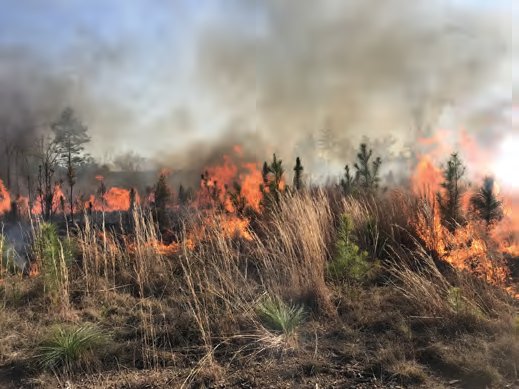
Flank fires are those fires that burn at right angles to the wind. Because winds shift considerably during a burn, flank fires usually alternate from flank, head, and back fires. These fires are useful for securing the “sides” of a burn block, where the downwind side has already been burned and secured with a backfire and the sides of the block are lit into the wind. Since these fires are usually a combination of back, flank, and head fires, they can be used to ignite larger amounts of acreage. Linger time, flame height, intensity, heat, and smoke all are intermediate between head and back fires.
These three types of fires are the most common used to secure burn block boundaries. Commonly, spot and strip head fires are used in the interior of the burn block to “finish out” the burn. Spot fires are simply individual spots of fire set inside the burn unit and allowed to burn to the downwind side. Spot fires combine all directions with head fires burning downwind, flank fires burning sideways and backfires burning into the wind. Strip head fires are lines of fire let to burn with the wind to the backfire burning off the downwind break. These fires consume more acreage with the head fire portion than the backfire but do burn with both back and head fires. The distance these fire types are set from the downwind fire dictates how hot your fire will be and how quickly your fire will burn the unit. The farther spot and strip head fires are set behind the downwind line, the hotter your fire will be and the more acreage will be consumed. Bear in mind that the areas where these fires meet will often be intense and can result in scorch.

By the time most folks are burning “winter” burns, fuels have had plenty of low humidity and windy days to “cure”. These fine “dead” fuels like broomstraw and other grasses, pine straw and small sticks and brush dry out quickly after rain events and often, after one to two days, will burn quick and hot in low humidity conditions. Volatile conditions of low humidity and/or higher winds often result in “poorly behaved” fires that seem to always attempt to get out of the burn unit.
This is especially true in areas where the fine fuels are “held up” off the ground. The amount of fuel and how high off the ground it is has a lot to do with how it will burn. Fuels like pine straw can be flat on the ground in a mat or held up off the ground on bushes, branches, etc, like a “ladder”. Situations where bushes like blueberry, wax myrtle, yaupon, etc. have draped pine straw, allows these fuels to dry very quickly and burn with access to a lot of oxygen. This can result in a very hot fire that “climbs” up into the tops of smaller trees. This is often the case where a site has not been burned in several years. Care must be taken to burn these sites carefully and slowly to avoid scorch and an escaped fire. One or two cool fires on sites like this help reduce this heavy fuel loading and removes the shrubs that hold the fuel off the ground. Later fires become more easily controlled.
On sites that have been more regularly burned, shrubs and small saplings are often less prevalent and fuels are composed of more “matted” pine straw and lower fuels like broomstraw and other grasses. While these fuels can burn quickly, they are, typically, not as hot nor tend to climb into the canopy. Winter fires are ideal to maintain these conditions and keep fuel loading low.
Interestingly, winter burns have a much better chance of burning down into hardwood drains and bottoms than growing season burns. Allowing fires to burn into hardwood areas is not a particular problem unless the fire is hot. In all fires, there is a risk of damage to hardwoods that you want to keep and high value trees of bottomland hardwoods, especially sawlog size trees, can be damaged by a hot fire. While a low-intensity backfire creeping into a hardwood stand usually does no damage, a fast, hot fire in low humidity and dry conditions can create a significant amount of “butt scars”, rot, mortality and reduce the value of sawlog hardwood. Many landowners establish permanent firelanes along all hardwood areas to prevent fires from entering hardwood stands. Those who prefer a more “natural” look let fires go into bottoms as the conditions allow.
Fire CAN be used in hardwood and mixed pine/hardwood stands, however care should be taken to use slow, cool fires to avoid damage to crop trees. Some species of hardwoods have developed thicker bark and are quite fire-tolerant. Upland oaks like white, post, southern red and other hardwoods like dogwood, and hickory have thick or “corky” bark and are very fire tolerant. Thinner barked “slick” trees like water oak, maple, etc. have the least fire tolerance and are easily fire damaged.
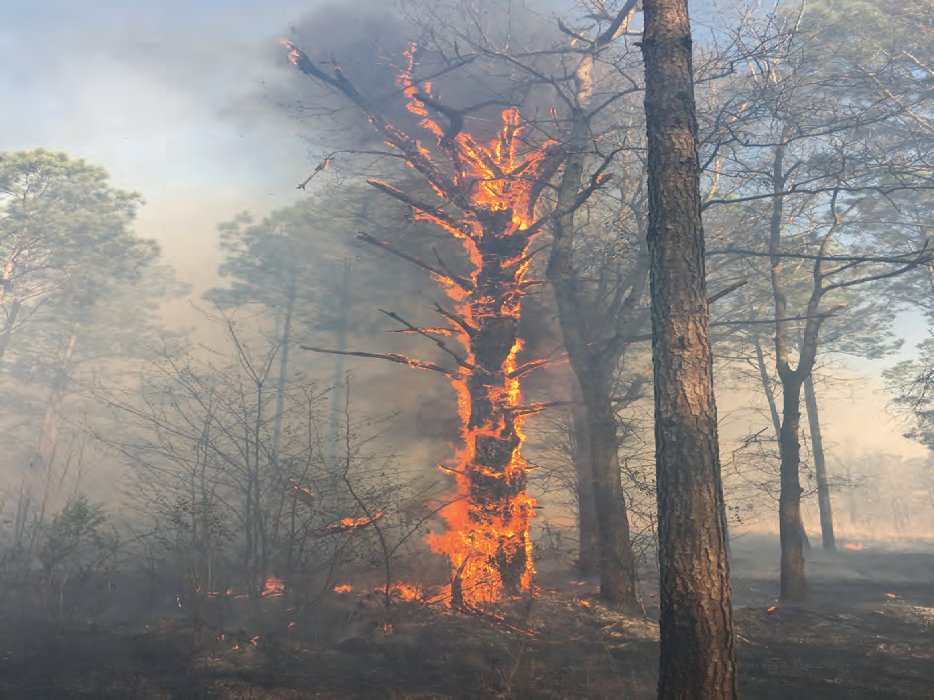
The bottom line with winter burns is that while conditions can be more volatile, fires can be used to impact a large amount of acres in a brief time. Smoke dispersion is usually better and winter burns tend to produce less smoke because fuels tend to be drier with less “greenry”. Cooler temperatures help keep scorch to a minimum. Heavy fuel loads and ladder fuels can be diminished easily this time of year. However, winter burns do not do a very good job of controlling hardwood sprouts and brush coverage. They can top kill sapling hardwoods up to 3-4 feet tall but do little damage to saplings larger than that. While they tend to do a good job of promoting “good” wildlife weeds and grasses, as we will see, there are better ways to promote good wildlife cover and food.
A quick note about firebreaks is in order as well. Firebreaks can be anything that a fire will not cross and often is different depending on the conditions. Wet creek bottoms, roads, and disked or bulldozed dirt lanes are the most common. However, a grassy road that has been driven on all winter and is packed down may hold a fire on one day with high humidity but fire might cross it vigorously on another day. A paved road is a good firebreak but if there is a lot of traffic it may not be the best firebreak to use. It is also very possible for fires on windy days to throw an ember across a paved road easily.
Burn conditions to be highly aware of and knowledgeable about are as follows:
Humidity – is often the driver of how well your fuel will burn. Humidities in the 30-55% range are preferred. Humidities in the 20’s can be dangerous and volatile. Above the 60’s it can be difficult to burn.
Temperature – Warm days dry out fuel better than cool days. It can be hard to burn when days are close to freezing and fire on days over 80 degrees can be damaging.
Surface wind speed and direction – Wind does some obvious things like move a fire and clear smoke. It increases ventilation and oxygen to the fuel helping it to burn in addition to helping it dry out. Some wind is almost always desirable. Wind speeds above 20 mph can start to get volatile unless in heavily forested stands.

Transport wind and direction – Transport winds help move smoke away from the burn unit and higher mixing heights help dissipate smoke plumes effectively.
Dispersion – Dispersion and atmospheric stability also help indicate how well smoke leaves burn units. Low dispersion days and stable conditions make smoke linger and risks smoking in roads or communities. High dispersion and unstable conditions allow smoke to disperse into the atmosphere. Keep in mind that dispersion almost always gets worse after dark and winds usually decline so smoke can linger and stay close to the ground overnight.
Probability of ignition – POI is an interaction of fine fuel moisture and temperature. It is measured in percent. If POI is high (70%+) and a hot brand falls across the line the chances of it resulting in a jump are high. Low POI can result in having a hard time lighting a fire.
Many of these conditions interact closely so days with higher temperatures and higher humidity can burn similarly to cooler days with lower humidity. Also, as a rule, humidities drop during the day as temperatures increase. A fire lit at 10 o’clock will be much more volatile at 2 o’clock in the afternoon so plan accordingly. Terrain is another condition that makes a significant difference in fire behavior. Fires burning up a hill act completely different than one burning down a hill.
General Rules and Conditions of Concern
AKA, How to NOT kill your timber and burn off the neighbors!
- Always secure the downwind side of burn blocks with firelanes, a body of water, creeks, roads, and/or backfire creating a “blackline” that is burned out and with no remaining fuels before attempting to burn the rest of the block.
- Burning is volatile when humidity is below 25%, soil moisture is low (KDBI index more than 400), winds are above 15 mph, or any combination of these.
- Fires nearly always burn fast, hot and head fire uphill. Unless you know what to expect, never light at the bottom of a hill or in a ditch going uphill.
- On windy days with low humidity, expect spotting across the firelanes with any head fires.
- In most cases, burn ridge tops first, where most scorch occurs, and allow the fires to “drape” off the sides of the ridges to the bottoms. On steeper slopes, most fires will “back” downhill regardless of wind direction.
- Ring fires (stringing fire completely around the burn block perimeter), will almost always result in severe damage in the middle. There is probably more timber damage done because of burning with ring fires than any other technique. The more walking out and stripping/spotting the middle of the burn blocks, the better the burn results.
- If smoke dispersion levels, fuel moisture levels, or humidity levels are too low, or winds too high, POSTPONE the burn. Better to burn another day than risk having to “fight” your fire all day or burn on another property.
- Take your time!! Rushing will get you into trouble, damage timber and result in jumps.