
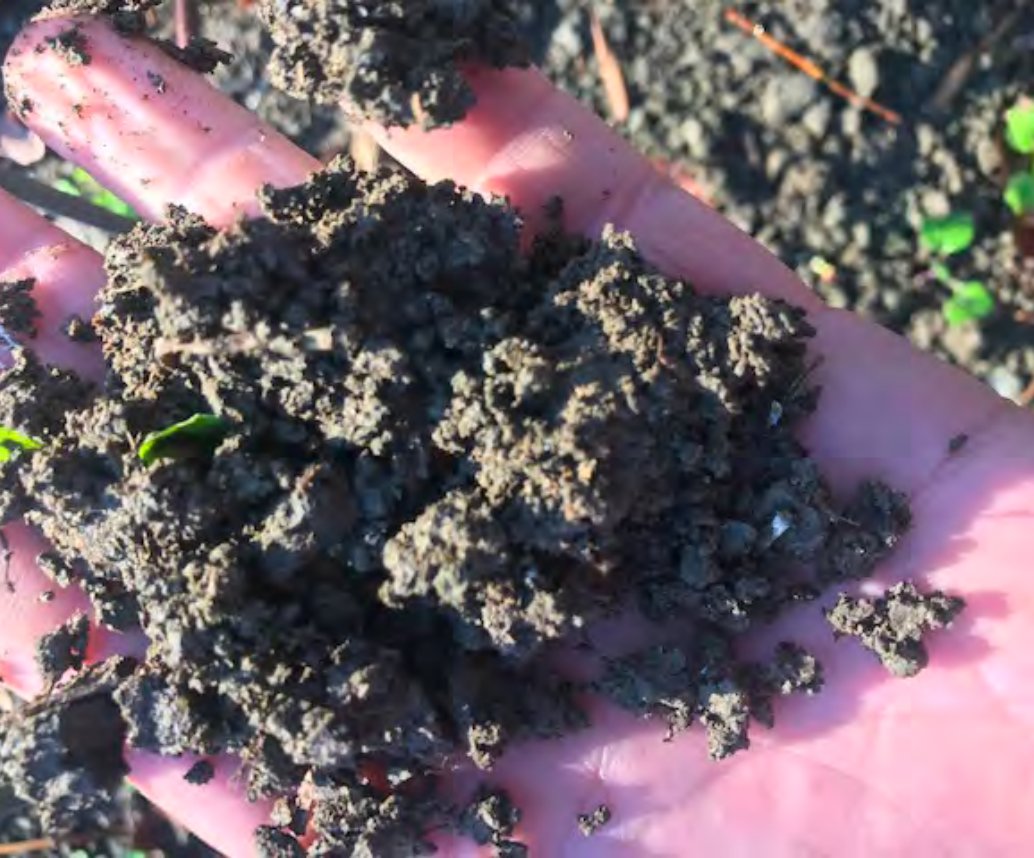
Food plots are an important factor in a quality wildlife management program and provide many benefits to hunters and landowners alike. Food plots attract and increase the chance of harvesting wildlife species such as deer, turkeys, dove and even wild hogs. During the summer months, food plots are used to provide essential wildlife habitats and high-quality forage to increase antler development and help pregnant doe during gestation. Food plots can also provide suitable bugging areas for turkeys as well as cover and feeding areas for quail.
With the many benefits food plots provide, one must do their research and carefully prepare the very ingredient responsible for a food plot’s success or failure – soil.
Between seed, fertilizer, time, and equipment costs, planting a one-acre food plot can cost more than $250. Many people buy the same commercial mix every year, spread 4 bags of 13(N)-13(P)-13(K) (N-Nitrogen; P-phosphorus, and K-potassium) per acre and expect everything to grow vibrant and healthy. If the plot soil pH is below 5.5 or above 7.4, all that money may have been wasted, not to mention the cost of fertilizers that may have been unnecessary.
A successful food plot program requires knowledge of the soil and what it has available by way of nutrients for a plant to not only grow, but thrive. Cation exchange capacity, pH, available phosphorus, nitrogen, and potassium are all important factors to consider. Each has a direct effect in the production and attractiveness of a plot. A soil analysis provides all the information you need to get a food plot management plan together to ensure maximum forage production. A soil analysis is low cost, and one of the most important pieces of information when planting food plots.
What does a soil analysis tell us and how do we get one?
A soil analysis is the best way to start a good nutrition plan for each plot so the crops grown can provide the most attractive and nutrient rich foods for the wildlife. A soil analysis will identify limiting factors in forage production such as pH along with macronutrients like phosphorus and potassium. The minimal cost of a soil analysis up front can save thousands of dollars in wasted fertilizer and seed down the road. An analysis will also steer how a seed and fertilizer budget should be allocated for each field. Think of it as a risk management tool for food plots.
Crops require different nutrient needs along with optimal soil type. If clover or other inoculated legumes are going to be planted alone, nitrogen does not need to be present. However, phosphorus and potassium are necessary, each at different levels. Common winter cereal grains like wheat, rye, and oats do require nitrogen at higher levels. The pH is also extremely important in crop production and nutrient availability and a soil analysis will provide that information. Some plants grow better in a pH of 5.7 to 6.2 while others may prefer a more neutral pH of 7. If you know the pH of the soil, it may affect the decision about what crops are planted in which plot.
How a soil sample is collected is just as important as the final lab results as improper sampling can lead to invalid results. The first factor in taking a good soil sample is to have good spatial variability over the entire plot. This will give a good sample of the field and provide a representation of what is most predominant in that plot. This means that the final 2 lbs. of soil sent to the lab should include soil from the entire plot. Collecting one scoop of soil from the middle of the plot and sending it in for analysis only provides information on that spot. Collecting samples from many sites in the plot will provide a more accurate result for interpretation. Most wildlife openings are under ½ acre and in these smaller plots, a minimum of three various samples should suffice, but five samples are recommended, especially in plots one acre or more.
The depth at which each soil sample is collected is also a factor in producing a good soil analysis. Collecting a hand full of soil from the top layer does not indicate what is happening at the root level. Some plants have shallow root systems. Yet others, like wheat, can penetrate many feet below the soil surface. An analysis of the top 6 inches may show nutrient values much different than what is 12″ to 18″ below the surface. Nutrients such as nitrogen can move many feet through the soil, but potassium may only move a few inches and phosphorus does not move at all. It is imperative to collect a sample that represents what is happening at the surface as well as one to two feet below.
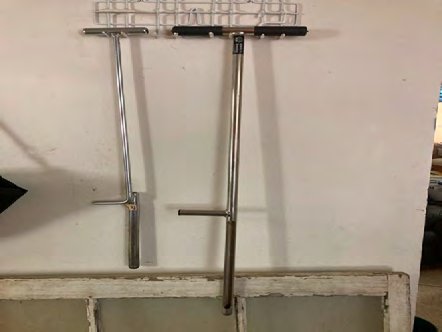
Soil scientists use a soil probe to collect soil at varying levels. A probe is the fastest and simplest way to take soil samples from numerous plots quickly and is worth the cost. Soil test probes come in all lengths but one that will take a minimum 12″ plug is recommended. The probe is pushed into the ground and the plug is easily removed. Soil probes can range from $50 to $200 a piece. The higher cost products tend to be heavy duty and have the added footstep that aids in penetrating deeper into the soil, making them ideal for sampling heavy clays.
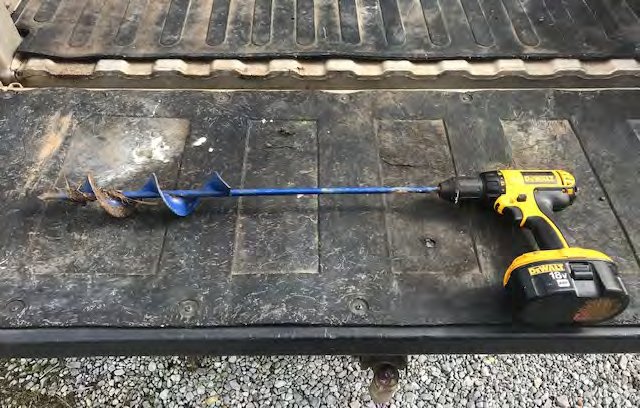
Another collection tool that works well in sandy or loam soils is the small diameter dirt hole auger. These augers attach to cordless drills and are easy to use. I recommend the ones with the 1.5″ bits as they don’t put as much strain on the drill. They can be found at many big box stores and the ones with smaller bits work great. They are very affordable, costing between $15 to $30. It takes a little more time to collect a sample, but it works effectively. The only issue that may arise with this tool is when trying to collect samples from a harder soil texture. Attempting to drill through dry clay soils down to 12″ can prove a little difficult.
There are many other ways to get samples such as using a spade or shovel. These methods work but are very time consuming. No matter which method is used, make sure to collect plenty of 12″ or deeper samples per plot. Put each sample in a bucket and mix well. Once the sample is thoroughly mixed, put a small amount into a container to submit to the lab. Labs only need a pound or two of soil for each analysis and many have their own containers and forms they require for submission. Depending on time of year and the soil lab, it can take more than 2 weeks to receive your analysis. Remember, the analysis is only as good as the sample provided.
Understanding the Results
Each lab will send the data from your soil samples in its own format. There is little consistency between each lab, but most will have the soil group which is correlated to the cation exchange capacity, pH, and macronutrient values. Next to these values, the report will indicate very low, low, medium, high, very high and sometimes extremely high levels for that nutrient. Some labs will provide recommendations on lime applications if the soil pH is too acidic. Nitrogen, phosphorus, and potassium recommendations may be included as well.
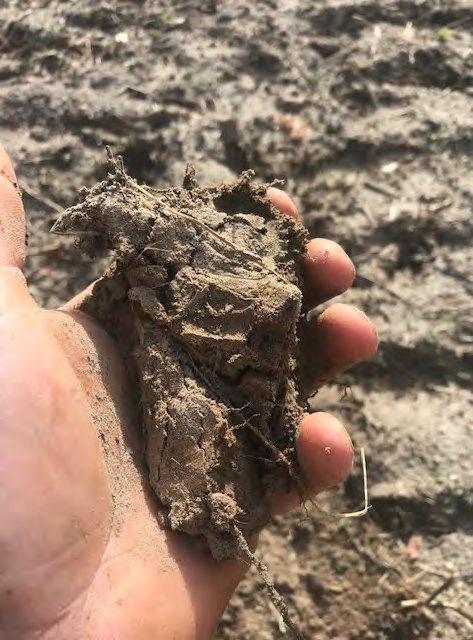
Two unique soil analyses, recently conducted, are detailed below. The first analysis was conducted using soil collected from the vegetable garden at my personal residence. The other is from soil collected at a hunting property I’ve managed since 1999. Each location has different soil types, determining the way I approach managing soil pH and fertilization requirements. The soil analyses from each property also demonstrates how different crop fertilization needs can vary so widely on the same property.
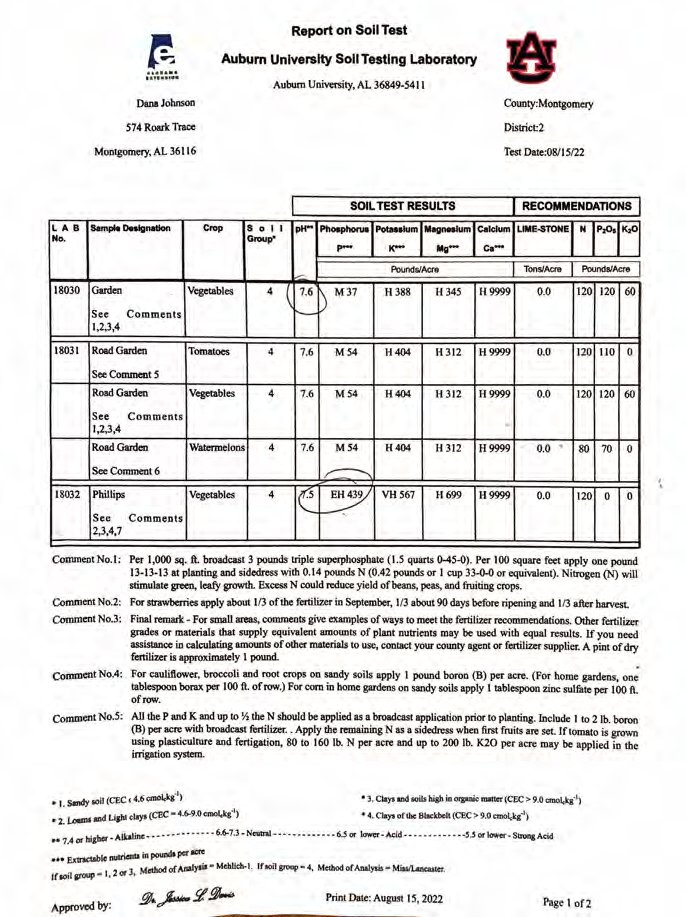
The first soil analysis is in illustration 1, Lab No. 10832, sample designation Phillips. This has been a garden site for 25 years and has never had a soil analysis completed. Soil types consist of blackbelt clays with a high cation exchange capacity (CEC – the capacity of a soil to retain nutrients.) Every year, a base 13-13-13 fertilizer has been laid. The soil analysis shows a pH of 7.5, extremely high phosphorus, and very high potassium. For growing general vegetables, the analysis recommends 120 lbs. per acre of nitrogen and no phosphorus or potassium.
Based on the soil analysis, the pH needs to be lowered, because both phosphorus and potassium are unavailable to the plant in this alkaline soil. This can be done by adding elemental sulfur, aluminum sulfate, or iron sulfate. Plants will start absorbing these nutrients once the pH is lowered to 7.0 and down to 6.0. Additionally, inclusion of ammonium nitrate can lower the pH level of this soil.
A few simple math calculations are then necessary to determine the amount of fertilizer recommended. For this plot, the results from the lab indicate a recommendation of 120 lbs. of nitrogen per acre. A 50 lb. bag of 32-0-0 means this bag is 32% nitrogen, hence the number 32 in the name. To know how many bags will need to be purchased, simply multiply the number of lbs. per bag. In this case, that would be 50 multiplied by 32%. The result is 16 which means each bag contains 16 lbs. of nitrogen. Divide the amount you need, 120 lbs. by 16lbs. and 7.5 is the result and number of bags you need to purchase for one acre.
In the same soil report, in illustration 1, Lab no. 18030, sample designation “Garden” has a pH of 7.6, but the lab recommends 120 lbs. of nitrogen, 120 lbs. of phosphorus and 60 lbs. of nitrogen. Already knowing that 7.5 bags of 32-0-0 is needed, the phosphorus and potassium must now be customized. To get 120 lbs. of phosphorus, use 5.21 bags of 0-46-0 or triple super phosphate and 2 bags of muriate of potash which is 0-0-60. I round up to whole bags as the extra spread over an acre will not hurt the crop.
When submitting a soil analysis, it is important to specify what crops are desired to be planted in the soil. To illustrate the point that different crops require different amounts of macronutrients, refer to the same illustration with lab number 18031 and notice the nitrogen, phosphorus, and potassium recommendations for three different crops. Tomatoes, other vegetables, and watermelons all require different amounts to maximize their crop potential. If this entire field was going to be planted only in watermelons, 80 lbs. of nitrogen and 70 lbs. of phosphorus are needed. Potassium is not recommended. If vegetables, other than tomatoes were to be planted in this field, 120 lbs. of nitrogen, 120 lbs. of phosphorus and 60 lbs. of potassium are recommended. Finally, if tomatoes are to be planted, 120 lbs. of nitrogen, 110 lbs. of phosphorus and no potassium are the recommendation from the analysis.
The second soil test report, completed in October 2022, is from a hunting plantation in Macon County I’ve been managing since 1999. The soil types on this 1000-acre property include all four soil groups. They include sandy soil, loams and light clays, soils with high organic matter, and finally blackbelt clay. Eight of the sixteen plots were tested as they are analyzed on a two-year rotation schedule. The results indicated the pH ranged from 5.1 to 7.7 and fertilizer recommendations were different for nearly every plot. Lab recommendations were calculated on pounds per acre and then adjusted based on field size.
Soil analysis was used to make specific decisions regarding each plot on this property. Two plots were not planted at all, but only limed. Lime takes approximately 3 to 6 months to raise a soil pH a full point and would still yield a low nutrient uptake by plants. If these fields had been planted and fertilized as normal, money would have simply been wasted on fertilizer and seed. The same holds true for another plot that was determined to be highly alkaline. In the spring, elemental sulfur will be added to this plot as the addition of sulfur can only create an impact when soil temperature is above 50 degrees. Ammonium nitrate could also be used to lower the pH, but one must also consider the cost of fertilizer in the planning process.
The remaining plots received specific added amounts of nutrients based on the soil analysis recommendations. Two plots had lower pH’s and it was recommended to add one ton of lime per acre. The landowner and I decided to lime and plant anyway in the hopes that by mid-January the pH will have adjusted enough to allow for nutrient uptake by the plants. Other plots received similar recommendations of additions of nitrogen, phosphorus, and potassium. We completed our calculations of the nutrients needed for each plot, based on the contents of nutrients in a bag, and purchased accordingly.
Soil Analysis: Is It Worth It?
You now might be thinking you have to be a mathematician to know how to properly plant a food plot for maximum wildlife benefit. Planting food plots is already a difficult task getting the equipment ready and rounding up the manpower to plant multiple plots to be ready by hunting season. Why, then, do we make it more complicated, collecting soil samples, sending them to a lab and waiting two weeks to get a report with seemingly random numbers you don’t understand. It can be tedious and time-consuming figuring out what each plot needs based on the soil analysis and trying to locate a store that carries all the different fertilizers recommended.
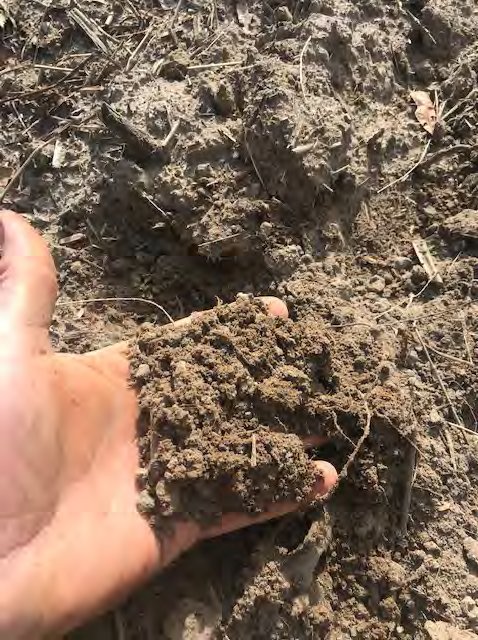
The simple answer is yes. But why? You can spread all the fertilizer you want over a food plot, but if the soil pH isn’t in a specific range, the nutrients simply will not make their way to the plant for it to thrive. Nitrogen, phosphorus, and potassium are not in a form available to the plant if the pH is not within a specific range. The cation exchange capacity (CEC) in soil is also important and the lab uses this to calculate recommended fertilizer amounts. Sandy soil holds fertilizer different than that of heavy clays. Sandy loams and light clays are much different than blackbelt clays. The soil analysis takes the soil type into account and allows the lab to make the best recommendations for the contents of fertilizer to be applied. If the plant cannot absorb the nutrients provided, then you have wasted your money purchasing the wrong kind of fertilizer.
Some nutrients may be in amounts that are toxic to plants and the environment. If you have a pH of 5.1, and apply too much nitrogen to the acre, the plant cannot take it up because it’s in what is called an unavailable form. Nitrogen also moves easily through soil and can leach into the environment with unintended consequences. For example, nitrogen can move below the root zone with excessive rain and directly impact water quality. This happens much more frequently on sandy soils than on clay.
Phosphorus is another example of a nutrient that can be toxic when not applied appropriately. Phosphorus does not move in soil and if the pH is very acidic or alkaline, phosphorus will also be unavailable to the plant and will remain stagnant until the pH is adjusted to a range that allows it to move. Many wildlife food plots can have excessive phosphorus because it has not been absorbed by the planted crop. Plants will not grow because the excessive phosphorus amount does not allow the plant to absorb nutrients like zinc, copper, and calcium. Extremely high phosphorus levels can even kill plants.
Food plot plants need Potassium for the adenosine triphosphate (ATP) that produces plant energy. This nutrient moves well in a soil solution, but not to the extent of nitrogen. Where nitrogen can move feet in soil, potassium may only move inches. Just like Phosphorus, if the pH is not within a specific range, plants will not absorb Potassium. Continued applications of Potassium can create excessive amounts and lead to toxicity issues. Too much Potassium will prevent plants from taking up much needed micronutrients to thrive such as magnesium, iron, zinc, and calcium.
Conclusion:
Conducting a soil analysis every two to three years is a cost-effective risk management tool for planting food plots that will thrive and benefit wildlife populations. Collecting and submitting a soil sample for analysis is logical and can save a landowner and hunters a significant amount of money. Deer and other wildlife will choose the most nutritious forage. On the other hand, plants that do not gain nutrients from the soil lose palatability. If you want to draw deer and/or other wildlife to your hunting area, collect a soil sample, send it to an accredited lab, and follow the recommendations; it is well worth the effort. To find a soil analysis lab near you, contact your local extension office for further information.