
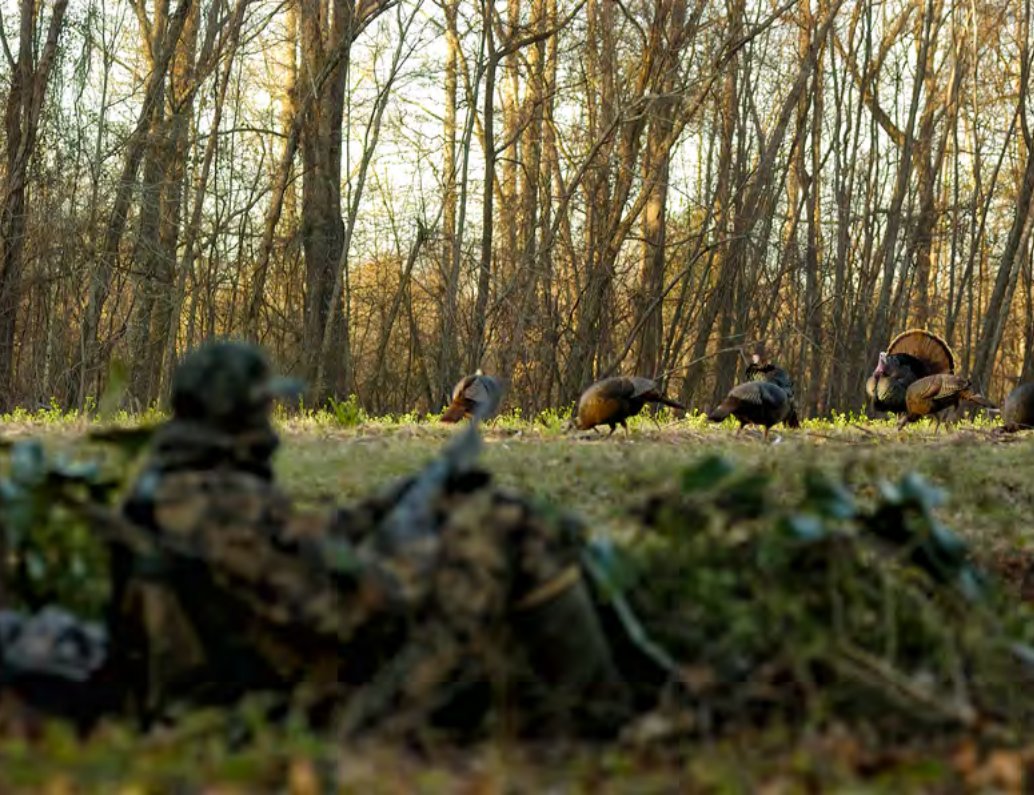
I saw my first wild turkey gobbler over six decades ago. He came to simple yelps produced by a handmade mouth diaphragm call. I was lying on my belly behind a fallen log. I don’t remember what I was wearing but the man I lay beside wore blue jeans, a khaki shirt and green cap. His shotgun was a Model 12 Winchester loaded with high brass shells stuffed with #6 lead shot. He trusted that set up out to 30 yards.
You may wonder how a boy of six years could remember details about a man all these years later. Easy, he did it the same way every time I turkey hunted with him until I left home for college. The man was my dad, and was considered a turkey man back in the day. In fact, he was one of only a few men who hunted turkeys in our area in those days. In his wildest imagination he could never have dreamed how turkey hunting would look today.
He was a man of tradition and very hesitant to change his turkey hunting methods and tactics. After all, nobody he knew had the experience, knowledge or strategy to persuade him there was a better way. He was content with yelp three times, wait 30 minutes, yelp three times and wait some more. He was confident in the method but for a young boy it was pure torture.
After college I began hunting turkeys on my own. The old school tactic of yelp three times, wait 30 minutes then yelp three times was replaced with aggressive yelps, cuts, clucks, purrs and cackles. Waiting 30 minutes for a result became the last resort as hunters learned aggressive calling and changing positions on a gobbler often put him in front of the gun. If you got busted so be it, there was usually another hot gobbler on the next ridge. It was during this evolution of turkey hunting that my addiction to turkey hunting became an incurable disease that afflicts me to this day.
Decades have passed since that morning with my dad and seeing my first wild turkey gobbler. The innovations and changes to the sport of turkey hunting are too numerous to list. There are, however, some innovations that have revolutionized how hunters outwit turkeys and give them a ride in a pickup truck.
The Glorious Decade
The decade of the 1980’s was a boon for wild turkey populations across the United States. State wildlife agencies developed trap and release techniques that returned wild turkeys to areas where they had disappeared decades before. The National Wild Turkey Federation, established in 1973, gained popularity in the 80’s and romanticized wild turkeys, turkey hunting and conservation of the bird and its habitat.
It was also during this decade that many innovative companies sprang onto the scene and introduced cutting edge products that literally changed how turkey hunters thought, talked and hunted. Everything from better calls, guns, ammunition and camouflage were introduced to the market place. Decoys, snake boots, copper plated shot—the list goes on and on. One of those companies was Mossy Oak® Camouflage. With the introduction of the original Bottom Land pattern, hunters were able to hide in plain sight of keen-eyed gobblers as they were coaxed into gun range.
Another company that shook up the turkey hunting world was Feather Flex® Decoys. Their introduction of light-weight, collapsible turkey decoys, crude by today’s standards, added realism to a hunter’s setup and distracted the attention of wily gobblers from the caller to the fake turkey in front of him.

Arguably, the company that had the biggest impact on turkey hunting during the 1980’s was Primos® Hunting. This company manufactured innovative calls such as stack frame mouth diaphragms, friction calls and more, but that was not what propelled the company to national recognition. The introduction of the Truth Series videos changed the turkey hunting culture by sharing the turkey hunting experience while educating turkey hunters simultaneously. Primos became a household name with America’s turkey hunters and developed a cult-like following that is still going strong today. Phrases such as cut and run, limb hanger, the Rodney Shuffle, call too much, call too loud and roasted ain’t roasted are widely used today to describe some of turkey hunting’s grandest moments.
I was fortunate to be a turkey hunter in the 1980’s and affiliated with the aforementioned companies in some fashion. In 1984 I ordered, sight unseen, a Remington 870 Special Field shotgun with a 21-inch full choke barrel. When it arrived, I replaced the straight English stock with a standard 870 stock and applied a custom paint job. Loaded with 2 ounces of copper plated shot, it was devastating on a gobbler at 40 yards. It would be 35 turkey seasons before I considered another turkey gun.
Sherwood Tactical
I first met Jeff Sherwood while turkey hunting near Cleveland, MS. I was struggling and needed help. Jeff agreed to show me some new ground. We clicked and became close friends. Jeff is a hunter with uncanny abilities and suffers greatly from his turkey hunting addiction.
Jeff is a machinist by trade and his company, Cleveland Hydraulics, serves the farming community in the Mississippi Delta. His passion is hunting and building guns. His other company, Sherwood Tactical (www.sherwoodtactical.com) produces custom-made, long-range rifles for hunters and target shooters and customized shotguns for turkey hunters.
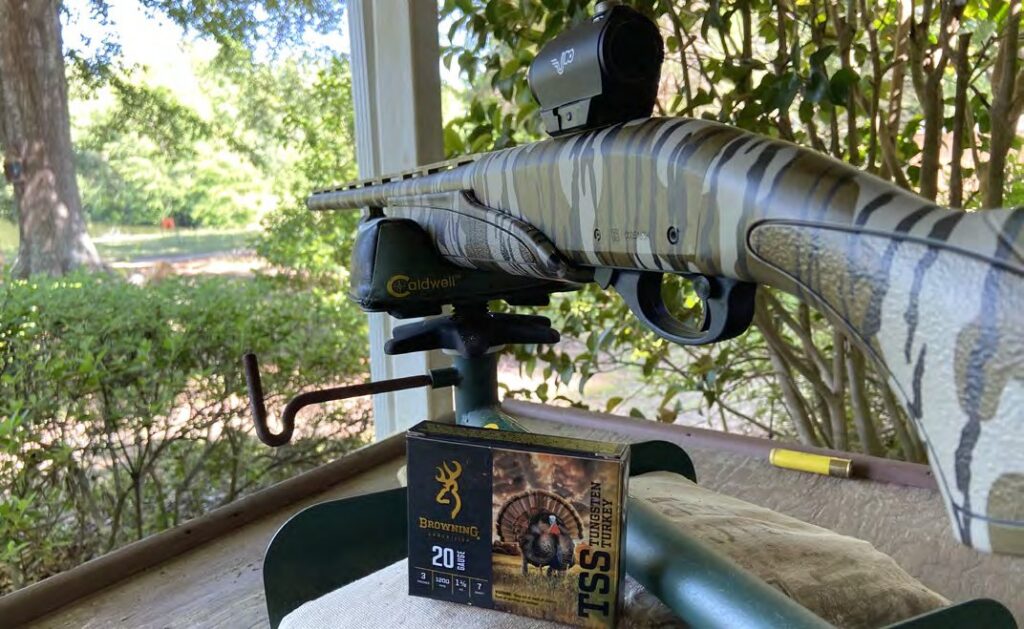
In February, 2020, my old friend Jeff Sherwood insulted me for the first time in our 30-year friendship. We were talking turkey hunting and he bluntly told me my old 870 Special Field was obsolete; a dinosaur. “Jolly, I can build you a 20 gauge that will smoke your old 12 gauge 870,” said Jeff.
My reply, “Prove it!”
When Sherwood says he will build you a shotgun, he actually takes a factory-built gun of your choice and customizes it to your specifications. In my case, he started with a black Remington 870 Youth model .20 gauge with synthetic stock and pump.
“You choose the gun. Doesn’t matter the brand or gauge. I take your factory-built gun and dip it in the camouflage pattern you choose. Once that is done, I install the optic of your choice or fit it with top-of-the-line rifle-style open sights. Now days most hunters choose small red dot optics for turkey hunting,” said Sherwood.
“The most important thing I do to a custom shotgun is make certain it fits the owner. Length of stock is very important. On most factory-built shotguns I have to raise the comb of the stock so your eye aligns perfectly with the optic. To do this I install a cheek piece on the stock and adjust it to fit the owner. This ensures your cheek is anchored on the stock and full view through the optic. This enhances accuracy and comfort when shooting the gun. When that is done, I evaluate the trigger. Most shotguns have terrible triggers for shooting stationary targets. They are hard to pull and normally have slack or creep. On some guns I can fix that but on others I can’t. If I can’t fix it, I recommend replacing the factory trigger with an aftermarket trigger.”
“When the gun has been fitted to the owner, I begin the process of matching a choke and load. In my custom rifles I develop a round specifically for the rifle. This is a meticulous process but when you leave with that rifle you have the recipe for the perfect bullet matched for that rifle. I don’t have to do that with shotguns,” said Sherwood.
For my gun, I chose Mossy Oak Bottomland for the camouflage pattern and topped it with a UDO red dot optic. Sherwood was able to work some magic on the factory trigger giving it a crisp break with no creep. I relied on Jeff to choose the choke and load.
“That’s the easy part,” said Sherwood. “I use a Carlson TSS Turkey Choke. It is designed to withstand the abrasive nature of super hard and dense tungsten shot. For the ammunition, I choose Browning TSS Tungsten Turkey. I don’t have to design a load for your shotgun. Browning has already done it, why re-invent the wheel? The shells are loaded with #7 tungsten shot or a #7/#9 blend. Both are devastating on turkeys at 50 yards or more.”
At this point I need to admit Sherwood was right about my old 870 Special Field. Compared to my Sherwood Tactical 20 gauge loaded with Browning TSS ammunition, it’s obsolete, a dinosaur. I am an old school turkey hunter who believes turkey hunting is about how close, not how far but it is good to know I have more options with this new gun and ammunition.
Tungsten Super Shot (TSS)
To learn more about TSS turkey loads, I contacted the experts at Browning Ammunition, (www.browningammo.com). There is a lot more to producing game changing shotgun loads than meets the eye. Here is what I learned.

TSS is the highest technology shot on the market. Bringing that technology to the Browning brand elevates the company as a provider of premium products that give hunters a competitive edge and trust in Browning products.
TSS stands for Tungsten Super Shot and is reserved for the highest density tungsten you can get. The tungsten manufacturing process allows you to vary the density of the shot you are making from 18 grams per cubic centimeter for TSS all the way down to 11 grams per cubic centimeter, which is the density of lead. The high density of TSS shot allows for greater penetration at extended range with smaller shot sizes. Put simply, a pellet made of tungsten is 60% heavier than a lead pellet the exact same size. Browning offers two TSS loads for 12- and 20-gauge shotguns. The first is a #7-#9 shot blend and the second is a #7 shot load. The blended round contains 50% #7 shot and 50% #9 shot and gives you more pellets per round. They offer the #7 load for hunters who hunt states where #9 shot is not legal. The .410-gauge load is loaded with #9 shot. Most states that do not allow #9 shot for turkeys do not allow hunting with a .410 gun. Always check regulations before hunting.
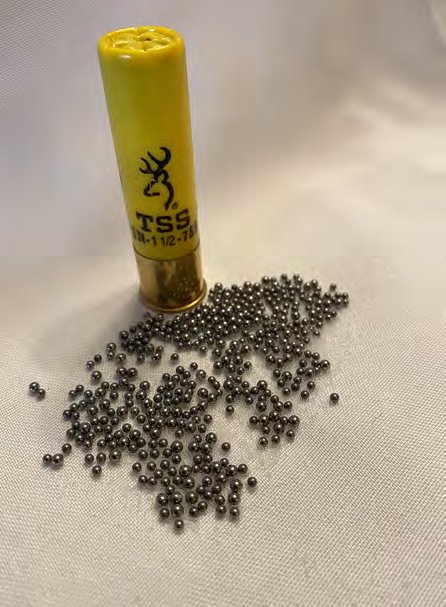
There is a lot more to TSS Turkey Tungsten loads than just the shot. They use only premium primers in all their turkey loads. Internally it’s called the turkey primer and it’s designed to put as much energy into the powder as possible guaranteeing powder ignition. The powder is a very refined powder that is clean burning and designed to propel the shot at 1200 feet per second.
It is a double based powder that performs in all weather. The wad that holds the shot has thicker petals than a lead shot wad. It’s designed to protect the bore of the gun from the super hard tungsten shot.
The price of Browning’s TSS Tungsten Turkey loads is in the materials and the process of manufacturing tungsten shot. Tungsten is a rare metal and a large percentage of tungsten used today is recycled material. Browning justifies the price of TSS Turkey Tungsten by saying; “TSS Turkey Tungsten #7-#9 blend, in 12 or 20 gauge, will put three times more pellets on target and deliver 30% deeper penetration at 60 yards when compared to our BXD turkey shell loaded with copper plated lead #5 shot. TSS Turkey Tungsten shells loaded with #7 shot will put two times the pellets on target and deliver 50% deeper penetration.”
What’s Next?
Much has changed in the turkey hunting world since that day long ago when I saw my first wild turkey gobbler. We don’t dress the same way, we don’t call the same way and we don’t hunt the same way. About the only thing that has not changed is the wild turkey. They are still wild, beautiful and challenging birds to hunt.
The restoration of the wild turkey to 49 of the 50 United States is one of conservation’s greatest success stories. This tremendous accomplishment was achieved on the backs of state wildlife agencies, like-minded conservation groups and hunters. During this process much was learned about wild turkeys by the biologists who managed the restoration effort nationwide. This knowledge was shared with hunters and land managers across the nation. Turkey populations flourished and so did turkey hunters.
There is a romance between wild turkeys and we who hunt them that is incomprehensible to those who don’t hunt turkeys. Those who have never experienced a close gobble, heard drumming behind you, seen a loud-mouthed hen bossing the flock or watched the ritual of a gobbler in strut have no clue why turkey hunters are so fanatical. I am somewhat old school. I believe the real thrill of turkey hunting is how close, not how far.
There is an old saying, “You must be present to win!” I think that quote applies perfectly to turkey hunting. Just being there makes us all a winner.
If you have shot turkey shells loaded with tungsten super shot (TSS), you know the advantage they bring to your turkey hunting game. It is hard to believe smaller gauge shotguns shooting smaller pellets can be so devastating on turkeys but they are. Here is why:
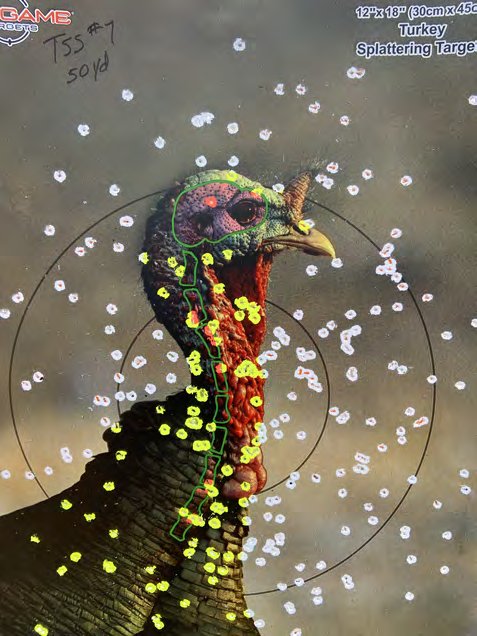
- Denser pellets maintain kinetic energy from the muzzle to the target
- Smaller pellets means more pellets per load
- More pellets means denser patterns with fewer holes
Pete Daugherty is retired military and an ardent turkey hunter. He started shooting TSS eight years ago. “I shot my first TSS loaded shells eight years ago. To say I was impressed is an understatement. I did some research and began reloading my own shells that same year. I quickly learned that I could get all the distance and knock down power I needed from a .20 gauge and have shot a .20 gauge ever since,” said Daugherty.
Daugherty is not alone. There is a craze among America’s turkey hunters that takes the TSS evolution to another level. There are a growing number of hunters who have chosen to level the playing field by hunting with .410-gauge shotguns and loads.

Pete Daugherty had one more point to make: “Turkey hunters are a passionate group and are willing to make sacrifices to improve their experience in the turkey woods. A box of five factory loaded TSS shells average around $50 retail. I can reload those five shells for $35. Loading my own increases my pleasure in the spring woods.”